
Video Production for Startups: The Complete Playbook
 August 16, 202622 Minutes
The popular advice is to make one cinematic hero video, launch it everywhere, and move on. For most startups, that's backwards. Video production for startups works better as a repeatable workflow, where one focused shoot creates a library of useful assets for product education, sales conversations, social channels, and launch moments. In 2026, 91% of businesses use video as a marketing tool, up from 86% in 2024, according to recent video marketing data. Flexwork Studios helps teams turn that pressure into a practical production system, from studio rentals and Content Day sessions to podcast production packages and podcast websites.
Why Most Startup Videos Fail Before the Camera Rolls
The first mistake usually happens in the planning meeting. Someone says the startup needs a polished brand film, the team starts collecting cinematic references, and the project becomes a costly test of whether the company has already figured out its message.
Early-stage startups often haven't. Their product changes, positioning develops, and the language that resonates with buyers is still being tested. A beautiful video can lock an unclear idea into an expensive final cut. The result may look impressive while failing to answer the basic question, “Why should this audience care?”
A more durable approach starts with a content engine, not a hero asset. One shoot can produce a founder explanation, product education clips, sales follow-up videos, customer questions, and vertical social edits. That system gives the team more opportunities to learn what earns attention before it commits to a larger creative package.
Practical rule: Don't spend your first serious production budget making one video that has only one job.
The retention problem
Shorter formats aren't a passing preference. B2B marketers surveyed in 2026 identified 30 seconds to 2 minutes as the most effective video length, while benchmark data reported a 65% completion rate for videos under 1 minute and 20% completion for videos longer than 20 minutes in the same source's overview of video marketing benchmarks. The practical takeaway is clear: lead with one message, cut quickly to the value proposition, and plan multiple edits from the same recording. These figures come from B2B video marketing statistics and benchmarks.
That doesn't mean every startup should avoid longer content. A detailed demo, investor presentation, or educational conversation can have a role. It does mean the long version shouldn't be the only version. Build the source material so an editor can extract the strongest moments without forcing every viewer through the full recording.
Replace production friction with a system
Founders lose time when they assemble a freelance crew, rent equipment from different vendors, record in an untreated room, and then manage scattered post-production handoffs. Each task seems manageable until the team has to coordinate the whole chain while also running the business.
The studio model removes much of that friction. Flexwork Studios provides a controlled environment for recording, with production support designed around video and podcast content. Its broader service mix includes studio rentals, podcast production packages, Content Day sessions, and podcast websites, so a startup can connect recording with editing, publishing, and audience development instead of treating each deliverable as a separate project.
The shift is operational. A startup doesn't necessarily need a more elaborate set first. It needs a cadence it can maintain, a shot list designed for reuse, and a distribution plan that gives every finished clip a destination.
Defining Your Video Goals and Choosing the Right Formats
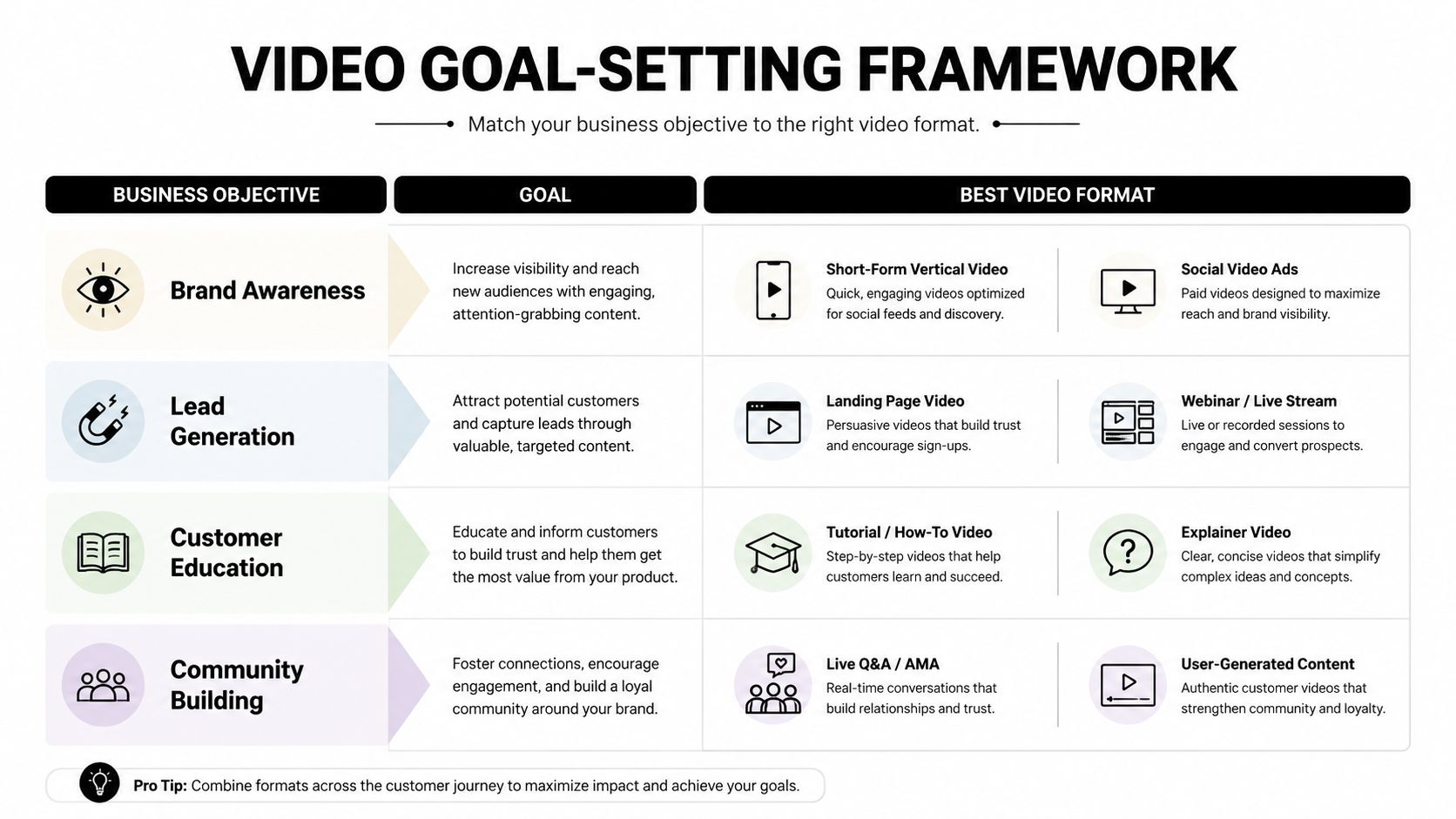
Before anyone chooses a lens, define the business job. “We need video” isn't a production brief. “We need three assets that explain the category, demonstrate the workflow, and give sales a concise follow-up tool” is much closer.
Start by choosing one primary objective:
- Brand awareness: Use a founder story, problem statement, or sharp point of view. Keep the language durable so the video remains useful while the product evolves.
- Lead generation: Record a focused explanation tied to a landing page, campaign, or sales question. The call to action should match the viewer's next decision.
- Customer education: Build a demo, walkthrough, or answer to a recurring support question. Clarity matters more than visual spectacle.
- Community building: Capture conversations, behind-the-scenes moments, expert interviews, or audience questions that invite response rather than announcing a product.
Match the format to the stage
An early startup usually benefits from flexible, durable content. A founder-led explanation of the problem can stay relevant while features change. Educational clips can answer buyer questions before the audience is ready for a sales conversation. A campaign-specific pitch or launch video makes sense when it supports a clear moment.
A scaling startup can become more specific. Product demos, customer testimonials, implementation explainers, sales enablement videos, and recruiting content become more useful once the product and message have settled. The format should follow the company's level of certainty.
Use this simple first-three decision matrix:
| Growth situation | First video | Second video | Third video |
|---|---|---|---|
| Testing the market | Founder problem story | Educational answer | Audience question clip |
| Preparing for launch | Product overview | Founder or team story | Campaign-specific cut |
| Building a sales process | Product demonstration | Objection-handling clip | Customer testimonial |
| Growing a creator or podcast brand | Short-form opinion reel | Full conversation | Guest or audience highlight |
Length should support the job. Short-form clips are useful for discovery and attention. A longer conversation can provide source material for many edits, but it still needs a clear opening and deliberate pacing. Use the guidance in short-form versus long-form video content when deciding whether an idea needs a complete episode or a concise social asset.
Write for the first seconds
A widely cited benchmark reports that approximately 33% of viewers stop watching after 30 seconds, 45% by 1 minute, and 60% by 2 minutes, making the opening especially important for a startup video. The benchmark is summarized by the SUNY instructional video guidance.
Open with the problem, the surprising insight, or the specific outcome. Don't spend the first moments on a long logo animation, greetings, or a slow explanation of company history. The viewer should understand the relevance before deciding whether to continue.
In-House DIY Versus Turnkey Studio Production
DIY production gives a startup control, but control isn't the same as efficiency. A phone, a quiet room, and a capable editor may be enough for a quick update. The trouble starts when the team expects a repeatable content program from equipment and skills it hasn't had time to standardize.
The in-house path often includes camera purchases, acoustic treatment, lighting, editing software, storage, file management, and internal review. None of those expenses guarantees clean audio, consistent exposure, flattering framing, or a finished edit. The largest hidden cost is founder and marketer time spent learning production instead of shaping the message, speaking with customers, or shipping the product.

Where DIY makes sense
In-house recording can be the right choice when the team needs frequent low-stakes updates, has someone who enjoys production, and can maintain a consistent setup. It works especially well for informal product notes, internal training, quick founder reactions, and experiments where speed matters more than visual polish.
The risk is inconsistency. One episode may have clear sound and balanced light, while the next has room echo, mixed color temperatures, or a distracting background. If the audience sees a different level of quality every time, the brand starts to feel less deliberate.
For teams building at home, Flexwork's guide to setting up a home studio offers a practical starting point. A home setup can improve with careful placement and repeatable habits, but it still requires someone to own the process.
Where turnkey production earns its place
A turnkey studio makes more sense when the startup needs a polished batch of assets, has limited production experience, or wants the team on camera rather than behind it. Acoustically treated rooms, professional sound mixing, controlled lighting, cinema-grade cameras, and post-production support reduce the number of variables the founder must manage.
Flexwork's Content Day costs $3000 per day and includes 20 edited reels or 60 professional photos, according to the stated service pricing. That structure changes the calculation. Instead of spreading production across fragmented sessions, the team can prepare a modular shot list and leave with a substantial set of launch-ready assets.
The right choice depends on the cost of inconsistency. For a useful external perspective on aligning video planning with marketing operations, review the Busylike video playbook for CMOs. It's particularly relevant for teams deciding whether video should remain an occasional project or become part of the regular marketing workflow.
Pre-Production Planning and Production Day Best Practices
Great footage rarely rescues a vague idea. The strongest startup shoots begin with a clear audience, one central message per asset, and a production plan that anticipates the final formats before recording begins.
Write the opening first. Then write the supporting points. Keep the on-camera person working from conversational talking points rather than a rigid script when authenticity matters, but use a teleprompter for investor pitches, formal announcements, or messages where exact wording carries risk.

Build the shoot around modular assets
A useful shot list might include:
- Core message: Record the complete explanation in a clean, direct take.
- Short answers: Ask the founder or subject to answer individual questions in concise segments.
- Proof and detail: Capture product interactions, close-ups, screen references, workspace activity, or supporting visuals.
- Calls to action: Record distinct endings for social, sales, landing pages, and investor follow-up.
- Room tone and transitions: Give the editor usable pauses, cutaways, and clean visual bridges.
This approach prevents the common mistake of filming one long interview and hoping the editor discovers a campaign inside it. The producer should know which moments need vertical framing, which require clean horizontal composition, and which can work as audio-led clips.
Make the room disappear
Professional-looking startup video depends less on decoration than on control. Echoey sound, cluttered backgrounds, inconsistent white balance, and harsh overhead lighting distract viewers before the message has a chance to work.
A practical production check includes:
- Audio first: Place the lavalier microphone securely and test for clothing noise. Use a boom microphone when the setup allows it.
- Light consistently: Keep color temperature consistent across the key, fill, and background lights. A simple three-point arrangement gives the subject separation without making the frame feel theatrical.
- Frame for reuse: Leave enough visual space for captions and vertical crops. Record alternate angles when the same answer may serve several channels.
- Protect the brand: Use set colors, wardrobe, props, and background details that support the company's identity without competing with the speaker.
- Record a technical test: Check focus, exposure, audio levels, wardrobe texture, and background reflections before the full conversation.
Flexwork's guide to maximizing studio time for content teams is useful for turning these checks into a repeatable shoot-day routine. In a turnkey environment, technical execution is handled by the production team, allowing founders to focus on delivery, clarity, and energy.
Post-Production Workflows and Content Repurposing Systems
A shoot day creates raw material, not a content system. The post-production workflow determines whether that material becomes one approved video or a month of usable assets across several channels.
Begin with the cleanest complete recording and build a core edit. It should establish the narrative, remove repetition, balance audio, apply the brand treatment, and give every derivative asset a reliable reference. The editor can then identify moments organized around one question, claim, objection, or product benefit.
Build the asset ladder
A practical repurposing sequence includes:
- Core edit: Assemble the strongest complete version with clean sound, captions, brand treatment, and a clear ending.
- Short-form clips: Create concise vertical edits for Instagram Reels, TikTok, and YouTube Shorts. LinkedIn cuts may need a different opening and caption style.
- Supporting assets: Adapt key lines into quote cards, audiograms, email excerpts, blog sections, and sales follow-up snippets.
- Publishing package: Prepare thumbnails, captions, titles, transcripts, and channel-specific file names before approval so publishing does not stall.
The Content Day package described earlier belongs at the production-planning stage. Here, the operational lesson is more useful: define the intended asset list before editing begins. That prevents a freelance editor from receiving an unstructured folder and spending days deciding what the shoot was meant to produce.
AI-assisted editing can speed up rough cuts, transcription, caption generation, and clip discovery. A cited industry report found that AI-assisted editing reduced post-production time by an average of 24%, while 44% of video marketers said it significantly reduced production timelines. Use those tools for repetitive tasks, not editorial decisions. A producer still needs to judge whether a clip has a clear premise, whether the pacing feels natural, and whether the cut sounds like the brand.
Document the approval path in a structured video editing workflow. Assign one final approver, collect feedback in one location, and label exports by channel and version. That discipline reduces revision loops and keeps a single shoot day connected to the wider publishing plan.
Distribution Tactics and Measuring What Matters
A polished video in a shared drive is unfinished marketing. Distribution belongs in pre-production because every channel changes the framing, opening, captions, crop, and call to action. Plan the path from one shoot to its publishing destinations before the camera rolls, then capture enough variations to support that plan.
Upload native files where the platform supports them instead of sending every audience to one external link. Write captions for silent viewing, choose a thumbnail that communicates the subject quickly, and adjust the opening for each channel. A founder clip on LinkedIn may need a direct business insight. A Reel or Short may perform better when it starts with a sharper tension point.
Map your content distribution channels to the buyer's journey. Social clips can create discovery, a longer conversation can build trust, a product demo can answer evaluation questions, and a sales video can support the next conversation. The same source footage becomes a system only when each version has a defined job.
Track the drop-off, not just the view count
Wistia defines engagement as actual watch time divided by total possible watch time, and its reporting shows engagement staying near 50% for the first three minutes before declining steadily afterward. Review the methodology in Wistia's State of Video report.
Another benchmark reports average engagement of 50% for videos under 1 minute, 47% for 1 to 3 minutes, 46% for 3 to 5 minutes, and 16% for videos longer than 60 minutes in its dataset. The video engagement benchmark cheat sheet provides the source methodology and comparisons.
Use these benchmarks as editing signals, not promises. If viewers leave during the introduction, remove throat-clearing and move the useful statement earlier. If they stay through the product explanation but do not click, revise the call to action or improve the match between video and landing page. If a clip earns attention without meaningful response, it may be entertaining while missing the business objective.
Measure four layers:
- Retention: Where do viewers stop, replay, or continue?
- Response: Do they comment, save, share, or answer the question?
- Action: Do clicks, inquiries, demo requests, or sales conversations follow?
- Learning: Which opening, topic, speaker, and format should shape the next shoot?
Treat production as an ongoing program. Track patterns across channels, then feed those findings into the next brief rather than judging each upload in isolation. Teams that need a deeper reporting stack can use these LinkedIn analytics tools to organize platform-level measurement.
Flexwork Podcast Studios offers turnkey studio rentals, podcast production packages, Content Day sessions, editing, sound mixing, social-ready clips, and podcast websites for teams building a repeatable content engine. Visit Flexwork Podcast Studios to review production options and book a studio session for a focused batch of startup video assets.