
How to Choose an Audio Recording Studio Near Me
 August 15, 202621 Minutes
You've got a strong episode idea, a guest who's finally available, and a launch date that's already on the calendar. Then the recording starts. One microphone sounds thin, the room echoes, a cable fails, and the edited file comes back with distracting noise. Searching for an audio recording studio near me feels like a quick fix, but the cheapest room can become the most expensive choice once your time, brand, and release schedule are included.
The right studio protects more than sound quality. It gives you a dependable room, suitable equipment, experienced support, and a post-production path that turns one session into a finished show and useful content. This guide gives you a practical way to compare studios, understand the cost of DIY, and evaluate whether a production hub such as Flexwork Studios fits your goals.
Why the Studio You Pick Shapes Everything Downstream
Creators often search for a local studio as if they're buying an empty room by the hour. That approach misses the central decision. The room affects how much editing the episode needs, the pace of the recording, the consistency between guests, and whether the final show feels polished enough to represent a serious founder, coach, or company.
A poor room creates problems that multiply later. Echo can be difficult to remove without making speech sound unnatural. Uneven microphone technique can force an editor to spend more time balancing voices. A confusing setup can turn a focused conversation into a slow equipment troubleshooting session. You may save on the booking and lose an afternoon fixing what should have been handled before the first take.
Use four questions to judge every studio:
- Is it convenient? A nearby location matters when guests, crew, samples, and repeat sessions are involved. Convenience should reduce friction, not excuse weak production.
- Does the room support spoken word? A room can look impressive and still sound reflective, noisy, or distracting.
- Is the equipment configured for your format? A podcast with two hosts, a founder interview, and a video roundtable need different arrangements.
- What happens after recording? Ask who edits, mixes, creates video, prepares clips, handles branding, and supports distribution.
The history of recording explains why this integrated workflow is possible. Édouard-Léon Scott de Martinville filed the first patent for a sound-recording device, the phonautograph, on March 25, 1857. In 1975, Denon became the first company to achieve fully digital audio recording using Pulse Code Modulation. Modern studios build on that progression from analog capture to precise digital editing and distribution, as outlined in this history of recording sound and music.
For a closer look at what a serious podcast room should include, review the insider look at Flexwork's studio setup. The point is simple: choose the workflow, not just the address.
Mapping and Shortlisting Studios Worth a Call
Start with maps, but don't stop at the first attractive listing. Search for studios within a practical drive of your home, office, or guest base, then open the website, recent photos, booking information, and sample work. A studio that looks active online should make it easy to understand what it records, who operates the room, and what you receive after the session.
Reviews deserve a closer read than star counts. Look for repeated comments about clean audio, responsive communication, easy booking, prepared engineers, and reliable turnaround. One enthusiastic review can be useful, but patterns are more valuable. If reviews focus only on parties, music rehearsals, or photography, confirm that the space regularly handles spoken-word recording.
Your shortlist should include two or three studios, not a dozen. For each one, verify:
- Current activity: Recent posts, current availability, and functioning contact details suggest the studio is actively serving clients.
- Relevant samples: Listen to work similar to yours, including interviews, solo narration, roundtables, or branded content.
- Clear booking terms: Ask about hourly rates, minimum bookings, setup time, cancellation terms, and whether engineering is included.
- Production scope: Confirm whether audio, video, editing, reels, show notes, and distribution are separate services.
- A real conversation: A useful studio should ask about your format instead of pushing you into a generic room.

What a useful tour should reveal
A tour isn't a sales ceremony. It's a production test. Ask to see the recording position, control area, guest seating, cable management, lighting, and any video sets. You should understand where each person sits, how the engineer monitors the session, and whether the room can support your planned format without improvisation.
Ask direct questions: Who runs the session? What happens if a guest arrives late? Can the team capture short-form video during the recording? What files do you receive? How are revisions handled? Vague answers usually signal that you're renting access, not buying a dependable production process.
Use the studio's own explanation alongside this guide to podcast studios near you to sharpen your comparison. A strong candidate will explain its workflow in plain English and give you enough detail to make an informed decision.
Acoustics, Gear, and Engineers, What Matters on Tour
A polished room can still deliver amateur audio. During a tour, ignore the décor until you hear the space. Ask how the equipment is configured, whether an engineer is included, and what happens when the session goes wrong. The right booking reduces DIY friction. Every hour a founder spends correcting noise, mismatched microphones, or weak edits is an hour taken from growing the show.
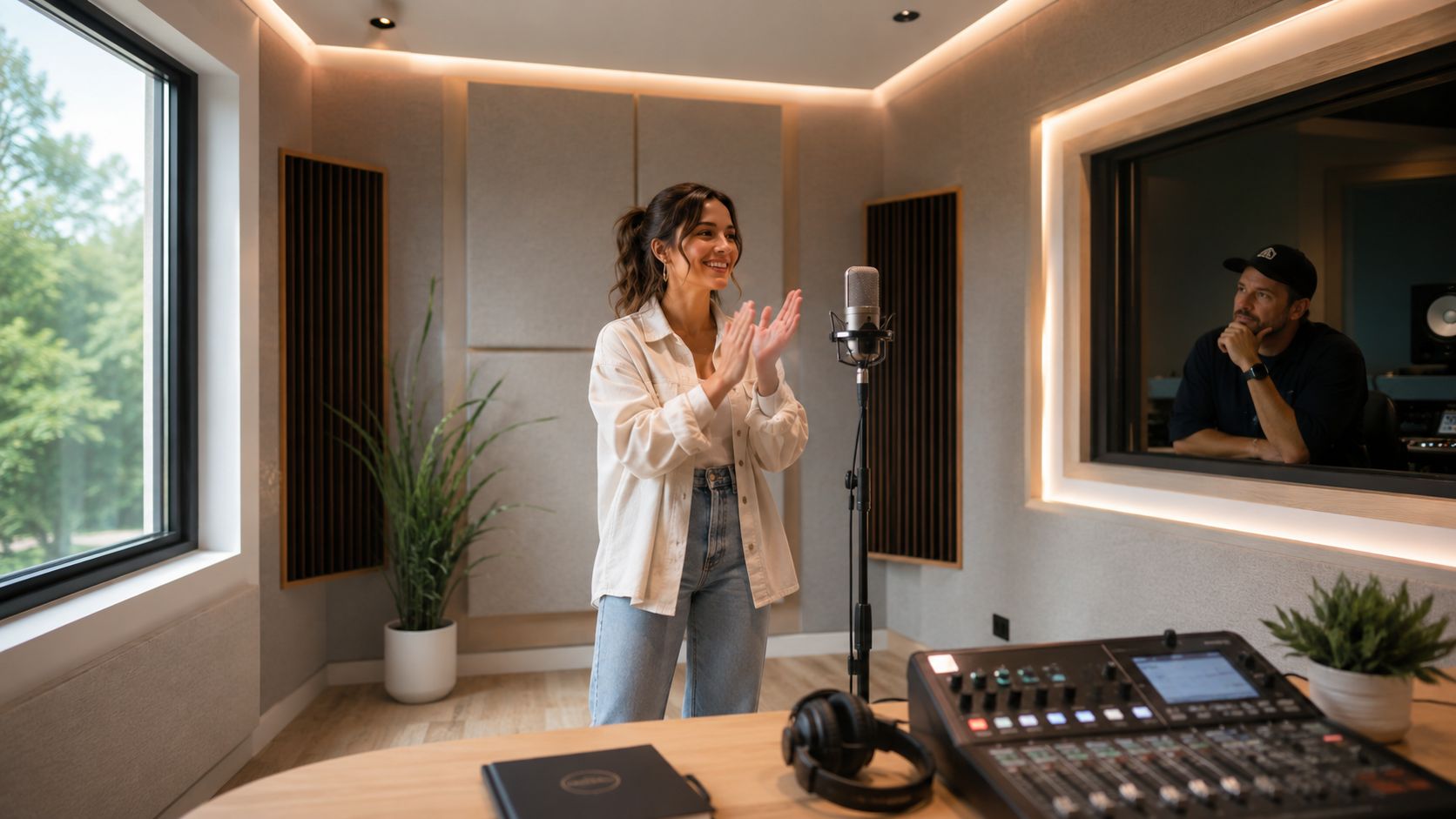
Clap once and listen to the decay. Speak from the intended chair, then request a short test recording. Speech should sound focused, not smeared by reflections. For podcast rooms, a useful benchmark is an RT60 of 0.25 to 0.35 seconds for two-host rooms and 0.30 to 0.40 seconds for four-person roundtables, according to podcast studio design guidance. You do not need to calculate RT60 during a tour. You need to hear whether the room supports clear speech.
Treatment isn't soundproofing
Acoustic treatment controls reflections inside the room. Soundproofing limits sound entering or leaving it. Foam on a wall may reduce some high-frequency reflection, but it will not fix traffic noise, a loud HVAC system, or voices from the next room. Read this acoustic-treatment guide for podcast rooms before judging a studio's panels.
Many podcast rooms only need treatment on about 20 to 30 percent of reflective wall surfaces, while speech-focused rooms also need a low noise floor. Professional targets can be at or below -60 dBFS, with room-environment targets around RC 20 to 25 or NC 20 to 25. Those figures matter because mechanical noise can survive every later production stage.
Ask the engineer to measure room tone with HVAC operating. A competent team should separate broadband noise from tonal spikes, identify the dominant source, and address it instead of scattering panels randomly. If the studio cannot explain its approach to HVAC, isolation, and room decay, keep looking.
The gear questions that matter
You do not need the longest microphone list. You need a setup suited to the voices, format, and production plan.
- Microphones: Ask which microphones suit each voice and whether every participant gets a consistent position.
- Monitoring: Confirm that the engineer can monitor every channel during recording.
- Recording path: Ask how files are captured, backed up, labeled, and delivered.
- Video integration: If the show has a visual component, ask about camera positions, lighting, framing, and vertical crops.
- Engineering support: Confirm who remains responsible for levels, guest direction, retakes, and session notes.
Leave the tour knowing what the room will sound like, who will operate it, and how the recording becomes a usable episode. That clarity is the value of a professional room. You are paying to remove technical rework, not merely to stand in front of microphones.
Comparing Pricing Models and Production Packages
Two studios can appear similar until you compare what happens before, during, and after the recording. A room rental may look affordable, but the actual price includes your preparation time, engineering, editing, revisions, publishing, and the cost of rebuilding assets that weren't captured correctly.
Three ways studios usually charge
Hourly room rental suits a creator who already has a clear workflow, can handle files independently, and needs a reliable space for a focused session. It works well for a pilot, a solo recording, or a repeat host with a trusted editor.
Bundled sessions combine room access with some technical support and post-production. This model is easier for a founder or coach who wants professional delivery without hiring separate specialists for every stage.
Full-service production is built for a show that needs consistent recording, editing, visual assets, branding, publishing, and audience development. The price reflects responsibility for the entire pipeline, not just access to microphones.
| Pricing Model | Best For | Flexwork Benchmark |
|---|---|---|
| Hourly room rental | Focused sessions and experienced creators | Hourly studio rentals for fast, affordable recording |
| Bundled recording session | Hosts who need recording plus production support | Recording and production support matched to the show format |
| Full-service production | Brands and creators building a consistent show | “Market, Manage & Produce My Podcast” starts at $1,500 per episode with a 20-episode growth commitment |
Flexwork Studios also offers Content Days at $3,000 per day, including 20 edited reels or 60 professional photos, and podcast websites at $5,000 plus hosting, according to its 2025 services document. Those packages make sense when the goal isn't merely to record an episode, but to create a library of branded material from a concentrated production day.
Match the deal to the ambition
A first-time host shouldn't pay for an elaborate growth system before testing the format. Start with a dependable recording workflow and define what success looks like. A founder launching a recurring branded show has a different problem. That creator needs consistency, repeatable production, visual assets, and a release process that doesn't depend on late-night editing.
Before booking, ask for a complete scope:
- What does the quoted fee include?
- Is engineering included?
- Are setup and breakdown time billed?
- How many edits or revisions are included?
- Who owns the finished files?
- Are publishing and distribution separate?
- Does the package include short-form content?
- What happens when the episode needs a correction?
Use this breakdown of podcast studio costs in New Jersey as a starting point, then compare total output rather than the room rate alone. The right question isn't “What does the hour cost?” It's “What does it take to release a finished, on-brand episode?”
How to Walk Into Recording Day Ready to Nail It
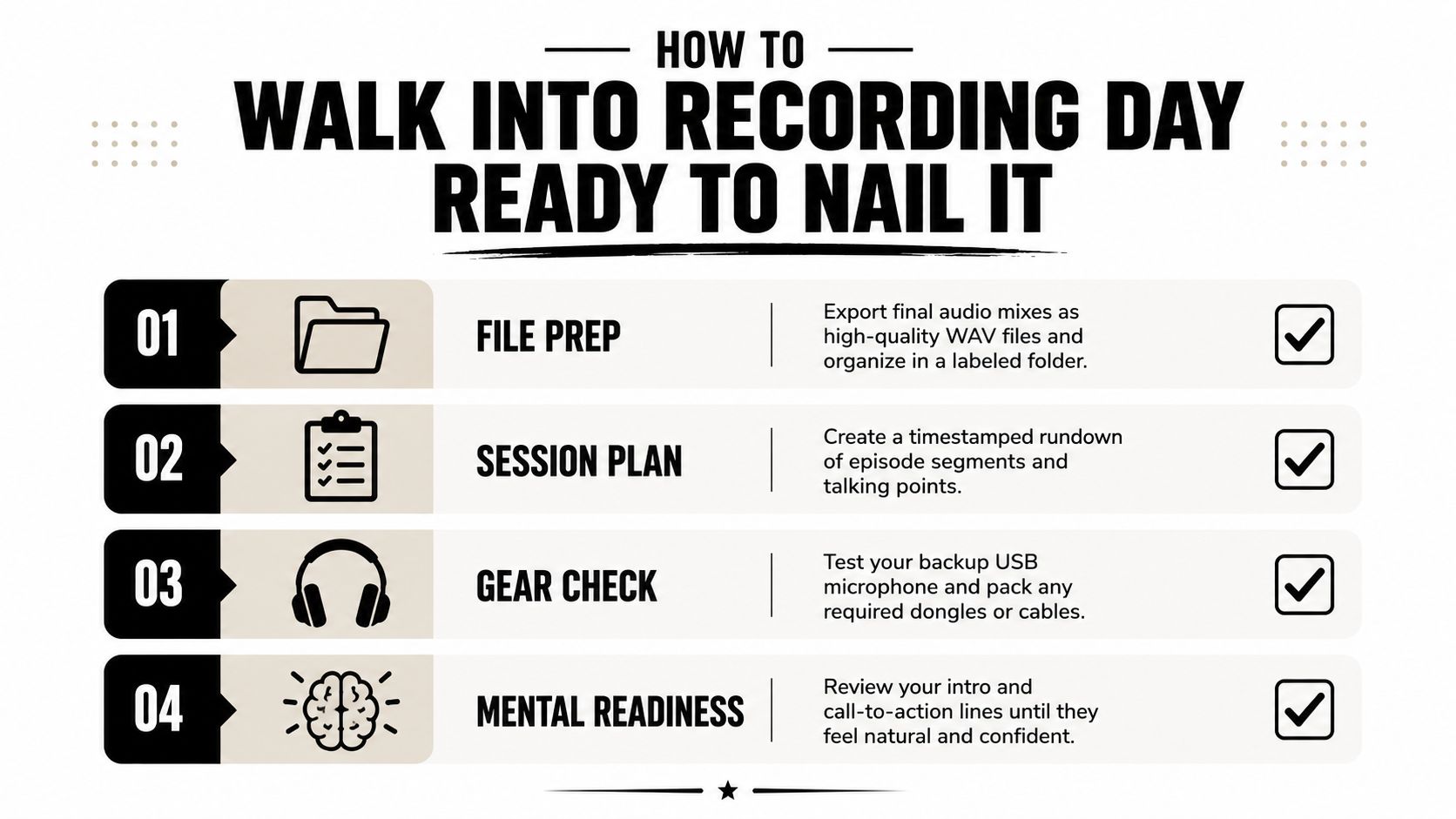
A professional room can't rescue an unprepared host. If the run-of-show is loose, the guest brief is missing, or the opening hasn't been practiced, you'll spend paid studio time making decisions that should have been settled earlier.
Send the studio a concise production brief before the session. Include the episode purpose, guest name and role, pronunciation notes, required talking points, sponsor language, call to action, and any topics that need careful handling. Give the engineer enough context to set the room and anticipate changes.
A practical pre-session checklist
- Lock the rundown: Mark the intro, core conversation, audience takeaway, sponsor message, and closing call to action.
- Tighten scripted sections: Rewrite anything that sounds formal when spoken. A clean, natural intro is easier to record than a paragraph written for the page.
- Prepare the guest: Share timing, arrival details, clothing guidance, and the general shape of the conversation.
- Bring wardrobe options: Layers help if the room feels warm, and solid colors usually keep attention on the speaker rather than distracting patterns.
- Reserve a mic check: Use the opening minutes to test levels, headphone comfort, pronunciation, and camera framing before recording the final take.
- Capture extra material: If video is available, record a short introduction, a few concise answers, and stills that can support clips and promotion.
A Content Day works best when the team plans those extra assets rather than hoping they happen spontaneously. The same conversation can produce the full episode, vertical clips, promotional images, and a cleaner bank of material for social publishing.
For smoother logistics, review the unspoken rules of scheduling and studio etiquette. Arrive ready, communicate changes early, and let the engineer protect the session.
From Raw Recording to Release-Ready Episode
The red light turning off is not the finish line. It's the handoff point between capture and production. A release-ready episode may need noise cleanup, level balancing, EQ, music placement, video editing, motion graphics, show notes, chapter markers, transcripts, branded artwork, and distribution.
That work has a hidden cost when you do it alone. You may need to learn several applications, manage file versions, chase freelancers, review exports, and repair mistakes that began in the room. Each task can be manageable on its own. Together, they can pull a founder away from sales, client work, audience development, or the next episode.
A turnkey production team can keep those stages connected. Flexwork's Be My Podcast Producer package is suited to creators who want help with editing, branding, and production execution. The Market, Manage & Produce My Podcast package is aimed at shows that also need ongoing management and growth support, with the published tier starting at $1,500 per episode and a 20-episode growth commitment.
The distinction matters. A bare rental room gives you a place to record. A production hub can help you maintain a repeatable system from concept through release. That system may include audio mixing, video editing, motion graphics, distribution, show branding, and marketing support.
Producer's rule: The cheapest room is rarely the cheapest episode if you spend the difference fixing audio and rebuilding content yourself.
The best choice depends on your capacity. If you have an editor, a publishing workflow, and strong technical confidence, hourly access may be enough. If your show is part of a business, the time saved through coordinated production can be more valuable than a lower room rate.
Book the Tour, Then Book the Session
Use the four-question filter before you commit: location, acoustics, gear, and post-production support. Schedule a tour, sit in the recording position, listen to a test take, ask who engineers the session, and request a clear explanation of what arrives in your inbox after recording.
For New Jersey and the New York metro area, Flexwork Podcast Studios in Springfield, NJ, brings audio, video, branding, and growth services into one production environment. That makes it a practical option for creators who want more than a microphone and a room, especially when one recording needs to become a finished episode plus short-form assets.
Booking logistics should feel as organized as the production itself. If you're comparing scheduling systems for teams or looking for a replacement for Microsoft's default workflow, this resource on how to replace Microsoft Bookings for teams offers useful context.
Don't choose the first “audio recording studio near me” result because it has a polished photo. Choose the room that protects your time, gives your show a consistent sound, and supports the work required after the session.
Flexwork Podcast Studios offers hourly studio rentals, professional podcast production, Content Day sessions, and podcast websites for creators building serious shows. Visit Flexwork Podcast Studios to schedule a tour, compare production packages, and request a recording plan built around your next episode.