
Content Distribution Channels: Your 2026 Guide
 May 21, 202623 Minutes
Meta description: Learn how to choose content distribution channels, repurpose smarter, and build a resilient podcast growth system that compounds.
URL slug: content-distribution-channels-guide
Primary keyword: content distribution channels
Secondary keywords: podcast distribution strategy, owned earned paid media, content repurposing
You finish recording. The episode is sharp, the lighting looked clean, the guest delivered, and for an hour you felt like the show finally clicked.
Then the main question lands. Now what?
Most creators don't fail because the episode was weak. They stall because they treat publishing like distribution. Uploading to Spotify, posting one clip, and dropping a link on Instagram isn't a strategy. It's a habit. And habits don't build audience unless they're designed to do it.
That gap is where good shows disappear. The talent is there. The message is there. The system isn't. If you want your podcast to grow, you need to think like a producer after the cameras stop rolling. You need a plan for where each asset goes, in what order, and why.
Your Best Episode Is Done Now What
A lot of creators hit the same wall. They leave a recording session buzzing, export the files, post the episode, and wait for momentum that never quite arrives. A week later they're back in production mode, creating another strong episode without fixing the distribution problem from the first one.
That cycle is expensive. Not just in money, but in attention.
The smart move is to stop treating the episode as the final product. The episode is the source material. Growth comes from everything you build from it after the session ends. If you want a practical breakdown of how to maximize your content's value, start there. Then look at a tactical example of how to turn one recording into a multi-asset pipeline with this guide on repurposing a single podcast episode into 10 pieces of content.
A polished episode with weak distribution is still invisible.
Creators who grow don't just publish. They package, sequence, and redeploy.
The Modern Creator's Distribution Dilemma
The hard part isn't making content anymore. The hard part is getting the right version of that content in front of the right person before they scroll past something louder.

Attention is split across formats
Audience behavior doesn't reward lazy duplication. It rewards adaptation. The strategic challenge is not just channel awareness but channel orchestration. With 82% of consumers watching video on social platforms and U.S. weekly podcast listening at 47% of adults, the highest-value distribution comes from repurposing one recording into multiple channel-native assets rather than pushing the same file everywhere.
That means the same conversation has to live differently in different places. A full episode can work on YouTube or podcast apps. A tight opinion clip may work on Reels. A strong quote carousel may work on LinkedIn. A recap email may pull the most qualified listener back to your site.
Most creators know this in theory. They get stuck in execution.
DIY burnout kills consistency
When you're the host, producer, editor, clipper, caption writer, thumbnail reviewer, social manager, and growth lead, your distribution quality collapses first. Not because you're lazy. Because you're overloaded.
That's why so many talented hosts end up with a random publishing pattern:
- One full episode goes live and gets almost no supporting assets.
- Three clips are posted too late to create launch momentum.
- No website article gets published so the episode has no real home base.
- No email goes out so the audience you already earned never hears about it.
The result feels personal, but it isn't. It's operational.
Practical rule: If your distribution depends on how motivated you feel after recording day, it isn't a system.
Platform choice isn't the real problem
A lot of creators waste time asking whether they should focus on YouTube, TikTok, Instagram, or LinkedIn. That's not the first question. The first question is what role each platform plays.
Here's the simpler way to frame it:
| Channel type | What it should do for you |
|---|---|
| Long-form platform | Hold the full conversation and deepen trust |
| Short-form social | Create discovery and repeated visibility |
| Website | Give the episode a permanent home |
| Pull people back into your world | |
| Guest appearances and collaborations | Borrow attention from adjacent audiences |
If you're working on video-first growth, it also helps to understand the packaging side of discoverability. This breakdown of YouTube video optimization services is useful because it focuses on how creators improve titles, metadata, and positioning, not just the edit itself.
If you want more listeners, stop posting everywhere with the same energy and the same file. Start building a system around audience behavior. This guide on getting more podcast listeners is a good companion if your current distribution feels scattered.
Understanding Your Three Core Channel Types
If you don't have a framework, every new platform feels urgent. That's how creators end up busy and invisible at the same time.
The cleanest framework for content distribution channels is still the one professionals use every day.
Owned media is your home base
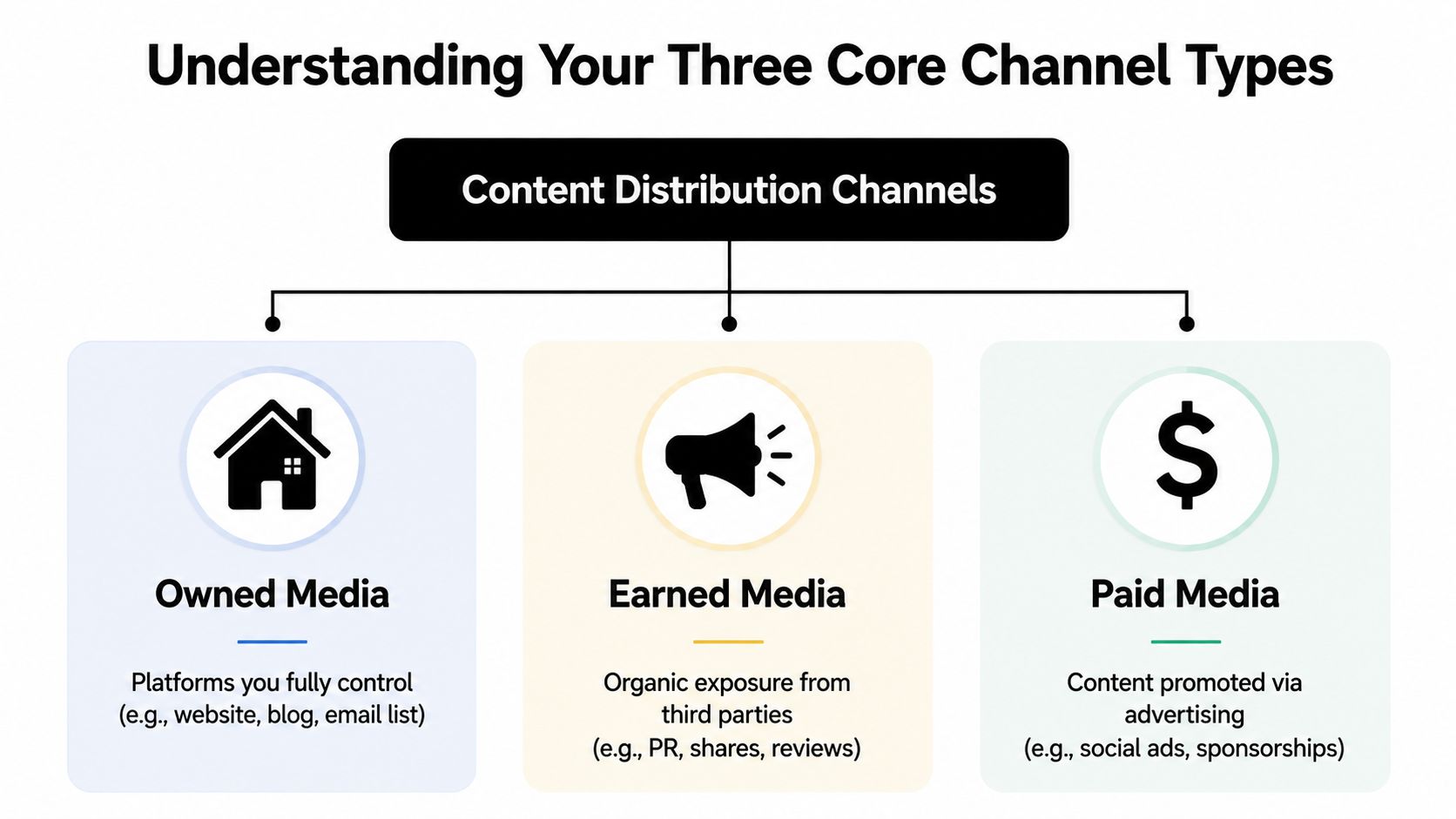
The foundational model for content distribution classifies channels into three categories: owned (website, blog, email), earned (mentions, guest posts, shares), and paid (PPC, social ads, sponsored content). This framework helps marketers structure how content moves from production to audience according to Terakeet's explanation of owned, earned, and paid media.
Owned media is the part you control. Nobody can throttle your publishing calendar on your own website. Nobody can decide your episode page won't be shown today. Nobody can take away your email list because an algorithm changed.
For podcasters, owned usually includes:
- Your podcast website where episodes, show notes, and calls to action live
- Your blog where episodes become searchable articles or recaps
- Your email list where you can announce, nurture, and sell
- Your branded social profiles because you control the account, even if you don't control reach
A lot of creators underinvest here because owned channels feel slower. They aren't flashy. They compound.
Earned media is borrowed trust
Earned media is what happens when other people carry your message. That includes shares, press mentions, guest spots, backlinks, reviews, reposts, and community conversations.
Here, credibility scales faster than self-promotion.
A guest appearance on another podcast can do more for your authority than ten self-congratulatory clips. A mention in a niche newsletter can drive better traffic than a generic social post. A thoughtful Reddit contribution can outperform a polished ad if the context is right.
Use earned when you want:
- Credibility from someone else's platform
- Reach into adjacent audiences
- SEO support through mentions and backlinks
- Social proof that your work matters beyond your own feed
When someone else shares your work, they're not just extending reach. They're lending trust.
Paid media is your accelerator
Paid media gets dismissed by creators who think buying attention is somehow impure. That's amateur thinking. Paid is a tool. Use it badly and you waste money. Use it well and you shorten the time between publishing and visibility.
For creators, paid often looks like:
- Social ads pushing a strong clip or lead magnet
- Sponsored content in relevant publications or newsletters
- Retargeting to bring back site visitors or video viewers
- Paid influencer or collaborator amplification when it fits the brand
Paid should not be your first move. It should support a system that already knows what it's trying to amplify.
How to think about the mix
Don't ask which type is best. Ask what job each one should do.
| Media type | What you control | Best use |
|---|---|---|
| Owned | High control | Archive, nurture, convert |
| Earned | Partial control | Validate, expand, build authority |
| Paid | High distribution control, budget dependent | Accelerate, target, retarget |
If you're building a real show, your owned assets should anchor everything else. Your website holds the canonical version. Your email list drives repeat attention. Your social channels package the work for discovery. Your collaborations create earned lift. Paid helps when you need speed.
For creators building a video-led show, this matters even more. A proper video content marketing strategy only works when each asset knows where it belongs in the distribution stack.
A Creator's Playbook for Channel Selection
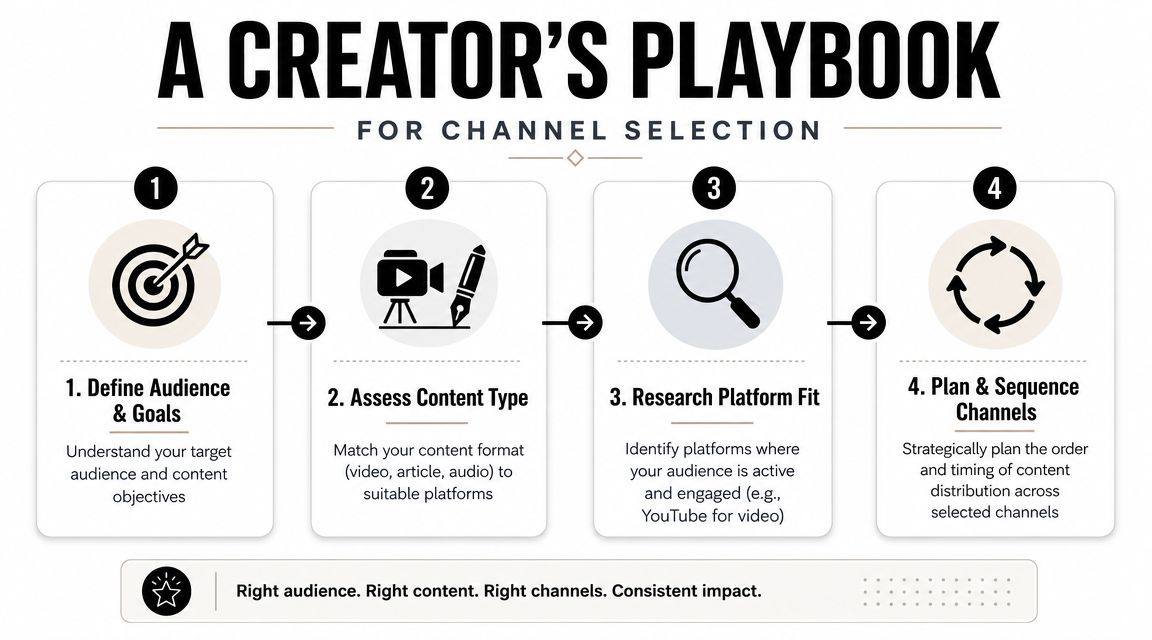
Most advice about content distribution channels is too loose to be useful. “Be everywhere” isn't strategy. It's how you end up with five weak platforms instead of two strong ones.
Start with fit, not hype.
Pick channels by role
Not every platform deserves equal effort. Some channels are for depth. Some are for reach. Some are for retention.
Here's the blunt version:
| Channel | Best use for a podcaster | What to publish |
|---|---|---|
| YouTube | Long-form discovery and trust building | Full video episodes, strong titles, clips that lead to full episodes |
| Instagram Reels | Fast discovery and brand feel | Opinion cuts, guest moments, behind-the-scenes visuals |
| TikTok | Broad awareness through short, punchy ideas | Hooks, hot takes, short educational cuts |
| Professional positioning | Business clips, founder insights, B2B thought leadership | |
| Email newsletter | Retention and audience ownership | Episode drops, recaps, curated insights, offers |
If your show has business value, LinkedIn often performs better than creators expect because the context rewards expertise. If your show is personality-driven, Instagram and TikTok may do more discovery work. If your guest conversations are deep and searchable, YouTube deserves real attention.
Follow what marketers already trust
You don't need to guess where distribution still matters. In 2025, the most effective distribution channels reported by marketers included in-person events (52%), webinars (51%), social media (42%), and corporate website blogs (41%), showing a reliance on a mix of owned and experiential channels that creators can tap into.
That should change how you think.
Creators tend to obsess over apps and ignore the channels that generate substantial impact. Your website matters. Live experiences matter. Webinar-style conversations matter. Social matters too, but it shouldn't operate alone.
The strongest distribution system isn't a single platform. It's a stack.
Build a content waterfall
A high-level episode should create a week or more of distribution material. If it doesn't, you didn't extract enough from the session.
A simple waterfall looks like this:
Record one strong long-form episode
Prioritize a clean set, clean audio, strong prep, and a focused angle.Publish the full asset first
That gives every derivative piece a destination.Cut short-form clips by purpose
One clip for controversy. One for clarity. One for emotion. One for authority.Turn the episode into written assets
Recap article, key takeaways, quote graphics, email copy.Distribute in sequence
Launch clip, full episode drop, follow-up insight post, newsletter, collaboration outreach, retargeting if needed.
That sequencing matters more than most creators realize.
Here's a useful video to think through the workflow side of channel planning and repurposing:
Use owned first, then earned, then paid
One of the smartest strategic rules in modern distribution is sequencing your effort. HubSpot's guidance on content distribution recommends using owned media as the home base, layering earned distribution for authority and SEO lift, and using paid channels for targeted acceleration or retargeting through its overview of how to structure content distribution.
For creators, that translates into something very practical:
Owned first
Put the full episode on your site, YouTube, podcast feed, and email list.Earned second
Ask the guest to share. Pitch clips to niche pages. Turn insights into collaborations and guest appearances.Paid third
Promote the clip or episode that already proved it can hold attention.
This is how you stop wasting strong content. You stop asking one asset to do one job. You turn one session into a system.
Building Your Distribution Engine with Flexwork
If your distribution plan lives in your notes app and depends on late-night discipline, it won't hold. You need infrastructure. Not just ideas.

Start with an asset-rich production day
Most creators don't need more random content. They need a better capture day.
A focused production session should give you long-form episodes, short-form clips, stills, cutdowns, and enough visual variation to support multiple weeks of publishing. That's why a structured Content Day for podcasters makes sense when your bottleneck is asset volume, not ideas.
Here's the practical math of amplifying efforts from the service side. Content Days are $3000/day and include 20 edited reels or 60 pro photos. That solves a common problem fast. Instead of recording one episode and hoping it creates momentum, you walk away with a library built for distribution.
Use that kind of session for:
- Launch campaigns when a show is new and needs immediate surface area
- Season resets when your brand look and messaging need tightening
- Batch creation when consistency has become your weak point
Build your owned channels before the algorithm turns on you
This is the part creators postpone, then regret.
Amidst search and social algorithm volatility, owned channels like email lists and websites are increasingly valuable as a hedge. Building these first-party audience assets is a key strategy for creating a resilient distribution model that isn't dependent on fluctuating platform reach according to MGID's analysis of content distribution channel resilience.
That means your site is not optional. Your email list is not optional. If your audience can only find you through rented platforms, you don't have a stable business. You have exposure with a timer on it.
A custom podcast website solves several distribution problems at once:
| Asset | What it fixes |
|---|---|
| Podcast website | Gives every episode a permanent, searchable home |
| Email capture | Turns casual viewers into retained audience |
| Episode pages | Creates destinations for clips, guest shares, and backlinks |
| Brand-controlled design | Makes the show look serious enough to trust |
The service angle matters too. Podcast websites are $5000 plus hosting. For creators treating the show like a real media property, that's not decoration. That's infrastructure.
Build the place you want people to return to before you spend all your energy trying to reach strangers.
Use managed support when growth needs a system
Once a show has traction, scattered freelance help often makes things worse. One person edits. Another posts. Nobody owns the strategy. The result is motion without coordination.
That's when managed production and distribution become useful. For example, Market, Manage & Produce My Podcast starts at $1500 per episode with a 20-episode growth commitment. That kind of setup fits creators who need a repeatable engine, not random execution.
This is also where one integrated option can be practical. Flexwork Podcast Studios offers studio recording, editing, motion support, podcast websites, distribution help, and growth-focused marketing in one workflow. If your bottleneck is fragmentation, an integrated setup can reduce handoff problems.
If you want more outside perspective before choosing your stack, this roundup of content distribution strategies is useful because it shows how teams think about promotion as an operating system, not a one-time push.
The point is simple. Distribution gets easier when the production workflow is designed for it from the start. Strong framing, intentional clip moments, episode pages, email capture, and post-production planning all need to happen upstream. Not as an afterthought after the upload.
Stop Being Just a Creator Be a Content CEO
The shift is mental before it's tactical.
A creator makes the episode. A content CEO builds the machine that keeps the episode working after release. That means choosing the right content distribution channels, assigning each one a job, and making sure every recording session produces more than a single upload.
You don't need to be on every platform. You need a sharper system. You need owned assets that protect your audience, earned exposure that expands trust, and selective paid support when speed matters. You need a brand that looks organized enough to deserve attention. If yours doesn't yet, fix that with a stronger approach to branding your business.
Great work deserves reach. Not someday. Now.
If you're ready to stop publishing into the void, explore Flexwork Podcast Studios and book a tour or review the production options that fit your next season.