

Short Form vs Long Form Video Content: A Creator’s Guide
 July 29, 202625 Minutes
You're probably already living this tradeoff. You shoot a podcast, cut a pile of vertical clips, post them everywhere, and the numbers look busy, but the business side stays stubbornly quiet. That's the trap with short form vs long form video content. The question isn't which format is “better,” it's which mix gives you reach, trust, and revenue without eating your week alive. Flexwork Studios sees this all the time with creators who want premium output, not more content chaos. The winners are the ones who build one strong source piece, then turn it into a distribution system that makes sense.
| Metric | Short Form | Long Form |
|---|---|---|
| Best job | Discovery and reach | Trust and conversion |
| Viewer behavior | Fast completion, quick shares | Deeper retention and intent |
| Production style | Tighter, lighter, faster | More planning, scripting, and editing |
| Best home | TikTok, Reels, YouTube Shorts | YouTube, Vimeo, podcast websites |
| ROI question | How many new eyes did it earn? | How much revenue and intent did it create? |
The Format Trap That's Costing You Reach
A podcast host can spend six hours a week cutting vertical clips, post every day, and still wonder why no sponsor calls come in. The clips get views. The feed looks active. The business still feels flat. That's because high engagement and high monetization are not the same thing, and too many creators confuse the two.
The first mistake is choosing a format based on what feels easiest to make. Short clips are addictive because they're fast, immediate, and easier to ship. Long-form feels heavier, but it gives you a real story, a stronger point of view, and something a buyer can trust. The decision is not creative first, it's commercial first.
The real question is ratio, not loyalty
The useful lens is not “Should I do short or long?” It's “How much source content do I need to generate the right number of derivatives?” That's the workflow that scales without frying you.
Practical rule: if your content does not feed a clear business goal, you're making noise, not building leverage.
Short-form is excellent for opening the door. Long-form is what turns a curious viewer into someone who believes you know what you're doing. If you want a broader strategy lens, Flexwork's guide on how to grow social media following lines up with the same logic, audience first, format second.
The creators who win in 2026 are not the ones picking a side. They're the ones who use short-form to earn attention and long-form to earn money, then run both through a repeatable system. That shift matters more than obsessing over runtime.
Defining Short Form and Long Form Without the Fluff
A shoot starts in the edit bay, not on the platform. If you do not define short-form and long-form correctly, you will waste studio time, create the wrong cut, and end up with assets that look busy but do nothing for revenue.
Colorado State University draws a clean line for its framework, long-form means anything longer than two minutes with a beginning, middle, and end, while short-form lives in places like TikTok, Instagram Reels, and YouTube Shorts (Colorado State University video strategy). That is a useful starting point because it ties format to audience behavior, not just duration.
Firework takes a different cutoff, saying short-form videos are usually under 10 minutes, while long-form videos exceed 10 minutes and fit better on YouTube, Vimeo, and company websites (Firework's short vs long-form video marketing guide). That mismatch is exactly why creators get sloppy with the labels. A three-minute clip can behave like short-form on one platform and long-form on another.
Use runtime as a hint, not the whole definition
Platform changes the job. A three-minute YouTube video can work as a clear explainer. A three-minute TikTok can drag if the hook arrives late. Same length, different edit, different expectation, different payoff.
A format is defined by how it's consumed, not just by how long it runs.
The practical rule is simple. Use short-form for vertical, fast-hook content built for feeds. Use long-form for structured, intentional content built for depth, search, or conversion. If your team needs a tighter planning framework, Flexwork's page on video content marketing strategy gives the right operational context.
That distinction matters because the wrong format can make a strong idea look weak. A clear message can still fail if the packaging does not match the channel.
A long-form source shoot should feed a stack of short-form derivatives. That is the ROI move. One clean interview, one product demo, or one client story can become the core asset, then break into clips for discovery, retargeting, and follow-up. If you are running a salon or local service business, how UGC campaigns drive salon referrals shows the same principle at a different angle, one source of proof can support multiple downstream assets.
The winning ratio is not one format versus the other. It is how much long-form source content you need to produce enough short-form cutdowns to justify the shoot, the edit, and the distribution work.
Engagement vs Monetization Where Each Format Actually Wins
Short-form wins the attention game. Long-form wins the money game. That's the blunt version, and the data backs it up.
A 2026 industry roundup reports that videos under 60 seconds generate 2.5x more engagement per impression than any other content type, while 85% of videos under 30 seconds reach completion, and short-form accounts for 57% of marketing budgets with a dedicated line item (Digital Applied video marketing statistics 2026). The same source says short-form content produces 47% more shares than long-form, which is exactly why it's so effective for discovery and reach.
Long-form flips the economics. 2026 YouTube benchmark data shows Shorts RPM at roughly $0.03 to $0.08 per 1,000 views, versus $1 to $10 RPM for long-form videos in the same niches, a 20x to 30x revenue gap per view opportunity (Komet Media long-form YouTube vs short-form clips). In other words, short-form gets attention cheaply, long-form turns that attention into income more efficiently.
Performance benchmarks that actually matter
| Metric | Short Form | Long Form |
|---|---|---|
| Engagement per impression | 2.5x more than other content types | Lower on social, stronger on depth |
| Completion | 85% for videos under 30 seconds | Retention matters more than raw completion |
| Shares | 47% more shares than long-form | Less share-heavy, more trust-heavy |
| RPM | $0.03 to $0.08 per 1,000 views | $1 to $10 per 1,000 views |
| Best use | Discovery, hook testing, audience growth | Monetization, authority, intent capture |
For brands that rely on referrals and social proof, the logic is similar to how UGC campaigns drive salon referrals. The content that spreads fastest is rarely the content that closes best.
If you're building a sponsorship strategy, Flexwork's page on how to get podcast sponsors belongs in your bookmarks. Sponsors care about trust, audience quality, and placement, not just raw views. Long-form gives them something sturdier to attach to.
The takeaway is simple. Optimize short-form for shares, completion, and replay value. Optimize long-form for watch time, retention, and conversion depth. If you ask the wrong format to do the wrong job, you'll think the content failed when the strategy did.
The Production Math Most Comparisons Skip
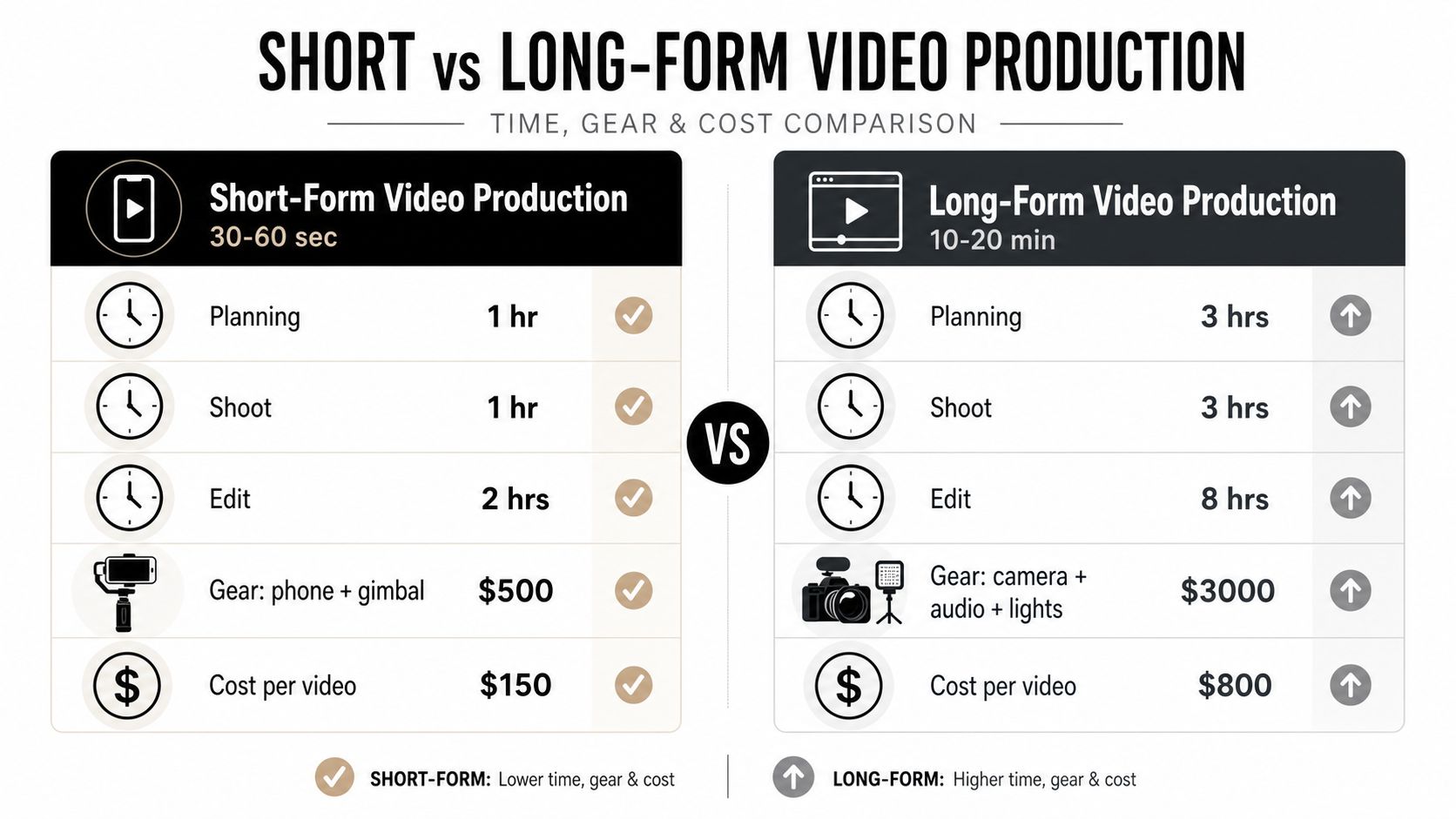
Short-form is cheaper per asset. Long-form costs more upfront, but it pays off when you plan for repurposing from day one. That is the part many content creators overlook.
Long-form usually asks for more planning, scripting, and production resources than short-form. In plain production terms, that means more prep, tighter set control, and more post-production time, but it also means more usable raw material once the camera stops rolling. Firework's short vs long-form video marketing guide makes the same basic point, long-form demands more work on the front end, and that work creates more material to cut from later. Firework's short vs long-form video marketing guide
What the workflow looks like in real life
A clean short-form shoot stays narrow. One hook, one message, one vertical deliverable, and you are done. A longer session becomes a source for multiple assets if you set it up correctly.
- Short-form session: one focused idea, lighter setup, faster edit, and usually multiple clips from a single recording block.
- Long-form session: more scripting, more camera time, more audio work, and a stronger base for repurposing.
- Best hybrid move: record the long-form core first, then cut it into clips for social distribution.
A guide from Life Inside on short-form vs long-form video recommends recording the long-form core first, then clipping 3 to 5 vertical shorts from it. That is the right call for brands that want depth without wasting distribution opportunities.
Long-form also gives you more room for a clean transcript, which helps with editing, captions, and accessibility. If you want a practical reference for that part of the process, the HyperWhisper video audio guide is useful for teams that need cleaner repurposing without letting post-production turn into a bottleneck.
For a producer, the math is simple. One recording day can produce a single polished asset or a small content library, depending on how you structure it. Flexwork's Content Day pricing makes the tradeoff concrete, $3000 per day for 20 edited reels or 60 pro photos. That is not just a shoot. It is a batch output system, and that is how studio time starts paying for itself. If you want the production side set up for that kind of output, Flexwork's in-house studios are built for exactly that workflow.
Short-form is cheaper to make. Long-form is cheaper to scale once you have captured enough source material. The mistake is buying neither workflow, then paying for scattered one-off edits all year.
Matching Format to Business Goal and Funnel Stage
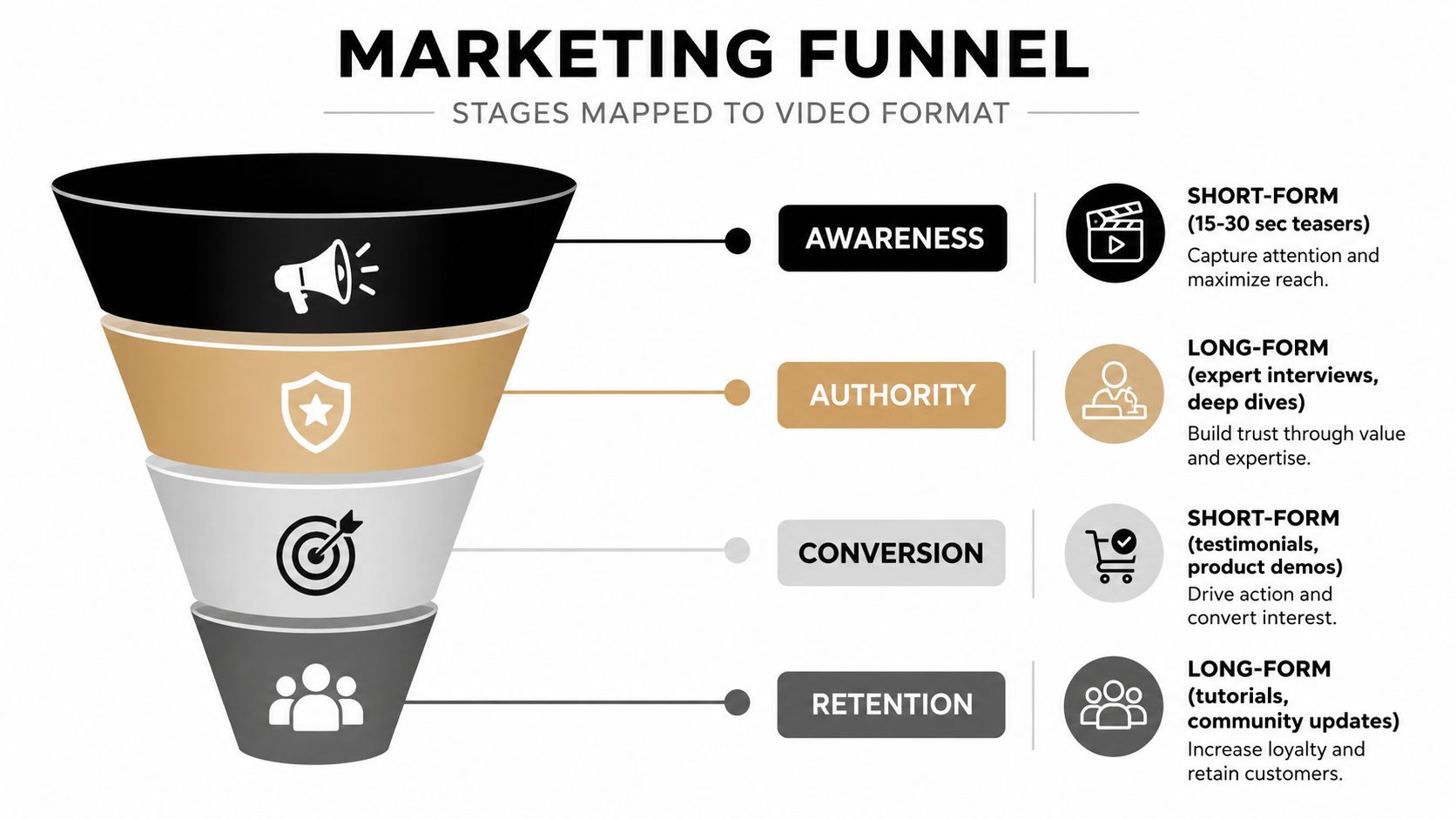
If your goal is awareness, start with short-form. If your goal is authority or conversion, long-form earns its keep. That's the cleanest way to think about it.
Short-form works because platform algorithms reward completion, replays, and shares. That makes it the better format for hook testing, audience growth, and getting your name in front of people who do not know you yet. Longer videos win when the viewer already has intent and needs more proof before taking action.
Match the format to the job
- Awareness: use short-form teasers, quick takes, and punchy proof points.
- Authority: use long-form interviews, deep dives, and detailed walkthroughs.
- Conversion: use long-form when the buyer needs reassurance, then use short-form to prompt action.
- Retention: use long-form for tutorials, community updates, and ongoing trust.
There's an important algorithmic twist here. An arXiv study on YouTube Shorts found that short-form content performed better on average than long-form in views and engagement, while industry guidance still frames long-form as the format for deeper trust and monetization (arXiv study on YouTube Shorts). That combination is the key takeaway, short-form can beat long-form on raw reach while long-form still wins where intent matters.
For creators in the middle of a growth push, this changes the playbook. Use short-form to pull people into the world. Use long-form to keep them there long enough to care. Then let the offer live where the trust is highest.
If you're a service brand, coach, or podcaster, this is the stage where a premium studio setup starts to matter. A better set and cleaner audio don't just look nice. They raise perceived authority before you say a word.
The Repurposing Workflow That Multiplies One Shoot Into Ten Assets

Start with the long-form source. That is the highest-ROI move. One podcast episode, interview, or monologue gives you a clean master file, then the short clips become distribution assets instead of a second production problem.
A smart repurposing workflow is simple to run and hard to beat on cost. One studio session captures the core message, and the edit team breaks it into platform-specific cuts that keep the audience moving from awareness to trust.
- Record the core session. Use one long-form recording as the anchor, ideally a conversation or expert-led episode.
- Pull the moments that hit hardest. Look for sharp opinions, useful frameworks, and clean one-liners.
- Cut the vertical clips. Keep them tight, usually in the 10 to 15 second range when the point is simple.
- Caption and package them. Add text, hook lines, and platform-native framing.
- Publish with intent. Release the long-form piece first, then roll out the clips around it.
The production math is why this workflow wins. One shoot fills the long-form channel, the short-form feed, and the distribution queue without booking separate studio time for every asset. That is how a single day of filming turns into a content package instead of one video that dies in a folder.
Recent guidance keeps pointing to this order because it protects depth while giving you more surface area for reach from the same recording session. Creators miss the point when they treat clips like leftovers. Clips are the distribution engine. The long-form piece is the source file that makes them worth editing.
Record once, clip hard, publish with a plan.
If you need a workflow companion for this exact system, the repurposing guide for a single podcast episode into 10 pieces of content matches this approach closely. It lays out the same logic a good studio uses on content days. One strong session should feed multiple assets, not stop at one upload.
Clean audio makes the whole pipeline faster because transcription, stringouts, and captioning move with less correction. For teams that want a practical reference on that handoff, the HyperWhisper video audio guide is a useful starting point.
Repurposing becomes a system when one recording session feeds the long-form platform, the short-form feed, and the edit queue in sequence. That is the ratio that protects studio time, keeps edit costs under control, and gives each shoot a real distribution plan.
How Flexwork Studios Turns This Workflow Into a Booked Calendar
A booked calendar starts with one decision, stop treating content as a single deliverable and run it like a production pipeline. That is where Flexwork makes sense. The studio removes the small frictions that burn studio time, keeps output consistent, and lets creators stay on camera instead of managing lights, timelines, and edits between shoots.
The offer stack fits the short form vs long form video content question because each service supports a different part of the same workflow. Content Days are priced at $3000 per day and include 20 edited reels or 60 pro photos, which fits a session meant to feed several platforms at once. Podcast websites start at $5000 plus hosting, which gives long-form content a permanent home for SEO, sponsor links, and conversion. The Market & Manage production tier starts at $1500 per episode with a 20-episode growth commitment, which works for a serious show that needs reach and revenue to grow together.
What each option solves
- Hourly Rentals: good when you need speed, control, and a clean place to record.
- Producer Packages: useful when you want a polished show without building an in-house team.
- Content Days: ideal when one shoot needs to generate a batch of short-form assets.
- Podcast websites: useful when long-form needs a home that supports credibility and search.
- Market & Manage: built for creators who want a real growth system, not just file delivery.
I've edited enough client projects to know the expensive part is rarely the camera. It is the scattered decision-making. Flexwork cuts that drag by handling the planning, shoot, edit, and distribution chain under one roof. If you want tactical publishing ideas while you shape the next batch, content creator video tips is a useful external benchmark, and it pairs well with a studio workflow because it keeps attention on output instead of vanity.
That setup matters because one recording session should feed the long-form platform, the short-form feed, and the edit queue in sequence. That ratio protects studio time, keeps edit costs under control, and gives every shoot a distribution plan that can be repeated.
Your Next Move and How to Book It
If you want the highest ROI, treat long-form source content as the master asset and build short-form derivatives from it. That ratio wins because one clean recording session can feed authority, search, clips, and social distribution without forcing your team to start from zero every time. For a practical publishing reference while you plan the next batch, content creator video tips is a useful benchmark.
The production math is straightforward. One strong source shoot costs studio time, setup, and editing once, then the derivative clips pull from that same footage with far less overhead. That is why content days make sense for creators who need volume, and why a cleaner package works better when you want the planning, shoot, edit, and distribution chain handled under one roof.
If you are still recording everything yourself, start with a Content Day or an hourly studio rental and get the source material right first. If you are building a show that needs consistency, use the production package that keeps the calendar, post-production, and repurposing moving without extra handoffs. Flexwork Podcast Studios gives you a professional place to record, produce, and repurpose content without turning the week into post-production chaos. If you want to turn one strong session into a system that books attention, visit Flexwork Podcast Studios and book the next step.