
What Is Guest Network in Podcasting: The Flexwork Guide
 September 22, 202622 Minutes
You've got a strong concept, a polished intro, and a calendar that keeps losing momentum because every episode depends on finding one more compelling guest. You search LinkedIn, send careful pitches, and spend valuable creative time waiting for replies that may never arrive. The issue often isn't your interview style. It's access.
In podcasting, a guest network is the relationship infrastructure that connects a host with credible, relevant people who can bring expertise, perspective, and energy to the show. It turns guest booking from a recurring administrative burden into a repeatable part of your media strategy. For creators building a serious brand, understanding what is guest network means looking beyond Wi-Fi terminology and recognizing the social capital behind memorable conversations. Flexwork Studios supports that broader production ecosystem through studio rentals, podcast production, content creation, and guest strategy.
The Struggle to Find Great Guests
Every podcaster knows the quiet panic of a blank guest list. You have a sharp episode theme and a clear audience, but the people who could make the conversation matter are difficult to reach. You open LinkedIn, refine a search, send a thoughtful message, then move on to another prospect because the first person hasn't responded.
A week later, the calendar still has gaps.
Manual outreach can work, especially when the host already has strong relationships in a specific field. The problem starts when every booking requires starting from zero. You research a person's background, confirm that they fit the topic, find a contact route, write a pitch, follow up, negotiate a recording time, and coordinate the details. None of that guarantees the guest will be engaging on camera or prepared to share a useful story.
Practical rule: A recognizable name isn't automatically a strong guest. Relevance, communication, preparation, and the ability to tell a clear story matter just as much.
The modern creator needs more than recording equipment. They need reliable access to voices that match the show's point of view. That access might come from previous clients, industry relationships, professional communities, or a service that actively maintains a qualified roster.
A useful podcast guest-finding framework helps you build that foundation, but the larger shift is strategic. Instead of treating each interview as an isolated booking, treat your guest pipeline as an asset that compounds. One strong conversation can introduce your show to a new professional circle, create clips for social channels, and give future guests a reason to take your invitation seriously.
That's how a podcast starts feeling less like a personal project and more like a media brand. The microphone captures the episode, but the network creates the opportunity.
What Is a Guest Network in Podcasting
In technical networking, a guest network is a separate connection for visitors. It lets guest devices reach the internet while restricting access to the primary network and local resources such as shared folders or printers. The Canadian Centre for Cyber Security recommends configuring a separate guest network with WPA2 or WPA3 where available, a practice described in its guest Wi-Fi guidance.
Podcasting uses the same phrase in a completely different way. A guest network in podcasting is a curated ecosystem of potential interviewees who are assessed for expertise, story quality, communication, and fit with a show's audience. It's not a spreadsheet of names. It's a working relationship system that helps hosts identify the right person, make a credible introduction, and move from interest to recording.
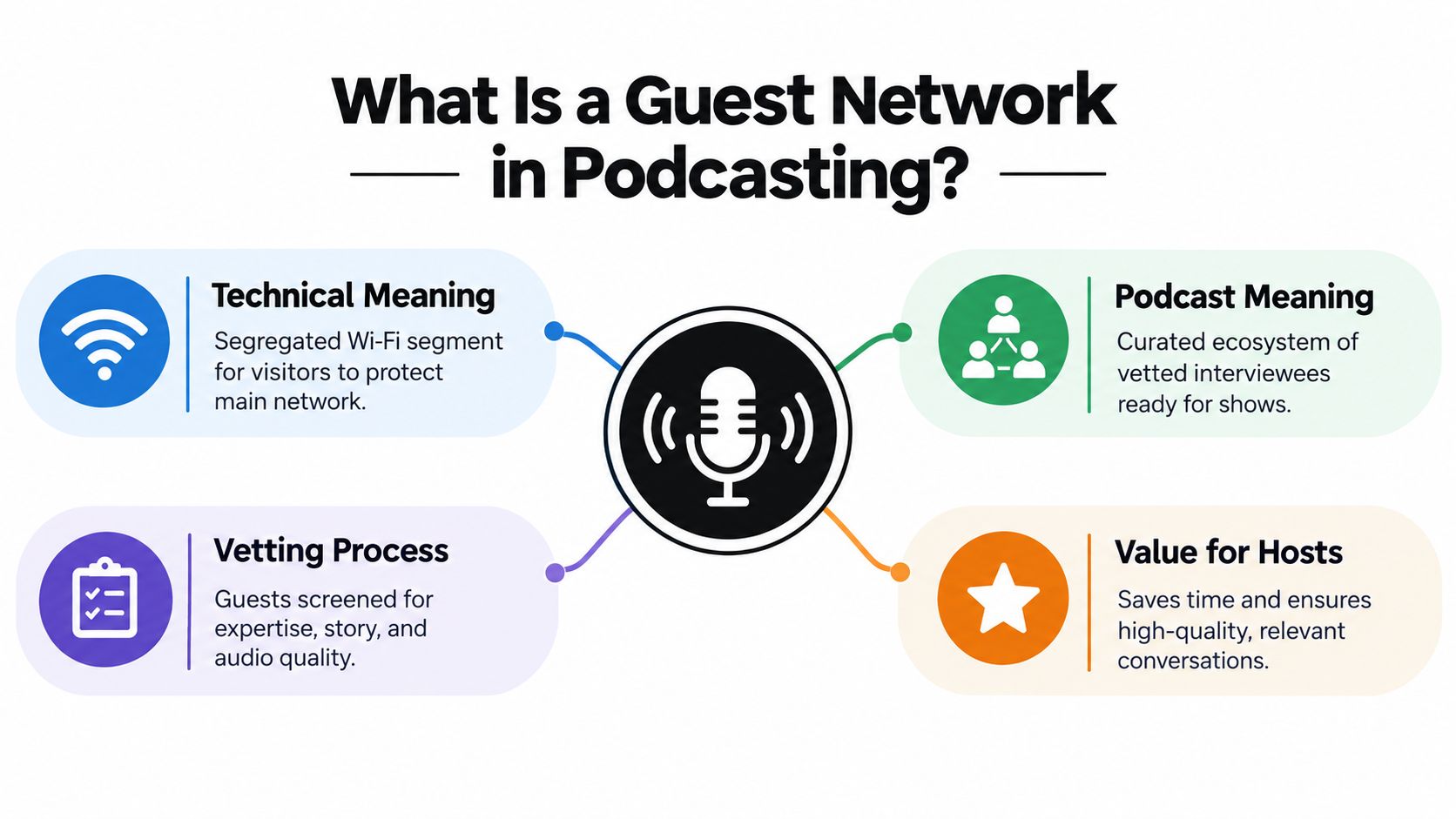
Use this definition to separate four ideas:
- Access: The network gives you a warmer path to people who may ignore a generic pitch.
- Curation: Someone evaluates whether a potential guest fits the show, rather than adding every available contact.
- Coordination: A useful network supports scheduling, preparation, and expectations before recording.
- Leverage: A strong guest can add authority, fresh perspective, and new distribution opportunities.
A technical guest network protects the host's devices from unknown connections. A podcast guest network protects the host's time from unfocused outreach. Both create boundaries and apply rules, but one manages network traffic while the other manages relationship access.
The distinction matters because many hosts confuse volume with strategy. A large contact list won't help if the people on it lack relevance, availability, or the ability to contribute to a compelling conversation. A curated system gives your show a better chance of attracting guests who understand their role in the episode.
For a practical approach to building that system, explore this podcast guest booking strategy.
You can also see how guest access fits into a professionally managed production workflow:
Why a Strong Guest Network Drives Growth
A guest network creates value in three connected ways: reach, credibility, and perspective. The right guest doesn't merely fill a chair. They can help the show enter a new professional community, add authority to a topic, and challenge the host's assumptions.
Reach starts with relevance. When a guest has a meaningful connection to the subject, they're more likely to care about the finished episode and share it with people who would benefit. That can introduce the show to listeners who wouldn't have discovered it through the host's existing channels.
Credibility comes from the quality of the conversation, not just the guest's job title. A knowledgeable guest who can explain decisions, mistakes, and practical lessons gives the audience a reason to trust the show. Over time, that association helps position the host as someone who convenes valuable conversations rather than comments on them.
Perspective keeps the format alive. A show that relies on the same professional circle can drift into predictable talking points. A wider network brings contrasting experiences, industries, backgrounds, and working styles into the editorial mix.
The three growth effects
- Reach: Guests can introduce your episodes to adjacent audiences through their own relationships.
- Credibility: Vetted voices make difficult subjects easier to explore with substance.
- Diversity: Different experiences prevent the show from becoming an echo chamber.
The technical world offers a useful parallel. Wireless platforms can record session start and end time to the second, bytes transferred, connection frequency, and whether a device is new or returning, as described in guest Wi-Fi analytics documentation. The podcasting equivalent is a more deliberate view of relationship activity. You can track which introductions lead to recordings, which topics produce the strongest conversations, and which guests become repeat collaborators.
That doesn't mean reducing relationships to a dashboard. It means learning from your own booking history. If every episode depends on one type of guest, your editorial strategy is fragile. If your network includes founders, operators, specialists, creators, and community voices, you can sustain more topics without losing the show's identity.
Hosts who want to turn those relationships into a consistent growth engine can use this podcast growth guide as a planning reference.
How Curated Networks Operate
A curated network works because someone has already invested in relationship-building. Instead of asking a host to identify, research, pitch, and qualify every guest independently, a professional intermediary maintains connections with people who may be open to appearing on relevant shows.
The process usually begins with the show. A booking team needs to understand its audience, subject areas, tone, recording format, and standards. Without that context, matching becomes a name-sharing exercise. With it, the team can look for guests whose expertise and story are useful for a specific episode.

What gets evaluated
A credible network considers more than a person's résumé. It may assess:
- Whether the guest can explain complex ideas clearly
- Whether their experience matches the episode's audience
- Whether they have a story rather than only promotional talking points
- Whether they can meet the recording format and schedule
- Whether they understand the expectations around preparation and promotion
The operating model resembles good production design. A secure enterprise guest network uses a separate VLAN, subnet, DHCP scope, and firewall rules that deny access to internal subnets while permitting internet-bound traffic, according to this enterprise guest Wi-Fi segmentation guide. The podcasting analogy is useful because curation also creates a controlled pathway. The host gets access to appropriate participants, while the network protects the show from mismatched bookings.
That structure saves more than outreach time. It reduces the hidden costs of poor fit, including weak preparation, unclear expectations, unusable footage, and conversations that never find a strong editorial angle.
A professional podcast guest booking service can handle the relationship and coordination layer while the host concentrates on questions, pacing, and storytelling. The network doesn't replace the host's voice. It gives that voice better material.
DIY Booking Versus Professional Access
DIY booking gives you maximum control. You choose every guest, write every pitch, and decide exactly which opportunities deserve attention. It's a sensible starting point for a host with a narrow niche, a strong personal network, or plenty of time for administration.
The trade-off is that booking becomes another job. You're responsible for prospecting, qualification, follow-up, scheduling, reminders, release details, and promotion coordination. The work can pull attention away from research, recording, editing, and the business activities that make the show valuable.
Professional access changes the allocation of effort. A network provider can help identify suitable guests, make introductions, manage communication, and keep the recording pipeline active. You give up some control over the initial search, but you gain a process that can operate beyond your immediate circle.
| Decision factor | DIY booking | Professional access |
|---|---|---|
| Control | You direct every outreach decision | A partner works from your criteria |
| Administrative load | You manage the full booking cycle | Coordination can be handled externally |
| Guest discovery | Limited by your research and relationships | Expanded through an established network |
| Editorial fit | Depends on your screening process | Supported by defined qualification standards |
| Best fit | Early-stage or highly specialized shows | Hosts prioritizing consistency and production time |
The word “network” shouldn't create false confidence. In Wi-Fi security, AirSnitch research reported in 2026 found that client isolation and guest-network separation can be bypassed even when WPA2, WPA3, and isolation are enabled, meaning a guest SSID isn't always a dependable boundary for printers, NAS devices, or other internal assets, as discussed by AppleInsider's coverage of the research. In podcasting, the equivalent lesson is simple: access still requires verification.
Before outsourcing outreach, review the provider's screening method, communication process, guest expectations, and ownership of relationships. For hosts managing their own prospecting, these influencer outreach best practices offer useful guidance on personalization and respectful follow-up.
Tips for Booking High-Quality Guests
A strong booking process makes the guest feel prepared before they ever enter the studio. It also gives the host a better chance of capturing a conversation that can support a full episode, short-form clips, and future collaborations.
Start with a specific invitation. Explain why the person's experience fits the episode, identify the audience they'll reach, and suggest a focused conversation angle. Generic praise makes a pitch feel automated. A clear editorial premise shows that you've done the work.
A practical booking checklist
- Lead with relevance: Connect the guest's work to one precise topic your audience cares about.
- Set the format early: State whether the episode is audio, video, remote, or in-studio, and explain the expected conversation style.
- Send useful preparation: Share a concise outline, recording details, arrival guidance, and any topics you want to avoid.
- Protect the guest experience: Confirm timing, technical needs, releases, and promotional expectations before recording day.
- Prepare sharper questions: Build questions around decisions, lessons, tensions, and examples rather than a résumé recap.
A polished environment helps, but it can't rescue weak preparation. Guests notice when a host understands their work and has a reason for bringing them into the conversation. They're also more likely to recommend the experience when communication is organized and the recording feels intentional.
Technical friction deserves the same attention. Public guest Wi-Fi can fail because of DHCP pool exhaustion, DNS interception problems, incomplete walled gardens, HSTS redirect blocking, VPNs, or MAC randomization, according to this captive portal troubleshooting guide. The podcasting parallel is familiar: a missing release, unclear call time, bad remote audio, or untested video link can derail an otherwise promising booking.
Treat logistics as part of hospitality. The guest should know what happens next, who to contact, and how the finished episode will be used.
How Flexwork Supports Your Guest Strategy
A guest network creates opportunity, but the recording still has to deliver. Poor sound, inconsistent lighting, weak framing, and rushed post-production can make a strong guest look less credible than they are. Flexwork's role is to connect guest access with the environment and production process needed to present that conversation professionally.
Flexwork Podcast Studios offers acoustically treated recording spaces, podcast and video production, editing, sound mixing, motion graphics, branding, distribution, and growth-focused marketing. Its guest booking service supports hosts who want qualified voices without managing every outreach task themselves.
The value comes from combining the layers. A guest strategy identifies the right person. A studio rental gives the episode a controlled setting. Production turns the conversation into a finished show and usable short-form assets. Marketing and a podcast website help the audience find and understand the series.
Choose the production layer that matches the show
- Be My Podcast Producer: Built for creators who want hands-on support with the recording and production workflow, so they can focus on hosting.
- Market, Manage & Produce My Podcast: Starts at $1,500 per episode with a 20-episode growth commitment, according to the service pricing provided by Flexwork.
- Content Day: Priced at $3,000 per day, including 20 edited reels or 60 professional photos, making it useful when a guest appearance needs a broader content package.
- Podcast website: Available for $5,000 plus hosting, giving the show a dedicated home for episodes, positioning, and conversion.
A properly configured technical guest setup places visitor devices on a separate IP range or VLAN-like segment and blocks access to the primary network. Administrators should verify that guests can't reach the main LAN and disable settings such as “Allow Local Access” or “Access Intranet” unless there's a specific reason to permit it, as outlined in this guest-network configuration guidance. The podcasting lesson is similar. Build a clear boundary around each responsibility, then connect the pieces through a reliable workflow.
For creators who need ongoing coordination, podcast management services can bring guest strategy, production, publishing, and growth planning into one operating system.
Ready to Scale Your Podcast
Your podcast is only as strong as the conversations it hosts. A guest network gives you a repeatable way to reach relevant voices, while disciplined screening keeps the show aligned with its audience and editorial identity.
The strongest setup combines access with execution. You need guests who can contribute substance, a recording environment that captures them well, and a production process that turns one conversation into a complete content asset. Without that connection, even a promising guest list can leave your show stuck in planning mode.
Flexwork Podcast Studios in Springfield, New Jersey, provides studio rentals, guest booking support, production packages, Content Day sessions, podcast websites, and growth-focused services for creators and businesses. If booking logistics are slowing your momentum, schedule a free tour and discuss the guest strategy, recording format, and production support your show needs.
Flexwork Podcast Studios connects creators with professional recording spaces, production support, content repurposing, and guest-network services designed for stronger conversations. Visit Flexwork Podcast Studios to schedule a free tour and build a more reliable path from guest booking to finished episode.