
B2B Podcast Marketing: The Playbook for Pipeline Growth
 August 20, 202624 Minutes
The popular advice says a B2B podcast succeeds when it collects downloads, builds awareness, and eventually creates demand. That advice is incomplete. A show can attract attention without creating a single qualified conversation, while a focused interview series can influence deals through a small audience of relevant executives, guests, and target accounts. B2B podcast marketing works best when the show is built as a pipeline system, not a publishing obligation.
The opportunity is substantial. Global podcast listeners reached 584.1 million in 2025 and are projected to reach 619.2 million in 2026, according to Omniscient Digital's B2B podcast statistics. In the United States, 73% of people age 12 and older have consumed a podcast, while 55% listened in the past month and 40% in the past week, based on Edison Research's Podcast Consumer 2025 report.
This playbook focuses on the part most brands skip: selecting guests who can become customers, capturing conversations in formats built for distribution, and connecting every meaningful interaction to your CRM. Flexwork Studios fits into that workflow through studio rentals, production support, Content Day sessions, podcast websites, and growth-oriented packages for teams that want polished content without building an entire production department internally.
Why B2B Podcasts Are a Pipeline Channel Not Just a Brand Play
Downloads confirm distribution. They do not confirm pipeline. A target account may never hear the episode, a guest may have no connection to an active opportunity, and a prospect may consume several episodes without taking a measurable next step. B2B podcast marketing works when the show is designed as a pipeline channel, with audience relevance, guest relationships, and CRM attribution built into production from the start.
Executives already include podcasts in their vendor research habits. One 2026 industry summary reports that 67% of B2B buyers use industry-specific podcasts when researching vendors for purchases over $50K, while another reports that 83% of senior executives listened to a podcast in the past week. Those figures come from Empire 325 Marketing's podcast marketing statistics. The commercial implication is practical: episodes can influence buyers later in the buying process when they address the operational questions, risks, and selection criteria that shape a vendor decision.
Retention still needs careful interpretation. The verified B2B benchmark reports 67% average audience retention, according to Share Your Genius's B2B podcast benchmarks. That figure does not prove revenue impact, but it does reinforce two production priorities: match the subject to the audience, and structure the conversation so the strongest insight arrives before attention fades.
The channel comparison
| Metric | B2B Podcast | Blog / SEO | Webinar | LinkedIn Post |
|---|---|---|---|---|
| Primary strength | Trust, executive access, relationship depth | Search discovery and education | Live objection handling | Fast reach and conversation |
| Pipeline role | Guest introductions and buyer influence | Intent capture and validation | Qualification and demonstration | Awareness and social proof |
| Main limitation | Requires consistent production and attribution | Slow to build authority | Attendance depends on timing | Short attention window |
| Best measurement | Meetings, influenced opportunities, guest conversion | Assisted conversions and qualified organic leads | Registrations, attendance, opportunities | Account engagement and responses |
A recorded interview creates a warmer commercial interaction than a cold email. The guest receives a useful conversation and a shareable asset. The host gains a legitimate reason to continue the relationship after recording. That follow-up may produce a referral, meeting, account insight, or future opportunity, even when the guest is not ready to buy.
Video extends the conversation beyond the RSS feed. The Moonb B2B video guide covers production decisions for filmed interviews, including framing, lighting, and short-form extraction. The goal is not television-level production. It is consistent visual quality that lets one conversation work on YouTube, LinkedIn, and an owned episode page, while giving sales and marketing usable assets for account follow-up.
Attribution belongs inside a broader thought leadership content strategy. Add a podcast-sourced field to demo forms, store guest account names in the CRM, and tag episode views, email clicks, meeting bookings, and opportunity progression. Flexwork Studios can support that workflow through studio rentals, production support, Content Day sessions, podcast websites, and growth-oriented packages. The result is a show your revenue team can evaluate by meetings and influenced opportunities, not attention alone.
Building a Guest Strategy That Converts Listeners Into Meetings
A guest list shouldn't be a collection of impressive names. It should be a prospecting map with editorial standards.
Start by creating an Ideal Guest Profile, or IGP, that mirrors your Ideal Customer Profile. Define the industries, company characteristics, roles, strategic priorities, and pain points that matter commercially. Then rank potential guests by relationship value, not follower count.

Use three guest tiers
Strategic prospects belong at the top of the commercial priority list. These are executives at accounts you want to reach, people already connected to your sales team, and decision-makers whose operational questions align with your offer. The episode should give them a reason to participate that doesn't feel like a disguised pitch.
Industry influencers expand the show's relevance. They can introduce new language, challenge your point of view, and share the finished episode with an audience that may include target buyers. Reach is helpful here, but relevance matters more than celebrity.
Existing customers provide practical depth. Their conversations can reveal implementation obstacles, internal buying dynamics, and the outcomes your market cares about. Handle these episodes carefully. The guest should sound like a knowledgeable operator, not a scripted endorsement.
Make the invitation valuable
Weak outreach asks for time. Strong outreach proposes a specific conversation that makes the guest look thoughtful and gives them a useful asset afterward. Mention the subject you want to explore, explain why their experience fits, and state what they'll receive, such as edited video clips, a finished episode, or a share-ready media kit.
Don't promise an acceptance rate you can't verify. Track your own funnel instead:
- Invitations sent.
- Positive replies.
- Calls scheduled.
- Interviews recorded.
- Episodes published.
- Follow-up meetings.
- Opportunities created.
- Revenue closed.
Professional surroundings can reduce friction for guests who care about how they appear on camera. A controlled set, reliable audio, and a clear production process create a credible experience, particularly for executives who don't regularly record content. Flexwork Podcast Studios is one option for teams that want a managed environment rather than a home-office setup.
The post-episode sequence is where many shows lose their commercial value. Send the guest a concise thank-you, the live link, selected clips, and a relevant next-step resource. Record every interaction in the CRM. For a practical operational guide, use Flexwork's process for booking podcast guests as a starting point, then adapt the qualification criteria to your sales motion.
Producing Multi-Format Episodes Built for Repurposing
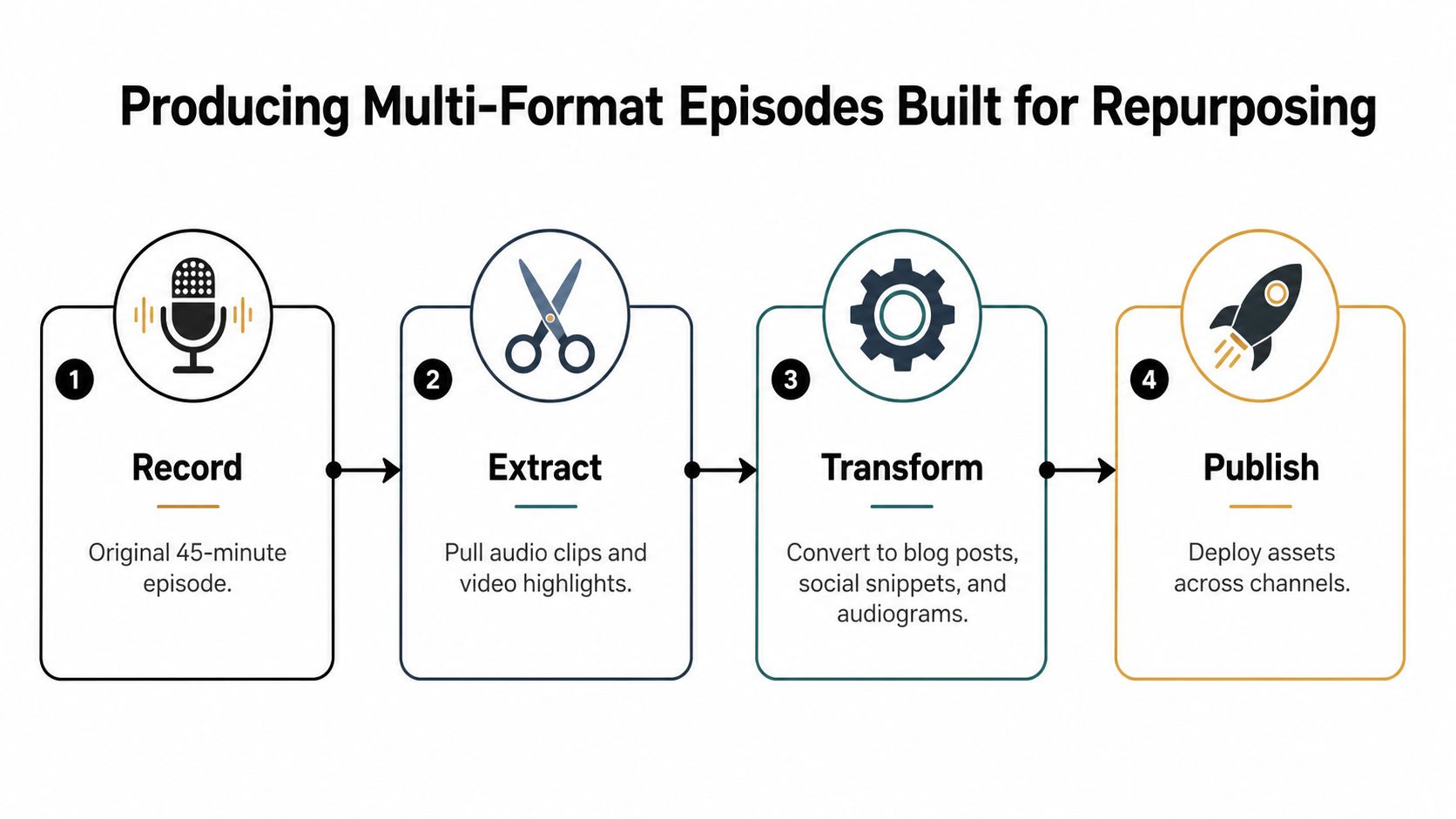
A recording only becomes a content engine when the production plan anticipates every destination before the host presses record. The question isn't whether you can cut clips afterward. It's whether the interview structure creates clean, useful moments that can stand alone.
A strong pre-interview does three jobs. It identifies the guest's most specific experience, surfaces disagreement or tension, and maps questions to the buyer's actual concerns. Generic prompts produce generic edits. A question such as “What changed in your operating model after the market shifted?” gives the guest room to tell a story, explain a decision, and offer a point of view that can support a clip, article, or sales follow-up.
Design the recording around extraction
A multi-camera studio setup gives editors more than a static talking-head frame. It creates options for vertical crops, reaction shots, speaker changes, and visual pacing. During the conversation, a producer can mark timestamps for strong answers, clear sound bites, emotional turns, and sections that need additional context.
The asset plan might include:
- Full episode: Audio distributed through the RSS feed and a complete video version for YouTube.
- Short clips: Vertical excerpts for LinkedIn, Instagram, Reels, and Shorts.
- Search page: A structured episode page with a summary, transcript, key questions, and timestamped chapters.
- Written insight: A LinkedIn carousel or article built around the guest's most useful framework.
- Email recap: A short newsletter that links the episode to a commercial problem or resource.
The exact output depends on the conversation and the editing brief. More assets aren't automatically better. A dozen repetitive clips can dilute a strong idea, while a small set of distinct excerpts can support a coherent campaign.
Choose consistency over production theater
Production quality and speed trade against each other. Elaborate sets, heavy animation, and extensive revisions can make a show look refined while delaying publication until the conversation loses relevance. A simpler visual system with dependable audio, clear lighting, and repeatable graphics often serves B2B teams better.
Batch recording is a practical compromise. A Content Day at Flexwork costs $3,000 per day and includes 20 edited reels or 60 professional photos, according to the stated service pricing. Teams can use that structure to build a library of material while protecting executive calendars. For a deeper workflow, review how to repurpose a single podcast episode into 10 pieces of content, then create an editorial checklist that assigns each asset an owner, deadline, channel, and CTA.
Distributing Episodes for Maximum First-Week Impact
A B2B episode rarely creates pipeline from one announcement. It needs a coordinated first-week sequence that gives executives several ways to discover, assess, and share the conversation. Use the first seven days as the primary review window, then compare episodes by topic, guest type, account engagement, and promotion level rather than chasing a universal target. Podnews summarizes research showing YouTube's growing role among podcast listeners, so treat it as a distribution channel, not merely a video archive.
Publish the complete video when the visual conversation adds context. Cut shorter excerpts around one buyer problem, one strong opinion, or one practical answer. Each clip should point to the episode page and carry a clear next action.

A usable seven-day sequence
Launch day: Publish the episode page, transcript, audio feed, and primary video. Send the subscriber email, notify the guest, and give employees approved clips, copy, links, and the intended CTA.
Day two: Have the host share a personal perspective instead of a generic announcement. Identify the buyer problem raised in the discussion and invite informed responses.
Day three: Release a behind-the-scenes clip or concise answer that introduces the guest's point of view. Give the guest copy they can adapt to their own voice, then make sharing the finished asset easy.
Day five: Publish an audiogram or vertical excerpt built around one idea. Send viewers to the episode page, where the CTA and conversion path are visible.
Day seven: Resurface the full video and review the launch cohort. Record which target accounts engaged, which clips generated meaningful replies, and which CTA produced a visit, inquiry, or meeting.
Prepare a guest media kit with custom graphics, suggested copy, the episode link, embed details, and a short audience description. Employees also need clear instructions. A vague “please share” request creates little coordinated distribution.
For channel-specific execution, use Flexwork's guide to podcast distribution to map ownership, timing, formats, and channel roles. ABM promotion can place selected clips in front of matched high-value accounts, but paid reach should support relevant positioning rather than hide a weak episode. Flexwork Podcast Studios can manage the production and delivery workflow when the internal team needs consistent execution across audio, video, and campaign assets.
Measuring What Matters for B2B Podcast ROI
Downloads show distribution. Meetings show commercial progress. A B2B podcast dashboard needs to separate attention from activity that can enter the pipeline.
Set one source-of-truth rule: every meaningful podcast interaction must have a consistent path into the CRM. Add campaign fields to forms, use dedicated landing pages for episode CTAs, create unique promo codes where relevant, and ask “How did you hear about us?” on high-intent forms. Self-reported attribution will not capture every touch, but it can reveal influence that last-click reporting misses.
Replace the vanity dashboard
| Vanity Metric | Pipeline KPI | How to Track |
|---|---|---|
| Downloads | Meetings booked | Tag podcast-related form submissions and calendar bookings |
| Listener count | Qualified opportunities | Associate contacts and accounts with podcast campaigns |
| Video views | Account engagement | Compare target-account activity with episode publishing dates |
| Social likes | Sales conversations | Record replies, referrals, and follow-up meetings |
| Lifetime totals | First-week distribution | Review episode cohorts during the seven-day launch window |
Guest-to-client conversion needs its own view. A reported average conversion rate is 10%, while top performers have reached 48% through strategic guest selection and strong follow-up, according to Komet Media's B2B podcast statistics. Use these figures as external benchmarks, not forecasts. Your internal funnel should record invitation acceptance, recording completion, follow-up response, meeting creation, opportunity stage, and closed-won outcome.
Komet Media also reports that 87% of B2B podcasts generate zero attributable pipeline when proper measurement frameworks are missing. The operating lesson is straightforward: without campaign tags, clear ownership, and follow-up rules, proving revenue influence becomes difficult.
Track influence, not only origin
Podcast engagement can affect an opportunity after the prospect has already entered the sales process. Add episode-consumed or episode-engaged fields to opportunity reviews, then compare account activity with changes in stage. A prospect may advance after watching an interview that addresses a buying objection, even though the podcast did not source the original opportunity.
Connect those signals to account-based reporting. Review whether target accounts watched an episode, replied to a clip, visited a related page, or booked time after a guest conversation. This creates a clearer path from executive listener to qualified opportunity than platform-level reach alone.
Keep leadership reporting focused: meetings booked, qualified opportunities created, influenced opportunities, pipeline amount, closed-won revenue, and production cost. Flexwork's guide to measuring branded podcast impact can help structure the reporting layer before you commit to a larger production cadence. Flexwork Studios can also support the production, CRM-ready asset, and reporting workflow when internal teams need consistent execution.
Your 30 to 90 Day B2B Podcast Launch Plan
A staged launch protects the show from the most common failure pattern: announcing a podcast before the team has the guests, production rhythm, distribution assets, or measurement system to sustain it.
Days 1 to 30, position and prepare
Begin with the commercial question. Which accounts should the show help you understand, reach, or influence? From there, define the listener, guest profile, recurring themes, format, CTA, and criteria for a qualified episode.
Record a buffer before launch. A controlled studio session can produce the first conversations while the marketing team builds the episode pages, email sequence, LinkedIn calendar, guest media kit, and CRM tags. At this stage, approve the visual identity and editing style once, so every future episode doesn't trigger a new round of brand decisions.
A podcast website costs $5,000 plus hosting, according to the stated Flexwork service pricing. That investment makes sense when the site functions as an owned content hub with episode pages, transcripts, conversion paths, and guest resources. It makes less sense if it becomes a decorative archive with no search structure or CTA.

Days 31 to 60, publish and activate
Release the opening episodes with a coordinated sequence rather than leaving each launch to chance. Ask guests to approve their clips, prepare employee posts in advance, and give sales representatives a short note explaining which accounts may benefit from each conversation.
Review the first-week data by episode. Compare topic fit, guest relevance, retention, responses, form activity, and account engagement. Avoid changing the entire format after one underperforming release. Look for patterns across the cohort.
Days 61 to 90, optimize the system
By this point, your team should know which guest categories create the strongest conversations and which CTAs generate useful responses. Refine the IGP, expand the repurposing brief, and schedule a production sprint for the next group of episodes.
For teams that want ongoing support, the Market, Manage & Produce My Podcast tier starts at $1,500 per episode with a 20-episode growth commitment, according to the stated service pricing. The package is designed for brands that need more than recording. It can support the recurring work of production, publishing, promotion, and growth operations.
Use the final phase to present evidence, not enthusiasm. Show leadership how many meetings originated from the show, which opportunities were influenced, how guests progressed, and what production cost each episode carries. Then decide whether to scale, narrow the audience, change the CTA, or pause a format that isn't earning its place in the marketing mix.
Flexwork Podcast Studios can provide the recording environment, editing, visual content, podcast website support, and growth services needed to build this system without forcing your internal team to manage every production detail.
Visit Flexwork Podcast Studios to explore studio rentals, production packages, Content Day sessions, podcast websites, and marketing support for a B2B show built to create qualified conversations. Book a tour or inquiry session, bring your ICP and guest list, and leave with a clearer production path from executive interview to measurable pipeline.