

Short Form Video Content: The Complete Guide for Creators
 August 23, 202621 Minutes
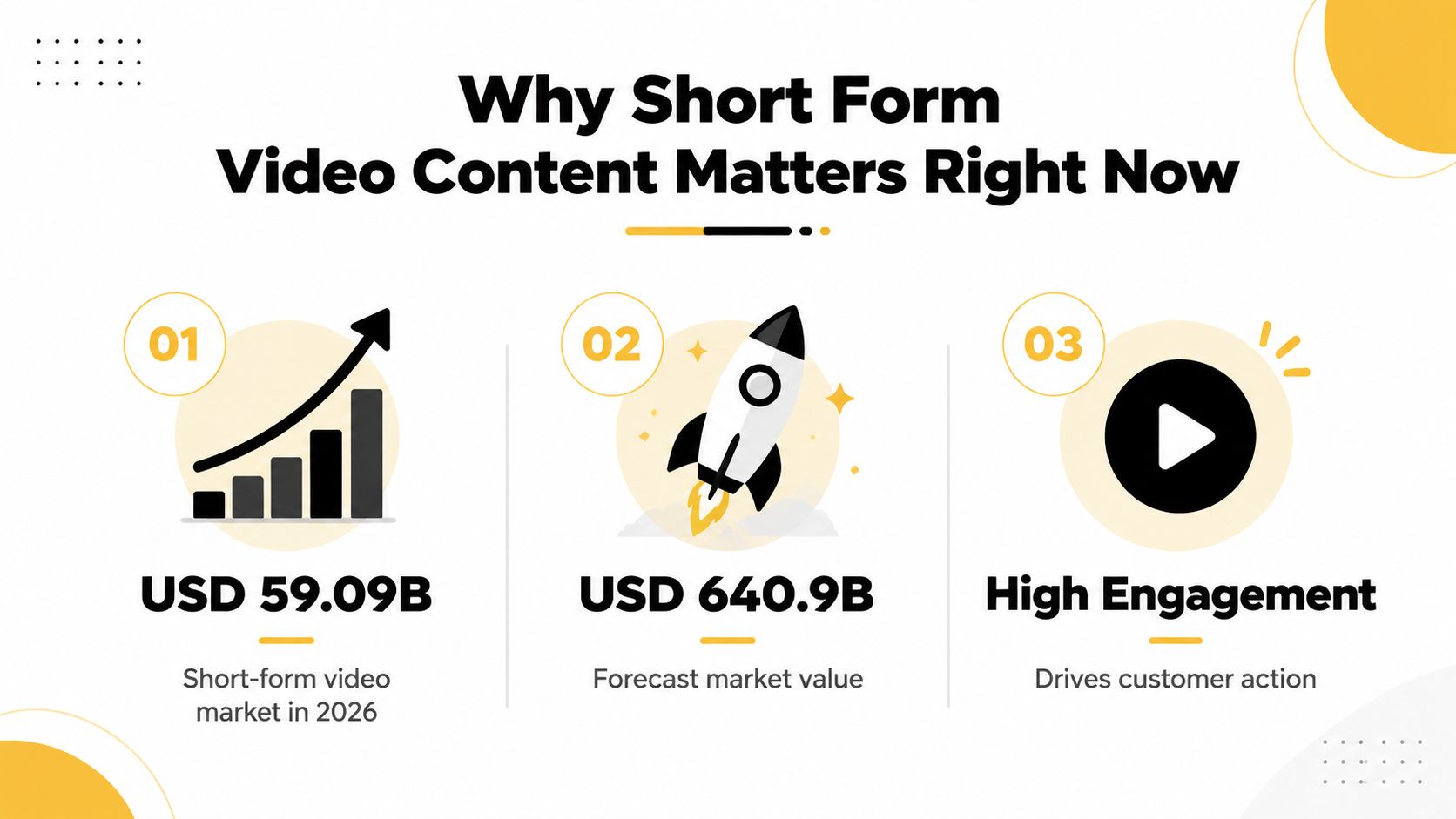
USD 59.09 billion in 2026, growing to a projected USD 640.9 billion by 2035, is the scale of the short-form video market. The opportunity is massive, but creators who can't build a reliable production workflow will struggle to turn that demand into consistent output.
Short-form video content has moved from an occasional social post to a core business asset for podcasters, entrepreneurs, and modern brands. The challenge isn't usually finding ideas. It's scripting them, recording clean footage, editing efficiently, packaging each version correctly, and publishing before the next idea arrives.
Flexwork Studios helps creators solve that operational bottleneck with professional studio rentals, Content Day sessions, podcast production packages, and podcast websites. This guide covers the strategic choices behind short-form video, from platform selection and hooks to workflow design, repurposing, and performance measurement.
Why Short Form Video Content Matters Right Now
The projected short-form video market is estimated at USD 59.09 billion in 2026 and is forecast to reach USD 640.9 billion by 2035, representing a projected 30.33% compound annual growth rate over that period, according to short-form video market forecasts. That scale signals sustained investment from platforms, advertisers, media companies, and creators.
Asia-Pacific leads short-form video revenue generation, but the format's appeal is global. A 2025 U.S. consumer poll found that 90% of respondents were open to seeing vertical short-form video on publisher websites, according to Media.net's consumer study. Vertical video can therefore travel beyond TikTok, Reels, and Shorts into websites, newsletters, landing pages, and embedded media experiences.
For an ambitious creator, the implication is practical. Short-form video content can introduce your expertise to new audiences, give a podcast episode a longer life, and create repeated entry points into your brand. But publishing one clip whenever inspiration strikes isn't a strategy. You need a production system that makes quality repeatable.
The real advantage: Creators who build a dependable workflow can turn one recording session into a steady stream of audience-facing assets.
That starts with choosing a primary platform, defining the role of each clip, and removing the friction between having an idea and publishing it. Flexwork's overview of short-form video trends offers additional context for creators planning around this shift.
Platform Differences Among TikTok Reels and YouTube Shorts
TikTok, Instagram Reels, and YouTube Shorts all use vertical video, but they don't serve identical audience behaviors. A clip designed for discovery on TikTok may need a stronger visual identity on Instagram, while a YouTube Short often works best when it connects to a deeper educational or podcast asset.
| Platform | Algorithm Focus | Ideal Length | Best For |
|---|---|---|---|
| TikTok | Discovery, novelty, viewer response, and strong opening moments | Concise, focused clips | Reaching cold audiences and testing ideas |
| Instagram Reels | Visual cohesion, relationship signals, and existing audience interaction | Concise branded clips | Strengthening a recognizable personal or business brand |
| YouTube Shorts | Discovery connected to broader YouTube viewing behavior | Focused clips that stand alone | Feeding subscribers toward long-form videos and podcasts |
TikTok is often the strongest environment for testing a point of view with people who don't know you yet. A direct opening, unusual visual, or confident opinion can create a reason to stop scrolling. Trends can help, but copying a trend without connecting it to your expertise usually produces attention without positioning.
Instagram Reels benefits creators who already care about a cohesive profile. Your fonts, color treatment, set design, and on-camera style matter because the viewer may discover one Reel and then assess the rest of your account. Consistency creates recognition, especially for coaches, founders, and podcast hosts building a premium identity.
YouTube Shorts has a different strategic advantage. It can function as a front door to longer conversations, interviews, explainers, and podcast episodes. A strong Short should answer one question clearly while giving the viewer a logical reason to continue exploring your channel.
Creators who want to experiment with assisted ideation, visual concepts, or platform-specific production can browse TikTok Reels AI tools as part of their research. Tools can accelerate production, but they shouldn't replace a clear voice or editorial judgment.
Use Flexwork's short-form video platform guide to refine your channel mix. The practical rule is simple: choose one hero platform, then treat the others as distribution extensions. Judge TikTok by discovery, Reels by brand interaction, and Shorts by its ability to create a deeper viewing journey.
Creative Formats and Hook Strategies That Convert
A short-form video succeeds or fails before the viewer reaches the middle. Opera Mediaworks' research found that six- to eight-second mobile video creative delivered an average of 36% higher engagement than long-form video, while 14- to 15-second videos were optimal for maximizing dwell time and click-through rates in non-native mobile environments, as reported by The Drum.
The opening doesn't need to be loud. It needs to establish relevance quickly. Three hook frameworks work across podcast clips, founder content, educational videos, and behind-the-scenes footage.
Direct value promise
Tell the viewer what they'll gain.
- “The fastest way to improve your podcast audio is to fix the room before you buy another microphone.”
- “Use this structure when your short-form scripts keep sounding repetitive.”
The promise should be specific enough to attract the right viewer and clear enough to understand without context.
Pattern-interrupt question
Ask a question that challenges a familiar assumption.
- “Why do polished podcast clips still get ignored?”
- “Are you creating more content than your workflow can support?”
The question earns attention by creating tension. The answer must arrive quickly, or the viewer will feel manipulated.
Curiosity gap
Introduce an unresolved detail, then pay it off.
- “The best clip from this interview wasn't the answer. It was the pause before it.”
- “We changed one part of this recording setup, and the edit became much easier.”
Curiosity works when the conclusion is useful, not merely withheld.
For additional hook prompts, creators can explore these proven TikTok hooks for brands. Adapt any framework to your audience's vocabulary rather than delivering it as a generic template.
Two formats worth building around
Behind-the-scenes process breakdowns work well when the audience wants access, proof, or transformation. Show the room before recording, the guest preparation, the lighting decision, or the editing timeline. The footage should reveal a meaningful choice, not just display equipment.
Single-idea tutorials work when the audience has a defined problem. One clip should solve one small problem, such as writing a stronger opening, improving eye contact, or structuring a podcast CTA. If the idea needs several explanations, divide it into a series.
Engagement isn't accidental. It's engineered through pacing, visual variety, clear audio, and a payoff that matches the opening promise.
Before shooting, check the script:
- Does the first sentence create immediate relevance?
- Does the clip deliver one central idea?
- Can the viewer understand it without prior context?
- Does every visual support the spoken point?
- Is there one clear next action?
A useful companion to this process is Flexwork's guide to the art of storytelling. Strong short-form video content still depends on narrative judgment, even when the final edit is brief.
Production and Editing Workflow for Consistent Output
Creative ambition doesn't solve an inconsistent workflow. A reliable short-form video operation needs defined handoffs, repeatable files, and an environment that reduces avoidable editing problems.
Phase one is scripting
Lock the hook, the central value, and the call to action before the camera starts. A useful script can be brief, but it should answer three questions: why should someone watch, what will they learn, and what should they do next?
For podcast teams, mark likely clip moments during the recording rather than searching blindly through a long episode later. Note the question, answer, or story that could stand alone. This small editorial habit saves time during post-production.
Phase two is shooting
Capture the primary take, supporting angles, and relevant B-roll. A controlled set makes this easier because the camera position, background, lighting, and audio environment stay consistent across multiple clips.
Audio deserves special attention. An expensive camera can't rescue dialogue recorded in an untreated, echo-heavy room. A reliable microphone in an acoustically controlled space often produces a more usable result than a premium camera placed in a poor recording environment.
Phase three is editing
Editors should prioritize clarity over decoration. Tight cuts remove hesitation, captions support silent viewing, and restrained motion graphics can direct attention without competing with the speaker.
Build a repeatable edit template with approved fonts, colors, caption styles, music rules, and export settings. The template should accelerate decisions, not make every clip look identical.
Phase four is asset packaging
Export clean files for each destination, then prepare captions, thumbnails, titles, descriptions, and calls to action. Keep the master file separate from platform-specific versions so future edits don't require rebuilding the entire project.
Flexwork's short-form video editing services can support teams that need a consistent post-production process without managing every edit internally.
Workflow standard: Treat the studio setup as a production system, not a one-off shoot. Every decision should make the next recording, edit, and publishing cycle easier.
Distribution and Repurposing Strategies for Maximum Reach
A strong recording session should produce more than one social post. The most efficient creators plan distribution before they shoot, then capture footage with multiple uses in mind.
Start with an asset map. Identify the source recording, the intended short-form edits, the supporting visuals, and the destinations for each version. A podcast interview might produce a direct answer clip, a disagreement clip, a story-led clip, a quote graphic, a written post, and an email excerpt. Each asset should have a job.
Build the map around decisions
Don't ask only, “How much footage can we capture?” Ask:
- Audience need: Which questions does this recording answer?
- Platform role: Is the edit designed for discovery, relationship-building, or deeper viewing?
- Visual requirement: Does the moment need a guest reaction, alternate angle, or product shot?
- Next action: Should the viewer follow, watch the full episode, visit a website, or inquire?
This approach prevents the common mistake of collecting hours of footage without a clear editorial plan. More raw material doesn't automatically create more useful content.
Adapt, don't simply duplicate
Repurposing works best when the core idea stays consistent while the packaging changes. A TikTok version may open with a stronger interruption, an Instagram version may use a more polished caption treatment, and a YouTube Short may point toward a longer conversation.
Written assets can extend the same idea into a newsletter, blog article, or LinkedIn post. A transcript can reveal search-friendly questions, while a compelling still frame can support a static social post. The source remains the same, but the audience experience changes by channel.
Distribution principle: Plan every shoot around the number of finished, platform-specific assets required, not the amount of footage you hope to capture.
Consistency also requires a realistic publishing rhythm. A schedule you can maintain will outperform a burst of daily posting followed by silence. Batch production reduces the emotional cost of showing up because publishing no longer depends on finding time to film from scratch.
How Flexwork Studios Accelerates Short Form Video Production
The hidden constraint for many creators is operational capacity. They have a strong podcast concept, thoughtful guests, and plenty of opinions, but the recording environment changes from week to week, the audio needs repair, and short-form edits remain stuck in a backlog.
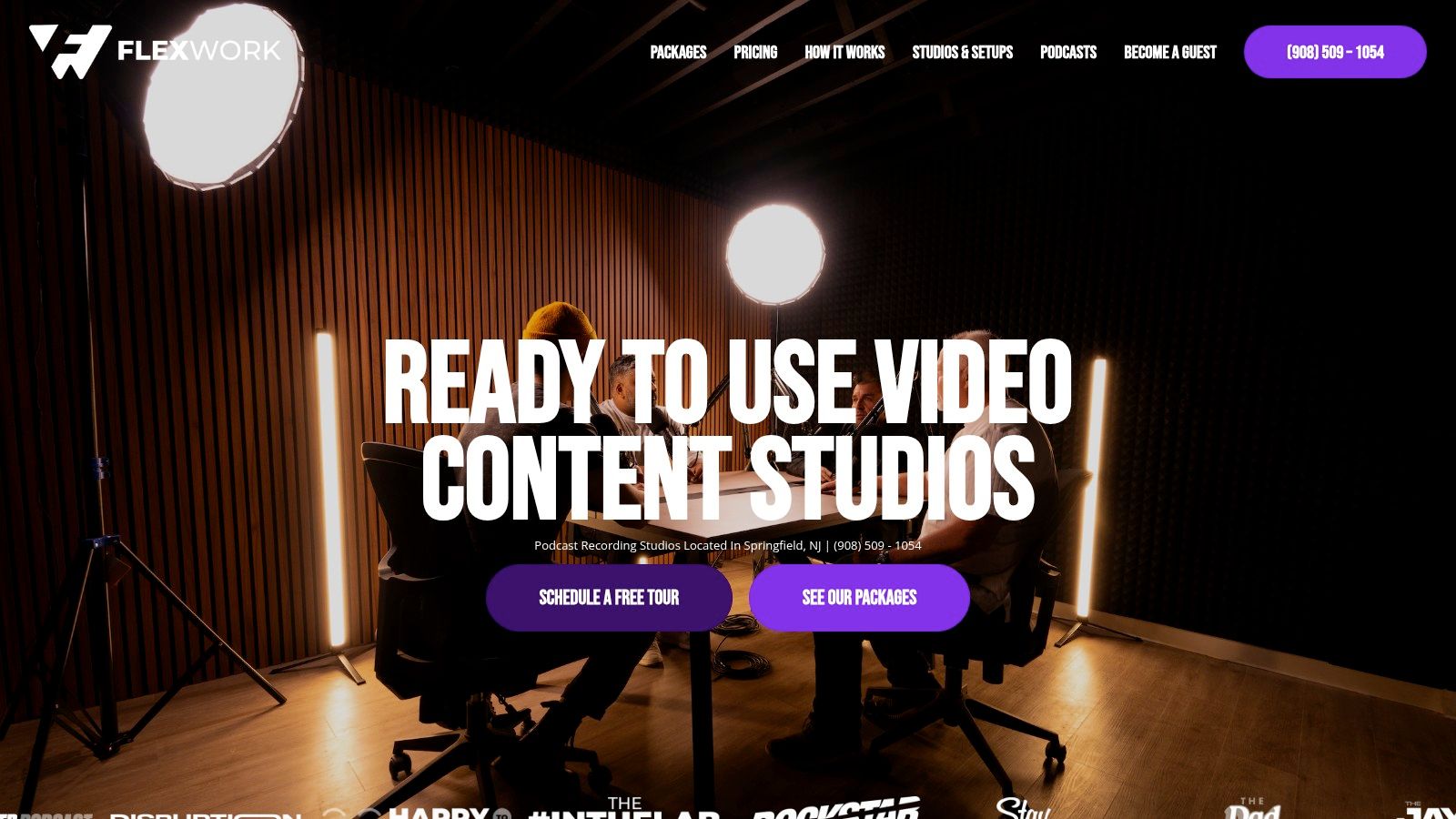
Flexwork Podcast Studios in Springfield, NJ provides acoustically treated podcast and video spaces for creators producing episodes, reels, Shorts, and livestreams. Studio rentals suit creators who want a professional environment while keeping more of the production process in-house. End-to-end producer packages are designed for clients who need editing, motion graphics, show branding, and social-ready deliverables managed as one workflow.
Choose the service level that matches the bottleneck
Content Days cost $3000 per day and include 20 edited reels or 60 professional photos. That structure gives a creator a concentrated production window and a defined set of finished assets rather than an open-ended promise of raw footage.
Hourly rentals make sense when your team already has a script, crew, and editor but needs a dependable set and recording environment. This option removes location uncertainty without requiring a full-service engagement.
The Market, Manage & Produce My Podcast package starts at $1500 per episode with a 20-episode growth commitment. It fits podcasters and thought leaders who want production connected to ongoing audience development rather than treating each episode as an isolated deliverable.
Flexwork also offers podcast websites priced at $5000 plus hosting, giving a show a dedicated home for episodes, clips, guest information, and conversion-focused calls to action. Details on short-form video production can help you compare the available support against your current workflow.
The right choice depends on where work is accumulating. If recording is the issue, rent the studio. If editing is slowing publication, use production support. If the entire content engine needs direction, consider a managed package.
Measurement and Growth Tips for Long-Term Success
Short-form video content can generate strong engagement without producing meaningful business results. Data compiled in 2026 indicates that videos under one minute can hold approximately a 52% engagement rate, while longer videos can earn higher click-through rates, according to Vidico's short-form video statistics.
That distinction changes how creators evaluate performance. Awareness content should earn attention and sharing. Conversion content must move qualified viewers toward a meaningful next step. The format should follow the objective, not the other way around.
Match metrics to the funnel
Retention shows whether the opening and pacing work. Review where viewers leave, then revise the sentence, visual, or edit immediately before that drop.
Shares and saves reveal whether the content has enough utility or relevance to pass between people. A clip that attracts fewer casual views but earns meaningful saves may deserve more investment than a broad but disposable post.
Profile visits and website actions indicate growing interest. Track whether viewers continue into your podcast, services, booking page, or email list.
Clicks and conversions are downstream measures. Longer content may be more effective when the viewer needs context before taking action, so don't judge every clip by reach alone.
Use a monthly review
Audit your top three hooks, identify the format generating the strongest saves and shares, and compare audience behavior across platforms. Keep the editorial voice consistent while changing one variable at a time, such as the opening, visual framing, CTA, or subject.
Metricool's 2025 report analyzed nearly six million videos and found that short-form video posts grew 70% year over year, with the number of accounts using the format also increasing in its broader dataset, as reported by Metricool's State of Short-Form Video report. More creators are publishing, so distinctive positioning and dependable execution matter as much as volume.
Flexwork Podcast Studios offers professional studio rentals, Content Day sessions, podcast production packages, and podcast websites for creators building a dependable short-form video content system. Visit Flexwork Podcast Studios to explore the right production setup, schedule a tour, and turn your next recording session into a library of finished, publish-ready assets.