
How to Book Podcast Guests That Actually Show Up
 July 30, 202625 Minutes
You're staring at a calendar that should be full and a guest inbox that keeps going quiet. The show idea is solid, the episode plan is halfway written, and yet the last few outreach emails vanished into the same void as every other generic pitch. That's the core issue with how to book podcast guests: most hosts treat it like a one-off sales task, when it works better as a production pipeline with clear stages, clean handoffs, and a guest experience that feels polished from first contact to final clip.
For hosts building a show in a real studio setting, that shift matters even more. Flexwork Studios in Springfield, NJ is built around the same reality every producer runs into, a guest is easier to book when the process feels organized, the episode feels worth their time, and the production looks serious before anyone hits record. By the end of this, you'll have a practical system for finding better guests, writing pitches that get read, moving bookings from yes to scheduled, and turning each episode into something both sides want to share.
The Empty Calendar Problem Every Host Recognizes
A lot of podcasters know the feeling. The concept is sharp, the audience is real, and the next guest slot is still blank because four emails went unanswered and the fifth sounded too much like a mass pitch. At that point, most hosts blame effort. The actual problem is structure.
A guest booking process breaks when it's treated like inbox triage instead of a production workflow. The strongest shows don't just “find guests,” they run a repeatable sequence that starts with a targeted shortlist, moves through a tight pitch, and ends with a confirmed recording plan. That's why a polished studio environment matters, because the guest isn't only evaluating the topic, they're evaluating whether the entire experience feels easy.
What usually goes wrong
The same mistakes show up again and again. The host reaches out before they've defined the exact episode angle. The pitch is long, generic, and buried under attachments. Then the follow-up is vague, so the guest either delays or disappears.
The fix isn't sending more emails. It's tightening the system around them. The moment you treat booking as a guest experience, not a begging contest, the whole process gets cleaner. Your calendar stops depending on luck, and your show starts looking like something a serious person would want to join.
If you want a version of that mindset applied to content strategy, Flexwork's perspective on networking through narratives lines up with the same principle, guests respond to clarity, relevance, and professionalism.
Practical rule: If the guest can't tell in 10 seconds why the episode fits them, the pitch is probably too broad.
By the end of this article, you'll have a system that covers sourcing, outreach, scheduling, prep, and promotion, so you can book guests with far less guesswork and a lot more consistency.
Building a Real Guest Shortlist Without Guessing
The easiest way to waste time is to start with a blank spreadsheet and a vague instruction to “find good guests.” A better guest list starts with three sourcing lanes, and each one gives you a different kind of advantage. The goal isn't volume for its own sake, it's building a list of people who are already close to your topic, your audience, or your professional circle.
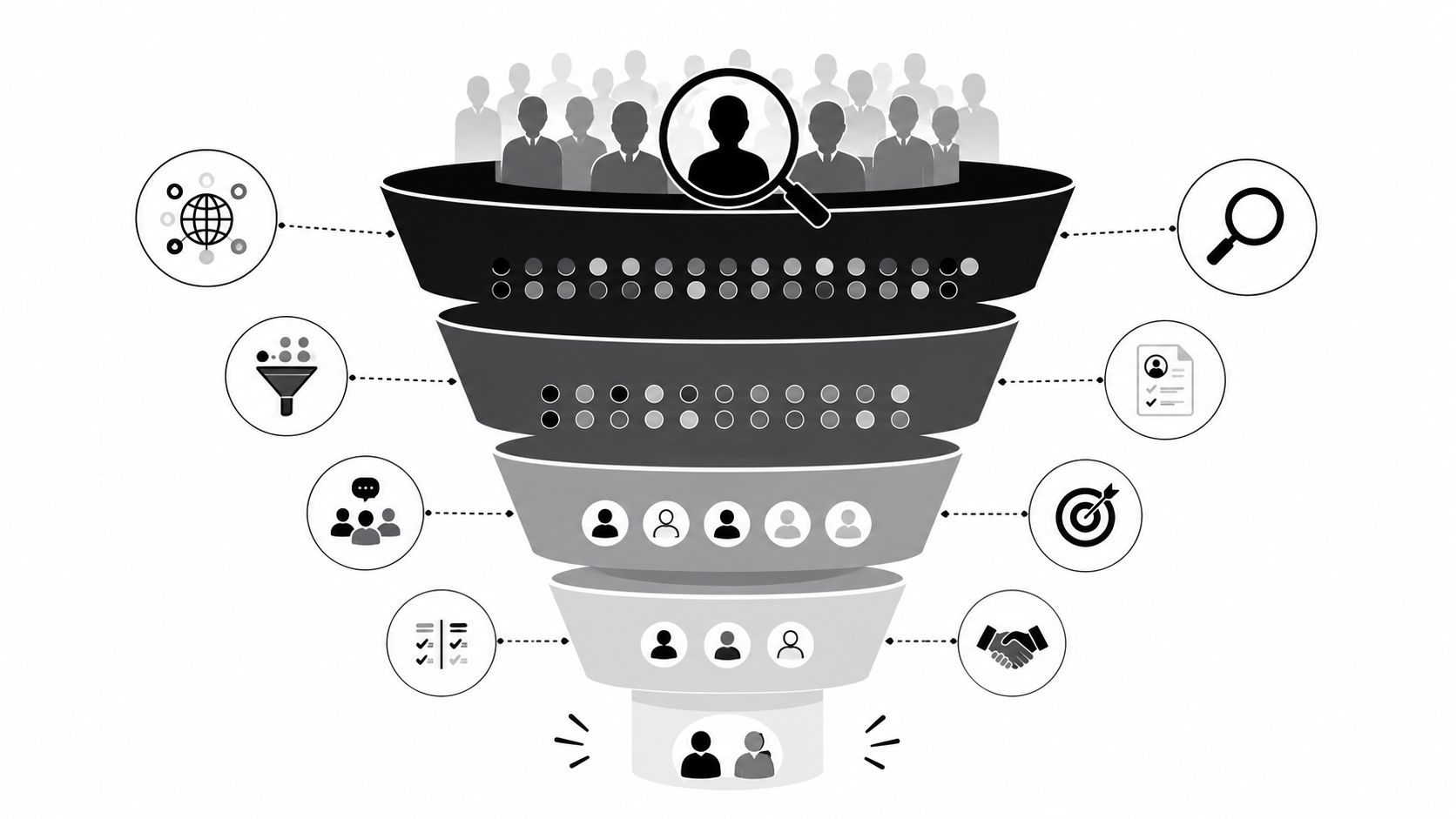
Warm intros should be your first pass. That lines up with the 2026 Buzzsprout finding that 69.7% of hosts discover guests through their personal network, far ahead of social media at 28.4% and cold email pitches at 28.0%. For booking, that means the people closest to your show are often the fastest path to a real reply, because the introduction already carries trust. Buzzsprout's booking survey makes the point plain enough for any producer to use it.
Three places to build your list
- Your own guest graph: Start with former guests, producer peers, clients, and friends of friends. If someone has already said yes to another show, they're far easier to approach again with a sharper angle.
- Fresh builders: Authors, founders, and operators who shipped something recently are often easier to book than big names. They have a current story, they care about visibility, and they usually understand the value of a focused conversation.
- Show-specific communities: Look where your ideal guest already spends time, niche Slack groups, private communities, alumni circles, event speaker lists, and topic-adjacent professional groups. Those spaces are full of people who are already primed for relevant conversations.
A quick qualification check keeps the list usable. Look for recent work, clear audience fit, prior podcast presence, and how fast they communicate. You do not need a perfect score on all four, but you do need enough overlap to justify the outreach.
Shortlist test: If a prospect hasn't done anything newsworthy lately, isn't a fit for your audience, and takes forever to reply, they don't belong in the first 15 names.
That's how you get from blank sheet to a real list in an afternoon. Ten to 15 qualified prospects is enough to move from “we should book guests” to “we're ready to pitch this week.” For hosts who want a more structured approach to guest discovery and qualification, that's also where a studio-backed process becomes useful, because the outreach is easier when the positioning is already clean.
Writing a Pitch That Earns a Reply
A guest usually decides in the first few lines whether your email gets a reply or gets ignored. The pitch fails when it asks for too much work from the recipient, or when the show sounds vague enough that the guest cannot tell why they were chosen. The strongest outreach stays short, specific, and easy to scan. Keep it under 150 words and skip attachments, because extra files make the message feel heavier than it needs to be. Convokast's founder playbook makes that point clearly.
The order matters, but the primary job is reducing friction. A pitch that feels prepared on the production side gives the guest confidence that the conversation will be worth their time.
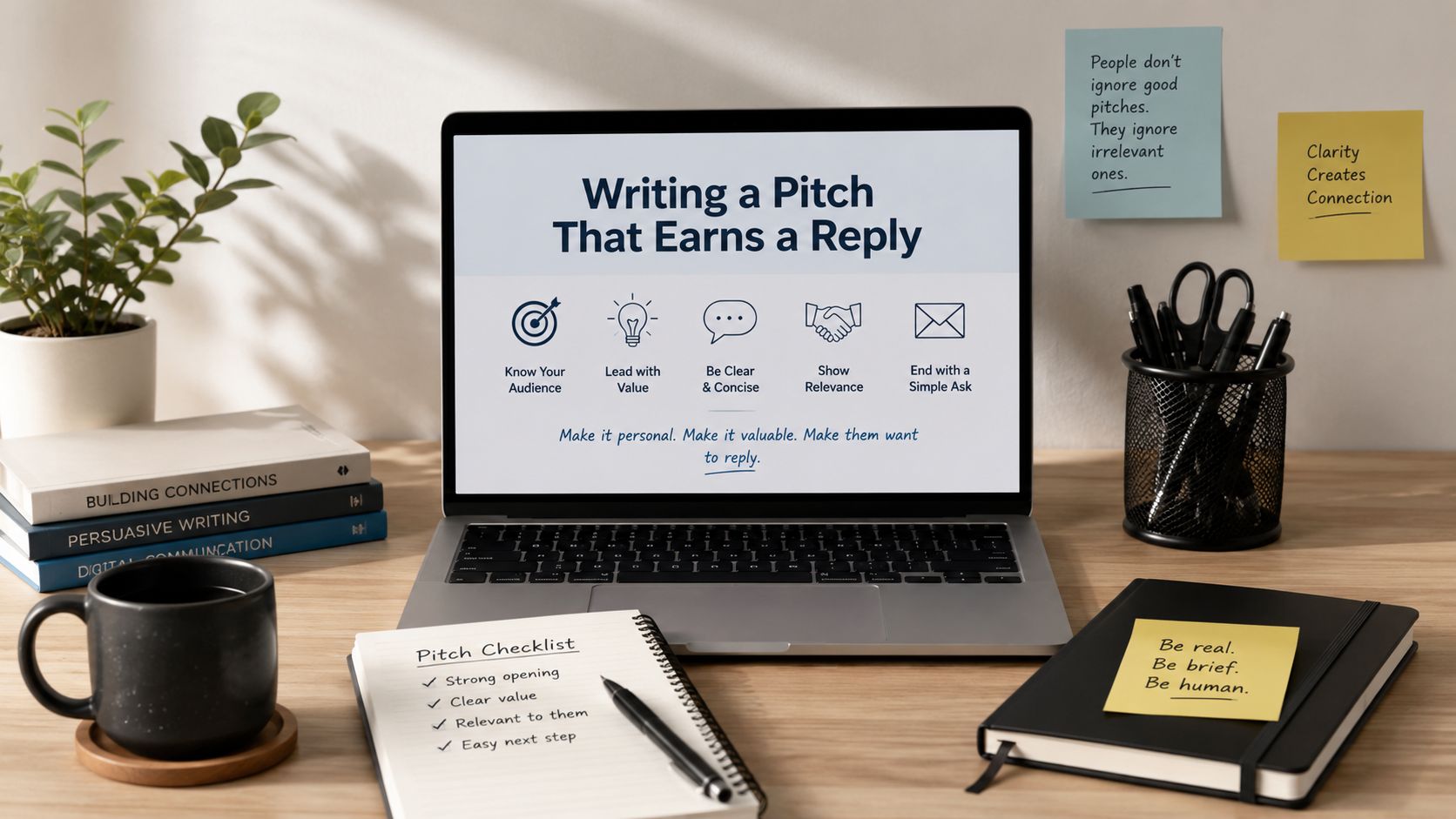
Open with something real. Mention a recent article, launch, keynote, product, or podcast appearance so the email does not read like a blast sent to a mailing list. Then state who the show serves in one clean sentence. The guest should be able to tell, fast, whether your audience overlaps with their expertise.
From there, give one episode idea, not a menu. A single angle is easier to assess than three loose options, and 2 to 3 talking points are usually enough for the guest to picture the conversation without doing the framing work for you. The ask should stay low-friction, too. Ask for a conversation, name the time commitment in plain language, and make the next step obvious so they can respond without opening your whole show archive first.
A weak pitch does the opposite. It starts with your bio, hides the actual topic, and makes the guest sort out what the episode would even be about. That reads like a form letter, and form letters get archived. Rachel Corbett's guidance follows the same logic, with a personal opening, a clear value exchange, a concise summary, proof points, and a direct call to action, because those elements make the email feel human instead of transactional. Rachel Corbett's guest booking guide is worth reading if you want to tighten the wording.
A tool can help, but only if the message still sounds like a person wrote it. PodSeeker's booking tools report found that AI-personalized templates converted better than fully manual pitches, which suggests the tool is useful when it supports the pitch instead of replacing it. The same report also tracked confirmed bookings and a median response rate across users sending 10+ pitches, a reminder that booking is measurable work, not guesswork. PodSeeker's booking tools report backs that up.
Keep the first email short enough that a busy guest can decide inside one sitting. If they need to save it for later, the momentum is already gone.
A quick checklist keeps the pitch honest before you hit send. Does the opening reference something real? Is the audience clear? Is there one episode idea, not five? Did you remove attachments? Did you make the next step obvious? If the answer is yes across the board, the pitch is ready.
Flexwork's branding guidance fits here because a show with a clear brand makes the pitch easier to understand at a glance. When the guest can grasp the tone and purpose quickly, the email carries more weight.
Running the Pipeline From Yes to Scheduled
A booked guest is not the finish line. It is the handoff into production, and that is where sloppy shows start to leak time. A yes buried in email is not enough, because the guest still needs a clean tracker, a clear confirmation flow, and a schedule that keeps both sides aligned.
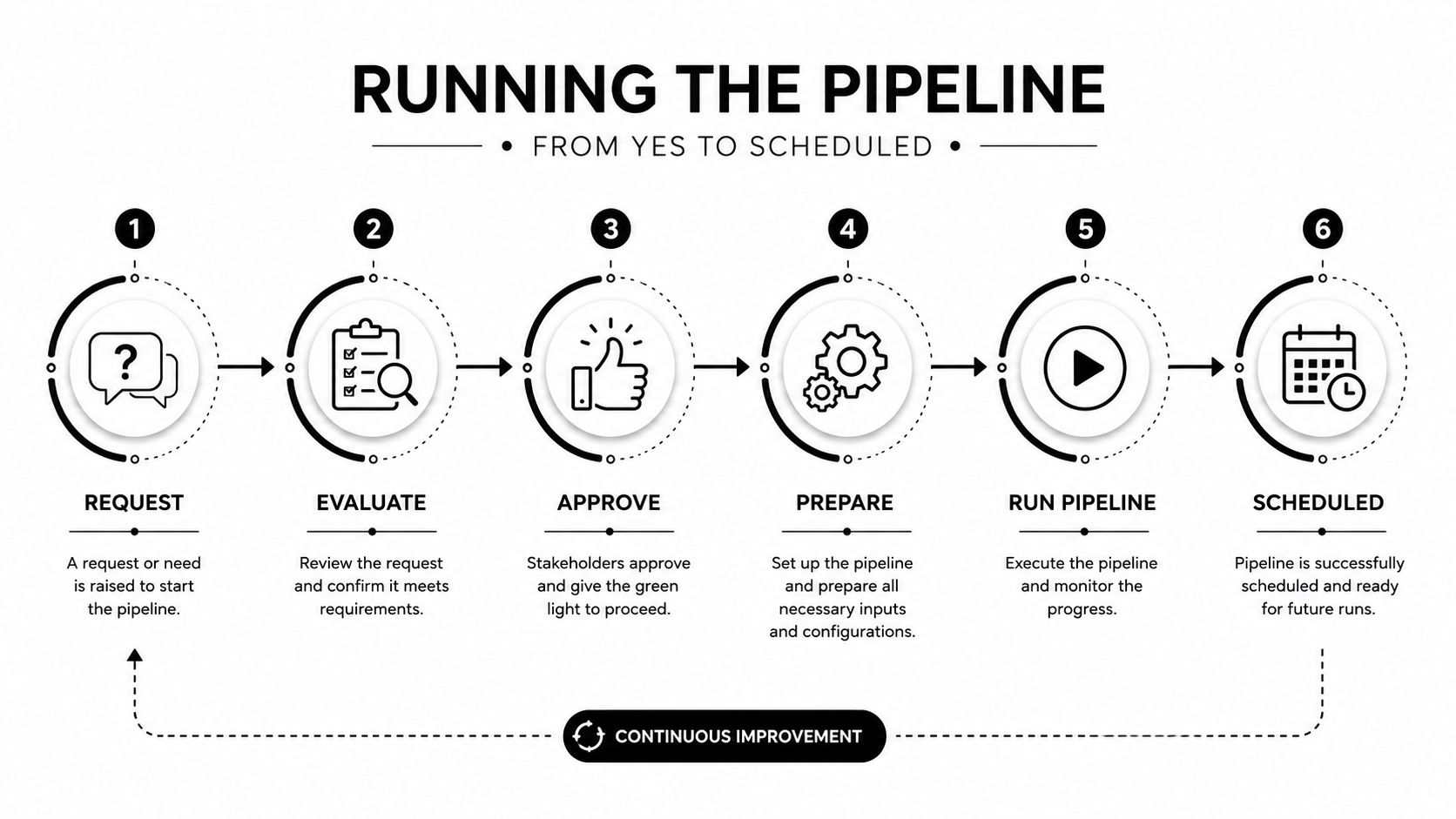
The cleanest way to run it is to treat every guest like a ticket moving through a pipeline. Identified, contacted, confirmed, scheduled, recorded, published. Each status needs one owner and one next action, or the handoff gets muddy fast.
A confirmation email should do more than say thanks. It should lock in the topic and angle, the time with timezone, the expected duration, the recording platform, and any setup notes that matter, like a quiet room or a microphone check. That message is part of the production handoff, so it should read like something a producer would send, not a casual reply.
The part that keeps the calendar from slipping is the reminder before recording. A note sent 24 to 48 hours before recording keeps the appointment visible without spamming the guest. PodRewind's guest booking workflow shows that immediate confirmation after a yes keeps the guest from floating in limbo, and that same workflow treats the reminder as a normal production step. PodRewind's guest booking workflow makes that sequencing clear.
Operational rule: Every yes should leave behind a paper trail, even if that trail is just a clean confirmation email and one calendar invite.
The next step is to send the guest packet in one pass. Angle, logistics, and prep instructions belong in the same email so nobody has to stitch together three different messages later. That keeps reschedules down, and it signals that the show has a real process behind it instead of a loose favor.
The guest prep side matters just as much as the scheduling side. Flexwork's detailed podcast interview preparation guide fits here because a stronger prep system makes it easier to keep the guest calm, keep the calendar intact, and keep the recording day from turning into cleanup work.
Tech, Legal, and the Pre-Recording Checklist
A guest can be eager to join and still throw off the recording if the technical setup or paperwork is loose. Booking is not only about getting a yes, it is also about protecting the session from avoidable problems. A studio-minded host catches those issues before the guest ever says hello, because fixing them after the fact usually means lost time and a messy edit.
Start with the tech, because that is where bad sessions usually show up first. Send a tested recording link ahead of time, and spell out how the guest can do a quick audio and video check before the call starts. If you skip that step, you find out on the clock that the guest's browser, camera, or mic setup is not working, and everybody pays for the mistake.
Paperwork comes next. A signed appearance release or guest agreement should already be in a shared folder before the mics go hot. That keeps the production clean and prevents the awkward scramble after recording, when the guest is ready to move on and the host still needs to sort out permissions.
The conversation itself needs boundaries too. A short pre-show call or a written exchange should lock in the angle and surface any off-limits topics before recording starts. You do not need a script. You need the same expectations on both sides.
A better checklist also makes the booking pitch stronger. In a physical studio, acoustically treated rooms, cinema-grade visuals, and on-site producer support solve a lot of the friction that remote setups create, especially for guests who care about how they will look and sound on camera. Flexwork's audio quality guidance is a useful reference here, because audio quality is not just a technical detail, it affects how professional the guest feels during the session and how usable the final cut is later. That matters on clip-heavy shows, and it matters even more for hosts planning Content Day sessions at $3,000 per day, which include 20 edited reels or 60 pro photos. It is also where a browse content repurposing tool can fit into the workflow, since the recording should feed clips and photos without creating extra cleanup work for the host.
A clean pre-recording checklist works best as a quick handoff, not a long rules document.
- Test the link early: Confirm the guest can open the platform and run a quick audio and video check.
- Store the release first: Keep the signed agreement accessible before the session begins.
- Confirm the angle: Make sure both sides agree on the conversation direction and any sensitive topics.
- Verify the environment: Quiet room, working mic, stable internet, and no last-minute surprises.
That level of preparation does more than prevent tech issues. It tells the guest they are in good hands, which lowers anxiety and makes the conversation better. For a show that needs to feel premium, the prep work is part of the guest experience, not just backend admin.
Coordinating Promotion Before the Mic Cools
A guest episode should never be treated like a file you publish and hope for the best. Promotion starts at booking, because the guest's willingness to share is easier to shape before the recording than after the episode is already live. If you want the interview to reach beyond your own audience, the launch plan has to be part of the booking plan.
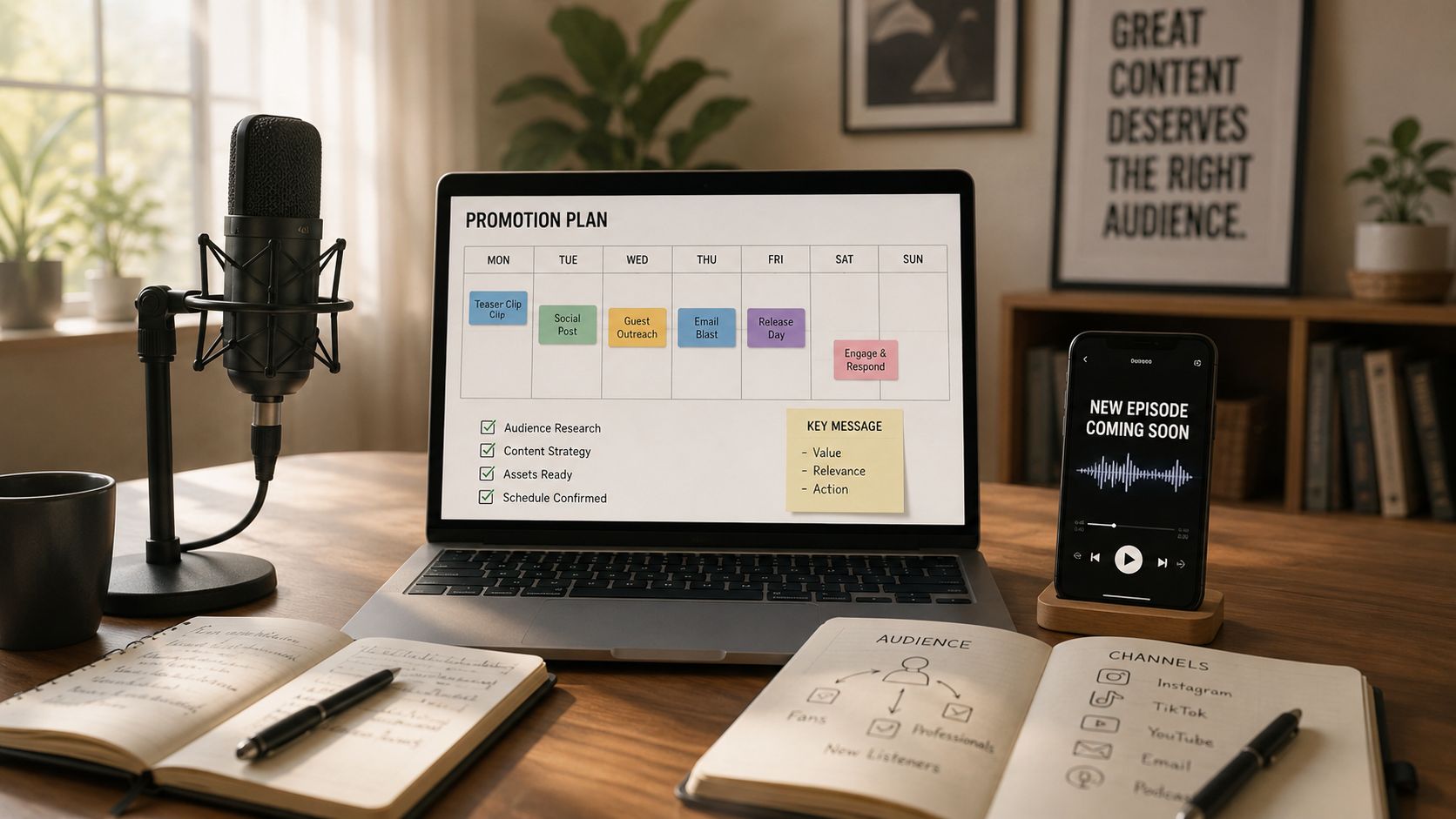
The first touchpoint is the release date. Both sides should know when the episode is going live and whether the guest is expected to post the same day. The second is clip rights, because if you're making short-form content from the conversation, that needs to be agreed on before editing begins.
The third is the promo kit. Quote cards, audiograms, and a short set of captions make it far easier for the guest to share without inventing their own assets. The fourth is the tag-and-cross-promote plan for the first 72 hours, which gives the episode a cleaner push across both accounts instead of a burst of random posting.
Promotion rule: If you wait until publishing day to talk about distribution, you're already late.
That's where production partners become operationally valuable. Flexwork's Market, Manage & Produce My Podcast package starts at $1,500 per episode with a 20-episode growth commitment, and the podcast websites offer is $5,000 plus hosting. Those services matter because a single guest episode shouldn't live as a one-off upload, it should feed your audience growth, your site, and your clips. Flexwork's repurposing framework also helps if you're trying to turn one recording into several distribution assets.
For teams that need a faster workflow between publish and promotion, a tool like browse content repurposing tool can help map clips and derivative assets without losing track of the original episode. The point isn't automation for its own sake. It's making sure the guest appearance keeps working after the microphones are off.
Booking Great Guests Before You Have the Numbers
The hardest version of this problem shows up when the show is new and the download count isn't doing any convincing for you. That's not a dead end. It's a chance to lean on what you can control, production polish, a sharp niche, a fast turnaround, and a guest experience that feels more professional than the size of your audience would suggest.
The hosts who book well without big numbers usually stop chasing celebrities and start targeting rising experts. Founders who shipped something in the last 90 days, authors on a book tour, and operators with a credible personal brand but limited podcast experience are often better fits anyway. They care about relevance, they value respect for their time, and they're more likely to respond to a pitch that feels specific instead of inflated.
A studio-backed host has an edge here because the value exchange is more concrete. The guest gets a cleaner recording, a stronger visual setup, and a smoother path to clips and social content. If you're trying to grow that external visibility alongside the show itself, resources like grow faster on X can help frame how the episode should support your broader distribution strategy.
Flexwork also shortens the cold-outreach grind by pairing a curated guest network with flexible workspace and event areas that make in-person sessions easier to coordinate. That combination is useful when you want the booking process to feel premium from the first message to the last clip.
If you're serious about making booking feel less chaotic and more like a repeatable production system, book a studio tour, look at the production packages, and see how Flexwork Podcast Studios can support your next guest episode from pitch to publish. Visit Flexwork Podcast Studios to explore the studio, the packages, and the kind of setup that makes great guests easier to book.