Best Video Production Company Raleigh: 2026 Hiring Guide
 June 2, 202620 Minutes
Meta title: Best Video Production Company Raleigh
Meta description: Choosing a video production company in Raleigh? Learn what local crews do well, where they fall short, and when a studio-first model wins.
URL slug: /video-production-company-raleigh
If you're searching for a video production company in Raleigh, most advice will push you toward the same playbook. Find a local crew, review the reel, request a quote, book a shoot day, and hope the final edit matches what you had in mind. That advice is incomplete.
Raleigh is a serious production market. It sits in the Research Triangle, with steady demand from universities, technology companies, and corporate buyers that regularly commission branded video, training content, and livestream work, which is one reason the local vendor ecosystem is so mature according to this Raleigh market overview. But a crowded market doesn't automatically give creators the best system for ongoing content.
That's the core concern. Ambitious creators don't just need one polished video. They need repeatable output, clean workflows, predictable budgeting, and content that keeps shipping. The question isn't only who to hire in Raleigh. It's whether the traditional local production model still fits the way modern content gets made.
The Search for a Raleigh Video Production Partner
Start with a harder question than "Who's nearby?" Ask which production model will keep your content publishing month after month.
Raleigh has plenty of capable video vendors. That is not the problem. The problem is that local proximity gets overrated, especially by founders, marketers, and creators who need repeatable content, not a one-off shoot and a long email thread about revisions.
A Raleigh search still has real value. Local crews are useful when the location itself carries the story, your team needs hands-on direction in person, or you need field production with fast coordination. Raleigh also has a mature bench of providers and institutional production teams, including operations such as NC State's WolfBytes, and the broader local vendor ecosystem is well documented in this Raleigh market overview.
What a local search gets right
Hire a local crew if your footage must happen on site.
That usually means:
- Office, campus, retail, or event coverage where the setting is part of the message
- In-person interviews with executives, employees, customers, or community partners who need live coaching on camera
- Regional campaigns that depend on Raleigh context, recognizable locations, or local access
That is the strong case for local production. It is specific, practical, and tied to footage you cannot fake from a studio.
If you're comparing Raleigh vendors, check how they present themselves before you ever book a call. Local search visibility often reflects how organized the company is, how clearly it defines services, and whether it takes buyer intake seriously. For a useful refresher on evaluating listings, reviews, and business profiles, read AI Tools for Local SEO's GMB guide.
Where the search often goes wrong
Plenty of buyers confuse convenience with fit.
A nearby team can still be the wrong partner if every shoot requires a fresh setup, every asset is scoped as a separate project, and every edit round turns into a budget conversation. That model works for commercials, event recaps, and brand films. It works poorly for recurring podcasts, weekly thought leadership clips, founder interviews, and social series.
Use a simple filter. If your goal is a flagship brand piece, local production can be the smart call. If your goal is volume, consistency, and a cleaner publishing system, stop treating geography as the main criteria.
The better option for ongoing creator content is often a controlled studio workflow built for repetition. A fixed environment gives you more visual consistency, tighter scheduling, cleaner audio, and fewer production variables to troubleshoot. That's why many serious teams get better results from a professional video studio rental option than from hiring a different local crew every time they need another batch of content.
Why Traditional Production Models Fall Short for Creators
The old model is built for campaigns. Most creators need a publishing engine.
That mismatch explains why so many entrepreneurs feel disappointed after hiring a video team. They wanted momentum. They got one hero asset, a long turnaround, and a post-production process that felt bolted on rather than planned from the start.

The traditional model solves the wrong problem
A lot of production companies still operate like every project is a standalone event. That approach breaks down fast when you need weekly output.
One Raleigh-focused source puts it plainly. A common pitfall is treating production as a one-step service, while a better-performing model includes scripting, batching multiple assets in one shoot, and defining revision limits up front, according to this breakdown of Raleigh video workflows. That's not a small process tweak. That's the difference between content that scales and content that stalls.
Here's where traditional setups usually frustrate creators:
- Single-project pricing: You pay for one shoot, then discover the actual need is a library of assets
- Location friction: Booking, travel, setup, lighting adjustments, and reshoots eat time before the camera even helps you
- Strategy gap: The crew captures footage, but nobody owns how that footage becomes clips, episodes, trailers, and platform-specific edits
Creators need output, not production theater
A creator doesn't win by saying, “We had a great shoot.” A creator wins by publishing on schedule.
That's why the most useful question isn't whether a company can shoot. Almost any competent crew can do that. The critical question is whether they can support a repeatable workflow that turns one session into many pieces of content. If you're trying to think through that shift in an ad context, this article on scaling video ads with AI is a useful companion because it pushes the same operational point from the paid-media side.
Great production without a batching system is still inefficient.
If your current process depends on rebuilding the setup every time, you're not running a content machine. You're renting moments. That's why more creators are moving toward controlled studio environments like in-house studio production systems that reduce variables and keep quality stable from one recording to the next.
The Studio-First Alternative A Modern Production Workflow
Stop treating geography as the main decision. For recurring content, the better question is which production model gives you consistent output without rebuilding the process every time.
A local Raleigh crew can still be the right call for commercials, event coverage, customer stories on location, or any shoot that depends on a real place. But if you are producing a podcast, interview series, social clips, or founder content every month, a studio-first system usually wins on speed, consistency, and asset volume.
Why a studio-first workflow works better
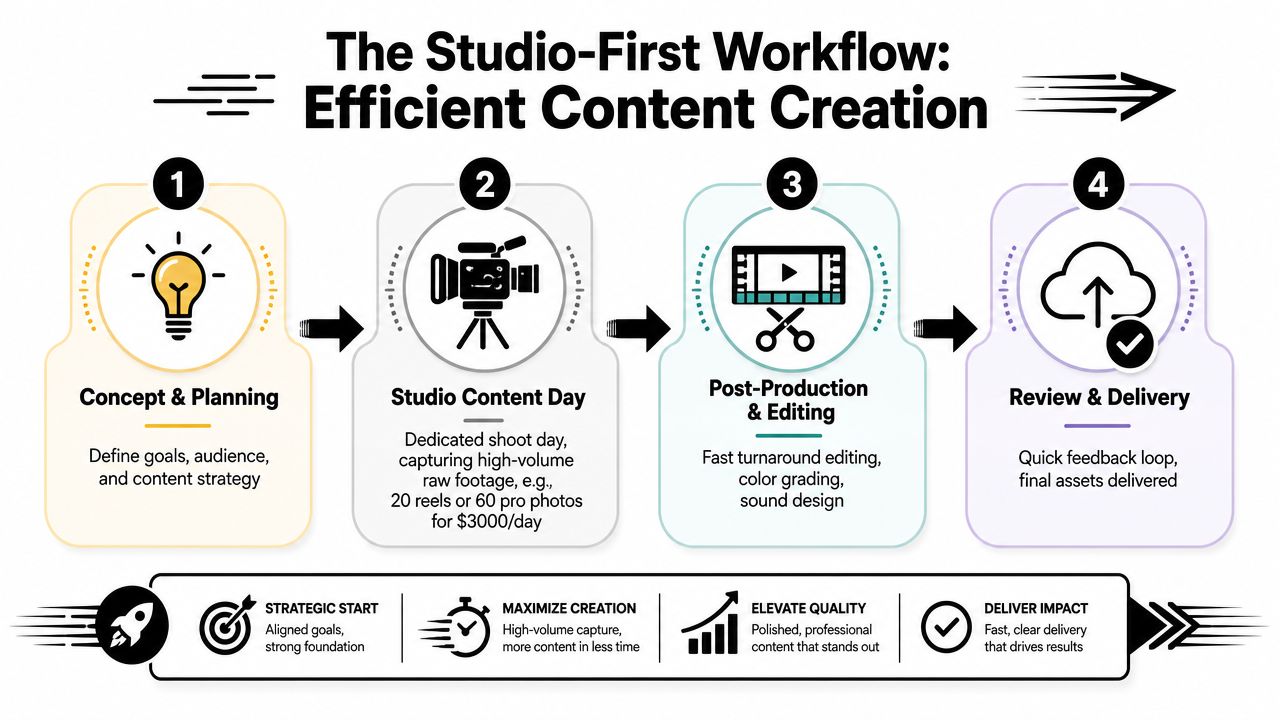
Controlled production removes avoidable variables. Audio stays clean. Lighting stays consistent. Framing matches from one session to the next. Your editor works from a predictable setup instead of fixing a different set of problems on every shoot.
That matters for content formats that depend on repetition, not novelty:
- Video podcasts
- Recurring interview shows
- Short-form social clips
- Thought leadership series
- Evergreen educational content
These formats need a repeatable environment and a team that knows how to turn one recording block into a backlog of usable assets.
A local production company often sells the shoot day. A modern studio model should sell the workflow.
Judge your production partner by output per session, not by how polished the shoot day feels.
What this looks like in practice
At Flexwork, a Content Day packages capture into one concentrated studio session built for batching. The offer is positioned around a deliverable-heavy format, including edited reels or professional photo assets, which makes more sense for an active brand than booking isolated project shoots over and over.
For creators who want more than recording help, Flexwork also offers a managed podcast production model. Flexwork's Market, Manage & Produce My Podcast service starts at $1500 per episode with a 20-episode growth commitment. That is not a generic market rate. It is a studio-led service model for creators who want editing, branding, publishing support, and growth structure tied together.
That is the real fork in the road. Hire local when the story requires Raleigh. Choose a studio-first partner when the goal is a reliable content engine.
If you are comparing pro production against doing it yourself, this breakdown of what you gain by going pro instead of DIY podcasting gives a clear view of the tradeoffs.
Your Pre-Production Checklist Before Hiring Anyone
Most budget problems start before the quote. They start when the buyer doesn't know what they're asking for.
If you contact a Raleigh video team without a clear deliverables list, timeline, content goal, and distribution plan, the quote won't be wrong. It'll be vague. And vague quotes become expensive projects.
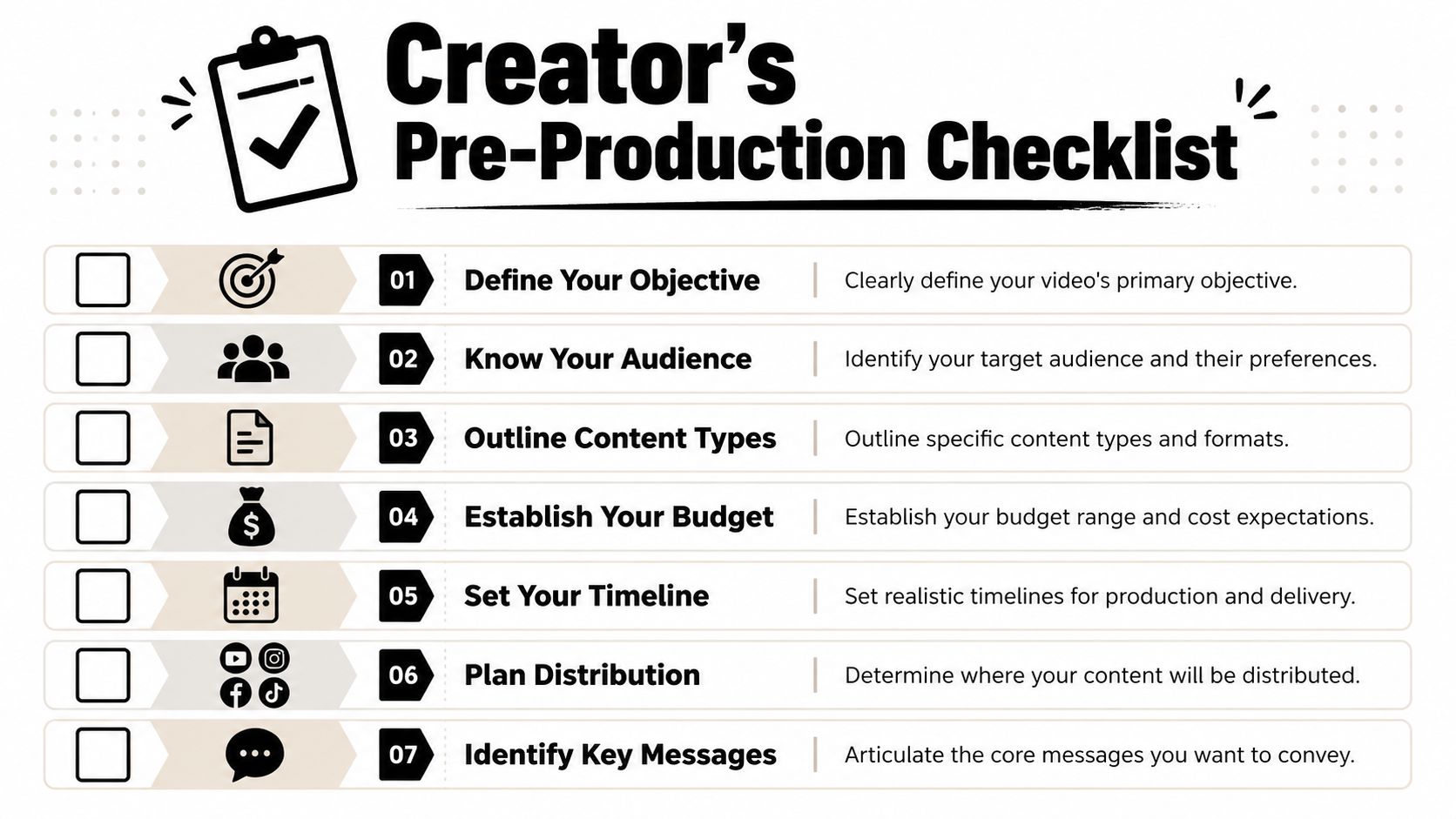
Lock the deliverables first
One of the most useful Raleigh pricing benchmarks comes from a local market guide. It pegs $500 to $2,000 for a basic social media video, $2,000 to $5,000 for a small-business promo, and $5,000 to $20,000+ for a commercial campaign. The same guide notes that a lean half-day, single-camera shoot is typically $1,600 to $1,900, and stresses that deliverable count, crew size, gear, and edit complexity drive the quote, as explained in this Raleigh video pricing guide.
That means your first job is simple. Define what needs to exist when the project is done.
Use this checklist:
- Name the primary asset. Is this a podcast episode, a founder brand video, a customer story, or a social campaign?
- List the cutdowns. Decide what gets repurposed from the main recording.
- Choose the visual style. Clean studio look, conversational interview, direct-to-camera teaching, or cinematic promo.
- Set the approval chain. Too many reviewers will slow the edit more than any camera issue.
- Plan where the content lives. Website, YouTube, LinkedIn, Instagram, paid ads, internal training, or all of the above.
Budget for the workflow, not just the shoot
A lot of buyers compare day rates and forget post-production. That's where projects drift.
Ask yourself:
- Editing depth: Do you need simple cuts or polished branded edits?
- Graphics needs: Lower thirds, titles, intro sequences, or motion design?
- Revision limits: How many rounds are realistic before the timeline slips?
- Distribution support: Will someone prepare exports for different platforms?
If you can't explain the final asset package in one paragraph, you're not ready to request a clean quote.
And if your current setup is inconsistent, it helps to understand the recording fundamentals before you book. Even a basic grounding in lighting choices for video recording will make your conversations with any production partner sharper and more productive.
Critical Questions to Ask Any Video Production Partner
Don't ask generic questions. Generic questions produce polished, meaningless answers.
Ask the kind of questions that expose how a team thinks when things get complicated. That's how you separate a vendor who can shoot from a partner who can support a content operation.
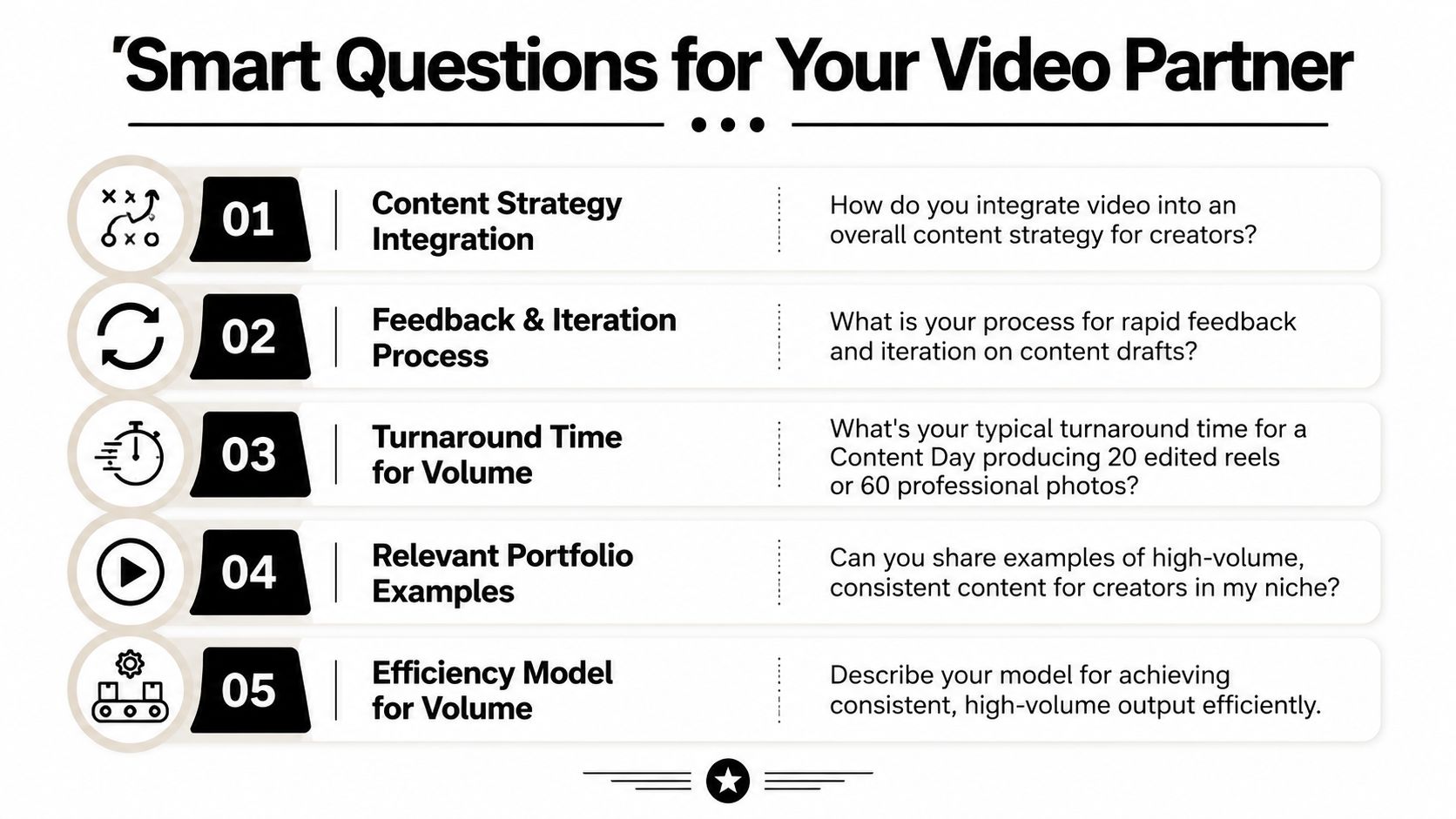
Ask about process before aesthetics
A beautiful reel only proves they've made good-looking work. It doesn't prove they can make your workflow easier.
Start with these:
- How do you scope revisions? If the answer is fuzzy, the budget will get fuzzy too.
- How do you batch content in one session? You want to hear a real system, not improvisation.
- Can you show me a project that became multiple assets? One long-form recording should lead to clips, cutdowns, and supporting media.
- Who owns scripting and pre-production? If no one does, the client ends up doing unpaid producer work.
- What happens after delivery? Posting specs, format versions, and file organization matter more than most buyers realize.
Ask how pricing expands with scope
Many Raleigh buyers are often surprised by project costs. Public directory listings show an average project range of $10,000 to $49,000, but those pages rarely explain how scope changes the budget. The primary cost driver is usually the full workflow from pre-production through post-production and deliverables, according to Clutch's Raleigh video production listings.
That's why this question matters: “What exactly turns this from one quote into a bigger quote?”
You want a detailed answer that covers things like additional edits, expanded asset libraries, motion graphics, creative development, and delivery versions.
The best partners make complexity legible. The weak ones hide it behind custom pricing language.
A serious partner should also be able to explain turnaround logic, not just promise speed. If they can't describe how they move from planning to recording to approvals to final exports, they probably don't have a reliable system.
Elevate Your Content Beyond the Local Scene
Hiring local isn't automatically smart. It's just familiar.
For some projects, Raleigh crews are the right move. If you need event footage, office b-roll, or location-based storytelling, local production still makes sense. But for podcasts, recurring interviews, social cutdowns, and creator-led content systems, the smarter move is often the one with fewer variables and tighter execution.
That's the shift more creators need to make. Stop asking who is nearest. Start asking which production model will support your publishing cadence, your brand standards, and your sanity.
A studio-first workflow gives you consistency that one-off vendor relationships usually can't. It also aligns better with how content performs now. Video is no longer just a launch asset. It's part of search visibility, brand discovery, and ongoing audience development. If you want a broader view of that shift, OneNine's 2026 SEO video marketing guide is a useful read.
The best content operators think like media companies. They care about systems, not just shoots. They care about pipelines, not just project decks. And they build for reuse, not reinvention.
If that's where you're headed, start with the model, not the zip code. A strong video content marketing strategy will do more for your growth than another round of vendor shopping ever will.
If you want a cleaner, more scalable way to produce podcasts, short-form video, and branded content, explore Flexwork Podcast Studios. You can book a studio session, review production options, or schedule a tour and see what a turnkey workflow looks like when it's built for serious creators.