
Podcast Hosting Jobs: Skills & Gigs for 2026
 June 1, 202626 Minutes
Meta title: Podcast Hosting Jobs Skills and Gigs for 2026
Meta description: Learn how to land podcast hosting jobs with a pro demo, hybrid skills, and a premium career strategy built for serious creators.
URL slug: /podcast-hosting-jobs
If you're reading this, you're probably already doing the thing half-right. You have the voice, the taste, the point of view, maybe even a few recordings on your laptop. But the gap between “I could host a show” and “someone will pay me to host one” is wider than commonly assumed. Raw charisma helps. It doesn't close the deal on its own.
That gap usually comes down to professionalism. Not fake polish. Real readiness. The people who get traction in podcast hosting jobs don't just sound good. They show that they can carry a show, support production, represent a brand, and deliver consistent work under pressure. If you want to turn your talent into paid opportunities, treat this like media, not a hobby. And if you're building that path in the NJ and NY orbit, that standard matters even more because the market is crowded with smart, ambitious creators.
The Professional Mindset for Podcast Hosting
A lot of bad advice starts with “just start talking.”
That's fine if your goal is self-expression. It's weak advice if your goal is paid work. Podcast hosting jobs reward reliability, clarity, and repeatability. Employers, producers, and brands aren't hiring a vague personality. They're hiring someone who can show up prepared, carry tone, make guests comfortable, keep a conversation moving, and protect the quality of the final product.
Revelio Labs reports that about one-third of podcast hosts have another primary occupation, while roughly two-thirds list podcasting as their primary job in its analysis of the podcast labor market, which signals that hosting has moved beyond hobby status into a serious career track and side-hustle lane alike. The same review also notes that side-hustle podcasters often come from creative fields such as writing, content, and production, which tells you something important about the job itself: it rewards broader media instincts, not just a pleasant voice. You can read that in Revelio Labs' look at podcasters as workers.
Stop thinking like talent only
The amateur mindset says, “I need a mic and a topic.”
The professional mindset says, “I need a format, audience fit, prep discipline, and a point of view that holds up over time.”
That shift changes how you work:
- You prepare before you perform. Strong hosts don't wing every intro and hope charm saves them.
- You build a point of view. Bland neutrality doesn't travel. Distinct taste does.
- You respect audience time. Tight conversations beat rambling authenticity.
- You think in episodes, not moods. A career needs systems.
Practical rule: If your process depends on feeling inspired, you're not ready for paid hosting work.
There's also a branding layer people ignore. If your on-mic identity is fuzzy, your opportunities will be too. A host needs to know what they stand for, how they sound, and what kind of audience they can hold. That's why personal brand work isn't vanity. It's positioning. If you need to sharpen that foundation, this guide on branding your business is useful because hosting careers rise faster when the person behind the mic feels clearly defined.
Professional media has a different standard
You can hear the difference between hobby content and professional media within seconds. The pacing is cleaner. The intro doesn't wander. The host sounds prepared without sounding stiff. Questions open doors instead of killing momentum. Segments feel intentional.
Here's the blunt version. Employers don't want to bet on “potential” when they can hire someone who already behaves like a working host.
A professional host usually does three things well:
| Standard | Amateur approach | Professional approach |
|---|---|---|
| Preparation | Talks until a thought appears | Builds a run-of-show |
| Delivery | Relies on personality alone | Uses tone, pacing, and structure |
| Responsibility | Waits for others to solve problems | Anticipates issues before recording |
If you want podcast hosting jobs, stop asking whether you're “good enough” yet. Ask whether your work habits match the level of opportunity you want. That's the actual dividing line.
Your Demo Is Your Audition So Make It Unforgettable
Your demo decides whether people take you seriously. Not your intentions. Not your notes app full of show ideas. Not your friends saying you have a great voice.
A weak demo kills momentum fast. Poor room sound, uneven levels, awkward framing, and vague hosting choices all send the same message: this person isn't ready. You might be smart, funny, insightful, and completely unhireable if your sample feels homemade in the wrong way.
That doesn't mean your demo needs to be overproduced. It needs to feel deliberate. Employers want evidence that you can carry a segment, shape a conversation, and hold audience attention with confidence.

What a strong demo actually proves
Think of your demo as a compressed argument for why you belong in the room. It should prove range without sounding scattered.
A sharp hosting demo usually shows a few specific things:
- Opening control. Can you start with authority and give listeners a reason to stay?
- Interview intelligence. Can you ask questions that move a guest somewhere interesting?
- Pacing. Can you keep momentum without sounding rushed?
- Brand fit. Can someone imagine you hosting for a business, network, or niche show?
A demo should sound like the first minute of a real opportunity, not a class assignment.
Most aspiring hosts sabotage themselves by recording something generic. They introduce themselves, speak vaguely about topics they love, and call it a reel. That's not enough. Your demo needs shape. It needs a host read, a sample transition, maybe a short guest exchange, and an ending that lands cleanly.
DIY is fine for practice, not for positioning
Record rough drafts at home if you want. That's smart. Use them to test ideas, hear your habits, and refine your cadence.
But don't confuse practice material with career material.
If you're pursuing premium-facing work, your demo should look and sound like you already understand production standards. That's where a real studio setup changes the game. Flexwork Podcast Studios offers acoustically treated rooms, podcast recording setups, and production support that can help you capture a demo that feels ready for clients, networks, and branded content teams. If you're still shaping your voice before you book time, this podcast script guide is a practical starting point because strong demos begin with tight writing, not gear shopping.
Two smart ways to build your first serious demo
You don't need to overcomplicate this. You need to choose a lane and execute it well.
Option one is an hourly studio session. This works if you already know your format and just need clean capture. Come in with a script, segment plan, and clear hosting angle. Record multiple takes. Leave with material you can use.
Option two is a full content day. This is the move if you're not only building a demo but also launching yourself as a visible media personality. A Content Day is $3000/day and includes 20 edited reels or 60 pro photos, which gives you more than an audition asset. It gives you launch content for your social channels, site, and outreach kit.
That second route is stronger than commonly understood. Hiring decisions don't happen in a vacuum. People check your clips, your visual identity, your consistency, and whether you seem like someone who can carry an audience beyond a single file attachment.
Build the demo package, not just the demo file
A polished sample alone isn't enough. Pair it with supporting assets that make it easy for someone to hire you.
Use this checklist:
- A featured clip that shows your strongest hosting style
- A short written bio with a clear niche and tone
- One or two stills that look current and intentional
- Social proof of consistency, even if that's just a clean profile with thoughtful clips
- A simple home for your work, whether that's a portfolio page or personal site
The host who gets the callback is often the one who made the decision easy.
Beyond the Mic The Hybrid Skills You Really Need
Here's the part most articles miss. A lot of podcast hosting jobs aren't really hosting jobs in the pure sense. They're hybrid roles. Employers may say “host,” but what they often mean is “host who can also help us make this whole thing run.”
That distinction matters because it changes how you train.
An analysis of job postings on Indeed for podcast host roles shows that many listings ask for work samples, editing software proficiency, and social media presence, which points to a market that wants multi-skilled content operators rather than voice talent alone. The same pattern shows up in listings that blend co-hosting, producing, contributor sourcing, and content development into one role. You can see that direction in Indeed podcast host job listings.
The modern host is part creator, part producer
This doesn't mean you need to become a full-time audio engineer. It means you should understand the production chain well enough to be useful inside it.
A podcast producer's workflow typically includes pre-production planning, guest booking, recording setup, editing, distribution, and analytics monitoring, according to Indeed's overview of the podcast producer role. The closer you are to that workflow, the more employable you become.
These are the four skill clusters worth developing:
Content creation
You need research instincts, segment design, interview prep, and the ability to turn a loose idea into a compelling episode.Audio production literacy
You should know enough about editing and cleanup to communicate with editors clearly, and in some cases handle rough edits yourself. If you're comparing tools, Isolate Audio reviews editing solutions in a way that's useful for hosts who want a realistic view of common software options.Promotion
Many employers expect hosts to help package the show for discovery. That can include clip selection, captions, title choices, and social presence.Project management
Guests need scheduling. Files need naming. Deadlines need respect. A host who creates chaos doesn't stay booked.
The host who understands the whole machine becomes harder to replace.
Learn enough to collaborate like a pro
You don't need mastery in every lane on day one. You do need fluency.
That means you should be able to answer basic questions without freezing:
- What makes a cold open work?
- How would you prep a guest for a branded interview?
- What editing changes improve listener experience?
- How should a clip be framed for social distribution?
If those questions feel fuzzy, fix that now. A lot of hosting careers stall because the talent insists on staying “just the talent.”
For creators building that broader fluency, this roundup of tools for content creators can help you get practical about workflow instead of treating everything as a mystery.
Your real edge is operational elegance
A host with style is attractive. A host with style and operational discipline gets hired again.
That means showing up with notes, understanding what the audience needs, handling guests with ease, and making the producer's life easier instead of harder. This is the premium path. Not louder branding. Better usefulness.
Finding and Landing Paid Podcasting Gigs
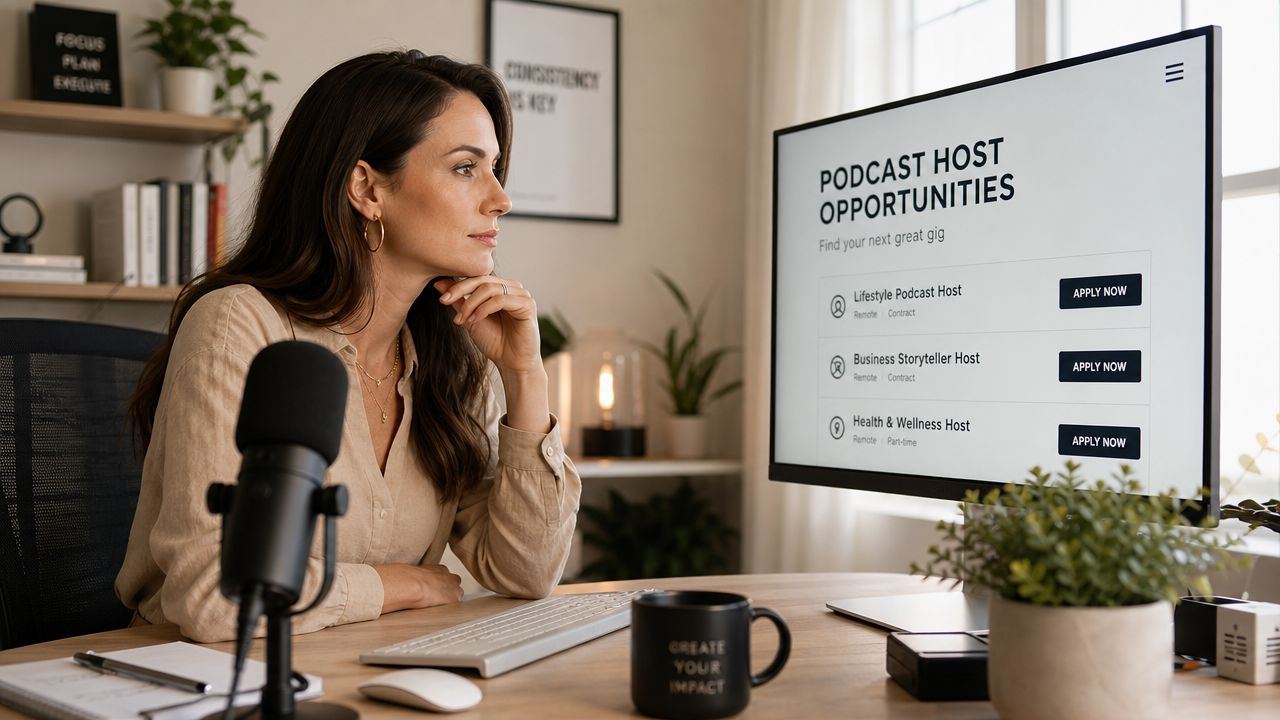
Once your demo is strong and your skill stack makes sense, you need a system for getting work. Random applications won't carry you far. Paid hosting opportunities usually come through a mix of listings, referrals, niche positioning, and well-aimed outreach.
The good news is the market isn't tiny. The global podcasting market is projected to reach $67.2 billion by 2030 with a compound annual growth rate of 25.7%, according to Research and Markets' podcast industry projection. That projection doesn't guarantee you a role, but it does support the larger point: there is sustained commercial interest in podcast production, distribution, and talent.
Start where buyers already look
Don't wait for the perfect “host wanted” posting. Those exist, but many of the best opportunities are attached to agencies, branded content teams, production companies, and founders building media around their businesses.
Focus your search in these buckets:
| Opportunity type | What they usually need | What you should send |
|---|---|---|
| Brand podcasts | A polished host who can represent the company well | Demo, niche fit, interview style sample |
| Production companies | Talent who can host and support workflow | Demo plus hybrid skills |
| Agencies | A presenter for client campaigns or series | Clean reel and concise pitch |
| Independent creators | A co-host, producer-host, or guest interviewer | Personality fit and collaboration samples |
Pitch like someone who respects time
Most bad pitches are too long, too needy, or too vague. Keep yours tight.
A useful outreach email should include:
- Who you are
- What kind of show you host well
- Why you're a fit for their audience or client
- A direct link to your demo package
- One sentence on hybrid value, such as guest prep, scripting, or editing support
Send the pitch that feels easy to forward internally.
That last point matters. If a producer likes you, they may need to share your reel with a manager, client, or founder. Make that simple.
Use the NJ and NY market intelligently
If you're in the NJ and NY orbit, don't limit yourself to national remote postings. There are local production companies, founder-led brands, agencies, coaches, and media startups that need podcast talent but don't always advertise in obvious places.
Your strategy should be local and layered:
- Target production houses and branded content teams. They often need hosts who can step into client work without drama.
- Attend creator and media events. A clean introduction and strong sample can open doors faster than another cold application.
- Build relationships with producers. Producers often know about openings before hosts do.
- Stay visible. A steady stream of short clips signals that you're active, current, and comfortable on mic.
If you want a better sense of how production-side hiring works, this guide to finding podcast producers near you is useful because producers often sit close to the hiring process for hosting talent.
Your first gigs probably won't look glamorous
That's normal. Early paid work may come as contract roles, co-host opportunities, branded interview series, pilot projects, or supporting positions that combine hosting with production help.
Take those seriously. Small gigs teach you client communication, deadline discipline, and audience adaptation. They also create the thing that gets you the next thing: evidence.
A simple weekly action plan works better than vague ambition:
- Apply to a small set of aligned roles
- Send a few custom outreach emails
- Post one strong clip
- Follow up with warm contacts
- Refine your reel based on feedback
Podcast hosting jobs usually don't go to the most hopeful person. They go to the one who's easiest to trust.
Scale Your Career From Freelancer to Brand
Getting booked is one level. Building a durable career is another.
If you stay in freelancer mode forever, you end up chasing assignments instead of shaping a market position. The hosts who grow don't just collect gigs. They build a clear niche, create owned assets, and turn one-off work into a body of work that compounds.
CareerExplorer's guidance on becoming a podcast host describes a repeatable path: define a niche, prepare a trailer and several starter episodes, choose a hosting platform, and promote through a website and collaborations. It also notes that editing or transcribing experience is often an entry point, which is useful because it reminds you that careers in this space are built, not granted. You can review that framework in CareerExplorer's host training overview.

Build assets that outlive the gig
A contract ends. A brand continues.
That means you need assets with staying power:
- A niche people can remember
- A website that houses your work and positioning
- Starter episodes or pilots that show ownership
- Reusable systems for notes, clips, and guest handling
Show notes matter more than most hosts realize because they shape discoverability, professionalism, and listener experience. If you want a clean framework for that part of the workflow, WhisperAI's podcast notes guide is a practical reference.
Turn freelance proof into leverage
Once you have a few completed projects, stop presenting yourself as “available for anything.” That's not a brand. That's a placeholder.
Start saying what kind of host you are. Maybe you're excellent at founder interviews. Maybe you thrive in culture conversations. Maybe you're sharp in health, business, or lifestyle storytelling. Pick the strongest lane and sharpen it until people can refer you with one sentence.
A few moves yield outsized benefits:
- Launch a focused personal site. Flexwork offers podcast websites for $5000 plus hosting, which makes sense for creators who need a dedicated home for reels, episode pages, bios, and inquiries.
- Invest in growth support when you're serious. The Market, Manage & Produce My Podcast tier starts at $1500 per episode with a 20-episode growth commitment, which is the kind of structure that fits hosts treating podcasting like a long-term media business, not an occasional experiment.
- Think sponsorship early, not sloppily. Even before major monetization, your positioning should make commercial alignment possible. This sponsorship guide is useful for understanding how hosts move from audience-building into brand partnerships.
A host becomes a brand when the work feels consistent across voice, visuals, topic, and audience promise.
Own something
This is the final leap. Hosting for others builds skill and credibility. Owning a show, a format, or a media identity builds equity.
That doesn't mean you need to quit client work and launch a network tomorrow. It means you should be building toward something with your name on it. A signature interview format. A category-specific show. A founder-led media property. Something that stops your career from depending entirely on permission.
The premium path isn't just “get hired.” It's become the kind of host people seek out because your taste is visible, your process is reliable, and your platform looks like it belongs in the market you're aiming for.
If you're ready to move from rough ideas to work that looks hireable, book time with Flexwork Podcast Studios. Use the studio to cut a serious demo, plan a Content Day, or start building the assets that make podcast hosting jobs easier to win.