

Build Your Video Production Company Website: Win Clients
 June 3, 202625 Minutes
Your work looks premium. Your website doesn't.
That gap costs more than pride. It costs inquiries, referrals, and the kind of clients who are ready to buy without needing a long explanation. A talented creator can have sharp cinematography, clean edits, strong audio, and a clear voice, then lose the deal because their site feels unfinished, confusing, or generic.
That's why a video production company website can't function like a digital scrapbook. It needs to work like a client acquisition system. For creators building a serious brand, the website has to position the work, explain the offer, remove friction, and make the next step obvious. If you've ever looked at your own homepage and thought, “This doesn't feel like me at my highest level,” you're in the right place.
Your Digital First Impression Is Everything
A familiar scenario plays out all the time. A creator produces beautiful work, gets strong reactions on Instagram, maybe even wins repeat business through referrals, then sends a prospect to their site and the momentum dies. The homepage loads slowly. The reel starts too late. The services are vague. The whole experience feels cheaper than the work itself.
That disconnect is hard to hide.
A prospect doesn't know how many late nights went into the edit or how dialed your lighting is on set. They judge what they can see in a few seconds. If your site feels like a placeholder, they assume the business may be one too. Even excellent creators run into this problem when their brand has outgrown the website they built in a rush.
You can see the difference when a brand environment is treated with intention, like the polished visual presentation on Sky Studios photography. The lesson isn't “make it flashy.” It's “make it coherent.” Your website should feel like the same level of care your client gets on shoot day.
A premium client experience starts before the discovery call.
Define Your Website's Core Mission
Most creators start with design. That's backwards. Before choosing fonts, templates, or a homepage layout, decide what job the site needs to do.
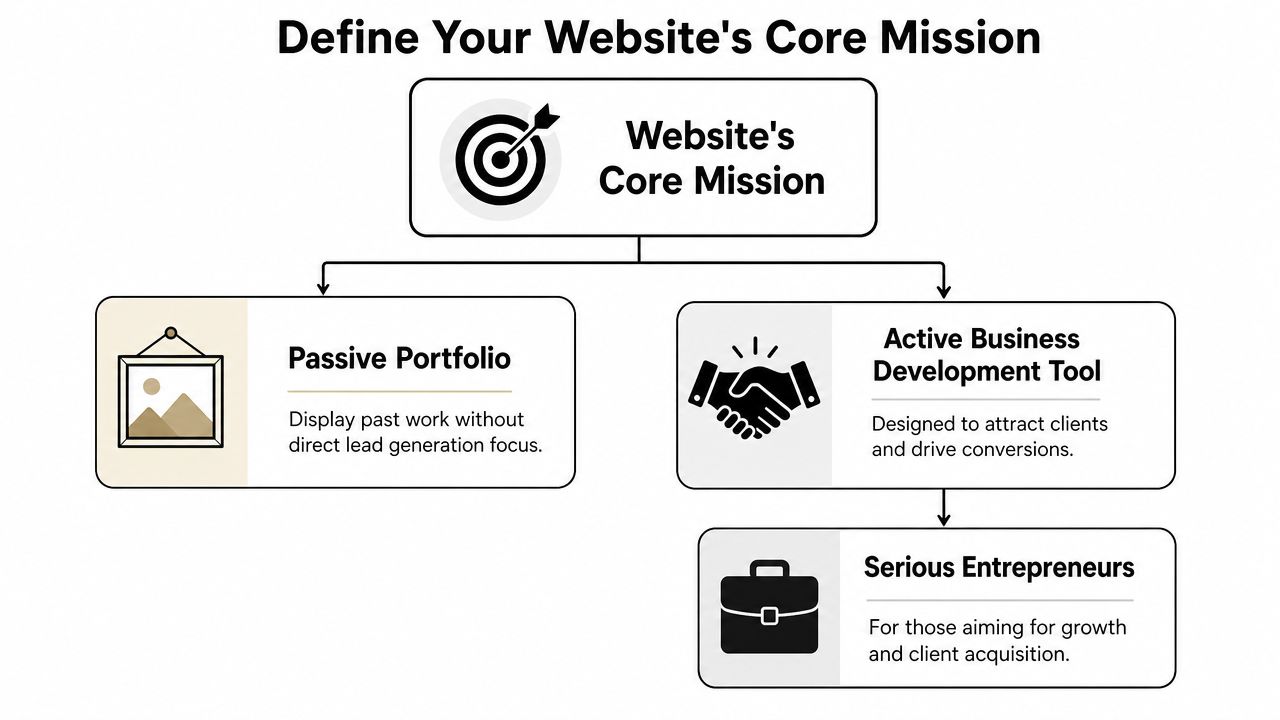
If your site exists only to display work, you're building a passive portfolio. If it's meant to attract qualified leads, pre-sell your process, and move people toward an inquiry, you're building a business tool. Those are different websites, even when they use the same footage.
The distinction matters because this isn't a small niche anymore. The global video production market was estimated at USD 70.40 billion in 2022 and is projected to reach USD 746.88 billion by 2030, with a projected 33.5% CAGR from 2023 to 2030. The same report notes that North America held about 32% of the market in 2022, which puts real weight behind the need for strategic positioning in the US and Canadian market (Grand View Research video production market report).
Passive portfolio or active pipeline
A passive portfolio says, “Here's what I've made.”
An active business website says, “Here's who I help, how I work, what kind of projects I take on, and what to do next.”
That second version closes the gap between admiration and action. It helps a marketing lead, founder, or podcast host understand whether you fit their problem. It also filters out people who aren't aligned, which saves time and protects your positioning.
Use this test:
- If a visitor loves your work but can't tell what to hire you for, the mission isn't clear.
- If the site shows style but not process, prospects will assume the engagement will be messy.
- If everything speaks to peers rather than buyers, you'll attract compliments instead of contracts.
Define the buyer before the homepage
A strong video production company website speaks to one primary buyer first. That buyer might be:
- A founder with no internal media team who wants a reliable production partner
- A marketing manager who needs a vendor that can hit deadlines and adapt assets by channel
- A podcaster or creator who wants recording, editing, short-form clips, and a website under one roof
- An agency producer who cares about execution, handoff, and professional communication
Each buyer needs different language. A creator responds to brand elevation. A marketing lead responds to clarity, speed, and usable deliverables. An agency partner wants proof that you won't create downstream chaos.
That's why your brand positioning work has to come first. If your message still feels broad, refine it before redesigning the site. A useful place to sharpen that thinking is this guide on how to brand your business.
Practical rule: Your website's mission should be simple enough that a stranger can understand your offer within one screen.
Build Your High-Converting Website Elements
Once the mission is set, the site needs parts that convert. Not trendy parts. Not filler pages. The right parts.
A lot of creators build a homepage that tries to impress other creatives. Buyers need something else. They need orientation. They need confidence. They need a fast way to understand the offer.

One market reality should shape your thinking here. Video already sits at the center of how people discover and evaluate brands. One industry summary states that 82% of all internet traffic involved video content in 2022, 96% of people said they use videos to learn about products and services, 86% of businesses use video as a marketing tool, and 50% of companies reportedly decided to make videos in-house (corporate video production statistics roundup from Holt Digital). Translation: buyers already expect video. Your site has to explain why they should hire you instead of the next capable person with a camera.
The homepage should do less, better
The homepage doesn't need to tell your whole story. It needs to do four things quickly:
- Show the level of work with a sharp, well-edited reel or featured project
- State the offer clearly so a visitor knows what kind of production you provide
- Build trust with recognizable client types, testimonials, or a clean process snapshot
- Create momentum with a direct call to action
Don't open with a long autoplay sequence that hides the message. Don't make people dig for your services. Don't write like an art school manifesto if you're trying to sell commercial work.
If you want the footage itself to carry authority, it helps to get the lighting and production environment right before the website stage. This overview of best lighting for video recording is a smart reminder that conversion starts with the quality of what you're showing.
Here's a useful reference point for how buyers think about video presentation and engagement:
Structure the portfolio around buyer intent
Chronological portfolios are easy for you and annoying for prospects.
A better structure groups projects by what the buyer is trying to achieve. That might look like branded content, podcast video production, event recaps, founder stories, social cutdowns, or corporate interviews. This lets a visitor self-select into the work that feels relevant.
A useful structural approach is to keep the company brand on a master domain and create subdomains or dedicated project spaces for major work. That setup can centralize the brand while giving projects their own indexable destinations and cleaner navigation, especially when project pages include poster images, loglines, synopsis, and sales links (The Guerrilla Rep guidance on production company websites).
Your service pages need operating detail
Good service pages reduce sales friction. Great ones answer the questions the client was about to email you.
Include:
- What's included
- Who it's for
- How the process works
- What the deliverables look like
- What the timeline depends on
- How revisions are handled
If you book a lot of consultations, your website should also support operations after the lead comes in. Tools for managing client appointments effectively can help reduce email ping-pong and make your intake process feel more polished.
Address ownership and reuse before they ask
One of the biggest misses on a video production company website is vague language around rights.
A major underserved angle in production websites is clarity on ownership and reuse rights. Clients want to know whether they can repurpose footage for social clips, paid ads, or future edits without extra fees or licensing confusion (New Angle Media on video production considerations).
That belongs on the website, not buried in a surprise clause later.
A short FAQ can answer questions like these:
| Question | Why it matters |
|---|---|
| Who owns the raw footage after delivery? | Clients want long-term control and flexibility |
| Can final edits be repurposed into reels or shorts later? | Multi-channel use is often the real value of the shoot |
| Are project files available on request? | Teams may switch editors or bring work in-house |
| Are music and asset licenses limited by platform or duration? | Paid use and distribution plans affect rights |
When you handle this clearly, you sound like a real business, not just a talented operator.
The Flexwork Advantage Your Premium Website Solution
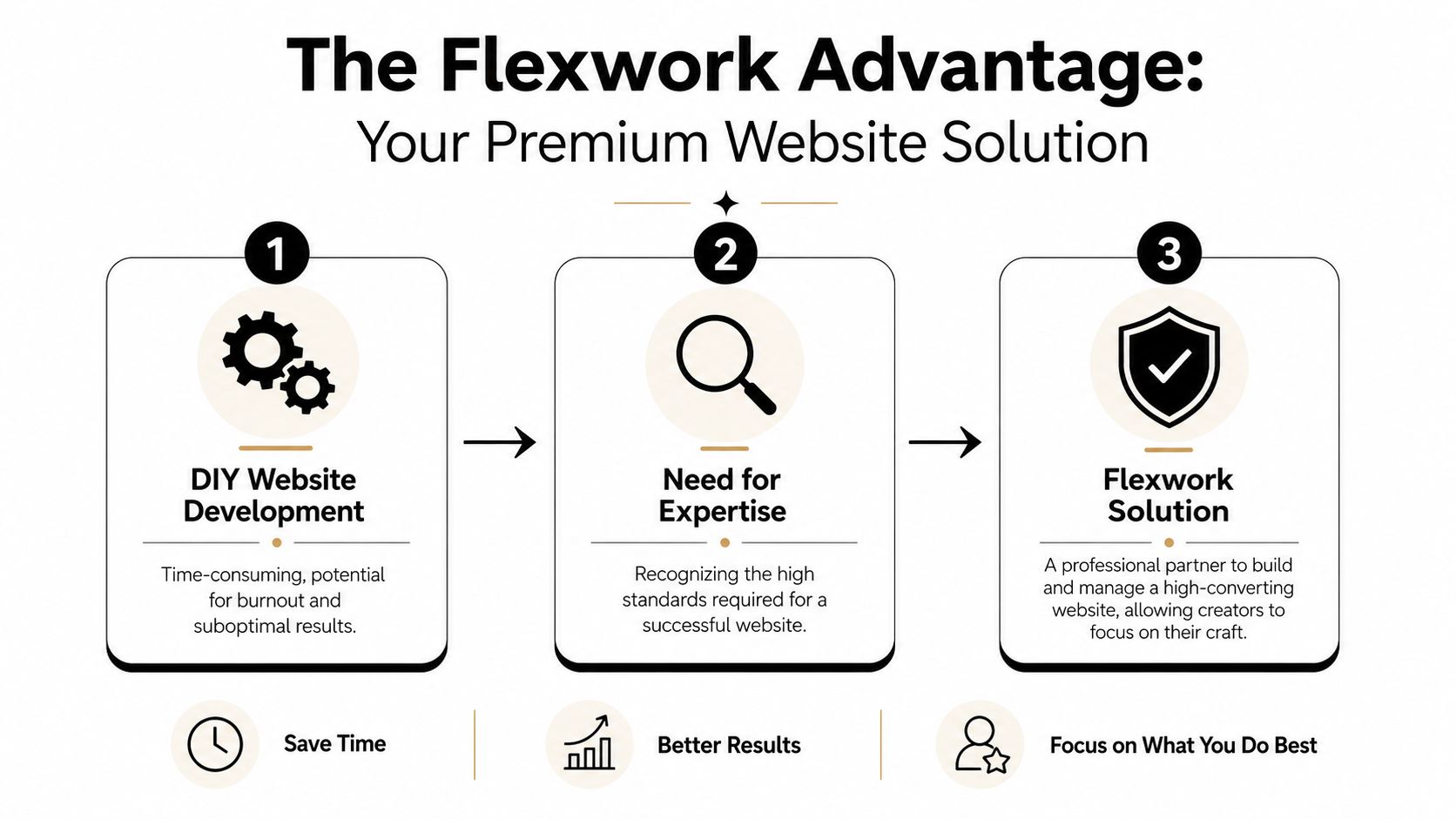
At a certain point, the DIY version stops being resourceful and starts being expensive.
Not because the software is costly. Because your attention is. If you're a working creator, every hour spent wrestling a template, rewriting homepage copy, resizing thumbnails, or patching together forms is an hour you didn't spend shooting, selling, editing, or building relationships.
That's where a done-for-you build makes sense.
DIY breaks down at the strategy layer
Most creators can get a website live. That isn't the hard part.
The hard part is making the site feel premium, read clearly, support discovery, present offers well, and connect to actual business operations. That takes architecture, copy, visual judgment, and a real understanding of how creators sell services today. It also takes restraint. Many self-built sites fail because the owner keeps adding instead of refining.
Common DIY failure points include:
- Too much work on one page
- No distinction between personal brand and company offer
- Portfolio pieces without context
- Weak inquiry flow
- Template design that doesn't match the quality of the work
When paying for help is the efficient move
If your website is holding back a premium offer, treating it like a side project doesn't make sense.
Flexwork Podcast Studios offers a Podcast Website package for $5,000 plus hosting. That's relevant for podcasters, producers, and creator-led businesses that need a polished site tied to content production, booking flow, and brand presentation. For creators who also need batch production support, Content Days are $3000 per day and include 20 edited reels or 60 pro photos, while the Market, Manage & Produce My Podcast tier starts at $1500 per episode with a 20-episode growth commitment.
That kind of support changes the equation. Instead of piecing together your site between client deadlines, you can focus on the actual work while the digital presence gets handled with the same level of care you want your brand to signal.
If the website has become the task you keep postponing, that's usually a sign it should move off your plate.
Implement Advanced Growth and Discovery Strategies
A polished website with no discovery system is still underperforming. If buyers can't find you, compare you, or understand what's working after they land, the site becomes a static brand piece instead of a lead asset.
That's why growth strategy needs to be built in from the start.

Search visibility starts with buyer language
Most creators write website copy using their own vocabulary. Buyers don't search that way.
They search by outcome, category, and location. They look for terms tied to the problem they're trying to solve. That means your page titles, page structure, image alt text, service descriptions, and blog content should reflect buyer intent. If you offer podcast video production, branded interviews, or corporate editing support, those offers need their own pages.
Good SEO also means organizing the site so each page has one clear purpose. Don't make one overloaded services page do all the work for short-form editing, studio rentals, and full production management.
If you're building content around discovery, this guide to a video content marketing strategy is useful because it keeps the focus on business outcomes rather than random posting.
Video SEO needs format awareness
A lot of production sites embed videos and stop there. That leaves discoverability on the table.
Production workflow guidance emphasizes a repeatable method: define audience and objective first, build a concise narrative arc, then optimize for platform-specific formats like aspect ratio, length, and captions. The same best-practice guidance also recommends A/B testing hooks, CTAs, and visuals, plus maintaining a production playbook to reduce revisions and speed onboarding (Backflip guide for corporate video production best practices).
That logic should carry into your website and YouTube strategy. Every embedded video should support a page topic. Every title and description should help a search engine understand what the video is about. If YouTube is part of your funnel, resources like PostPlanify's YouTube SEO workflow can help you think more deliberately about metadata, search intent, and discoverability.
Measure business impact, not just aesthetics
Many sites falter on this point. They sell production quality but say nothing about outcomes.
Many production company websites fail to address performance accountability, even though discerning clients increasingly expect partners to explain how strategy, editing, and distribution connect to outcomes like watch time, retention, or conversion lift (Superside on video post-production services and performance expectations).
That doesn't mean your website needs to invent hard numbers. It means it should show that you understand the chain from creative to result.
Use your site to make that visible:
- Add context to portfolio pieces by explaining the objective, audience, and distribution use
- Track inquiry sources so you know whether search, referrals, YouTube, or social is driving leads
- Review landing pages regularly to see where visitors drop off or convert
- Align calls to action with intent so someone ready to book doesn't get the same prompt as someone still evaluating
Better production doesn't automatically create better business results. Strategy, editing, distribution, and measurement have to work together.
Launch and Maintain Your Professional Presence
Launch day isn't the finish line. It's the handoff from build phase to operating phase.
Before you publish, test every form, every button, every mobile layout, and every embedded video. Read the copy out loud. Broken links and awkward wording make a site feel neglected fast. If the experience falls apart on a phone, it isn't ready.
Your launch checklist
- Test the inquiry path: Submit the form yourself and confirm the response process feels clean.
- Check mobile first: Most buyers will evaluate your site on a smaller screen before they ever open a laptop.
- Review your portfolio order: Lead with the work you want more of, not the work you did most recently.
- Proof your service language: Make sure the offer is clear to a buyer outside your industry.
- Tighten the backend: Keep plugins, forms, and security tools updated after launch.
Maintenance is part of the brand
A strong website ages well because someone is paying attention to it.
Update featured projects. Refresh service pages as your offer sharpens. Publish useful articles that answer real buying questions. Audit stale language and old visuals before they send the wrong message. Even your production stack evolves, which is why resources like this look at best video editing software from a practical, current perspective.
If your brand says premium, the website has to keep proving it. The next serious client won't judge the effort you intended to make. They'll judge what's live.
Frequently Asked Questions
A few questions come up almost every time a creator starts treating their website like a real business asset instead of a side project. The answers below are the ones that usually matter most when you're deciding whether to build, rebuild, or hand the job off.
| Question | Answer |
|---|---|
| What should a video production company website include first? | Start with a clear homepage message, a focused portfolio, dedicated service pages, an inquiry path, and basic FAQs about process and deliverables. If those pieces are weak, extra design polish won't save the site. |
| Should I show every project I've done? | No. Curate the work based on the clients you want next. A smaller, better-positioned portfolio is usually stronger than a large archive with no clear direction. |
| Do I need a separate page for podcast or studio services? | Yes, if those are real offers. Separate pages help buyers understand what they can book and help search engines understand what each page is about. |
| What if I'm worried about releases and permissions for featured video content? | Handle that before publishing. If you need a plain-English overview of what those permissions can involve, this video recording release form guide is a practical starting point. |
| Is a custom website worth paying for? | It is when your current site creates confusion, undersells the work, or takes too much of your time to manage. The point isn't custom for its own sake. The point is a site that supports the business model you're building. |
| Can one partner handle website creation and content production? | Yes. That's often more efficient because the team shaping the site also understands the footage, deliverables, and brand positioning behind it. |
If your question isn't listed here, the best next move is usually a direct conversation. A short call can surface what's blocking growth much faster than another month of tweaking your homepage alone.
If your website no longer matches the quality of your work, it may be time to rebuild it around the business you want. Explore Flexwork Podcast Studios if you need a professional environment for recording, editing, content production, or a website that supports a more polished creator brand.