Audio Visual Production Services: Elevate Your Content In
 July 21, 202625 Minutes
Meta title: Audio Visual Production Services for Creator Growth
Meta description: Audio visual production services help NJ and NY creators move past DIY burnout with polished content, smarter workflows, and brand-ready assets.
URL slug: /audio-visual-production-services-nj-ny-creators
Primary keyword: audio visual production services
Secondary keywords: podcast production services, video podcast studio NJ, content day production
You've probably felt the shift already. Your ideas are stronger, your audience is paying attention, and your content is no longer a casual side project. But the setup that got you started is now slowing you down. The audio needs cleanup every episode. Lighting changes with the weather. Editing eats your evenings. Guest scheduling, file management, clips, thumbnails, and distribution turn one recording into a week of admin.
That's the ceiling most serious creators hit. Not because they lack talent, but because DIY production has limits.
For creators in the NJ and NY orbit, audio visual production services are less about fancy gear and more about momentum. They give your brand consistency, your content a polished finish, and your calendar room to breathe. For podcasters, founders, coaches, and media-minded teams, that shift can be the difference between publishing occasionally and building a recognizable body of work.
The Quality Ceiling Every Creator Eventually Hits
A lot of creators hit the same wall in roughly the same way. The first few episodes feel exciting because you're learning fast and making something real. Then the weak points start showing up. One guest sounds thin because the room wasn't treated. The next episode looks flat because the lighting setup changed. By the time you finish cutting clips, writing captions, and fixing levels, the next recording date is already here.
That's not a motivation problem. It's a production problem.
A rising creator can get surprisingly far with a decent camera, a USB mic, and grit. But once your content starts representing your business, your reputation, or your paid offers, “good enough” starts costing you. Viewers may not know the language of compression, color balance, or room tone, but they notice when content feels uneven. If you want a useful primer on audio mixing techniques, that's a solid place to understand why clean sound changes the way people experience your message.
The jump from DIY to professional production usually happens when creators stop asking, “Can I record this?” and start asking, “Does this reflect my brand?”
That's where production support starts making sense. Not as a luxury line item, but as the infrastructure behind a more credible, more scalable creator business.
What Are Audio Visual Production Services Really
Hearing the phrase often brings equipment to mind. Cameras, lights, microphones, editing software. That's part of it, but it overlooks its full significance. Audio visual production services are the coordinated systems that turn a raw idea into content people trust, watch, hear clearly, and remember.
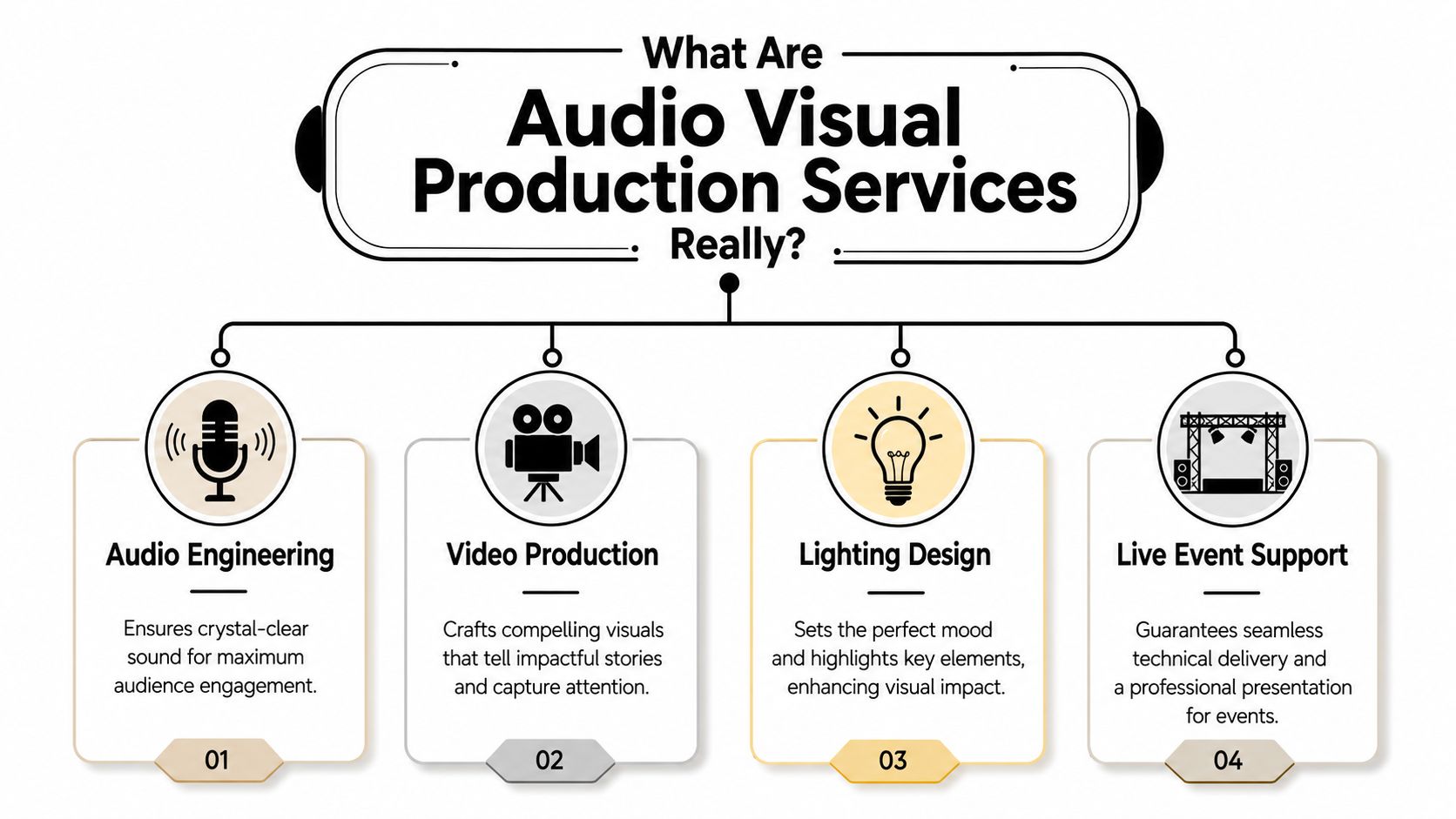
The category is growing because creators, brands, and companies need content that holds up in more places, on more platforms, and at a higher standard. The global audio visual production services market reached $44.81 billion in 2025 and is projected to reach $66.58 billion by 2030, with growth tied to demand for real-time, interactive content, according to The Business Research Company's market report.
Audio that makes people stay
If your sound is distracting, your audience leaves faster. Great audio isn't only about avoiding mistakes. It creates intimacy. It makes the listener feel close to the speaker, which matters in podcasts, interviews, educational content, and founder-led brand media.
A professional audio workflow usually covers:
- Microphone selection and placement: The right mic in the wrong position still sounds wrong.
- Room control: Echo and reflections are what make “nice gear” sound cheap.
- Mixing and leveling: Dialogue has to feel steady from intro to outro.
- Delivery formatting: The export should match where the content will live.
Video that supports authority
Video production does more than make things look expensive. It helps the audience understand who you are. Camera choice, framing, lensing, composition, and movement all communicate something about your brand. A finance podcast can feel sharp and controlled. A founder interview can feel warm and conversational. A course module can feel premium and structured.
If you're comparing providers, a useful benchmark is whether they can take you from concept through edit instead of only renting out gear. That's why creators often look for a podcast production company near me instead of just a room with microphones.
Lighting and live support change perception
Lighting is one of the fastest ways to tell whether a production feels intentional. Good lighting separates the subject from the background, flatters skin tones, controls mood, and keeps a set visually consistent across shoots. That consistency matters if you're publishing weekly and want your brand to feel established.
Live event and livestream support matter too. If you're recording a panel, hybrid event, launch, or live podcast, technical reliability becomes part of your public image.
Practical rule: Production quality doesn't have to be flashy. It has to be repeatable.
That's the deeper point. Good audio visual production services create repeatable quality, not one lucky shoot.
The Modern Creator AV Workflow From Start To Finish
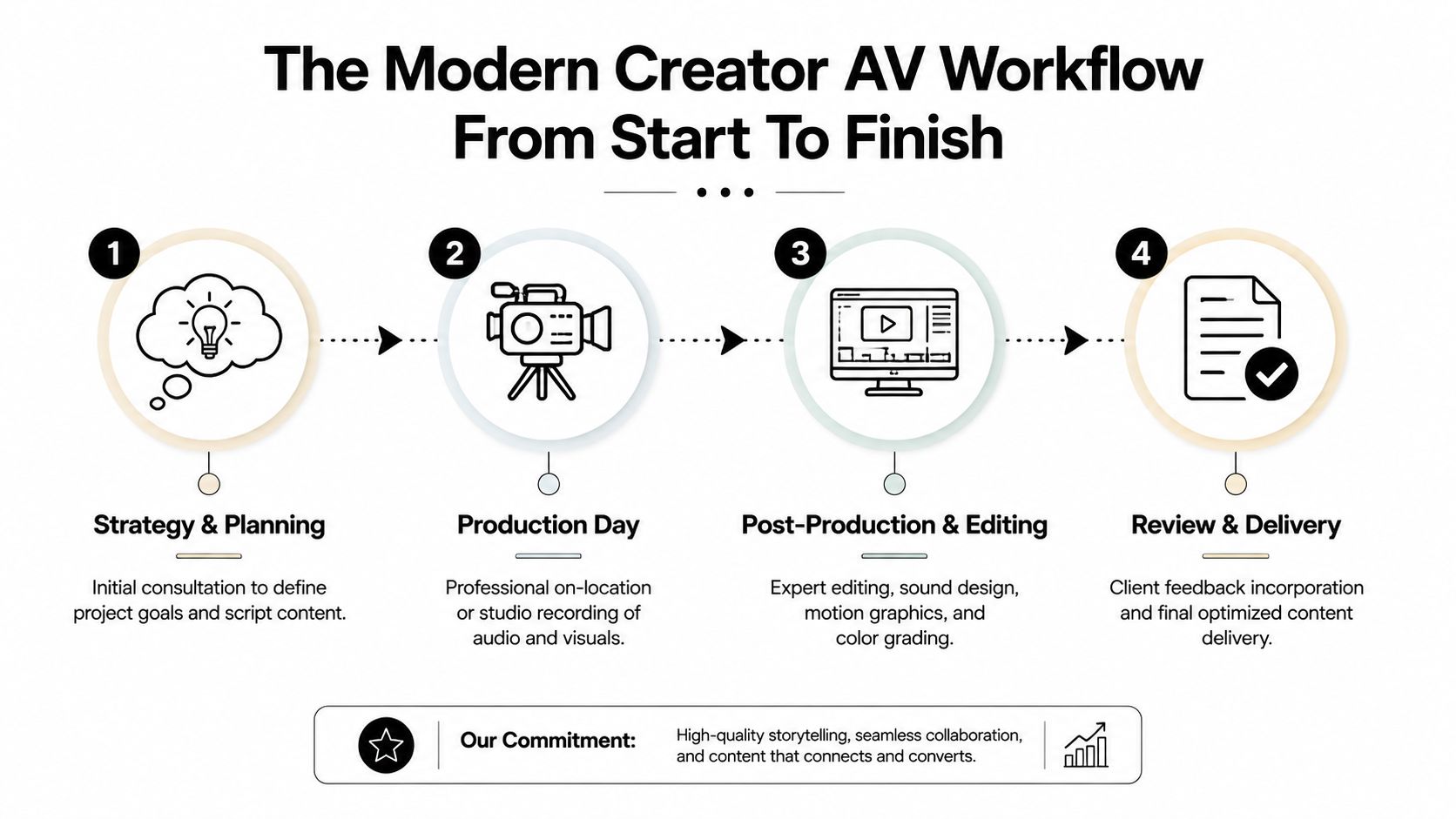
The process feels intimidating until you see it up close. Most creators imagine production as a room full of gear and people using terms they don't know. In practice, a strong workflow should make your role simpler. You bring the message. The production team handles the variables that usually drain your time.
Before the cameras turn on
A good production day starts before anyone hits record. That usually means clarifying the format, the audience, the set look, the run of show, and the intended outputs. A single recording session might need to serve a full episode, short clips, stills, social teasers, and a website embed.
This is also where smarter creators think about distribution. If a long-form episode is going to feed multiple channels, the recording has to be planned with repurposing in mind. That might mean pausing for clip-friendly moments, structuring talking points more cleanly, or designing visual beats that make vertical edits easier later. For creators exploring Using generative AI for better content, the most useful lesson is that AI works best after a human-led production plan exists. It can accelerate output, but it won't fix a messy recording day.
What happens during production
On set, your best day is usually the one that feels calm. The room is ready. The mics are checked. The camera angles are set. The lighting already flatters the frame. Guests know where to sit and where to look. Instead of troubleshooting, you get to perform.
That handoff matters because professional standards are less forgiving than most creators realize. For web delivery, broadcast-grade guidance still calls for -24 LUFS target loudness, a true peak below -1 dB, at least 1080p video, and a minimum 4 Mbps bitrate for H.264, according to the Webcasters streaming quality standards. A professional team manages those details in the background so your final content sounds clear and plays back cleanly.
A look at a polished workflow helps make that feel real:
After the session is where the value compounds
Post-production is where raw capture becomes content. The editor trims dead space, balances pacing, cleans the audio, grades the footage, creates titles or motion graphics, and exports versions for each platform. This is also where a smart team builds the repurposing plan into delivery.
Common outputs from one session often include:
- Full-length episode: The anchor asset for YouTube, podcast feeds, or your site.
- Short-form clips: Moments cut for reels, shorts, and social distribution.
- Branded visual assets: Lower thirds, intros, outros, and thumbnails.
- Publishing-ready files: Formats optimized for the places you'll post.
If you want to see how one session can stretch further, this guide on repurposing a single podcast episode into 10 pieces of content is worth studying.
Clean production feels invisible to the audience. That's the point. Nothing gets in the way of the message.
How Top Creators Use AV Services To Grow Their Brands
The creators who get the most out of production aren't chasing polish for its own sake. They use it to make their ideas travel farther. A better setup gives them better assets. Better assets create more touchpoints. More touchpoints strengthen recognition, trust, and recall.
One recording can become a full brand system
A lot of AV vendors talk about repurposing as an add-on. The bigger business question is whether you can justify the spend. That's where many creators get stuck. Miller Tanner points to a real gap in the market: providers mention repurposing, but often don't explain the business case for turning one long-form piece into 20 shorts and other assets in a way entrepreneurs can evaluate, as noted in this discussion of the ROI of repurposed content.
That matters because the strongest creators don't treat one episode as one episode. They treat it as a content source.
Three examples show the difference:
- The coach building a premium offer: A polished podcast or video series becomes trust-building media that warms up future clients before a sales call.
- The founder building public authority: A recurring interview format creates consistency, thought leadership, and cleaner material for LinkedIn, newsletters, and investor-facing pages.
- The marketing team batching content: One recording day can produce enough assets to support an entire campaign cadence.
Content Days work when the plan is editorial, not random
A Content Day sounds simple. Book a studio, record a lot, leave with assets. But the creators who get the strongest return usually arrive with a content architecture already in place. They know which episodes support their offer, which clips need direct-response energy, and which visual moments need to feel more lifestyle-driven.
A practical structure often looks like this:
- Anchor the day with a flagship conversation. Record the long-form piece first while energy is fresh.
- Pull out the strongest standalone ideas. These become short clips that don't require extra context.
- Capture promotional moments separately. Trailers, intros, sponsor reads, and launch language work better when recorded intentionally.
- Leave with a posting sequence in mind. Random clip folders don't create momentum. A rollout plan does.
If you're shaping that rollout, this framework for video content marketing strategy is useful because it connects production choices to actual distribution decisions.
Courses, branded shows, and expert media
Creators in NJ and NY are also using AV services beyond classic podcasting. Coaches are filming premium course modules that need clean sound and consistent visuals. Agencies are producing branded interview series for clients. Small businesses are turning founder expertise into regular media instead of relying only on static posts.
The common thread is simple. Professional production helps content perform double duty. It can educate, sell, recruit, position, and build familiarity all at once.
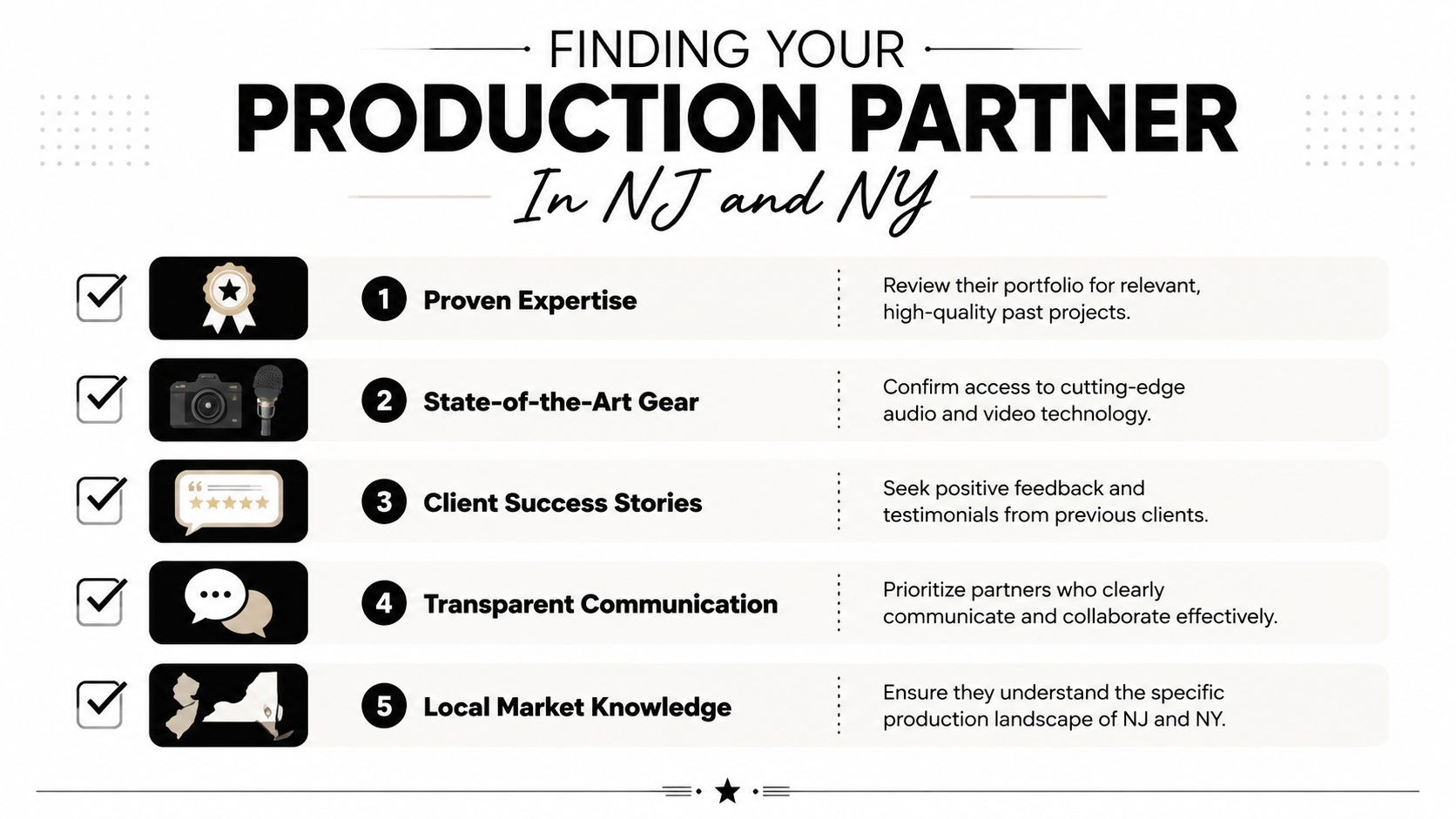
Finding Your Production Partner In NJ and NY
Choosing a production partner gets easier when you stop looking at marketing language and start looking at operating habits. Most studios can show a nice still frame. Fewer can show you a process that protects your time, your brand, and your deadlines.
What to check before you book
The basics matter more than people think. You want to know whether the room is acoustically controlled, whether the set options fit your brand, whether the staff can direct a session smoothly, and whether the provider can handle post-production without sending you into another vendor search.
Use a shortlist like this:
- Portfolio fit: Don't ask whether the work looks good. Ask whether it looks right for your format.
- Room quality: A stylish set means very little if the room sounds reflective.
- Workflow clarity: You should know what happens before, during, and after the shoot.
- Editing depth: Some studios record well but outsource the hard post work.
- Guest experience: If guests struggle with parking, timing, or setup confusion, the content feels rough before recording even starts.
Why local matters in NJ and NY
A local partner gives you practical advantages. Guests are more likely to show up on time when the location is accessible. You can tour the space before committing. If you're building a recurring show, working with the same team in the same environment creates visual and operational consistency.
There's also a relationship benefit. Good production improves when the team learns your rhythm. They start to anticipate the way you like intros framed, where your strongest clip moments happen, and how much support your guests need.
If you're comparing options, browsing actual podcast studios near me is more useful than reading generic studio claims because it forces you to assess the local fit, not just the sales copy.
The right studio doesn't just record your content. It reduces friction around your content.
What strong studio performance looks like
Benchmarks matter, even if you're not hiring like a procurement team. Dataintelo notes that high-performing niche AV studios tend to achieve a project completion rate around 90%, client satisfaction above 80%, and a client retention rate of 75%, which signals reliability and long-term partnership quality in the AV production services market.
That doesn't mean you should shop only by metrics. It means you should look for evidence that a studio can finish what it starts, communicate well, and keep clients coming back for more than one session.
Investing In Your Content With Flexwork Studios
At a certain point, the costliest option isn't professional production. It's staying stuck in a loop where your time disappears into setup, retakes, revisions, and inconsistent output. That's one reason post-production has become such a major category in media. The U.S. Video Postproduction Services industry was a $7.1 billion market in 2026, and the broader U.S. post-production market reached $9.06 billion in 2024, according to IBISWorld industry data. Editing, sound work, and graphics aren't side tasks anymore. They're a central part of how modern content gets finished properly.
For creators who want an NJ base with studio recording and post support in one place, Flexwork's comparison guide for NJ podcast studios gives a useful look at what you're paying for across different setups.
Which package fits which stage
Different creators need different levels of support. Some already know how to host on camera and just need the room, the gear, and a clean engineering setup. Others need a production partner who can manage the whole system from record to rollout.
Here's a practical way to think about the main options:
| Feature | Producer Packages | Content Days | Market, Manage & Produce |
|---|---|---|---|
| Best for | Creators who want polished recurring episodes | Brands batching assets in a single shoot day | Shows focused on sustained growth and managed execution |
| Core value | Production support and a cleaner finished product | High-efficiency asset capture | Ongoing production plus growth-minded management |
| Typical deliverables | Recording, editing, audio cleanup, visual polish | 20 edited reels or 60 pro photos | Production, management, and marketing support |
| Pricing | Varies by package | $3000/day | Starts at $1500 per episode with a 20-episode growth commitment |
| Ideal outcome | Consistent, professional episodes | A month or more of content from one day | A more structured show with audience-building support |
The business case for moving up
A Content Day is often the clearest example of strategic spend. If your audience sees you once every few weeks, growth tends to feel erratic. If one day of production gives you a long-form episode, a bank of reels, and professional photos, your brand starts appearing with more consistency and less weekly scrambling.
Podcast websites matter too, especially when you're moving beyond social-first distribution. A dedicated podcast website is $5000 plus hosting, and that cost makes sense when your show needs a central home for episodes, guest features, search visibility, and owned brand presence.
The highest-touch route is the Market, Manage & Produce My Podcast tier. That's built for creators who don't just want a polished show. They want help running a show as a brand asset. The package starts at $1500 per episode with a 20-episode growth commitment, which makes it a fit for teams treating podcasting as a serious channel, not an occasional experiment.
Production becomes easier to justify when you stop measuring it as a recording expense and start measuring it as a brand system.
Your Next Step To Professional Content
DIY content is a powerful starting point. It teaches taste, discipline, and presence. But once your content starts carrying your reputation, your sales narrative, or your public authority, the standard changes. People don't separate your message from its presentation. They experience them together.
That's why audio visual production services matter. They remove friction, tighten quality, and turn scattered effort into a repeatable publishing engine. For creators in NJ and NY, that shift can look like cleaner episodes, stronger reels, a more credible set, better guest experiences, and a brand that feels established instead of improvised.
If you've outgrown the setup that got you here, the next move is simple. Stop trying to do every job at once. Get support for the parts that require engineering, editing, visual consistency, and delivery discipline. Use your energy where it counts most: your voice, your perspective, and the ideas people came to hear.
If you're ready to create content that looks and sounds aligned with the brand you're building, explore Flexwork Podcast Studios and book a tour or start a conversation about your next recording day.