
Professional Recording Studio Near Me: Your 2026 Guide
 July 18, 202624 Minutes
Meta title: Professional Recording Studio Near Me Guide
Meta description: Find a professional recording studio near me with smarter questions, transparent pricing, and workflow tips for NJ creators.
URL slug: professional-recording-studio-near-me-guide
Primary keyword: professional recording studio near me
Secondary keywords: podcast studio near me, recording studio pricing New Jersey, podcast production studio
Your content probably outgrew your room before you admitted it.
You can feel it in the playback. The interview was strong, the ideas were sharp, the guest was worth listening to, but the audio still sounds like it came from a spare bedroom with a lamp in the corner and a refrigerator humming in the background. That gap matters. Listeners notice it fast, even if they can't explain why. So do sponsors, partners, guests, and clients.
Searching for a professional recording studio near me isn't really about finding a room with a microphone. It's about deciding your content now represents your brand, not your hobby. And if you want polished episodes, premium short-form clips, and a workflow that doesn't eat your week, you need more than a nice-looking set.
When Your DIY Studio Is No Longer Enough
A lot of creators hit the same wall. The first few episodes feel scrappy and exciting. You improvise. You record late at night. You throw blankets over hard surfaces and hope the edits will save you. Then the stakes change. Guests get better. Your audience grows. You start sharing clips with people who could open doors for you, and suddenly the room sound is embarrassing.
That's usually the moment the search begins. Not casually. Urgently. You type professional recording studio near me because your current setup is costing you confidence.
This shift is bigger than gear. It's about moving from “good enough for now” to “good enough to represent me.” There were exactly 4,298 professional recording studios operating in the United States as of 2023, and that supply is tight relative to the 5 million active podcasts projected for 2025 according to recording studio industry data. Premium rooms don't sit empty waiting for indecisive creators.
If you're at that turning point, read what you gain by going pro instead of staying DIY. It'll help you stop treating studio time like a luxury and start treating it like infrastructure.
The problem usually isn't your voice, your format, or your topic. It's that your environment has stopped matching your ambition.
What Truly Makes a Studio Professional
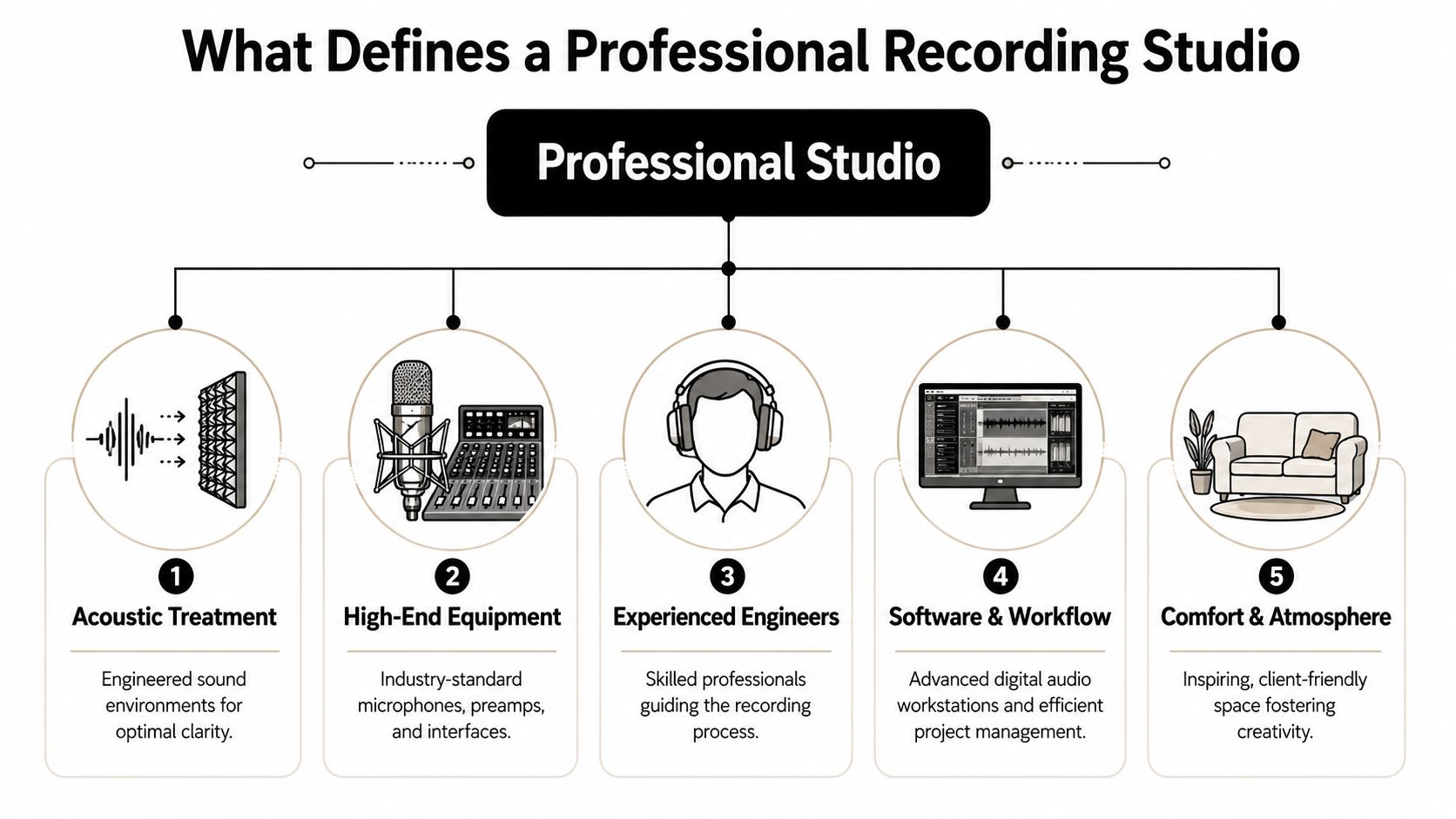
A professional studio isn't defined by LED lights, a stylish couch, or a camera on a tripod. Those things are nice. They aren't the reason the recording sounds expensive.
The primary difference starts with acoustics. If the room isn't designed for capture, every other upgrade is cosmetic.
Silence is part of the recording
Professional studios target NC-15 in control rooms and vocal booths, according to EBU-based acoustics guidance. You don't need to memorize the term. You just need to understand the benefit. It means the room is quiet enough that your voice doesn't have to fight HVAC noise, street rumble, or low-level electrical hum.
When a room misses that standard, engineers often have to use aggressive noise gates. That fixes one problem and creates another. The gate chops off subtle breaths, natural decay, and the tiny details that make a voice sound human instead of flattened.
Treatment matters more than decoration
A room can look premium and still record badly. Plenty of spaces have attractive backdrops and harsh reflections. The walls bounce your voice around, those reflections hit the mic at slightly different times, and your recording gets smeared before editing even begins.
Here's the simple test. If the room itself is working against the microphone, you're paying to capture problems.
A serious studio gets this right at the construction level, not just with afterthought foam panels. If you want a useful walkthrough of what that looks like in practice, this insider look at a strong podcast studio setup breaks down the choices that affect the final result.
What to look for when you tour
Don't get distracted by branding first. Listen for control.
- Room quietness: Sit still for a few seconds. You should not hear obvious traffic, vents, buzzing fixtures, or building rumble.
- Voice clarity: Talk at normal volume. Your voice should sound focused, not splashy or boxy.
- Mic placement options: A real studio adjusts around the host and guest. It doesn't force everyone into one awkward setup.
- Monitoring: You should be able to hear what's being captured, not guess.
- Workflow support: Someone should know how to move quickly if a cable fails, a level clips, or a camera angle needs changing.
Practical rule: If the studio owner talks more about aesthetics than sound, keep looking.
The Anatomy of a High-End Studio Session
A high-end session isn't just about entering a good room. It's about what happens minute by minute once the clock starts. Great sessions feel smooth because the variables were controlled before you arrived.
The clearest way to judge a studio is to break the session into three parts. Capture, guidance, and environment.
Capture that holds up in post
Professional acoustic treatment uses materials with an NRC above 0.8 and floor-to-ceiling bass traps to control reflections and low-end buildup, according to this studio treatment reference. The reason that matters is simple. Bad reflections create comb filtering. Once that gets baked into the recording, you can't fully fix it later.
That's why serious creators should stop asking only what mic a studio uses. The better question is whether the room lets that mic do its job.
A strong session setup usually includes:
| Session element | What quality looks like |
|---|---|
| Microphones | Clean vocal capture without exaggerated room noise |
| Cameras | Framing that suits clips, reels, and long-form delivery |
| Lighting | Consistent skin tone and separation from the background |
| Monitoring | Real-time checks so issues get caught immediately |
The engineer is not optional
New creators often assume the room is the product. It isn't. The engineer protects the session.
That person hears plosives before they ruin a take, catches clipping before you lose a quote, and notices when one guest is drifting off-mic. They also manage pace. That matters more than people realize. If your team spends paid time troubleshooting cables or resetting camera cards, the studio didn't save you time. It burned it.
For a useful behind-the-scenes look at how a polished recording day runs, this day at a New Jersey podcast studio is worth reviewing before you book anywhere.
Environment affects performance
Creators record better when they don't feel cramped, rushed, or visually distracted. That sounds soft. It's not. A sharp set, comfortable seating, and a calm room improve delivery because people stop thinking about the room and start focusing on the conversation.
Watch what happens in weak studios. Guests fidget. Hosts keep checking levels. Everyone feels like they're operating equipment instead of having a real conversation.
Use this filter when comparing options:
- If the gear is good but the room feels chaotic, your energy on camera will show it.
- If the room looks nice but the engineer is absent, your paid time gets wasted.
- If the acoustics are strong and the workflow is tight, you can focus on content.
A premium session feels easy because someone else handled the hard parts before you walked in.
Services That Scale Your Content Beyond the Mic
Recording is the start, not the finish line. A lot of “near me” guides stop at room rental, as if your job ends when the microphones turn off. That's amateur thinking.
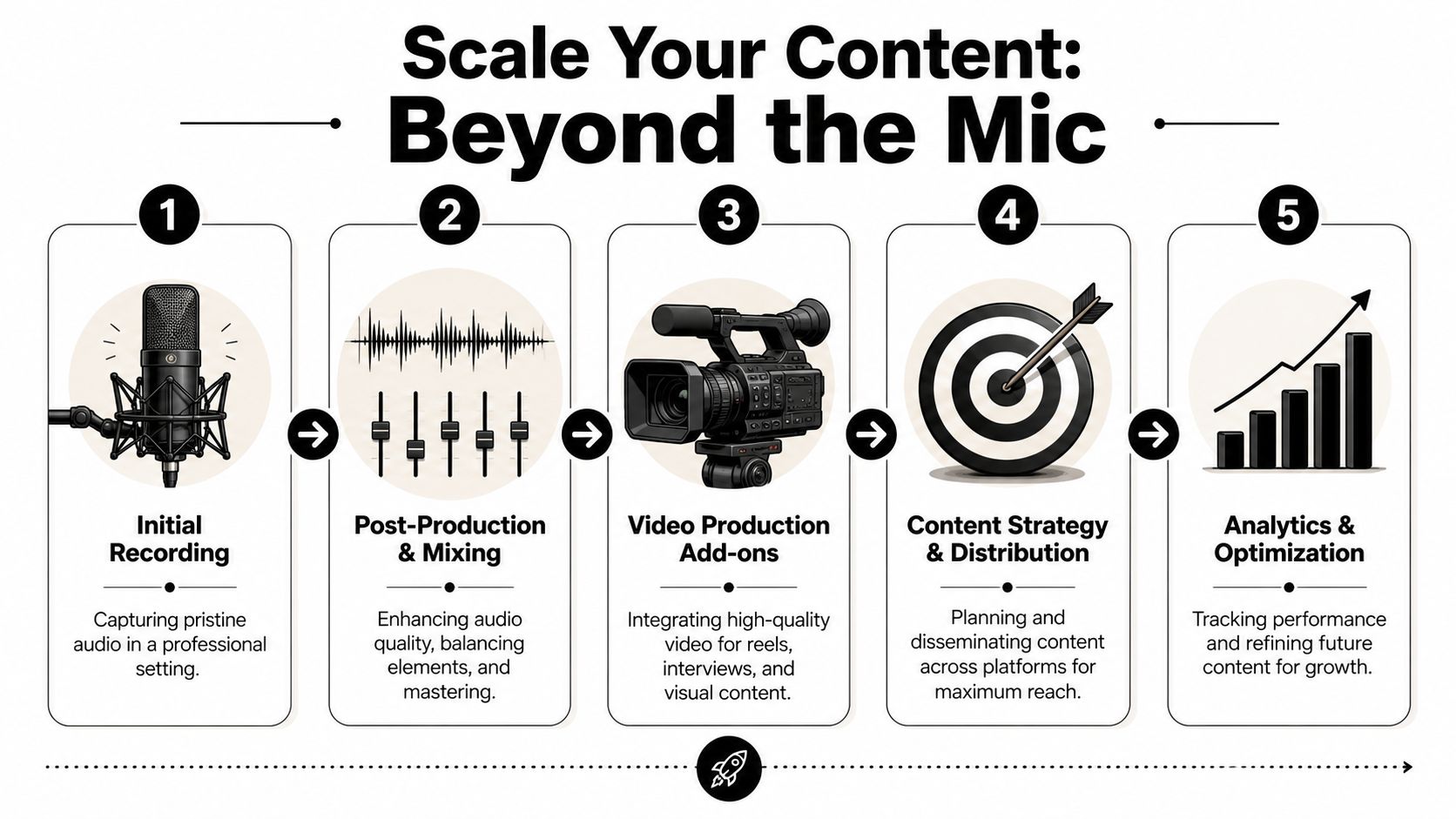
If you want content that builds authority, books clients, attracts guests, and earns distribution opportunities, you need post-production and packaging built into the plan. Raw footage sitting on a drive is not a content strategy.
The real product is usable content
Most creators don't need “studio time.” They need finished assets.
That usually means some mix of:
- Audio cleanup and mixing so the episode sounds balanced and release-ready
- Video editing for YouTube, site embeds, and social distribution
- Short-form cuts for reels, shorts, and promo clips
- Brand packaging so the show looks consistent everywhere
- Distribution support so episodes don't die in a folder
That's why package-based support beats piecing together freelancers after the fact. Once you split recording, editing, clipping, graphics, and publishing across different vendors, you introduce delays, mismatched expectations, and avoidable revision cycles.
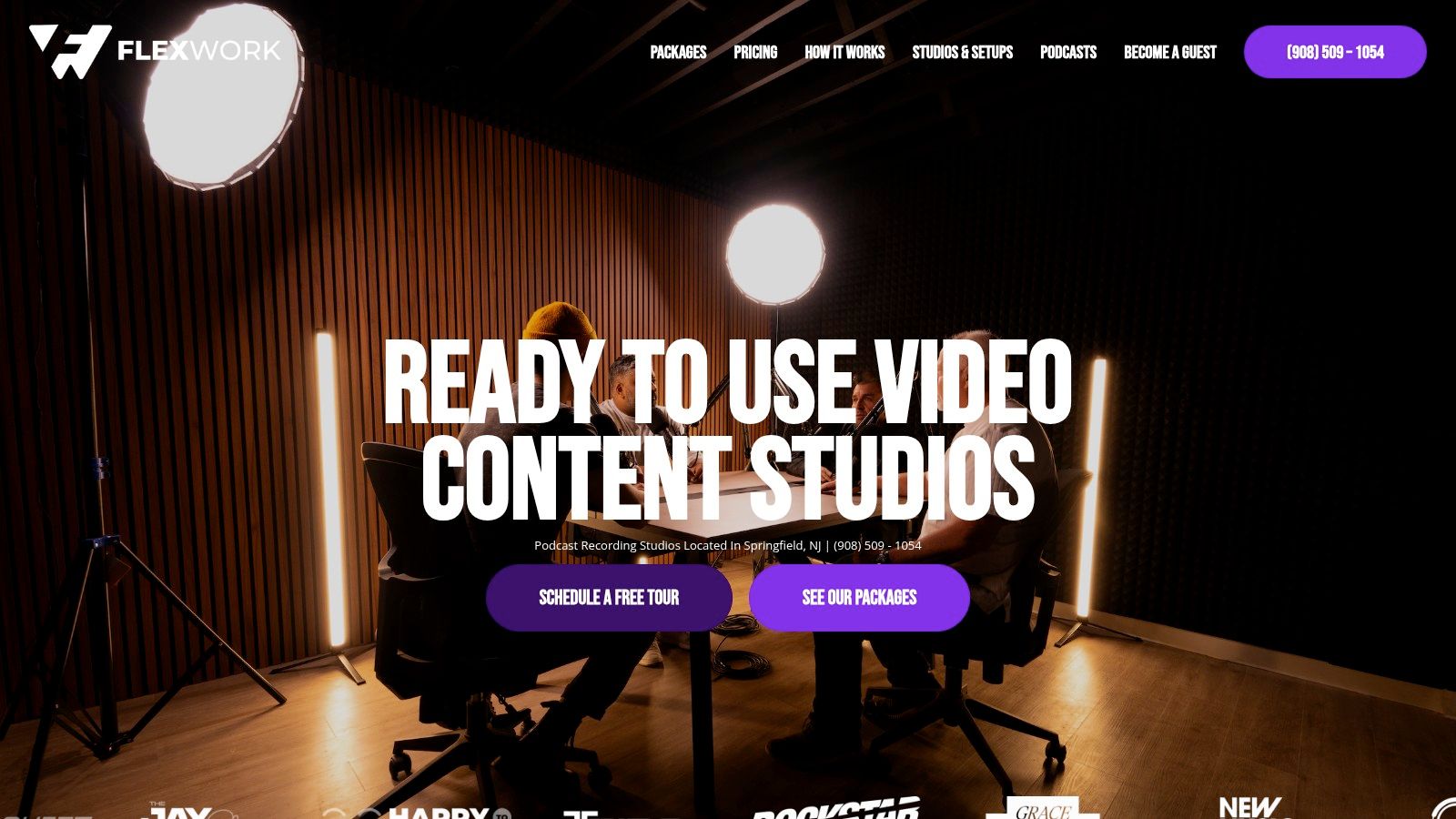
For creators who want a single production partner, Flexwork Podcast Studios offers studio recording, sound mixing, video editing, motion graphics, distribution support, Content Day sessions, and podcast website builds.
Packages make stronger businesses
If you're building a serious show, think in terms of systems.
A Content Day is useful when you want to batch multiple assets in one focused production day. At $3000/day, it includes 20 edited reels or 60 pro photos. That structure makes sense for founders, coaches, and media brands that need a backlog of polished content instead of one isolated episode.
A podcast website at $5000 plus hosting is the right move when your show needs a real home base, not just a streaming profile. It gives guests, listeners, and potential partners somewhere credible to land.
The Market, Manage & Produce My Podcast tier starts at $1500 per episode with a 20-episode growth commitment. That kind of model fits creators who don't want to just publish. They want operating support, consistency, and audience-building discipline.
If your monetization plan includes brand partnerships, it also helps to discover YouTube sponsors in music so you can study how channels position themselves for sponsor fit. Even if your show isn't music-focused, the sponsor research process sharpens your thinking around packaging and audience value.
Here's a quick way to think about service depth:
| Need | Weak approach | Strong approach |
|---|---|---|
| Episode production | Record and hope | Record, edit, mix, deliver |
| Short-form content | Clip randomly later | Plan clips during production |
| Brand presence | Social-only footprint | Site, assets, and platform consistency |
| Growth | Post whenever possible | Commit to a release and promotion system |
The visual side of the process matters too. This overview gives a good sense of how professional production turns one recording into a broader content engine.
If your studio can't help you after the session ends, you're still doing half the job yourself.
Your Local Search and Booking Checklist
The search process often goes poorly. Individuals open a map, scan photos, compare hourly rates, and book too fast. Then the surprises show up. Minimums. Deposit rules. Extra engineering fees. No clear delivery timeline. No one available to help when the guest arrives late and rattled.
A better search starts with the outcome you need, not the room you think you want.
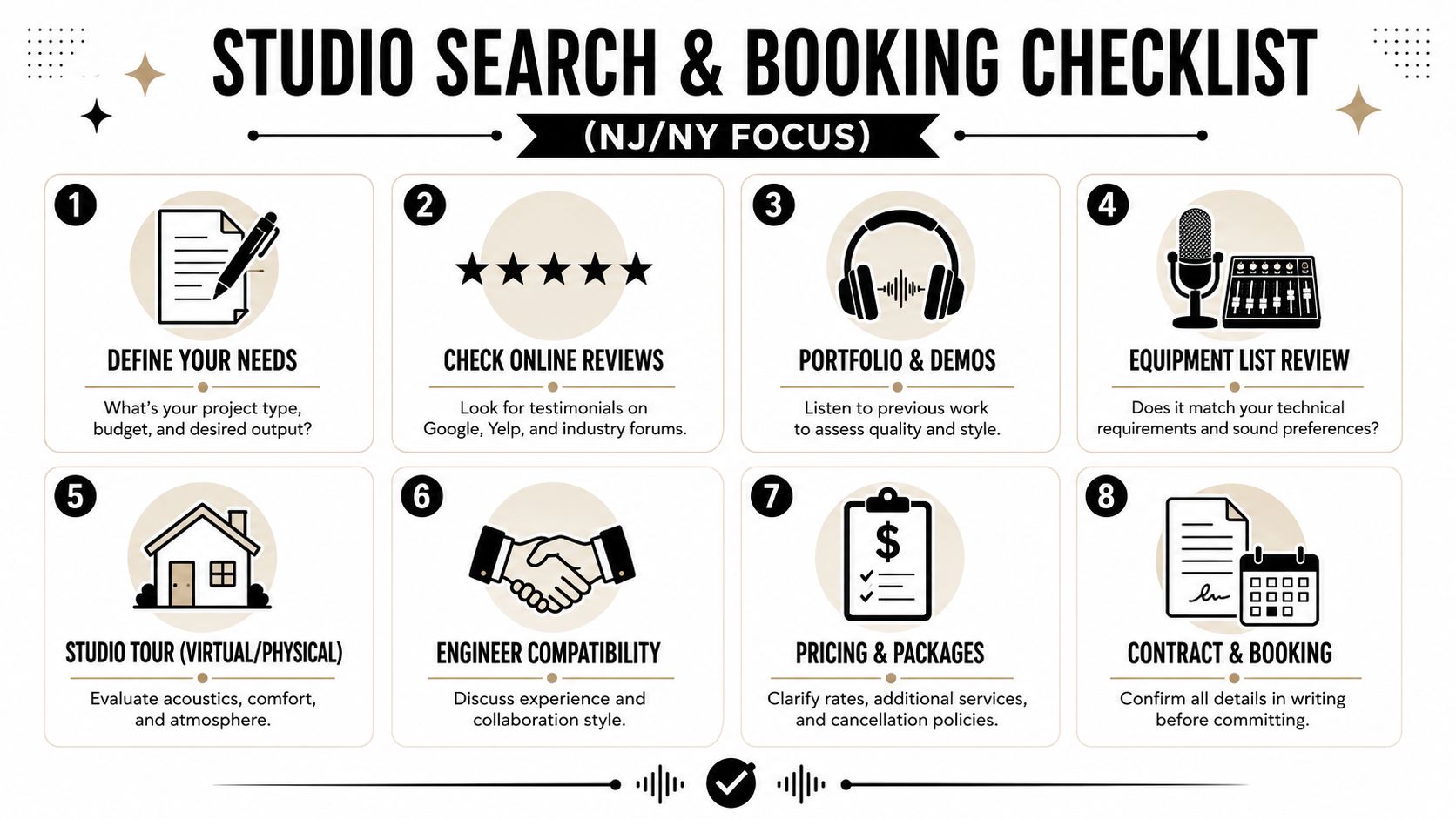
Start with the booking questions that expose problems
Many studio listings leave out the engineer or mixing cost, and that hidden fee can double the project price according to this audio engineering discussion on first-time booking questions. That's the workflow gap most creators don't see until the invoice arrives.
Ask these before you commit:
What does the quoted rate include?
Not “what's your hourly.” Ask what's included in that hour.Is an engineer included during the session?
If not, who runs levels, camera checks, and file management?What happens after recording?
Do you receive raw files, a mixed episode, edited video, or nothing unless you add more services?What file formats do you deliver?
You need clear handoff expectations, especially if another editor or agency is involved.Are there minimum session lengths or deposits?
Policies vary, and they affect your real cost.
Use local search like an operator, not a browser
The best studios usually look organized before you ever visit them. Their business listing is current, their booking path is clear, and their services are explained without vagueness. If you want to understand what separates strong local listings from messy ones, this guide on how studios improve local search visibility is useful.
For your own search, use a short evaluation grid:
- Reviews and responsiveness: Did someone reply clearly, or did you get vague answers?
- Portfolio quality: Do the finished clips sound and look consistent?
- Service clarity: Can you tell what happens after recording?
- Tour availability: Can you see the room before paying?
- Workflow fit: Does the studio support your format, whether that's solo commentary, interviews, or multi-camera video?
A local option worth comparing during your search is this guide to podcast studios near you in the NJ area, especially if you want to evaluate room setup and service scope before making calls.
Don't skip the tour
Studios can hide a lot online. They can't hide acoustics, energy, or disorganization in person.
When you tour, pay attention to three things:
- How the room sounds when no one is talking
- How the team answers operational questions
- How easy it feels to imagine your actual session happening there
Book the studio that answers operational questions cleanly. Fancy visuals without clear process usually become expensive confusion.
Decoding Studio Pricing and Packages in New Jersey
Most creators ask the wrong pricing question first. They ask, “What's the hourly?” That's understandable, but it's incomplete.
The smarter question is, “What will it cost me to leave with everything I need?”
In Springfield, NJ, the average cost to rent a professional recording studio is $95 per hour, and Peerspace lists 36 local studios in that market according to Springfield recording studio listings. That's a useful benchmark, not a buying decision.
Hourly rates are easy to compare and easy to misunderstand
An hourly rate tells you almost nothing by itself.
You still need to know:
- whether an engineer is included
- whether video capture is included
- whether setup time eats into your session
- whether editing, mixing, and delivery cost extra
- whether there's a minimum booking requirement
- whether a deposit is required
Elsewhere in New Jersey, the range proves the point. In Linden, rates average $71 per hour, with listings from $25 per hour to $200 per hour on Linden studio listings. In East Orange, audio recording services can run $35 to $75 an hour on average, with some flat-rate options like a $150 two-hour session for singer-songwriters on East Orange service listings. Some studios also set stricter policies, such as a deposit equal to one hour of session time or minimum booking blocks, as shown by New Jersey studio booking policies.
That range is exactly why hourly shopping can mislead you. Cheap rooms often become expensive projects.
Package pricing is easier to budget and easier to manage
Package-based pricing wins when your goal is output, not just access.
Compare the approaches:
| Pricing model | What you're buying | Main risk |
|---|---|---|
| Hourly rental | Time in the room | Add-ons and unclear workflow |
| Flat recording service | A narrower deliverable | Limited flexibility |
| Integrated package | Recording plus selected outputs | Higher upfront commitment, but clearer scope |
For music recording, the national average fixed price for professional services is $175 to $225, with the most common payment at about $199 per track, according to recording studio pricing benchmarks. That's another reminder that buyers often pay for a deliverable, not just a clock.
If you're running a show as part of your business, package logic usually makes more sense. A Content Day gives you a clear asset count. A website project gives you a defined digital home. A long-term production and growth package gives you operating consistency. That's easier to budget, easier to delegate, and easier to scale.
If you're also trying to strengthen your own discoverability as a creator or brand, this local SEO checklist for 2025 is a useful companion read. It helps you think beyond the recording itself and into how people will find your show, business, or local presence.
Cheap time is expensive when you still need to hire three more people after the session.
Choose a Studio That Matches Your Ambition
Your studio choice says a lot about how seriously you take your own work.
You can keep patching together a DIY workflow, fixing room tone in post, chasing editors after the fact, and hoping the final product feels more premium than the process that made it. Or you can choose a setup that matches where you want your brand to go.
That doesn't mean you need the flashiest room. It means you need the right one. Quiet enough to capture nuance. Structured enough to protect your time. Clear enough on pricing that you're not decoding invoices after the fact. Complete enough that your episode can become a finished asset, not another task sitting on your list.
The creators who level up fastest usually make one decision earlier than everyone else. They stop buying isolated studio hours and start buying reliable workflow.
If you're serious about building a show that sounds polished, looks polished, and moves like a real media product, explore the package details, ask sharper questions, and schedule a tour before you book anywhere. You'll know quickly whether the room is built for your next chapter or your last workaround.
If you're ready to record in a space built for polished audio, video, and end-to-end production support, explore Flexwork Podcast Studios, review the available packages, and schedule a free tour before you book your next session.