
What Defines a Professional Podcast Recording Studio
 August 31, 202619 Minutes
You've probably heard the same promise a dozen times, a clean mic and a quiet room are all you need. Then you record a great conversation at home, play it back, and the flaws jump out, the room rings, the levels drift, the guest sounds distant, and the whole thing feels harder to trust than it did in your head. A professional podcast recording studio solves that problem by changing the conditions around your voice, not just the gear in front of it. For creators working with Flexwork Studios in Springfield, NJ, that difference is the line between a file you can rescue and a show you can build around.
The Sound of Difference
The first giveaway is simple. A home recording can sound usable, but it often carries the room with it, refrigerator hum, soft reflections, and that hollow edge that shows up when someone laughs or leans back in a chair. Those little imperfections don't always jump out in the moment, but they add up fast once you start editing.
A professional space removes that strain from the listener. It gives your voice a cleaner frame, so the episode feels intentional instead of improvised. If you want a practical starting point for improving what you hear at home, Flexwork's guide on how to improve audio quality is a useful companion to this conversation.
What matters most is that the room stops fighting you. Once that happens, you can judge your delivery, your pacing, and your content on their merits instead of guessing how much of the problem is technical.
What Actually Makes a Studio Professional
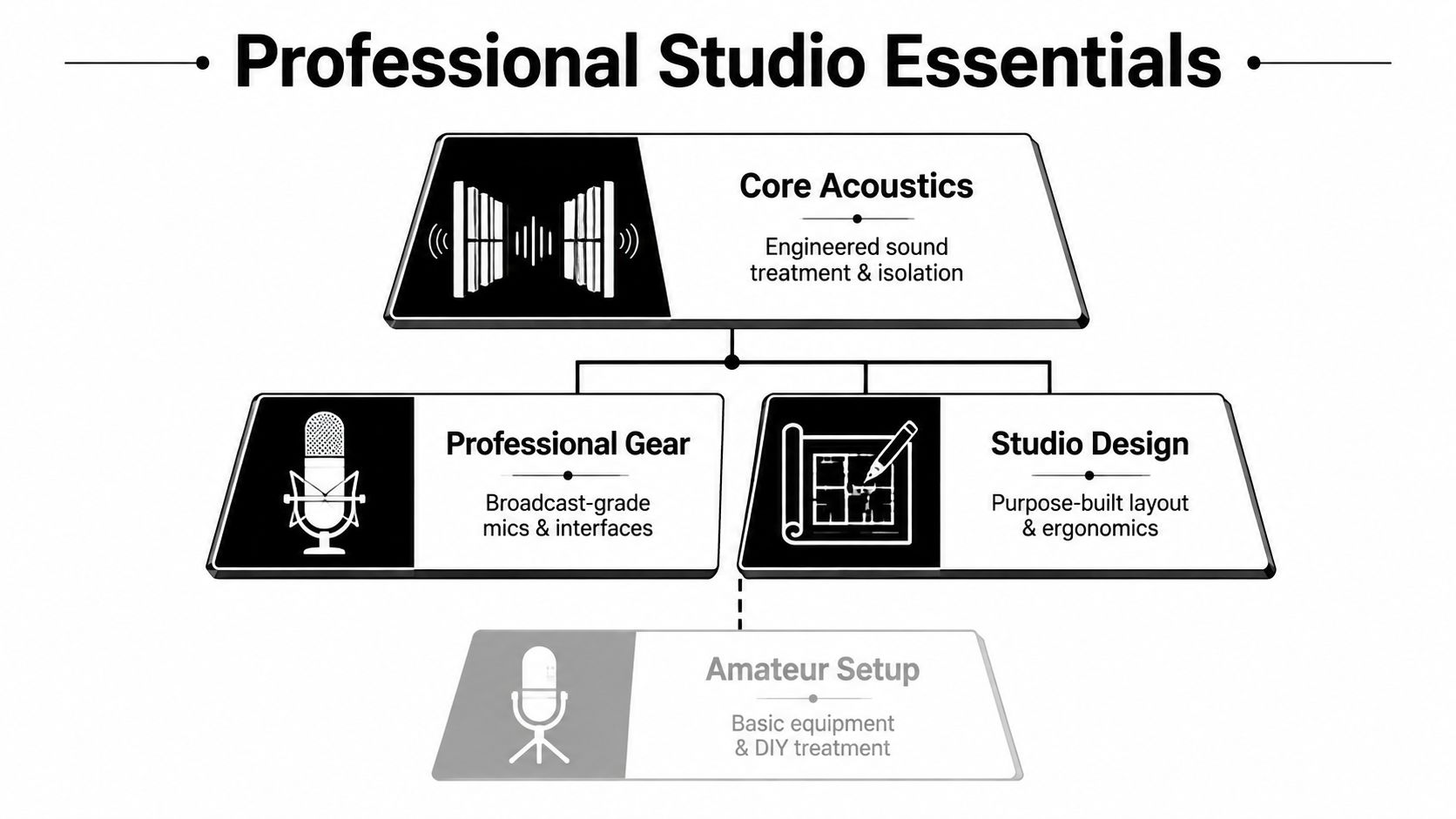
A lot of spaces call themselves studios because they own a microphone and have a dark wall behind the desk. That doesn't make them professional. A real professional podcast recording studio is built on three things working together, acoustic control, reliable gear, and a workflow that takes the episode beyond the recording session.
The room has to serve the voice
The biggest difference is acoustic design. Podcast rooms aren't supposed to feel dead or echoey, they're supposed to feel controlled. In spoken-word production, the room itself should stay out of the way so the microphone captures the speaker, not the reflections bouncing back from the walls.
Gear matters, but only inside a system
A great microphone in a bad room still sounds like a great microphone in a bad room. A professional setup pairs broadcast-grade gear with a calibrated signal chain, so each part of the path supports the next one. That means the studio is thinking about consistency, not just equipment shopping.
The studio's layout matters too. If the producer has to improvise every session, the creator pays for that in time and energy. A professional room is designed so you can walk in, sit down, and get to work without rebuilding the process from scratch.
Workflow is part of the definition
A studio isn't professional if it only handles the recording and leaves everything else to you. The standard has to include capture, cleanup, delivery, and the handoff to whatever platform or team comes next. That's the difference between a room with gear in it and a production environment.
The clearest test is whether the studio thinks like a partner or a rental counter. If the answer is a handoff, you're probably paying for access. If the answer is a finished process, you're paying for production.
The Acoustics and Audio Standards That Define Quality
The easiest technical benchmark to understand is RT60, the amount of time sound lingers after it stops. For a two-host room, a professional target sits around 0.25 to 0.35 seconds because that range keeps echo under control without making voices sound unnaturally dry. That guidance comes from a detailed podcast studio design reference, which also notes that around 1.0 second starts to feel cavernous, while values below roughly 0.15 seconds can feel sterile and overtreated. Sound Zero's podcast studio design guide lays out those room targets clearly.
What the room treatment is doing
The treatment itself is usually unglamorous, which is why people underestimate it. Thick 100 to 150 millimeter absorption panels, corner bass trapping, and decoupled construction work together to calm the low-end buildup and early reflections that make speech sound amateur. You don't need every wall packed with foam. You need the room to stop coloring the voice.
Practical rule: if the room sounds impressive to stand in, it may not be the best room to record in.
How the recording should be captured
The technical discipline continues in the session itself. Podcast audio is commonly recorded in 24-bit/48 kHz lossless PCM, then mastered to a target around -16 LUFS for stereo content, with true peaks kept below about -1 dBTP. During tracking, clean peaks around -12 dBFS to -6 dBFS help preserve headroom and reduce the risk of distortion later. Those delivery recommendations are summarized in IonO.fm's podcast creation guidance.
| Standard | Target Range | Why It Matters |
|---|---|---|
| RT60 | 0.25 to 0.35 seconds | Keeps speech natural while limiting echo |
| Tracking peaks | -12 dBFS to -6 dBFS | Preserves headroom for editing and compression |
| Master loudness | about -16 LUFS | Supports normal podcast playback levels |
| True peak ceiling | below about -1 dBTP | Helps prevent clipping after normalization |
The point of all that isn't to impress an engineer. It's to make sure your episode survives editing, platform normalization, and headphone listening without falling apart.
For a plain-language explanation of room control, Flexwork's page on what acoustic treatment is is worth reading if you're comparing spaces.
Production Services Beyond the Recording Room
A polished recording is only the first deliverable. The bigger gap between a bare rental and a real studio is what happens after the mics are off. Full-service production turns one session into assets that are ready for listeners, viewers, and your own marketing team.
The services that actually save time
Mixing is the obvious one. Good mixing balances voices, reduces noise, and brings the episode into line with delivery targets so you're not fighting loudness problems later. Video editing matters just as much if you're recording with cameras, because the finished show needs clean cuts, consistent framing, and files that match how people watch on different platforms.
Branding is part of the package too. Show openers, motion graphics, and visual identity make the show feel established, even before it grows an audience. Distribution support also matters, because uploading a file is not the same thing as preparing a show for Apple Podcasts, Spotify, and YouTube with the right metadata and structure.
Some studios go further and help with the business layer. That can include podcast websites, social distribution, and guest planning. If you want to see how those services are framed in a studio context, Flexwork's podcast production services page is the clearest place to start.
The best studios don't stop at “we recorded it.” They think about how the episode will move through your business after the session ends.
Why this changes the workload for creators
The difference is friction. Every extra handoff costs time, and every unclear responsibility invites delays. A creator who records in one place, edits in another, and publishes somewhere else ends up managing a process instead of making content.
That's why production services matter more than most gear lists admit. They turn the studio into an operating system for your show, not just a room with a chair and a camera.
What You Can Produce in a Professional Studio
A modern studio isn't just for long interview episodes anymore. It's a flexible content space, which matters because podcasting now overlaps with video and platform-first distribution in a much bigger way than it used to. Edison Research reports that in 2025, 73% of Americans age 12+ have ever consumed a podcast, 55% have consumed one in the last month, and 40% in the last week. The same study also shows how mainstream the format has become for regular listening. Edison Research's Podcast Consumer 2025 report captures that reach.
The format mix is broader than most people think
A professional studio can handle multi-host conversations, solo commentary, and guest interviews without making the setup feel different every time. It can also support video podcasting, which is now part of the normal workflow for many creators. The Infinite Dial 2025 press release says 48% of Americans age 12+ have both listened to and watched a podcast, and 33% of U.S. weekly podcast listeners use YouTube most often to listen. That combination makes hybrid production a practical choice, not a novelty. The Infinite Dial 2025 press release summary reflects that shift.
One session can produce more than one asset
That same setup can also be used for short-form clips, livestreams, branded content, executive talking-head videos, and training material. When the lighting, cameras, and sound are already dialed in, the creator doesn't have to rebuild the environment for each format.
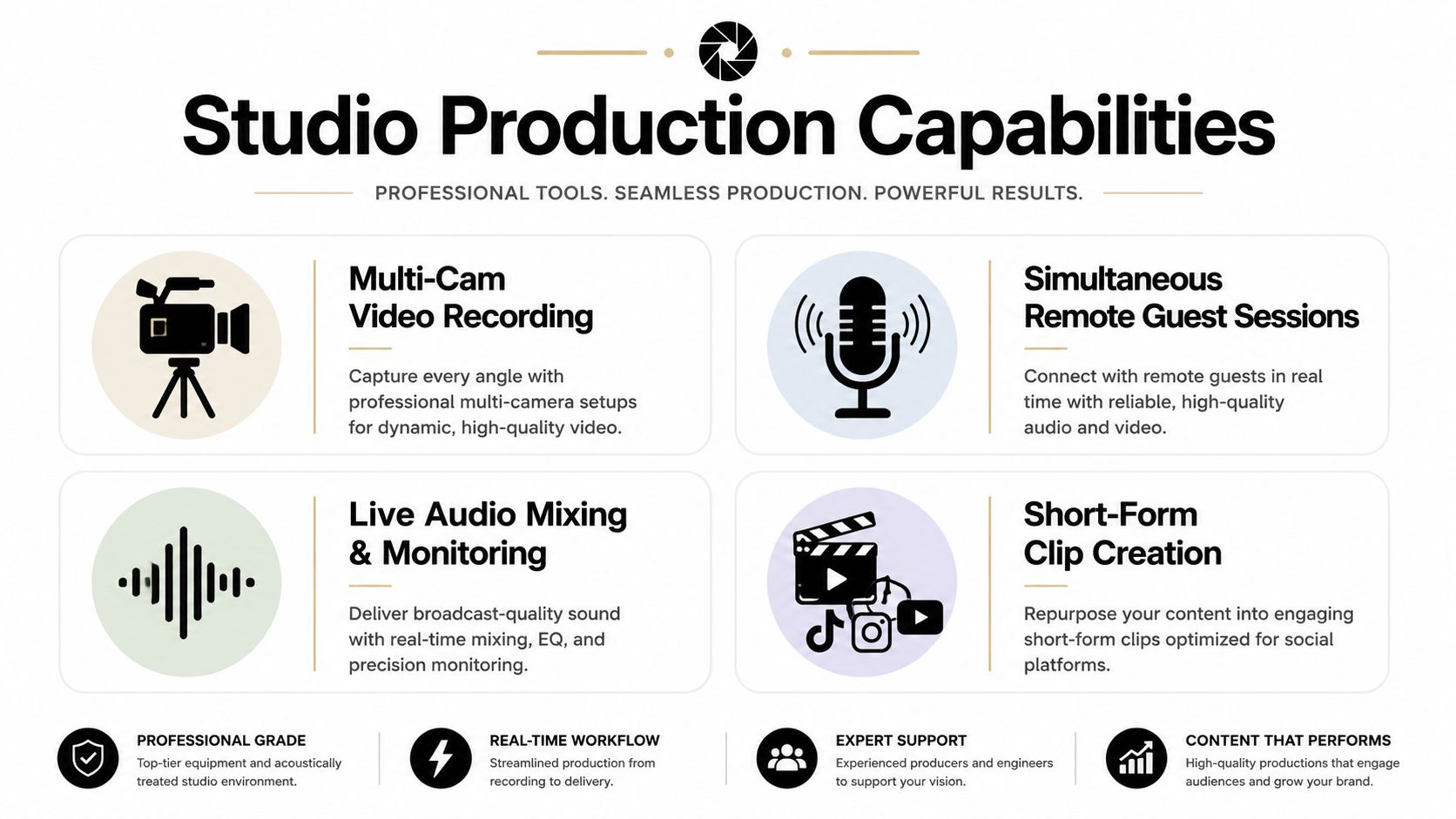
Consistency is the key advantage. The audience may meet your show through audio, video, a clip, or a search result, but they should still feel like they've found the same brand.
How to Evaluate and Choose a Studio Provider
The first question isn't whether a studio has polished walls and a nice camera. It's whether the studio fits the way you work right now. Recent creator data shows the market is still split, 49% of creators surveyed did not record video at all, while 34% recorded video for every episode, which tells you that buyers are still making real ROI decisions instead of following hype. The same dataset points to workflow and format as stronger decision factors than broad industry buzz. Castos' 2026 creator survey makes that split clear.
Start with your bottleneck
If your audio is already strong, don't pay extra for the wrong upgrade. If your editing is the problem, a nicer room won't fix that. If your guest experience is weak, look for a studio that removes friction before and after the session.
Then check the room itself. Ask how the space is treated, how the producer handles monitoring, and whether you can hear the difference between a raw room and a finished one. A provider that talks only about gear is usually skipping the harder question.
Ask what happens after recording
That part matters more than many buyers expect. If a studio records well but pushes editing, mixing, and delivery to outside vendors, you're inheriting extra coordination. A professional provider should be able to explain how the session moves from capture to output without making you act like the project manager.
Use a simple lens when comparing options. The podcast studio for rent near me search result should lead you to more than a price and a room photo. It should lead you to a process you can trust.
Watch for the hidden costs
A low hourly rate can turn expensive if engineering, editing, or delivery are billed separately in ways that interrupt your schedule. Transparent pricing is part of professionalism because it lets you plan the show without guessing where the next charge comes from.
The strongest studios are the ones that reduce uncertainty. They don't make you decode the process before you book it.
Why Top Creators Choose Flexwork Studios
Flexwork Podcast Studios in Springfield, New Jersey, is built around the practical side of making content that looks and sounds finished. The facility combines soundproof rooms, modern set design, and professional-grade audio and cinema equipment, so creators can record broadcast-quality episodes, reels, shorts, and livestreams in one place. For creators who want a more complete package, the studio also offers structured production support, and it provides options that can scale from a single session to a longer-term content plan. Flexwork's premium podcast studio page lays out the setting in more detail.
What that means in practice
The value isn't just the room, it's the handoff. Flexwork supports sound mixing, video editing, motion graphics and animation, show branding, podcast distribution, and growth-focused marketing, which keeps the production process from fragmenting into separate vendors. That matters for creators who want to move quickly without lowering the standard of the output.
Flexwork also offers studio rentals, Content Day sessions, podcast websites, and production packages such as Be My Podcast Producer and Market, Manage & Produce My Podcast. The service mix is designed for creators who want the production process handled in one ecosystem instead of stitched together after the fact.
If your show needs consistency, the studio should give you fewer moving parts, not more.
Why the decision gets easier here
The point of a professional studio is not just to sound better. It's to make the whole process easier to repeat, easier to scale, and easier to trust. That's the standard a creator feels when the room, the workflow, and the support all line up.
If your current setup is getting in the way of the show you want to build, Flexwork Podcast Studios can help you record, produce, and package it with more control and less stress. Visit Flexwork Podcast Studios to explore studio rentals, production packages, and Content Day options, then book a session that fits the way you work.