
What Is Podcast Production and How Does It Actually Work
 September 20, 202628 Minutes
Starting a podcast feels simple until you're the one in the chair. You've got a name in your notes app, a guest lined up, and a microphone in front of you. Then the questions show up. What are you supposed to prepare? How polished should the episode sound? Where does the video go? Who writes the show notes, clips the reels, uploads the files, and makes sure the whole thing looks like a brand instead of a side project?
That's where most first-time hosts get stuck. They think podcast production starts when they hit record. It doesn't. What is podcast production? It's the full system behind a show, from concept and setup to editing, publishing, and turning one session into a stack of usable content. If you're building a podcast in the NJ and NYC orbit, this is the point where a studio partner can save you from DIY burnout and help the show look as sharp as the idea behind it.
Primary keyword: what is podcast production
Secondary keywords: podcast production workflow, podcast studio rental, podcast production services
Meta description: Learn what podcast production is, how the workflow works, and how to turn one recording into a full content engine.
URL slug: /what-is-podcast-production
Inside a Studio Session on Day One
The room is quieter than you expected.
Not silent. Controlled.
The host leans toward the mic, testing a first sentence under their breath. A producer watches the levels, adjusts the headphones, and gives the kind of calm nod that says, “You're good. Just talk.” The red light comes on. The guest straightens up. Somebody reaches for a glass of water and suddenly every small detail matters. Chair height. Mic distance. Whether your intro sounds natural or memorized. Whether the room flatters your voice or exposes every hard consonant.
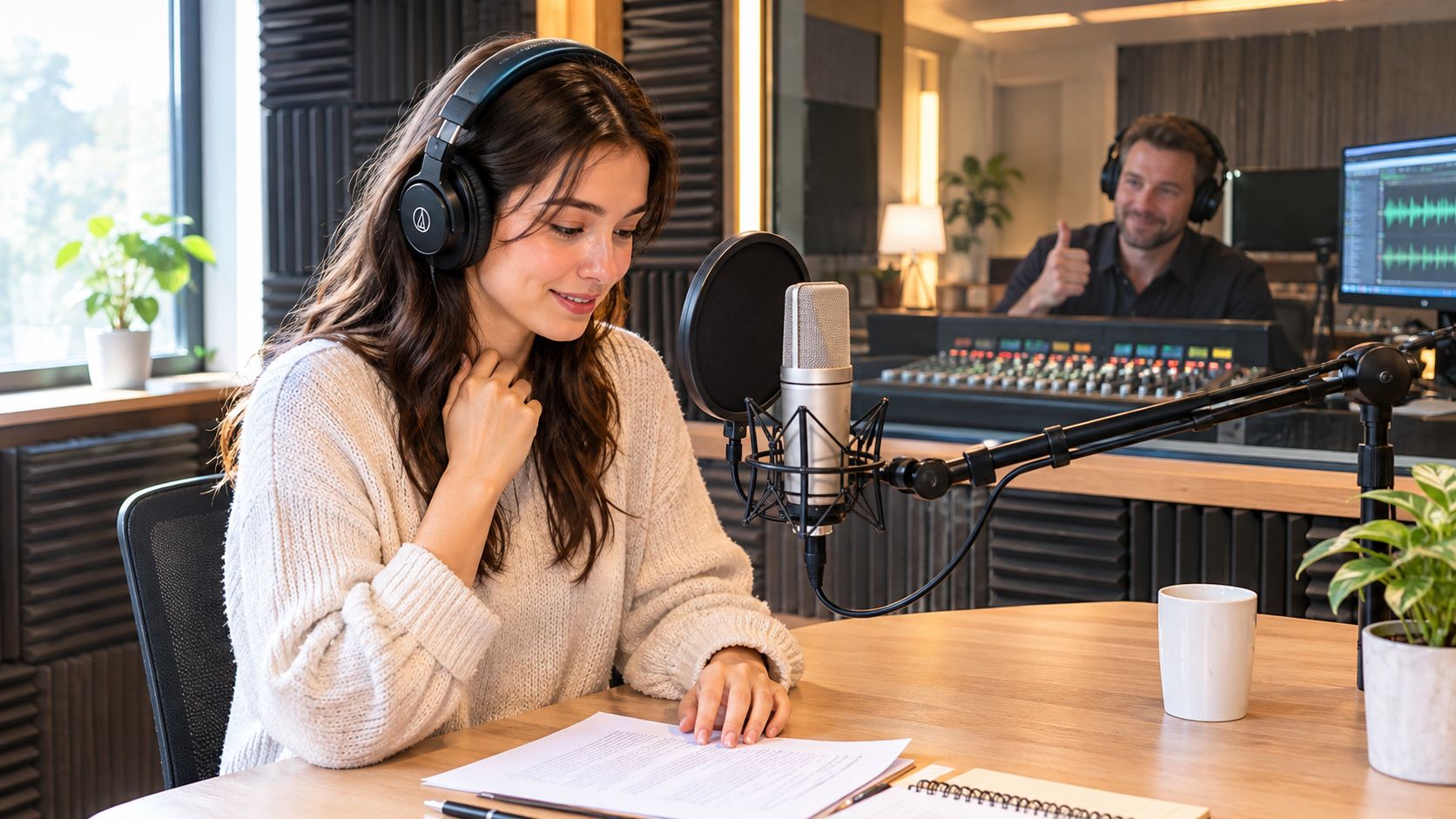
That first session teaches people something fast. Recording is only one slice of the job. Before the mic even went live, someone had already made decisions about the set, the audio chain, the run of show, the guest timing, and the look of the episode on camera. After the session ends, there's still the edit, the episode title, the platform upload, the clips, the captions, and the launch plan.
The booth hides a lot of invisible work
A first-time host usually notices the obvious pieces.
- The microphone: It shapes tone, clarity, and how forgiving the recording feels.
- The headphones: They let you catch mouth noise, plosives, and volume changes before they become editing problems.
- The producer cues: They keep the conversation moving when energy dips or an answer runs too long.
What new hosts usually miss is the friction hiding behind those details. If your mic placement is off, the editor pays for it later. If the room sounds boxy, no plugin can fully fake a clean recording. If nobody is tracking pickups, you end up hunting for fixes inside the edit.
Practical rule: The easiest episode to edit is the one that was produced well before anyone pressed record.
That's why studio support matters most in the moments that look least dramatic. The hand signal to pause. The quick reset before a better intro take. The producer who knows when to let a conversation breathe and when to jump in. If you want a sense of how that works in practice, this behind-the-scenes day at a New Jersey podcast studio shows the kind of coordination that turns “we recorded something” into “we made an episode worth publishing.”
What Podcast Production Actually Means
The question is often answered too narrowly. It is said that podcast production is recording, editing, and publishing.
That's part of it, but it's not the whole thing.
Podcast production is the complete process of turning an idea into a show that people can hear, watch, recognize, and return to. It covers planning, capture, polish, packaging, distribution, and promotion. A helpful way to think about it is as three connected phases: pre-production, production, and post-production, which is the common framework outlined by Amaze Media Labs on podcast production.
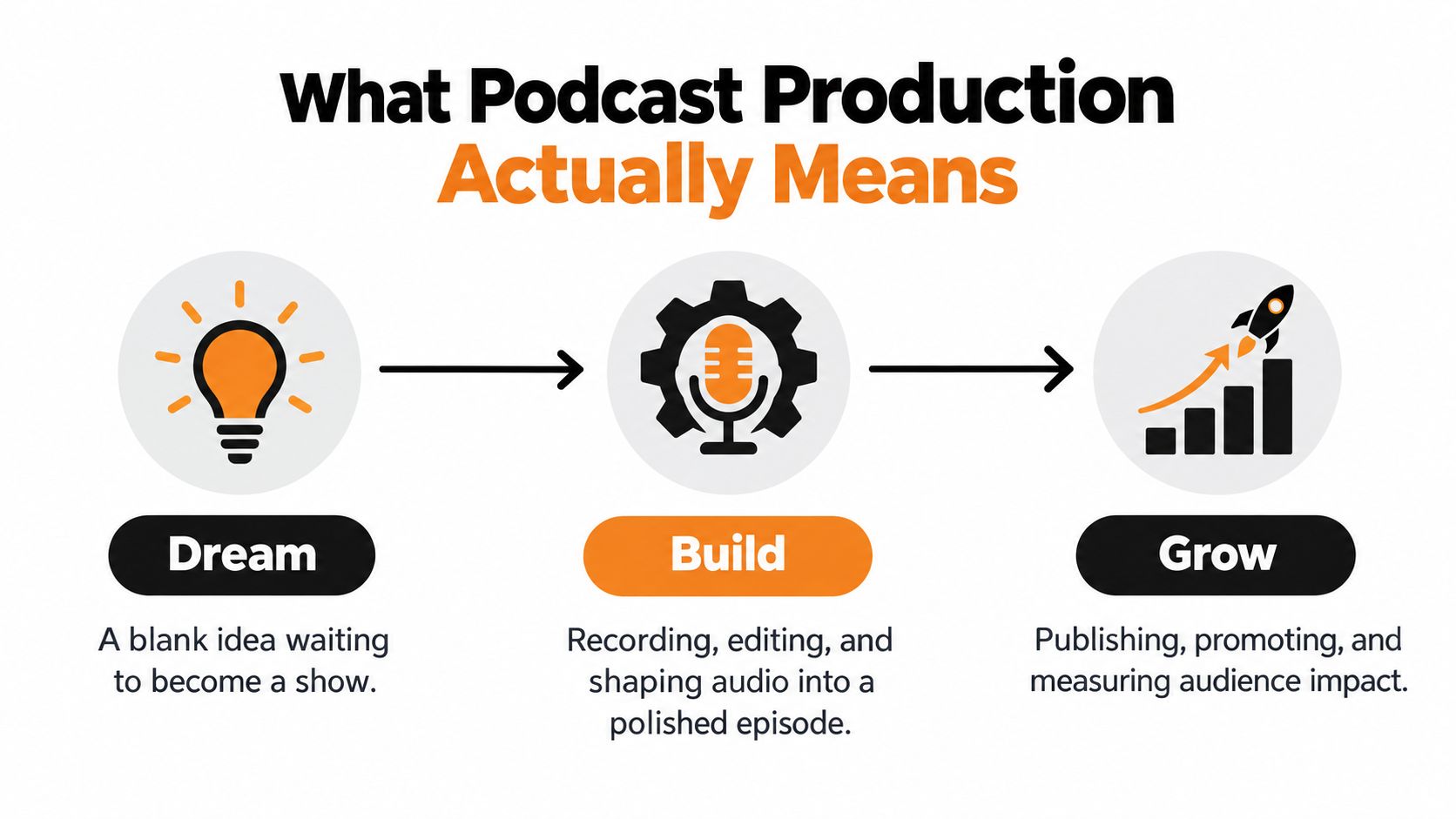
Dream means pre-production
This is the blueprint stage. You decide what the show is about, who it's for, how long episodes should feel, whether the format is solo, interview, or panel, and what kind of guest or topic fits the brand.
A lot of beginner confusion starts here because the work doesn't feel “real” yet. But this stage determines whether your show sounds focused or scattered.
Typical pre-production decisions include:
- Audience fit: Are you talking to clients, fans, peers, or a niche community?
- Format choice: Does your energy work better in conversation, teaching, or commentary?
- Episode architecture: Intro, cold open, segment breaks, guest Q&A, closing CTA.
Build means production
This is the recording phase, but it includes more than speaking into a mic. The room has to be set. Levels have to be checked. The host may need direction on pacing, energy, and how to recover from mistakes without sounding stiff.
For guest-based shows, this is also where hospitality becomes production. If the guest feels rushed, awkward, or unsure where to look on camera, the final episode carries that tension.
Later in the process, a good visual reference helps non-technical hosts understand the flow. This short video does that well.
Grow means post-production
Raw material becomes a finished media product. The editor tightens dialogue, removes distractions, shapes pacing, balances sound, and prepares files for release. The publisher handles metadata, show notes, artwork, platform delivery, and launch assets.
Better production doesn't just make a show sound cleaner. It makes the show easier to trust.
If you're still sorting out physical setup before you ever get to editing, this guide to podcast studio for guest booking is useful because it walks through the environment side of the experience, which many beginners underestimate.
The End-to-End Production Workflow
A podcast doesn't move from idea to Apple Podcasts in one leap. It moves through checkpoints. Every checkpoint produces something tangible, and each one creates a new decision for the host.
One practical workflow published by Rokuse estimates planning at 2 to 4 weeks, recording prep at 1 to 2 weeks per episode, recording at 1 to 2 hours per episode, editing at 1 to 3 days per episode, and first-time release propagation at 2 to 3 days. Those ranges are useful because they show what first-time hosts often miss. The recording itself is rarely the longest part.
What happens before the mic turns on
The early stage has less glamour and more influence. You name the show, define the audience, write or outline the pilot, map your first few episodes, and decide how the show should look and sound across platforms.
The core deliverables in this stage usually include:
- Show concept and positioning: A one-sentence promise for the audience.
- Episode list: Enough ideas to keep momentum after launch week.
- Recording plan: Guest schedule, host outline, set design, and call sheet.
A weak plan creates strong excuses. Most abandoned shows don't fail at talking. They fail at repeatability.
What happens on recording day
This is the stage people know, but even here the workflow branches. You'll capture raw audio, sometimes multi-camera video, pickups for flubbed lines, room tone, and a clean version of the intro or outro if needed.
The decisions get practical fast. Do you stop and redo that sentence, or keep rolling and fix it later? Do you leave a tangent because it has personality, or cut it because it slows the episode? Someone has to make those calls.
What happens after recording
Post-production is where quality either compounds or collapses. The editor shapes the conversation, the mixer evens out the sound, and the production team exports a finished master. For publishing, the final episode often goes out as an MP3 with ID3 metadata like title, show name, artwork, and episode number, then gets uploaded to a host that creates an RSS feed for directories such as Apple Podcasts and Spotify, as described by LA Film School's podcast publishing overview.
Apple Podcasts also recommends preconditioning podcast audio to around -16 dB LKFS with a +/-1 dB tolerance and a true-peak ceiling of -1 dB FS, calculated using ITU-R BS.1770-5, which helps maintain consistency when platforms normalize playback, according to Critical Listening Lab's Apple Podcasts loudness summary.
A strong post workflow also creates support assets:
- Episode master: Final audio file ready for hosting
- Transcript: Useful for accessibility, search, and derivative content
- Show notes and episode page: The written frame around the conversation
- Social cutdowns: Clips, reels, trailers, or audiograms
- Platform packaging: Artwork, metadata, and release scheduling
Podcast Production Stages, Deliverables, and Typical Timelines
| Stage | Key Deliverables | Typical Timeline |
|---|---|---|
| Planning | concept, audience definition, format, initial episode map | 2 to 4 weeks |
| Recording prep | outline, guest scheduling, tech setup, room prep | 1 to 2 weeks per episode |
| Recording | raw audio, raw video, pickups, session notes | 1 to 2 hours per episode |
| Editing | dialogue cleanup, pacing edit, sound polish, episode master | 1 to 3 days per episode |
| First release setup | host upload, RSS feed submission, directory propagation | 2 to 3 days |
A more detailed podcast production workflow breakdown is useful when you're trying to see where your own process is slowing down.
Studio Versus DIY and the Real Tradeoffs
You finish a strong interview, hit stop, and feel great for about five minutes. Then the next shift starts. One file needs cleanup. Another guest track is low. The episode title still is not written. Clips are not cut. The thumbnail is sitting in a draft folder. What looked like “recording a podcast” turns out to be a small production line.
DIY podcasting works well for testing ideas, building reps, and learning your own style. It also asks one person to run every station in that production line. You are the host in front of the mic, then the engineer in headphones, then the editor trimming pauses, then the publisher loading files and metadata.
A studio changes the shape of that work. You still own the voice and the message. The partner handles the parts that slow momentum. At Flexwork, that usually means recording support, editing, packaging, and release help, so the show keeps moving instead of stalling between steps.
The four tradeoffs that matter
The first tradeoff is time.
Home recording feels fast because there is no commute and no booking calendar. But the saved hour often comes back later in smaller pieces. Noise cleanup, guest tech problems, exports, file naming, thumbnails, show notes, and publishing checks all take a turn. A studio team removes those handoffs. Flexwork, for example, can take raw session files and turn them into a finished episode package, which gives the host their calendar back.
The second tradeoff is consistency.
Listeners may not know why one episode feels clean and another feels thin, boxy, or uneven. They still hear the difference. Consistency comes from the room, the mic chain, the session setup, and the edit choices staying steady week after week. A studio gives you that repeatable environment. Flexwork also extends that consistency into post, so the sound, titles, assets, and delivery format stop changing from episode to episode.
The third tradeoff is control.
New hosts often confuse control with doing everything by hand. Real control is knowing the final result will match the standard you promised your audience. DIY gives you direct access to every knob and every export setting. A studio gives you a process, checkpoints, and specialists who catch problems early. That means fewer surprises on release day.
The fourth tradeoff is content output.
DIY often ends with one finished audio file because the host is out of time. A studio can treat the session like a content factory. One recording can feed the episode, transcripts, clips, graphics, and posting support if the workflow is built for repurposing from the start. That is where a partner removes friction beyond audio polish.
Studio vs DIY Tradeoffs
| Factor | DIY Setup | Full-Service Studio |
|---|---|---|
| Cost | Separate purchases and subscriptions spread across gear, software, and upgrades | One bundled production expense tied to recording and post-production services |
| Time | Host handles setup, troubleshooting, editing, upload, and follow-up tasks | Team handles technical workflow so host can focus on the conversation |
| Quality | Depends on room treatment, mic technique, and editing skill | More consistent capture environment and managed post-production |
| Control | Maximum hands-on decision-making, maximum responsibility | Shared process with support from producer, engineer, and editor |
Who should pick which path
DIY makes sense when the show is still in workshop mode. You are testing your voice, trying formats, and deciding whether the idea deserves a bigger system around it.
A studio fit becomes clearer when the show supports a business, a founder brand, recruiting, sales, or a campaign with fixed dates. In those cases, the question is less about pride and more about throughput. Can one recording become a reliable stream of publish-ready assets without pulling the host into hours of production work? This studio versus DIY podcasting comparison helps answer that with practical examples.
Turning One Recording Into a Full Content Engine
Modern podcast production changes shape.
A common picture of a podcast is still one finished audio file. That's outdated. Production now works more like an asset factory. One strong recording session can feed a full month of content if the session is captured and edited with repurposing in mind.
Industry commentary in 2026 keeps returning to this shift. Production is no longer just audio post. It's the system that turns a single conversation into video episodes, clips, shorts, show notes, and written content, as noted in PodMuse's 2026 podcast trends article.

One session, many outputs
A single episode can usually produce a stack of formats if the team marks key moments during or right after recording.
- Full episode audio: The anchor asset for Apple Podcasts, Spotify, and other listening platforms
- Short video clips: Good for vertical formats where the hook has to land fast
- Audiograms: Useful when video isn't available or the quote carries the moment
- Quote cards: Strong for LinkedIn, newsletters, and guest promotion
- Transcript excerpts: Easy raw material for blogs, captions, and SEO pages
The editorial thinking matters as much as the editing. Not every smart answer becomes a good clip. Some moments work because of facial expression, some because of phrasing, and some because they answer a specific objection your audience keeps hearing.
Why package design matters
Production services become more than cleanup. If your process ends at “episode delivered,” you leave value on the table. If your process is designed around reuse, the recording day does much more work for you.
For creators who batch content, Content Days are $3000/day and include 20 edited reels or 60 pro photos. That pricing structure makes sense when you think of production as a content engine rather than a single deliverable. Podcast websites also fit this model because they give every episode a durable home. Podcast websites are $5000 plus hosting.
A useful example of this asset-first mindset appears in this guide on how to repurpose a single podcast episode into 10 pieces of content, which shows how one conversation can extend well beyond its original release.
Roles, Packages, and Timelines That Power a Show
Professional podcasting looks smooth because different people own different parts of the machine.
The host is the face and voice. Everyone else protects the outcome.
Who does what
The producer owns the shape of the show. That can include strategy, guest booking, prep documents, run of show, title direction, and making sure the episode supports a larger series arc.
The engineer handles capture quality. They manage room sound, microphone placement, signal flow, monitoring, and file integrity.
The editor turns the session into something watchable and listenable. They tighten pacing, remove friction, balance music, smooth transitions, and prep final exports.
The marketer or distribution lead takes it from finished file to published asset. That includes uploads, transcripts, clips, scheduling, and launch coordination.

How timelines work when a team is involved
When one team owns these handoffs, the launch process feels shorter because fewer files are bouncing between freelancers. The planning still matters, but the momentum is steadier.
One practical setup is to batch pre-production, record in concentrated sessions, and let post-production run in parallel with artwork, pages, and distribution prep. That structure is one reason many business podcasts feel organized from episode one instead of finding themselves in public.
Clean launches come from clean ownership. If nobody clearly owns the next step, the show stalls between “almost done” and “never shipped.”
For teams that need support beyond editing, package structure matters. Content Days are $3000/day and include 20 edited reels or 60 pro photos. For growth-oriented support, the Market & Manage tier starts at $1500 per episode with a 20-episode growth commitment. If your show also needs a dedicated web home, podcast websites are $5000 plus hosting.
One option in this category is Flexwork Podcast Studios, which offers studio rentals, producer support, editing, distribution, and website services under one roof. If you want a practical look at how those pieces are bundled, this podcast production services pricing page for 2026 lays out the package logic.
Launching Faster and Scaling With the Right Partner
A podcast usually doesn't grow because the host suddenly finds extra hours. It grows because the production burden stops living on the host's calendar.
That shift matters more now because the category is crowded. An industry roundup cited by AMW said there were about 4.58 million podcasts worldwide in January 2026, but only roughly 450,000 had published new episodes in the previous 90 days. The same source estimated the global podcast listener base at about 584.1 million in 2025, with projections reaching roughly 619 million by the end of 2026. The takeaway isn't just scale. It's that consistency is what separates a live show from an abandoned one.
What changes when production becomes a system
A partner absorbs repeatable tasks so the host can stay in their highest-value role: showing up prepared, interviewing well, and building a recognizable voice. Recording can be batched. Edits can move while artwork and metadata are being finalized. Clips and pages can be prepared before release day instead of after.
That same system also scales better when your ambitions change. If the show expands from audio to video, or from weekly episodes to a fuller content program, the process doesn't need to be reinvented from scratch. More hands can enter the workflow without the host turning into project manager.
Signs it's time to stop winging it
You're probably ready for more support if any of these feel familiar:
- Episodes keep slipping: Recording happens, but publishing keeps getting delayed.
- Your content dies after release day: The episode goes live and nothing else gets made from it.
- You've outgrown solo tools: The show now supports a brand, a team, or a business objective.
If you're still in the earliest planning phase and need a light way to organize ideas before formal production begins, tools like first steps with LunaBloom can help you sketch content direction and prep habits before you lock in a larger workflow.
Podcasting itself has grown up fast. A 2026 industry summary reported about 214 million total podcast episodes globally, up from 168 million in 2024, a 27% increase in two years, according to SearchLab's 2026 podcast statistics. That's why production now means more than recording. The shows that last are built like media operations, even when the host wants the conversation to feel effortless.
If you want that kind of support, Flexwork Podcast Studios offers studio rentals, production packages, Content Day sessions, and podcast website builds for creators who want a cleaner path from concept to launch. If your goal is to stop juggling gear, edits, clips, and distribution on your own, it's a smart place to turn one recording session into a repeatable content system.