
Podcast Editing Rates: What to Expect in 2026
 September 4, 202621 Minutes
Basic podcast editing typically costs $50 to $150 per episode, while full production packages with mixing, video, and clips can range from $450 to over $2,000 per episode depending on complexity. The right podcast editing rates depend less on recording length than on how much work stands between a raw conversation and a finished media asset.
You've just wrapped a strong interview. The guest delivered sharp insights, the conversation had energy, and you can already see the clips working on social media. Then you open the raw files and face the reality: uneven levels, interruptions, long pauses, camera angles, captions, music, show notes, and distribution still sit between the recording and publication.
That's why a serious podcast budget should cover total production value, not audio cleanup alone. This guide breaks down podcast editing rates, pricing models, service tiers, hidden cost drivers, and practical budget scenarios for creators who want a polished show without paying blindly. It also shows where Flexwork Studios fits, from studio rentals and production packages to Content Day sessions and podcast websites.
Why Podcast Editing Costs More Than You Think
The first mistake most creators make is treating editing as a single task. A recording might be one hour long, but the finished episode can require multiple passes across dialogue, music, video, branding, captions, and promotional assets. A clean interview with two well-recorded voices demands a different workflow from a narrative episode built from multiple tracks and heavy sound design.
A creator working alone often discovers this after the interview ends. The raw recording contains a guest who speaks too softly, a host who interrupts, a notification sound buried under a key answer, and several sections that need structural trimming. The creator can either spend the next stretch of free time learning a digital audio workstation or hire someone who already knows how to make those decisions quickly.
Practical rule: Budget for the episode your audience will receive, not the file you captured.
The market reflects that difference. Basic freelance editing for a standard 60-minute interview show generally sits around $50 to $150 per episode, while complex edits involving mixing, music, and mastering commonly reach $135 to $360. Premium full-production packages can reach $450 to $1,050 for the same episode length, according to a 2026 podcast production rate guide.
Scope determines the quote
Editors price the layers they must manage. Those layers can include:
- Dialogue cleanup: Removing distracting noise, clicks, false starts, and excessive silence.
- Editorial shaping: Tightening the conversation while preserving the guest's meaning and personality.
- Audio finishing: Balancing voices, music, transitions, and final loudness.
- Video production: Selecting camera angles, switching between speakers, correcting color, and preparing the final frame.
- Content repurposing: Creating clips, captions, audiograms, show notes, or trailers.
The more decisions an editor must make, the less useful a bare hourly comparison becomes. Flexwork's audio editing service is relevant for creators who want to define the desired output before production begins, rather than discovering extra work after the quote has been approved.
For a practical workflow reference, Isolate Audio's podcast production tips can help creators organize recording files, editing notes, approvals, and publishing tasks. Better organization won't turn a basic edit into a cinematic production, but it can reduce confusion and protect the budget.
Hourly vs Per-Episode vs Subscription Pricing Models
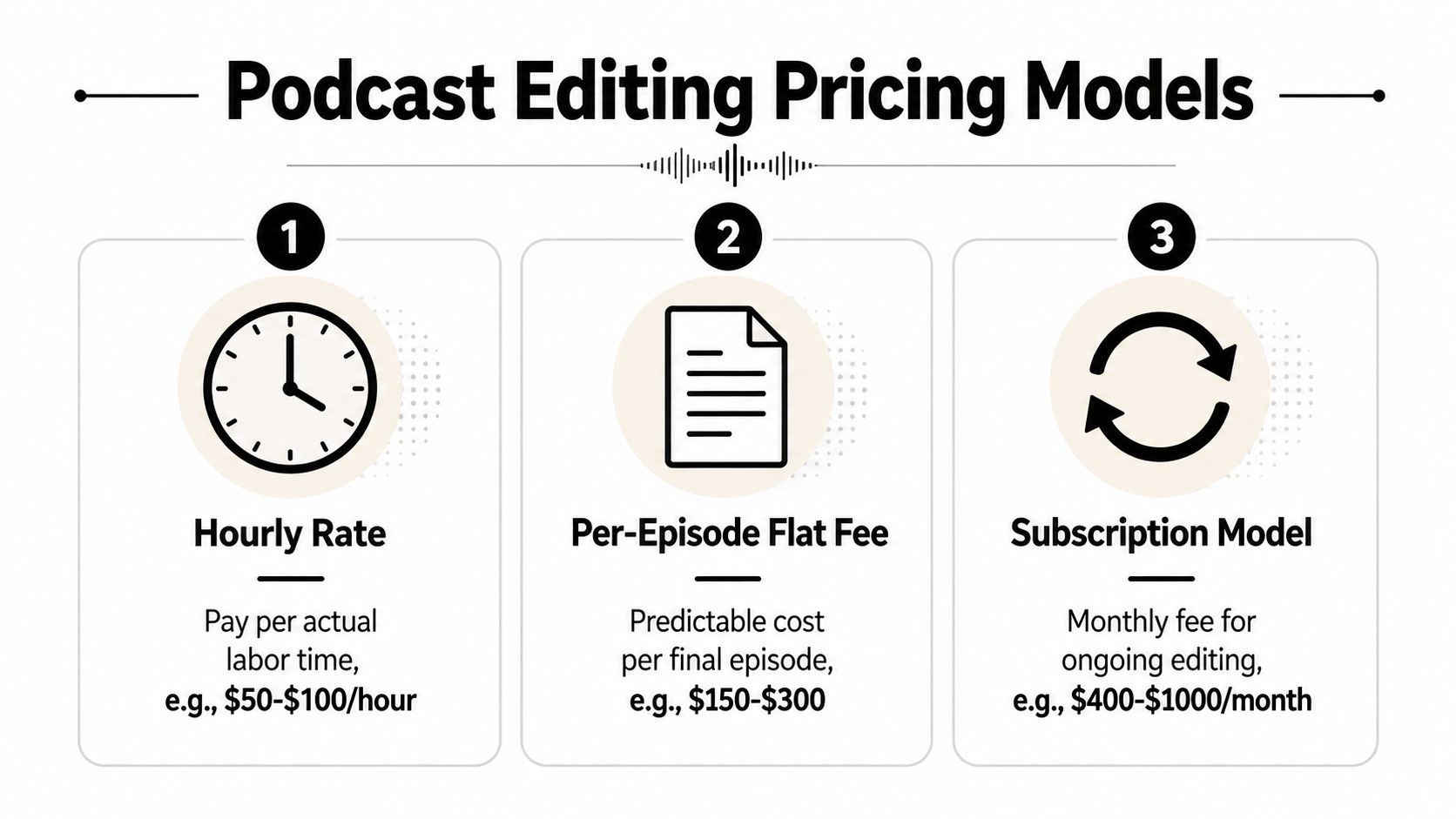
Podcast editing rates usually appear in three formats: hourly pricing, a flat fee per finished episode, or a recurring subscription and retainer. None is automatically superior. The right choice depends on how predictable your format is, how often you publish, and whether you need editing alone or a production partner.
Hourly pricing
Hourly editing makes sense when the project scope is uncertain. A new show may need a test edit, a complicated cleanup pass, or editorial consulting before both sides understand the recurring workload.
The 2026 hourly ladder is clear: junior editors often charge $25 to $40 per hour, experienced editors $50 to $100 per hour, and specialized audio engineers $100 to $200 per hour, as outlined in Rise25's podcast production pricing breakdown.
Hourly pricing works well for:
- One-off experiments: You're testing a format before committing to a recurring schedule.
- Irregular projects: Episodes vary dramatically in length, guest count, or style.
- Consulting-heavy work: You need editorial direction as well as technical execution.
The weakness is budget uncertainty. A quote based on labor time can expand when the recording needs additional restoration, revisions, or restructuring. Set a maximum approved scope and define what happens when the editor reaches it.
Per-episode pricing
A flat episode fee offers cleaner budgeting. You pay for a defined deliverable, such as a publishing-ready audio episode or a full video edit. This model works best when your recording setup, format, and approval process stay consistent.
The phrase finished episode must be defined carefully. Does it include noise reduction, content cuts, music, mastering, show notes, captions, vertical clips, and distribution? If the answer isn't written down, the same phrase can mean very different work to a creator and an editor.
A flat fee is the strongest fit for a repeatable interview show with a stable format. Ask for a revision policy, turnaround expectations, file specifications, and a list of included deliverables before approving the package.
Subscription and retainer pricing
Recurring pricing suits creators who publish consistently and want capacity reserved for production. Full-service packages are often structured as monthly retainers, with some 2026 guides citing $1,000 to $3,000 or more per month for four episodes. Transcripts, audiograms, show notes, and clips can push the total beyond basic editing, according to Awkward Sage's 2026 podcast editing cost guide.
A retainer can include:
- A set number of episodes.
- Standard editing and mixing.
- Video exports or short-form clips.
- Show notes and transcript coordination.
- Scheduled review and approval windows.
Choose this model when consistency matters more than finding the cheapest individual invoice. Before signing, compare plan options with attention to scope, revision limits, asset ownership, turnaround, and cancellation terms. For creators who need a physical production environment as well as post-production, Flexwork's podcast studio rental rates can be evaluated alongside editing costs, not as a substitute for them.
Current Market Rates for Every Service Tier
A useful quote should tell you what the editor is doing, not merely what the final episode costs. The following benchmarks place common 2026 podcast editing rates into practical tiers, using a standard 60-minute interview as the reference point where applicable.
| Service Tier | Per-Episode Range | Typical Deliverables |
|---|---|---|
| Basic freelance editing | $50 to $150 | Cleanup, level balancing, basic cuts |
| Complex audio editing | $135 to $360 | Mixing, music, mastering, deeper editorial work |
| Premium full production | $450 to $1,050 | Full audio production, expanded editorial work, broader deliverables |
These ranges come from the 2026 Freelancerates podcast editor guide. They're benchmarks, not automatic price tags. A quote at the lower end can be appropriate for clean recordings and a narrow scope. It can also be inadequate if the project includes multiple tracks, extensive content changes, or video.
Basic editing is a narrow service
Basic editing is appropriate when the conversation is already well structured and the recording quality is reliable. The editor may remove obvious mistakes, reduce distracting sounds, balance levels, and prepare a final audio file.
This tier is useful for a disciplined solo creator with a repeatable format. It isn't the right place to expect deep storytelling, extensive sound design, multiple social assets, and detailed brand treatment.
Mid-tier production adds editorial judgment
Complex audio editing adds more than technical polish. The editor may shape pacing, manage music, mix several elements, and master the finished file for consistent listening. That work requires judgment because every cut changes the rhythm and meaning of the conversation.
Independent 2026 guides also place standard interview edits around $45 to $180 per finished episode, with advanced narrative or sound-design-heavy work reaching approximately $200 to $650 per episode. The same market breakdown places US freelance hourly pricing at $25 to $40 for basic cleanup, $45 to $75 for standard interview editing, and $85 to $150 for premium narrative production, according to PodVenues' 2026 podcast editing report.
Premium production is a different purchase
Premium production is for creators who need a finished media system, not an exported audio file. It may involve story structure, detailed sound design, brand consistency, video, clips, captions, and publishing support.
Independent 2026 rate guides place basic editing around $50 to $100 per episode, mid-tier professional work around $150 to $350, and senior or specialist editing around $350 to $600. Narrative shows with heavy sound design can reach $2,000 or more per episode, as reported by Freelance Figures.
Use Flexwork's podcast production services as a reference point when comparing a production quote with a broader service package. The question isn't whether a premium quote looks high. The question is whether the deliverables justify the price and support the way you plan to publish.
Hidden Cost Drivers That Inflate Your Bill
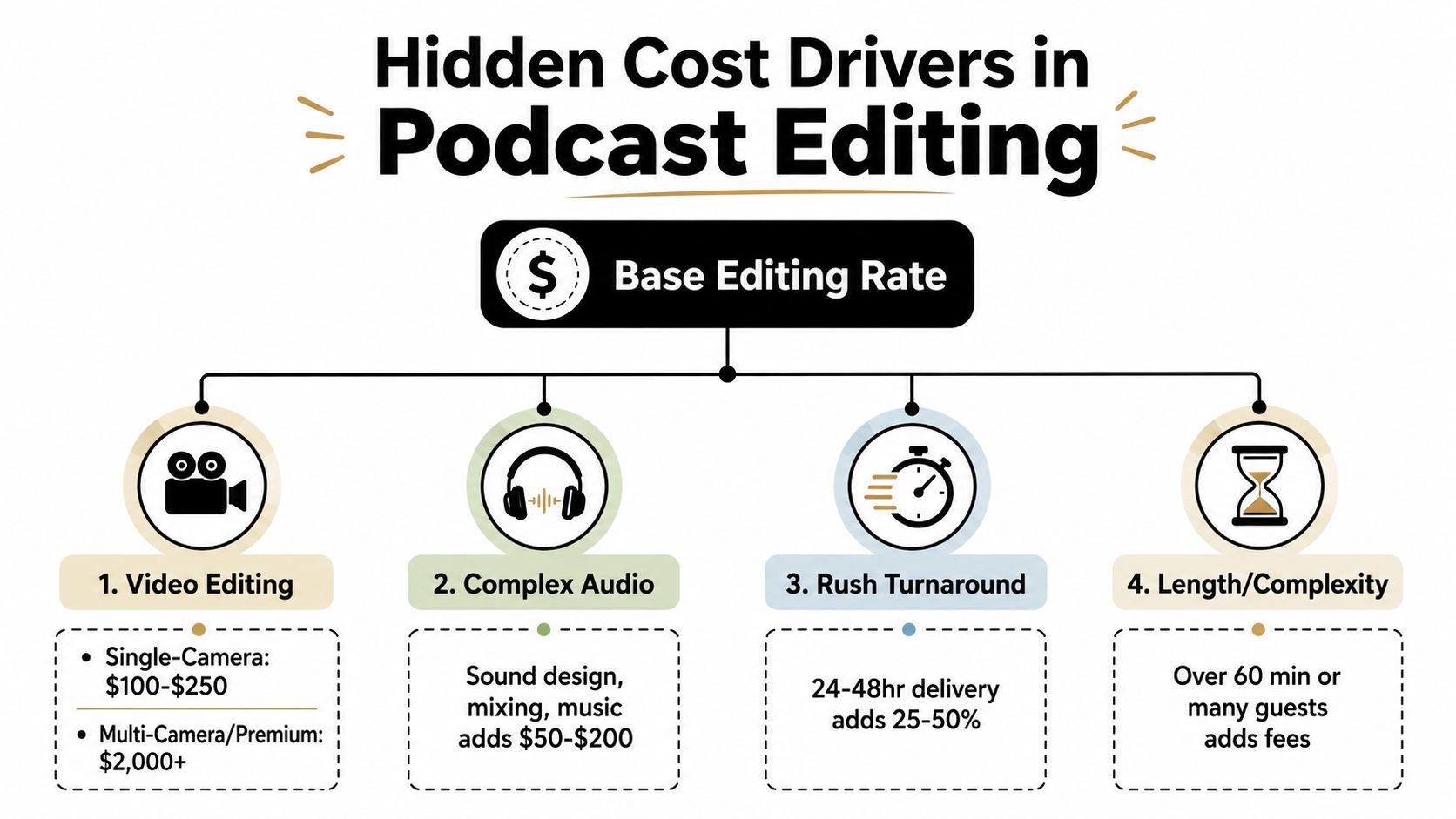
The raw length of an episode matters, but it isn't the primary cost driver. Edit layer count is more revealing. Each additional layer creates more decisions, more quality control, and more opportunities for revisions.
Video changes the category
Video podcast editing isn't just audio editing with a camera file attached. The editor must manage framing, camera selection, cuts, color, graphics, aspect ratios, and export versions.
Current 2026 video podcast rates commonly fall into these bands:
- Single-camera episodes: About $100 to $250.
- Multicam episodes: About $200 to $600.
- Premium branded shows: About $600 to $2,000 or more.
These figures come from Video Editing Company's 2026 podcast editing rates. Video deserves its own line item in your budget because it creates a separate post-production workflow.
Audio complexity creates invisible labor
A polished audio mix can involve multiple speakers, music, transitions, room tone, and brand elements. Remote recordings may need more repair than controlled studio recordings, while narrative shows require deliberate pacing and sound design.
Ask your editor to identify the audio layers included in the quote. “Mixing” can mean simple level balancing, or it can mean a detailed production pass across dialogue, music, effects, and transitions.
Speed carries a premium
Rush delivery compresses the editor's schedule. If you need an episode turned around immediately, the editor may have to move other work, extend production hours, or reserve capacity that could have served another client.
Agree on the standard turnaround before recording. If speed becomes a recurring requirement, a subscription or retainer is often more sensible than repeatedly negotiating emergency work.
Repurposing expands the deliverable set
Transcripts, audiograms, show notes, captions, trailers, and short-form clips all add value, but they aren't free extensions of the audio edit. Each asset needs selection, formatting, review, and sometimes platform-specific resizing.
Use Flexwork's guide to editing podcast audio to clarify which parts of the process you can prepare internally and which require professional post-production. Then request a quote that separates the core episode from optional growth assets.
A low base rate can become expensive when every useful deliverable appears as an add-on.
Realistic Budget Scenarios for Every Creator Stage
Your budget should reflect your operating model. A solo entrepreneur doesn't need the same production stack as a brand building a visual content engine, and a premium narrative show shouldn't be priced like a lightly edited interview.
The lean interview show
A solo founder launching an interview podcast can start with a controlled scope: reliable recording, basic cleanup, level balancing, and a publishing-ready audio file. The priority is consistency. Spend on clean capture and dependable editing before adding elaborate sound design or a large clip package.
Hourly studio rentals can make sense for this stage because they provide a professional recording environment without requiring a full production commitment. Keep the format stable, create a repeatable intro and outro, and document your approval process so each episode doesn't become a new project.
The growing brand
A brand with a video-first show needs a larger asset plan. The episode may include a full video edit, selected clips, captions, and visual consistency across platforms. Video podcast edits alone commonly range from $100 to $250 for single-camera, $200 to $600 for multicam, and $600 to $2,000 or more for premium branded shows, based on the video podcast rate data cited earlier.
For high-volume visual production, Flexwork's Content Day costs $3,000 per day and includes 20 edited reels or 60 professional photos. That structure is useful when the goal is to create a library of marketing assets from one organized production session, rather than commissioning every short-form asset separately.
The premium production
A premium show pays for editorial leadership, sound quality, video, brand treatment, distribution, and a reliable operating rhythm. Full-service packages are often priced as retainers, with some 2026 guides citing $1,000 to $3,000 or more per month for four episodes, before additional deliverables expand the scope, according to the previously linked Awkward Sage guide.
Creators focused on audience growth can evaluate Flexwork's Market, Manage & Produce My Podcast package, which starts at $1,500 per episode with a 20-episode growth commitment. That isn't a basic editing purchase. It represents a broader production and growth decision, so it should be assessed against publishing goals, available internal time, and the value of having one team manage connected tasks.
How to Negotiate and Package Your Editing Services
The strongest negotiation starts before the first file reaches the editor. Write a production brief that defines the episode format, expected runtime, recording method, number of speakers, music requirements, video outputs, clip requirements, revision rounds, turnaround, and delivery format.
Separate must-have deliverables from growth assets. The finished episode is one line item. Video, captions, trailers, audiograms, transcripts, show notes, and distribution should appear as distinct items so you can decide what to add without losing control of the core production.
Protect the scope
Ask these questions before approving a quote:
- What counts as a revision? Clarify whether revisions cover factual corrections, creative changes, or both.
- What does the fee include? Require a deliverables list rather than relying on “full edit.”
- Who owns the files? Confirm access to final exports and project assets where relevant.
- What happens when the format changes? A new multicam setup or narrative structure may require a new scope.
- How are rush requests handled? Agree on availability and pricing before urgency appears.
A monthly bundle can offer better operational value when your episodes share a format. The editor can reuse templates, brand elements, and production notes, while you receive a predictable workflow. But don't accept a retainer that hides unused capacity or vague deliverables.
For clean purchasing, use structured documentation. AurenWell's estimate and invoice templates can help creators and small teams organize approvals, line items, payment terms, and project records.
Finally, connect editing with distribution when audience growth is part of the business objective. Flexwork's podcast production workflow reflects the broader principle that recording, post-production, publishing, and promotion work better when the handoffs are deliberate.
Flexwork Podcast Studios offers studio rentals, podcast production packages, Content Day sessions, video editing, sound mixing, and podcast websites for creators who want to manage the full production value of a show. Visit Flexwork Podcast Studios to book a studio tour, review the available production options, and build an editing scope that matches your ambitions.