
Video Editing Services That Turn Raw Footage Into Growth
 September 5, 202624 Minutes
A strong episode can still lose momentum after recording. The cameras are rolling, the conversation is thoughtful, and the footage looks promising, but the raw files quickly become a backlog of sync work, awkward pauses, audio fixes, captions, exports, and unfinished clips. For ambitious podcasters, creators, and brands, DIY editing often turns publishing into a second full-time job.
That's where professional video editing services change the equation. The right partner doesn't just remove mistakes. They shape a clear story, protect your visual identity, create platform-ready versions, and help one recording session work harder across your marketing. Flexwork Studios, a Springfield, New Jersey production hub, connects studio capture with post-production so creators can move from raw footage to polished content without losing creative control. This guide breaks down what editing includes, how service tiers work, which operating model fits your goals, and how to choose a partner that supports growth.
Introduction Why Great Footage Still Needs Great Editing
Maya records a weekly business podcast in a carefully designed studio. Her guests are strong, the conversations are useful, and the camera setup captures a clean two-person frame. Yet by Friday, the episode is still sitting on a hard drive. She spends evenings trimming pauses, balancing voices, adding captions, and trying to find a short clip that makes sense without the full conversation.
The problem isn't a lack of content. It's the gap between capturing footage and creating something people want to watch. Raw footage contains possibility, but it rarely contains a finished narrative, polished sound mix, consistent color, or a useful distribution plan.
A professional editor turns that unfinished material into an editorial system. The process can include long-form episode assembly, vertical reels, captions, motion graphics, audio cleanup, thumbnails, and delivery formats for different platforms. You can explore the role of a structured video editing workflow when you're ready to replace ad hoc fixes with a repeatable process.
Flexwork Studios helps creators make that shift through studio rentals, podcast production packages, Content Day sessions, and podcast websites. The sections ahead clarify what you're buying, how tiers affect the result, and how to decide whether an in-house editor, freelancer, agency, or studio partner makes sense.
What Professional Video Editing Services Actually Include
Think of editing as architecture. Raw footage is the building material, while the finished episode is the structure people experience. An editor reviews what's available, chooses what belongs, creates a logical flow, and finishes every visible and audible surface so the audience can stay focused on the message.

The foundation is editorial judgment
The first pass is more than dragging clips onto a timeline. An editor reviews the footage, identifies the strongest answers, removes repetition, and decides where the conversation needs breathing room. For a podcast, that might mean protecting a guest's complete thought while cutting a long detour. For a brand video, it could mean leading with the clearest business insight instead of following the order in which the interview happened.
That judgment separates a basic cut from a strategic edit. A technically clean video can still feel slow if the sequence doesn't build curiosity or make the next moment feel worthwhile.
Sound and picture carry the brand
Audio cleanup removes distracting noise, controls uneven volume, and creates a comfortable listening experience. Color correction brings cameras into alignment, while a consistent grade gives episodes a recognizable visual character. These steps matter because viewers notice friction even when they can't name it.
Motion graphics add information without forcing the host to explain everything verbally. Lower thirds can identify a guest, captions can support silent viewing, and restrained animation can guide attention. The goal isn't decoration. It's clarity.
Core principle: Professional editing doesn't polish every frame equally. It gives the right moments the clearest path to the audience.
Delivery is part of the service
A finished master may need companion files for social platforms, YouTube, podcast hosting, or a website. An experienced team exports those versions deliberately, checking framing, captions, sound, and aspect ratio rather than treating delivery as an afterthought.
Large UHD files can also make local editing difficult. Proxy workflows use lower-resolution stand-ins to reduce decode overhead during timeline playback. The Post Flow's proxy workflow guidance cites ProRes 422 Proxy at about 40 Mb/s and roughly 17 GB per hour for 1080p media, while DNxHR LB is about 43 Mb/s and roughly 19 GB per hour. Both are positioned as practical proxy formats for local editing, allowing the editor to work smoothly while reconnecting the timeline to the original media for final output.
If you're comparing software before choosing a provider, this review of video editing apps can help you understand the capabilities behind different workflows. Flexwork also outlines its video editing workflow for creators who want capture and post-production to operate as one process.
Service Tiers and Workflows Explained Without the Jargon
Not every project needs the same editorial treatment. A founder filming a single interview may need clean assembly and captions, while a recurring podcast may need a dependable system for multicamera episodes, social cutdowns, graphics, and publishing support.
The tier should match the job the content needs to perform, not just the amount of footage recorded.

Three levels solve different problems
Light cleanup and assembly focuses on order and usability. The editor syncs the audio, removes obvious errors, trims dead space, and delivers a coherent file. This tier suits content where the speaker and message already carry most of the production burden.
A standard edit adds stronger presentation control. It may include multicamera cutting, color correction, music, basic graphics, captions, and platform versions. This is often the right fit for a podcast that wants a polished recurring look without commissioning elaborate creative treatment for every moment.
Full producer-level editing begins before the timeline is finished. The editor or producer helps shape the story, selects moments for repurposing, develops graphic direction, adds animation or advanced sound design, and manages a more collaborative revision process. This tier makes sense when the content represents a major brand, campaign, or growth initiative.
| Service Tier | Typical Deliverables | Best For |
|---|---|---|
| Light Cleanup and Assembly | Basic cuts, synced audio, simple transitions | Straightforward interviews and low-complexity episodes |
| Standard Edit | Multicam editing, color correction, music, basic graphics | Recurring podcasts and branded video series |
| Full Producer-Level | Creative direction, animation, advanced sound design, revisions | Growth-focused shows, campaigns, and premium storytelling |
The workflow determines the experience
A dependable process usually starts with media ingest and organization. The editor checks the footage, confirms audio tracks, creates proxies when needed, and prepares a timeline that can be reviewed efficiently. The rough cut establishes the story before finishing work adds visual polish.
Revisions should happen against a clear review format. Timecoded feedback prevents vague notes such as “make it feel faster” from turning into a new round of confusion. Once the structure is approved, the team completes graphics, sound, color, captions, and final exports.
Hardware affects that final stage. In Premiere Pro beta benchmark testing, NVIDIA hardware encoding produced roughly a 2x to 4x export-speed improvement over software encoding for 4K H.264 150 Mbps source media, and about 2x to 3x faster exports for 4K ProRes 422 sequences, according to the ICCV 2025 benchmark paper. That doesn't replace editorial skill, but it can help a service team handle revisions and multiple output formats with less friction.
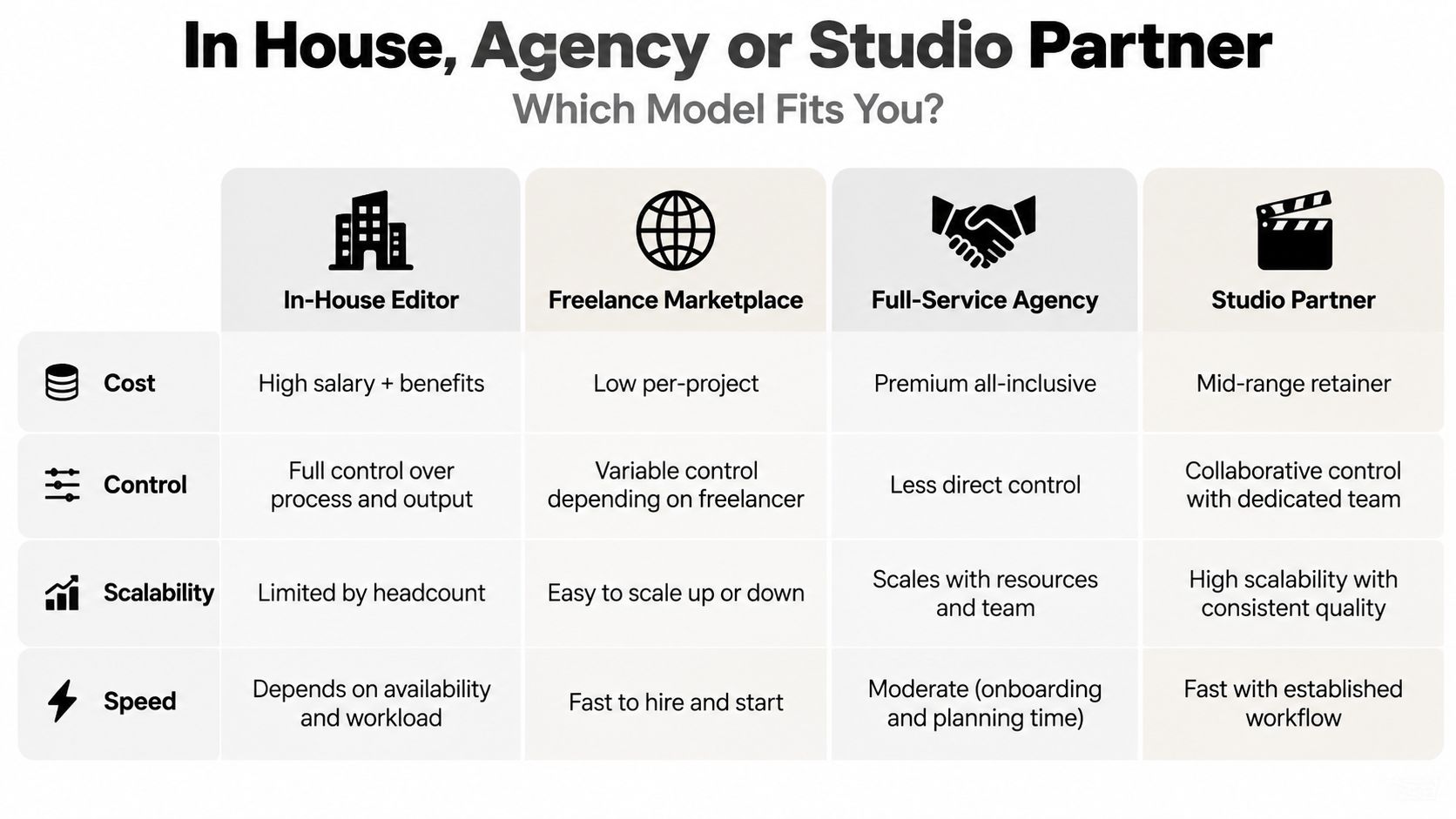
In House Agency or Studio Partner Which Model Fits You
The right editing model depends on how often you publish, how much creative direction you need, and how much operational responsibility you want to keep inside your business. Hiring an editor gives you proximity and control, but it also creates a permanent management obligation. A freelancer can be flexible and cost-conscious, yet quality and availability may vary from project to project.
An agency usually offers broader capabilities, including strategy, design, editing, and distribution. The tradeoff is that the engagement may involve more layers, approvals, and coordination. A studio-integrated partner combines production infrastructure with post-production, which can reduce the handoff between capture and editing.
In-house editing
An in-house editor can learn your voice and respond quickly during working hours. They can build internal templates, maintain project files, and collaborate closely with marketing or production teams. The model becomes less attractive when the editor is expected to cover filming, editing, motion design, social versions, and publishing at the same time.
You'll also need to account for recruitment, management, equipment, software, coverage during busy periods, and the risk of a single point of failure.
Freelance marketplaces
Freelancers can work well for defined assignments. You might hire someone to cut a product video, create captions, or turn a recorded interview into short clips. The main challenge is building consistency across repeated projects, especially when the person who understands your style isn't available for the next deadline.
A strong brief, reference edits, organized footage, and a clear revision policy can reduce that risk. Marketplace hiring requires more quality control from you.
Agencies and studio partners
Agencies are useful when the project includes messaging, campaign planning, creative development, and multiple distribution channels. A studio partner can be a better operational fit when you also need a controlled recording environment, professional audio, modern sets, and a reliable post-production pipeline.
The outsourced market reflects this broader demand. One estimate places video editing services at USD 2.70 billion in 2025, with a projection of USD 5.76 billion by 2033 and an 11.2% CAGR, according to Verified Market Research. Those projections indicate that more businesses are treating editing as an ongoing function rather than a one-off task.
For New Jersey creators who want capture and post-production connected, Flexwork's in-house studios represent one possible model. The useful question isn't which category sounds most premium. It's which model can maintain your standards when your content volume increases.
Real World Use Cases for Podcasters Creators and Brands
A podcast episode, a creator reel, and a brand interview may begin with similar camera files, but they need different editorial outcomes. The editor's job is to understand where each asset will live and what the audience should do next.

Podcasters need an episode system
For a video podcast, the long-form edit is only one deliverable. The episode needs clean multicamera switching, balanced dialogue, intentional pacing, captions, and a visual structure that works for people watching rather than only listening.
That audience shift is measurable. Video podcast consumption overtook audio-only consumption for the first time in Q3 2025, with 82% of weekly podcast consumers watching video compared with 78% listening to audio only, according to Edison Research. In 2023, 89% listened to audio only while 73% watched video, showing why a podcast workflow now needs to support both listening and viewing.
A useful request for your editor includes the full episode, a set of vertical clips, captioned versions, thumbnail guidance, and show notes or transcript coordination. The clips should feel like complete ideas, not random excerpts.
Here's an example of how the finished system can work:
- The full episode builds trust and depth.
- A short clip introduces a strong idea to new viewers.
- A captioned vertical version supports silent browsing.
- A transcript and show notes page give search engines and readers more context.
The production model becomes more valuable when each output has a purpose.
Creators need consistency without creative fatigue
A creator may record a livestream, tutorial, interview, or Content Day session and need several formats from the same material. One edit might emphasize a teaching point, another might lead with a reaction, and a third might use a visual demonstration.
The provider should understand platform behavior without forcing every video into the same template. Ask for a system that protects your voice while adapting framing, captions, opening moments, and duration to the destination.
For creators, the practical deliverables often include:
- Vertical short-form clips: Focused moments for reels and shorts.
- Captioned exports: Readable text that supports viewers watching without sound.
- B-roll integration: Cutaways that make explanations easier to follow.
- Template continuity: Repeated fonts, colors, transitions, and lower thirds.
Brands need repeatable identity
A brand series needs more than attractive footage. It needs a recognizable visual language across interviews, thought-leadership episodes, event recaps, and campaign assets. Editors protect that language through consistent color, typography, framing, music choices, and pacing.
For a brand team, request a style guide, reusable graphics, a defined approval path, and delivery folders that marketing staff can use. If the project includes studio capture, social cutdowns, and web publishing, a connected video content creation service can reduce the number of vendors managing the same source material.
The takeaway is simple. Buy deliverables based on the audience journey, not just the timeline. A viewer may discover you through a short clip, trust you through a full episode, and visit your website after reading the transcript.
How to Choose the Right Video Editing Service and What It Costs
Choosing an editor is less about finding the lowest quote and more about defining the finish your content requires. Two providers may both promise a “podcast edit,” but one may deliver a clean master while the other handles story structure, captions, short-form variations, graphics, revisions, and publishing support.
Start with the portfolio. Look for work that resembles your format, camera setup, audience, and tone. A cinematic wedding reel doesn't automatically prove that an editor can handle a conversational podcast, a fast educational short, or a founder-led brand series.
Ask questions that reveal the process
Use the first conversation to understand how the provider works:
- Review the editorial approach: Ask how they decide what to cut, what to preserve, and how they identify clips.
- Clarify revision limits: Find out how feedback is collected and whether revisions apply to structure, graphics, captions, or only minor changes.
- Confirm turnaround expectations: Ask when the first cut arrives and what affects delivery timing.
- Check platform knowledge: Make sure the team can prepare long-form, vertical, captioned, and web-ready versions.
- Request file organization: Confirm how masters, project files, captions, thumbnails, and social exports will be labeled.
- Test communication: Notice whether the provider asks about your audience and objectives, not just your file format.
Pricing usually reflects the amount of judgment and labor involved. Source organization, multicamera complexity, audio repair, animation, color treatment, captioning, the number of short-form versions, revision rounds, and distribution support all influence the quote. A low-cost cut may be appropriate for simple internal content, while a growth-focused series needs a more complete production system.
Match the package to the business goal
Flexwork's services illustrate how editing can sit inside a broader production plan. A Content Day costs $3000 per day and includes 20 edited reels or 60 pro photos. That structure suits creators and brands that want to record a concentrated batch of material and leave with a planned library of assets.
A podcast website costs $5000 plus hosting, which can give the show a dedicated home for episodes, transcripts, guest information, and calls to action. For a creator pursuing a sustained audience strategy, the Market, Manage & Produce My Podcast tier starts at $1500 per episode with a 20-episode growth commitment.
Spotify reported more than 250,000 video podcast shows on its platform, up from 100,000 in 2023, and said more than 170 million users have watched a video podcast there. It also reported that more than 70% of users consuming video podcasts watch in the foreground, which makes framing, visual clarity, and purposeful motion central to the viewing experience, according to Spotify's platform update.
For teams evaluating a connected production option, Flexwork's video production services can be part of that comparison. Choose the provider that can explain what each deliverable is designed to accomplish.
Your Next Episode Deserves a Premium Finish
Professional editing is the difference between content that was recorded and content that gets watched, shared, revisited, and found. The finished result should preserve the speaker's personality while removing the friction that makes audiences leave. It should also give your marketing team useful assets instead of one large file waiting for someone to start over.
The strongest video editing services treat the episode as a source system. A long-form conversation can become a polished show, focused clips, captioned vertical versions, a website feature, and search-friendly written content. Research summarized by Bright SEO Tools states that full transcripts create keyword-rich indexable pages, show notes can point audiences back to the creator site, and YouTube video versions can amplify SEO impact. The same source describes searchable pages emerging in roughly 2–4 weeks per episode.
That connection matters for New Jersey creators who want more than a finished export. A premium partner should help you record cleanly, edit with purpose, repurpose intelligently, and maintain a recognizable presence across every channel. Flexwork's studio rentals, producer packages, Content Day sessions, podcast websites, and post-production services give ambitious creators a way to build that system around their actual publishing goals.
The next episode doesn't need more footage sitting untouched in a folder. It needs a clear editorial plan, a reliable workflow, and a finish that respects the audience you're trying to reach.
Flexwork Podcast Studios offers acoustically treated podcast and video studios, production packages, Content Day sessions, and end-to-end editing for episodes, reels, shorts, and livestream content. Visit Flexwork Podcast Studios to explore the production options, schedule a studio tour, and turn your next recording into a complete growth-ready content system.