
Podcast Production Services Pricing in 2026
 September 3, 202627 Minutes
A first-time host can spend an afternoon comparing podcast production quotes and still have no idea what the numbers buy. One studio lists an episode fee. Another offers a monthly retainer. A third advertises editing at a price that looks attractive until publishing, show notes, clips, and revisions appear as add-ons.
That confusion is expensive. Podcast production services pricing reflects the scope behind the final file, not just the minutes of audio. This guide breaks down the major pricing models, the labor hidden inside each line item, and the practical difference between DIY workflows and professional production. It also shows how transparent New Jersey packages, including Flexwork's $3,000 Content Day, $5,000 podcast website, and growth-focused production options, can help you benchmark a budget without guessing.
The First Quote Moment and What It Really Means
A first-time host in Hoboken receives a quote for $1,800 for a four-episode season. The immediate reaction is predictable: “That's $450 per episode. What am I paying for?”
The sticker shock usually comes from seeing production as one purchase. A professional quote may combine recording support, editing, mixing, mastering, file delivery, and publishing preparation. If the proposal doesn't separate those responsibilities, the host sees one large number instead of the work required to turn a raw conversation into a usable media asset.
The price isn't automatically justified because a vendor calls itself “full service.” The buyer has to identify the deliverables. A clean voice edit, a mastered audio file, video exports, social clips, guest coordination, and distribution support all require different workflows and different amounts of labor.
Practical rule: Never compare the headline total first. Compare the deliverables, revision policy, turnaround, ownership rights, and publishing responsibilities.
A useful quote review starts with four questions:
- What's being billed: Is the vendor charging per episode, by the hour, through a monthly retainer, or by individual services?
- What's included: Does the price cover studio time, engineering, editing, mastering, show notes, clips, distribution, or only one of those tasks?
- What changes the scope: Do additional guests, longer recordings, video, rush delivery, or revision rounds increase the fee?
- Who carries the work: Will your team still handle booking, file transfers, uploads, captions, and promotion?
The market has settled into four common structures, and each one solves a different production problem. Per-episode pricing offers a clear unit cost. Hourly billing handles uncertain scope. Retainers reserve recurring capacity. À la carte billing lets experienced creators purchase only the tasks they can't or don't want to do themselves.
That framework makes a quote easier to decode. You're not asking whether $1,800 sounds expensive. You're asking whether the proposed production system matches your release schedule and the standard your audience expects. Flexwork's comparison of New Jersey podcast studios and included value is a useful reference point when you're checking whether a local quote covers an actual production workflow or only a room and a recording button.
Pricing Models Every Podcaster Will Encounter
A podcast quote becomes useful only when the billing model matches the work your team can manage. A predictable interview show may need a fixed episode price. A pilot with messy audio may need hourly editing. A multi-show brand may need reserved production capacity.
Per-episode flat rates
A flat rate assigns one price to one finished episode. It suits a consistent format, predictable recording length, and stable deliverables. Weekly and biweekly shows benefit because each release has a defined production cost.
National benchmarks separate the work into clear tiers: basic editing around $500 to $1,500 per episode, mid-tier production with content assets around $1,500 to $4,000 per episode, and full-production packages around $150 to $500 or more per episode, depending on deliverables (Rise25's podcast production pricing guide). Read those categories carefully. The lower figure may describe a narrower package, while the higher figure may include publishing, repurposing, or other production tasks. Ask the vendor to map every deliverable to the quoted tier.
Hourly billing
Hourly billing fits a pilot, limited series, or recording with unpredictable cleanup. Freelance editors commonly charge $45 to $75 per hour, while senior producer-level work often falls around $100 to $175 per hour (FreelanceRates.net's podcast editor benchmarks).
The flexibility comes with budget risk. Before work starts, request an estimated hour range, a spending cap, and a written definition of billable revisions. Without those limits, a small cleanup job can become an open-ended invoice.
Retainers and monthly subscriptions
A retainer reserves recurring capacity and groups services into a monthly commitment. It fits brands, agencies, and multi-show teams that need reliable scheduling, production management, guest coordination, and distribution support.
Professional business podcast programs can run $2,000 to $20,000 or more per month, particularly when video, clips, and audience growth support are included (MarketIntelo's podcast production services market overview). The model works when your publishing calendar is stable. It wastes budget when episodes are sporadic or internal approvals regularly stop production.
À la carte billing
À la carte pricing lets you purchase only the missing parts of your workflow. You can record remotely, hire an editor, buy mastering separately, and keep publishing in-house. Standard interview editing is often quoted around $150 to $400 per episode by agencies, while video podcast editing can range from $530 to $1,125 per episode for freelancers and $775 to $1,750 per episode for agencies (Content Allies' B2B podcast cost guide).
This model suits creators with dependable systems and enough time to manage handoffs. It fails when the supposed savings leave the host fixing levels, writing show notes, exporting clips, and chasing missing files every week.
| Pricing Model | Typical 2026 Range | Best For |
|---|---|---|
| Per-episode flat rate | $500 to $1,500 for basic editing, $1,500 to $4,000 for mid-tier production | Predictable episodic shows |
| Hourly billing | $45 to $75 per hour for freelance editing, $100 to $175 for senior work | Pilots and uncertain scope |
| Retainer or subscription | $50 to $500 for subscription models, with broader business programs reaching $2,000 to $20,000 or more monthly | Brands needing recurring capacity |
| À la carte | $150 to $400 for agency audio editing, with video priced separately | Creators outsourcing selected tasks |
Transcription belongs in the scope discussion. Translators USA transcription for events helps teams assess transcription as an accessibility, search, and repurposing deliverable instead of assuming editing includes it.
New Jersey and New York studios often carry higher overhead and talent costs than national providers. Compare the delivered workflow, not only the headline rate. Flexwork's New Jersey studio rental cost breakdown helps separate room rental from engineering, equipment, editing, and the rest of the production budget. Choose the structure that fits your release cadence, internal capacity, and willingness to manage production details.
What Drives the Cost of Production
A two-person interview can finish recording in an hour and still require a full production team afterward. Scope complexity drives the bill, especially when small decisions remain undefined in the quote.
The work before anyone presses record
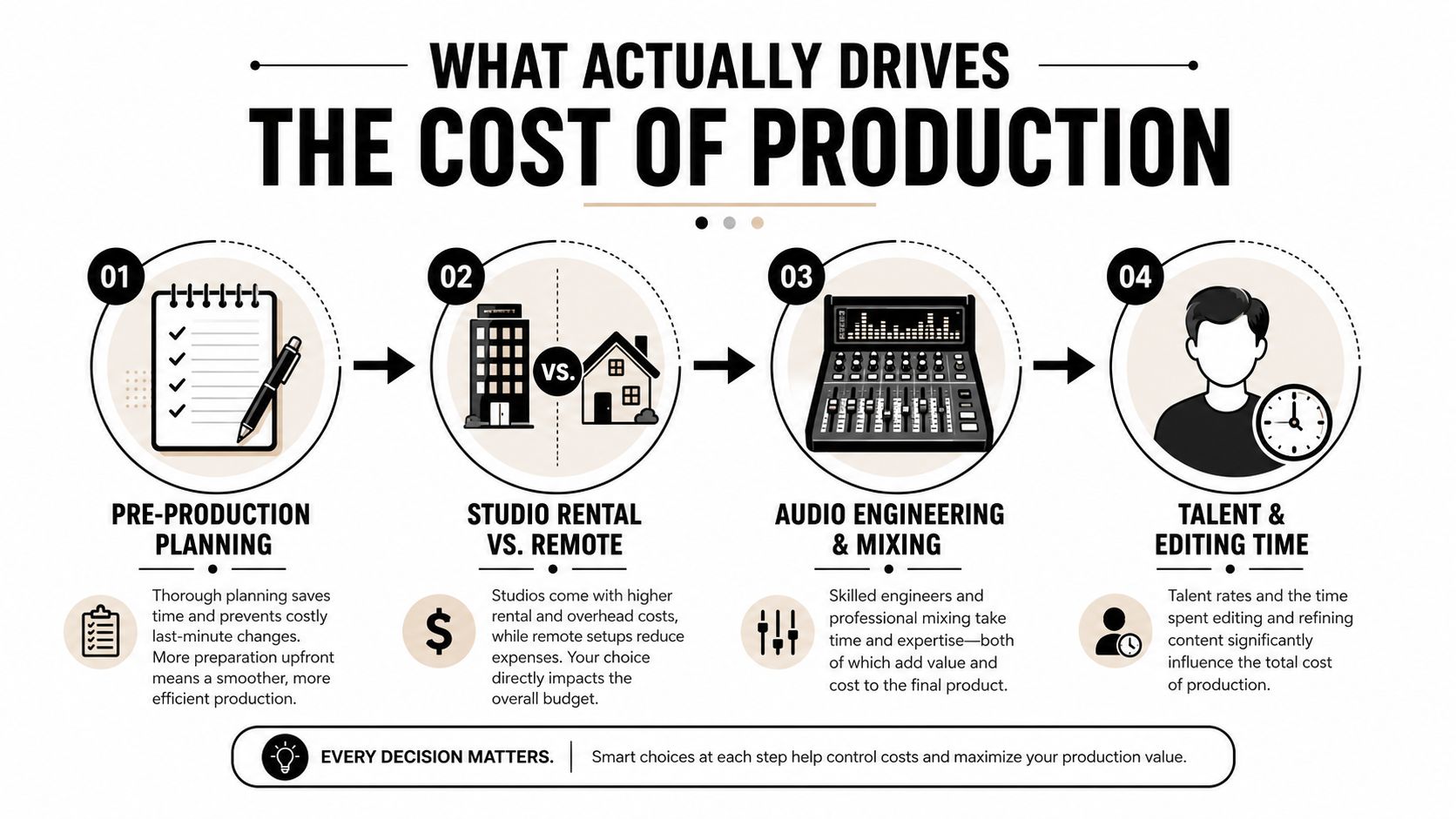
Pre-production covers guest coordination, episode planning, question development, technical checks, and creative direction. A solo show may need only a basic plan. A branded interview series with executive guests needs a producer to manage schedules, prepare the host, and keep each conversation aligned with the show's purpose.
Studio rental creates a different cost structure from remote recording. A studio supplies controlled acoustics, lighting, equipment, and on-site support. Remote production can reduce room costs, while adding platform setup, guest troubleshooting, inconsistent microphones, and cleanup work.
Audio work varies sharply
A clean interview with two isolated tracks requires a different workflow from a narrative episode with interruptions, overlapping speakers, music, sound effects, and aggressive noise reduction. Freelance editor rate cards for 2026 list $25 to $40 per hour for basic cleanup, $45 to $75 for standard interview editing, and $85 to $150 for premium narrative work (PodVenues' 2026 podcast editing cost report).
A separate 2026 guide places U.S. podcast editors at $40 to $120 per hour or $150 to $500 per episode for standard interview formats (What Should I Charge's podcast editor guide). Those rates reflect the decisions required for noise removal, pacing, cross-talk, music, sound design, mixing, mastering, transcripts, chapter markers, audiograms, and publishing.
Assets and urgency change the quote
Show notes, transcripts, audiograms, short video clips, thumbnails, captions, and platform-specific exports turn one conversation into a content pipeline. Every asset requires review, formatting, and delivery.
Turnaround affects staffing. A standard delivery window gives the team time to edit, review, revise, and export correctly. A 24-hour request may force a producer to move other work, so rush policies belong in the quote before recording begins.
Budget test: Ask the producer to identify the three deliverables that consume the most labor. Spend on the items your audience notices, and remove extras your team will not publish.
Music licensing needs a separate line item. A provided music bed does not automatically give your show rights for every platform and use. Confirm whether the license is included, limited, or your responsibility.
Video-first production adds multicam capture, lighting, camera matching, motion graphics, social cutdowns, and livestream support. These requirements add crew time and post-production decisions. The same budgeting logic applies to the cost of making product videos, where equipment, crew, creative planning, and post-production shape the final scope.
Before signing, list every deliverable and label it included, optional, or excluded. Flexwork's guide to building a podcast studio helps clarify whether your budget should fund a permanent setup, recurring studio access, or outsourced production.
DIY Versus Studio Production Tradeoffs
DIY production looks cheaper because the invoice is smaller. It isn't free. You pay with equipment, software, troubleshooting, editing time, and the attention required to keep every episode moving.
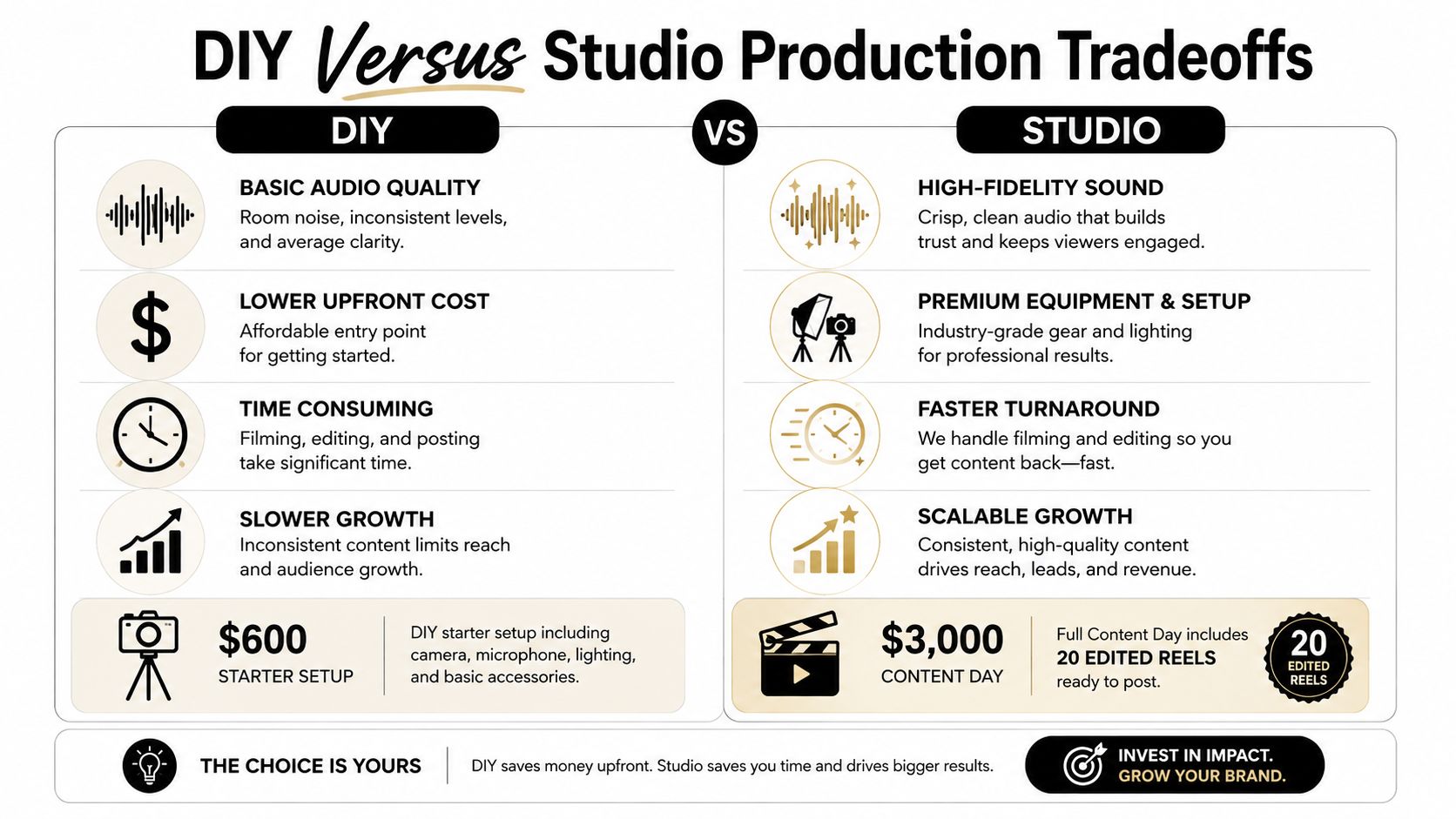
A $600 starter setup can give a solo host a microphone, headphones, basic recording equipment, and a workable home environment. The host still has to learn the software, monitor the recording, maintain the room, clean the tracks, export the master, and manage delivery. If the room sounds reflective or the microphone placement changes between sessions, the audience hears the inconsistency.
A $250 single-session studio booking can remove much of that friction. The creator arrives at a prepared space, records with professional equipment, and leaves with a cleaner source file. That doesn't automatically include full editing or marketing, so the quote still needs a clear deliverables list.
For a six-episode run, the comparison becomes more revealing. The assigned example places DIY at $3,600 in gear plus 30 hours of editing, compared with $1,800 in studio packages. Those figures are a planning illustration, not a universal market rule, but they expose the core decision: are you buying equipment, or are you buying reliable production time?
Match the path to your ambition
A solo hobbyist may prefer DIY because experimentation matters more than speed. A part-time host may use a hybrid workflow, recording at home and outsourcing cleanup. A brand-backed show usually benefits from a repeatable production partner because consistency, visual quality, and delivery deadlines affect the brand beyond the host's personal schedule.
| Creator profile | DIY makes sense when | Studio production makes sense when |
|---|---|---|
| Solo hobbyist | Learning and experimentation are the priority | The host wants a finished release without technical work |
| Part-time host | The format is simple and time is available | The host needs dependable turnaround |
| Brand-backed show | Internal staff can manage production | The brand needs consistent quality, video, and repurposed assets |
The key tradeoff isn't “cheap versus expensive.” It's control versus capacity. DIY gives you control over every decision, but it makes the host responsible for every decision. Studio production costs more upfront and reduces the number of technical tasks competing with recording, guest relationships, and promotion.
Flexwork's studio versus DIY podcasting comparison is relevant for creators deciding whether professional space supports their schedule and desired finish. The right choice is the one you can sustain through an entire season, not the one that looks cheapest during setup week.
Realistic Package Tiers and What Each One Delivers
A package earns its price through deliverables, not its label. Editing-only pricing buys a narrower task. Managed production buys coordination, technical oversight, and release support. Compare those outputs before comparing totals.
Flexwork's documented services offer clear New Jersey benchmarks. Audio-only editing is $200 per episode, long-format edited video is $500 per episode, and managed podcast production starts at $1,000 per episode. The same service document lists Content Days at $3,000 per day, with 20 edited reels or 60 professional photos, plus podcast websites at $5,000 plus hosting.
National pricing spans a broader range. Basic editing commonly falls around $500 to $1,500 per episode, mid-tier production around $1,500 to $4,000, and full-service retainers around $3,000 to $25,000 per month or more, as noted earlier. These figures do not match one-for-one with Flexwork's local packages because providers may include different production tasks.
| Package Tier | Flexwork NJ Price | National Average | Studio Time | Editing | Show Notes | Distribution |
|---|---|---|---|---|---|---|
| Editing essential | $200 per episode | $150 to $400 for agency audio editing | Not included unless quoted separately | Audio edit and publishing-ready delivery | Not included | Publishing-ready file delivered; upload handled by client |
| Long-format video | $500 per episode | $530 to $1,125 for freelance video editing, $775 to $1,750 for agencies | Varies by provider; request a line-item quote | Edited video for long-form platforms | Varies by provider; request a line-item quote | Varies by provider; request a line-item quote |
| Managed production | Starts at $1,000 per episode | $1,500 to $4,000 for mid-tier production | Included according to package scope | Full production workflow | Varies by provider; request a line-item quote | Included according to package scope |
| Content Day | $3,000 per day | Comparable scopes vary by asset count | Recording day | 20 edited reels or 60 professional photos | Not the primary deliverable | Confirm campaign needs and publishing responsibilities |
| Website build | $5,000 plus hosting | Website integration is often separately scoped | Not applicable | Podcast website setup | Website content scope must be defined | Hosting is separate |
The table makes the budget difference concrete. A $150 episode quote may cover a narrow audio edit and return a file for the client to publish. A $900 premium episode quote may include studio time, engineering, mastering, show notes, distribution, and content assets. Request each item in writing. Otherwise, the lower quote may leave more work with the host.
For a weekly show, consistent volume can support a retainer and more predictable scheduling. Flexwork's Market & Manage tier starts at $1,500 per episode with a 20-episode growth commitment, placing it outside editing-only comparisons. It serves clients buying a managed growth system rather than isolated audio or video files.
Quote discipline: Put every proposal into the same columns before choosing. Require specific deliverables for recording, editing, notes, publishing, revisions, and assets. If a vendor will not define the work, the low price is not transparent enough to trust.
Smart Budgeting Moves Before You Book
A good budget starts before the first studio booking. Ask questions that expose operational risk, not just the base rate.

The twelve-question quote check
- Package scope: What exactly is included in the quoted price?
- Cancellation windows: How much notice protects your deposit or session fee?
- Revision rounds: How many rounds are included, and what counts as a revision?
- Travel fees: Are travel, parking, or location charges separate?
- Extra episodes: What does an additional episode cost under the same agreement?
- Raw files: Who owns and receives the original recordings?
- Setup charges: Is there a separate setup or breakdown fee?
- Turnaround: What delivery window applies to standard and rush work?
- Music rights: Are licensing costs included, and where can the music be used?
- Payment terms: Is payment due per session, per episode, or monthly?
- Detailed quote: Will the vendor provide a written line-item estimate?
- Multi-session discounts: Does batching sessions reduce the effective rate?
A vague answer creates budget exposure. “Publishing included” might mean uploading an audio file, or it might mean writing metadata, preparing artwork, managing the RSS feed, and checking directory delivery. Ask for the exact handoff.
Use batching before cutting quality
Record multiple episodes in a planned block when your format allows it. You'll reduce calendar friction, preserve set continuity, and give the editor a repeatable structure. A Content Day can also shift the economics when you need a library of short-form assets, since Flexwork lists $3,000 per day for 20 edited reels or 60 professional photos.
Be careful with equipment rentals. Podcast equipment rental options may solve a short-term need, but the rental price should be compared with setup time, insurance, transport, and technical support. A lower day rate can lose its advantage if your team has to assemble and troubleshoot everything.
Run a sixty-second self-audit
Write down the show's three essentials. These might be clean audio, a fixed weekly delivery, or video clips for LinkedIn. Then list the nice-to-haves, such as elaborate sound design, animated titles, or extra exports.
Rank every deliverable by audience impact and internal effort. Fund the items that protect the listening experience and publishing consistency first. Add growth assets only when someone has the time and channel strategy to use them.
Common Pricing Questions and Booking Your Next Step
Is per-episode pricing cheaper than a retainer? Usually, per-episode pricing is safer for a pilot or seasonal show. A retainer becomes more practical when you have recurring volume, need reserved capacity, and want production management to remain active between recordings.
Why does the final bill exceed the first quote? The usual causes are undefined revisions, longer-than-expected recordings, extra video exports, music licensing, transcription, guest coordination, and rush delivery. The fix is simple: require the vendor to label each item as included, optional, or excluded before work begins.
Do entry-level packages include distribution-ready masters? Sometimes, but never assume it. A finished audio file may not include loudness checks, metadata, show notes, artwork, captions, or platform-specific exports. Ask whether “ready to publish” means technically complete or fully uploaded and verified.
How do travel charges work for New Jersey and New York sessions? Local studio work may involve travel, parking, location access, or equipment transport. Ask whether those costs are included in the session quote, especially when guests or crew cross state lines.
Should I pay for video? Pay for video when you have a distribution plan for the footage. Video-first production can create long-form episodes, short clips, reels, and visual brand assets, but the premium is wasted if the exports sit in a folder.
What should a business podcast prioritize? Start with the audience, guest strategy, and a repeatable release system. A polished microphone can't rescue an unclear show position or an unreliable publishing schedule.
Flexwork's service mix covers studio rentals, production packages, Content Day sessions, and podcast websites, so buyers can scope the exact layer they need instead of treating every project as a full agency engagement. The practical move is to request a custom line-item quote, compare it with the benchmarks above, and confirm which deliverables will reach your audience.
Visit Flexwork Podcast Studios to book a studio session, explore transparent production packages, or request a custom quote for your next season. Bring your current estimate, and use the conversation to turn every podcast production dollar into a defined deliverable.