Is Video Production a Good Career? a 2026 Guide to Success
 June 13, 202624 Minutes
Meta title: Is Video Production a Good Career in 2026?
Meta description: Is video production a good career? Learn the salary outlook, freelance realities, and how to build a profitable creative path in 2026.
URL slug: /is-video-production-a-good-career
If you're spending late nights studying polished reels, branded podcasts, cinematic YouTube intros, and sharp interview clips, you're probably asking a real career question, not a casual one. Can you make a life in video production, or is this another creative field that looks glamorous online and chaotic in practice?
My direct answer is yes, video production is a good career. But it's only a good career for people who stop treating it like a gear hobby and start treating it like a profession. That's the difference. The people who move forward build skill, taste, workflow, and client trust. They also learn branding early, which is why this guide on how to brand your business matters more than most beginners realize. The jump from “I make videos” to “I run a creative career” starts there.
From Passion Project to Profession
The turning point usually looks small from the outside.
You're filming friends, editing personal projects, maybe helping a local brand with social clips. Then someone asks what you'd charge next time. That moment changes everything. You're not just experimenting anymore. You're deciding whether your taste, discipline, and problem-solving can support a real working life.
That's why the question isn't just is video production a good career. The better question is whether you're willing to approach it like one. Passion gets you started. Professional habits keep you in the game.
Practical rule: If you want video work to pay you consistently, your workflow has to look professional before your title does.
A lot of talented people stall because they wait for permission. They assume they need the perfect camera kit, a massive client list, or film-school-level confidence. They don't. They need strong samples, reliable execution, and an environment that helps them produce work people trust.
The 2026 Video Career Market Demand and Salary
Let's deal with the practical part first. Creative ambition is great, but rent is real.
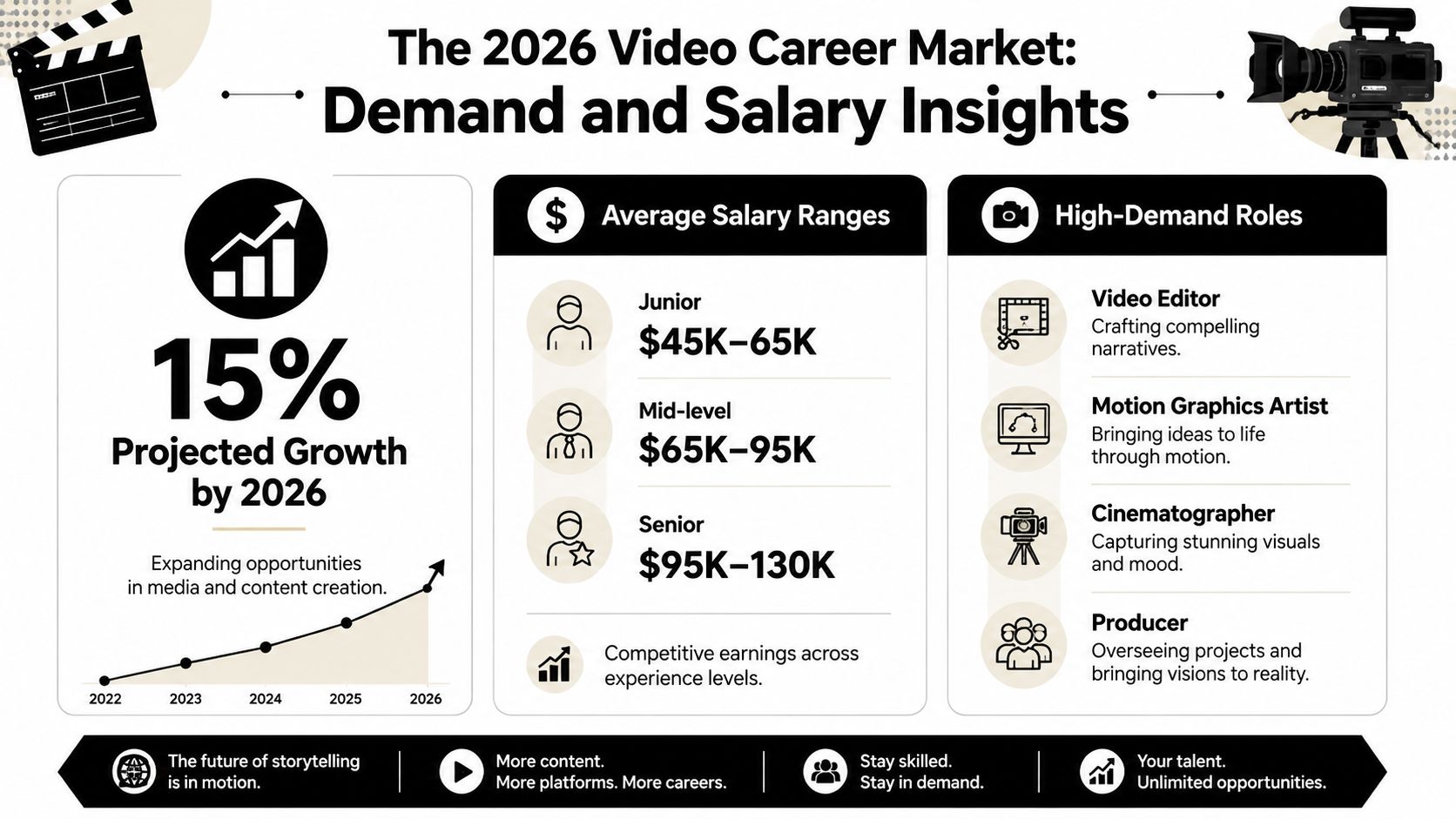
The strongest argument for video production as a career is that it isn't a fantasy market. The U.S. Bureau of Labor Statistics projects 3% employment growth for film and video editors and camera operators from 2024 to 2034, with about 6,400 openings per year on average over the decade, and reports median annual wages of $70,980 for film and video editors and $68,810 for camera operators in May 2024 (BLS occupational outlook).
That matters because it tells you three things at once. First, this field has a documented labor market. Second, openings don't rely only on explosive expansion. A meaningful share comes from replacement needs, which is often what makes a career category more durable than trendy. Third, the pay level puts video work in a different conversation than many starter jobs people take while “figuring it out.”
What those numbers actually mean
Don't read 3% growth and think mediocre. Read it correctly. It means this isn't a lottery ticket career. It's a working profession with a stable base.
A stable base is valuable in creative work. Hype-driven fields often attract people fast and shake them out just as fast. Video production is broader than that. Brands need content. Media companies need editors. Corporate teams need shooters. Podcasters need multicam video. Founders need launch assets. Short-form content keeps expanding the number of places skilled video people can contribute.
If you're trying to build modern content skills, it's smart to study how brands are using short-form formats right now. The PostPulse YouTube Shorts guide is useful because it shows where practical demand is showing up in business content, not just entertainment.
Stable doesn't mean easy. It means skilled people who can deliver on deadline usually have a lane.
Salary is only part of the story
A lot of people ask about earnings too early and career structure too late. Salary matters, but what's more important is what salary signals. In this case, it signals that companies and production environments already budget for this work as a serious function.
Here's the cleaner way to consider it:
| Career question | Better way to read the market |
|---|---|
| Can I get paid to do this? | Yes, there are established job categories with documented wages. |
| Is this just social media hype? | No, the field includes long-standing professional roles. |
| Will there be openings if growth isn't huge? | Yes, replacement demand creates recurring opportunities. |
If you're disciplined, adaptable, and willing to keep refining your work, the economics are credible. That's enough to take the career seriously.
The Two Paths In-House Job vs Freelance Business
Frequently, most advice gets sloppy.
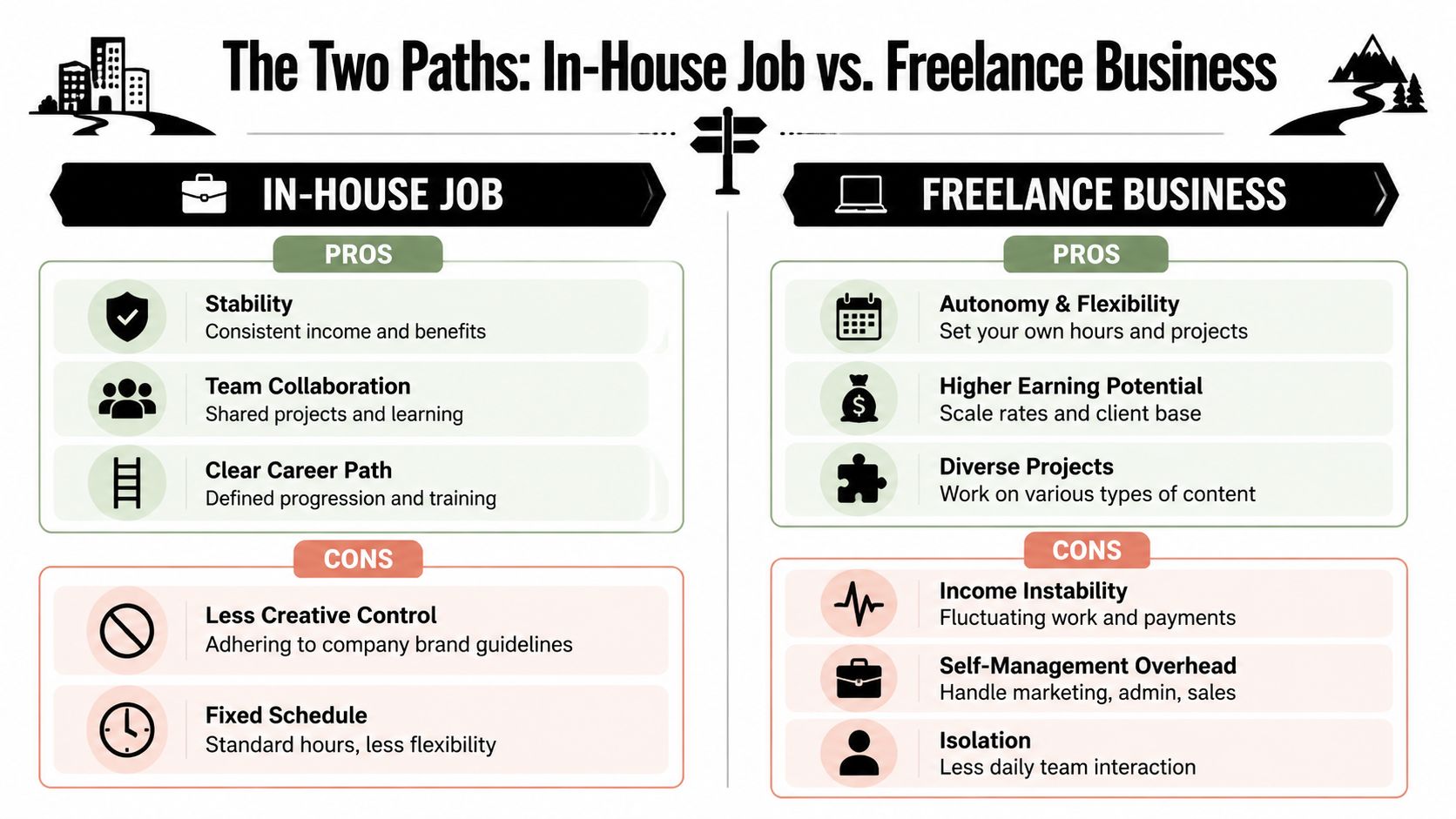
People talk about “a career in video” as if everyone works the same way. They don't. You are usually choosing between two very different lives. One is an in-house job. The other is a freelance business. If you confuse them, you'll make bad decisions fast.
The Bureau of Labor Statistics notes that demand is being driven by the proliferation of streaming content, while also pointing out that these are distinct occupations with different labor-market dynamics. Indeed's career guidance also treats videographer work as something that often involves freelancing and managing business operations and finances (BLS career feature on film jobs).
The in-house path
If you join an agency, media company, brand team, studio, or internal content department, you get structure. That's the appeal.
You're usually working inside a set brand system. The projects are defined. The deadlines are real, but the client pipeline isn't fully your burden. You can sharpen editing, production, lighting, interviewing, or post-production in a repeatable environment. You also learn how teams review work, how approvals happen, and how content serves business goals.
An in-house role is good for people who want:
- Predictable workflow: You know what the week is for.
- Team exposure: You learn from producers, editors, marketers, and operators around you.
- Skill compounding: Repetition improves quality faster than random gigs do.
The tradeoff is obvious. You get less control over what you make and how you spend your creative energy.
The freelance path
Freelancing sounds free because people focus on flexibility. That's incomplete. Freelancing is not freedom by default. It's ownership.
You are the sales department, account manager, operator, editor, collections team, scheduler, and strategist. If you don't market your work, no one else will. If a client ghosts an invoice, that's your problem. If your process is messy, your creativity will get buried under admin.
Freelancing works when you accept that you're building a company, even if it's a one-person company.
Many promising creators burn out. Their days often involve mornings chasing leads, afternoons filming, nights editing, and weekends fixing files or sending follow-ups. The issue isn't talent. The issue is workload design.
For people pursuing freelance-heavy careers, presentation matters almost as much as the work itself. If you've been stacking project-based roles and need to show that experience clearly, this guide on maximize contract work impact is worth reading.
Which path fits you better
Use temperament, not ego, to decide.
| If you want… | Choose… |
|---|---|
| Consistency, mentorship, and a clearer ladder | In-house |
| Autonomy, pricing control, and client variety | Freelance |
| Less admin and more focused craft time | In-house |
| A business you can shape around your style | Freelance |
Some people do both in sequence. That's often the smartest move. Build your craft in a structured environment, then go independent when your portfolio, process, and network can support it.
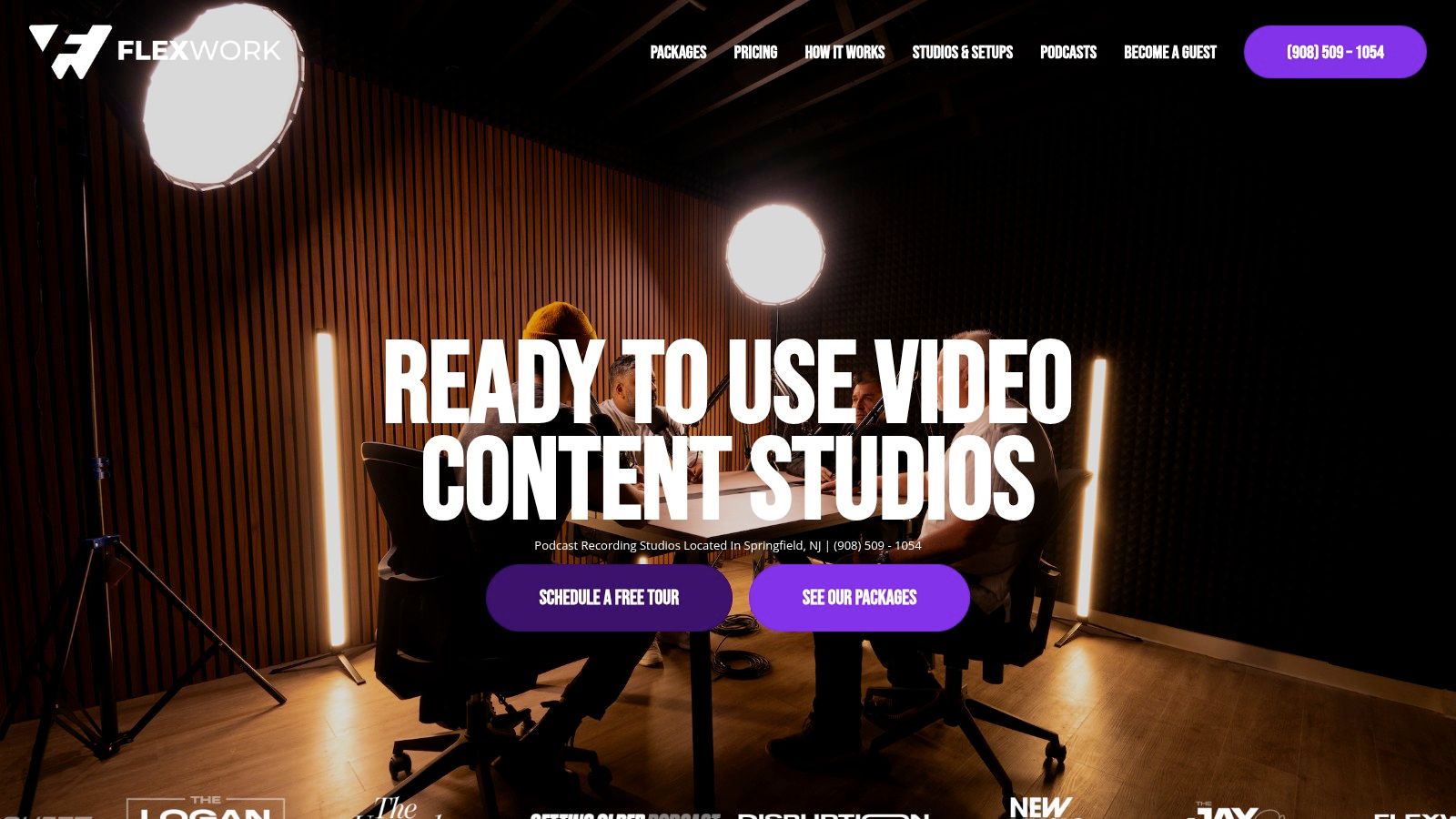
And if you're trying to understand what a more polished production setup looks like before making that leap, browsing in-house studio environments can help you see how professional infrastructure changes the quality of your output and your day-to-day pace.
How to Bypass DIY Burnout and Build a Pro Brand
You book the client, shoot the interview, dump footage at midnight, and spend the next day cleaning bad audio from a reflective room you tried to make work. By the end of the week, you delivered one decent piece and ignored three new leads. That is how talented video people stay stuck.
The trap is not starting small. The trap is staying small in your operations after your ambitions outgrow your setup. DIY gets you reps. It also starts stealing margin, time, and consistency the moment clients expect repeatable quality.
DIY is useful at first and expensive later
A spare room can teach framing, troubleshooting, and hustle. It also teaches bad habits if you keep forcing professional deliverables through an unreliable setup.
You lose hours fixing soft lighting, room echo, file issues, and inconsistent camera color. Then you call that “part of the creative process.” It is not. It is operational drag.
A better room and a tighter production process raise the floor on every project. This breakdown of studio vs DIY podcasting explains the difference clearly. Cleaner capture means faster edits. Faster edits mean more capacity to pitch, direct, and serve clients well.
The longer you insist on doing every job yourself, the longer your business stays harder than it needs to be.
Buy capacity, not more clutter
Beginners love gear because gear feels like progress. Capacity is what changes your career.
One more light, one more lens, and one more plugin will not fix a weak workflow. A repeatable production system will. If you want a professional brand in 2026, stop asking, “What should I buy next?” Ask, “What should I stop doing myself?”
That shift matters most for recurring content. Podcasts, founder videos, branded interviews, and short-form campaigns reward consistency. If every episode depends on your personal stamina, the business will wobble. If the production process is structured, the business can grow.
Protect the work only you can do
Your highest-value job is not cable management, noise cleanup, or rebuilding the same set every week.
Your highest-value job is direction. Taste. Decision-making. Client trust.
Use support to free up time for work that compounds:
- Sharpen your creative point of view: Strong concepts get remembered longer than technical improvisation.
- Direct talent better: A confident interview or founder delivery often matters more than another hour of setup tweaks.
- Build relationships that lead to retainers: Reliable communication and consistent output drive repeat business.
- Review edits with standards: Your attention belongs on pacing, story, and brand fit, not preventable technical cleanup.
If you are pitching for roles while building your reputation, this guide to video job applications can help you present your experience with more intent.
A pro brand comes from repeatable quality
Clients do not experience your brand as a logo or color palette. They experience it as consistency.
Can you deliver clean audio every time? Can you publish on schedule? Can you make your work look cohesive across multiple shoots, formats, and clients? That is what separates a promising creator from a professional business.
Many freelancers burn out because they confuse suffering with commitment. Drop that mindset. Professional resources are not a shortcut. They are how serious creators protect quality, keep their energy, and scale their output without turning every project into a rescue mission.
Later in the process, seeing the production environment in motion helps. This gives a clearer sense of what a cleaner setup looks like in practice.
Essential Skills to Accelerate Your Career Growth
Talent matters. Taste matters. But career growth usually comes from stacking the right skills in the right order.
The people who move fastest don't just become better editors or shooters. They connect craft skills with career skills. That's the combination that gets you hired, retained, recommended, and paid better.

The BLS describes film and video editors and camera operators as workers who manipulate moving images for entertainment or information, and Indeed notes these roles typically require a bachelor's degree in a related field such as film or broadcasting. That educational base has stayed relevant as the work has shifted into software-driven production pipelines, motion graphics, livestreams, and short-form content (Indeed video production career guide).
Craft skills that still separate professionals
You don't need to master every niche at once. You do need to become dependable in a few fundamentals.
- Shooting with intention: Framing, movement, lens choice, and coverage should support the story, not distract from it.
- Lighting for clarity: Good lighting isn't about making everything dramatic. It's about control, mood, and consistency.
- Editing for pace: Strong editors know what to cut, what to hold, and where attention drops.
- Sound judgment: Audio problems make otherwise strong work feel cheap.
- Platform awareness: A polished vertical reel and a polished interview episode are not edited the same way.
Career skills that raise your ceiling
Many gifted people often fall behind at this stage. They assume the work speaks for itself. It doesn't. People have to find it, trust it, and understand it fast.
Three career skills matter more than most beginners expect:
Portfolio curation
Don't dump every project into one gallery. Show range, but keep standards high. One polished interview clip, one clean brand piece, one strong short-form edit, and one example of thoughtful storytelling can outperform a bloated portfolio.Client communication
Fast replies, clear scopes, organized delivery, and calm revision handling win repeat work. Clients remember whether working with you felt smooth.Personal positioning
People hire specialists faster than they hire vague creatives. “I help founders record polished video podcasts” is stronger than “I do content.”
Strong portfolios don't just show what you made. They show what it's like to trust you.
Three ways to build a portfolio that gets you hired
- Use controlled environments: Record at least one project in a professional-looking space so your reel isn't sabotaged by weak lighting or messy backgrounds.
- Edit for the role you want: If you want podcast clients, show multicam interviews. If you want branded short-form work, show hooks, pacing, captions, and clean delivery.
- Sequence your samples well: Lead with the piece that makes someone stop. Nobody owes your portfolio a patient viewing.
If you're applying for roles and need help translating your work into a stronger pitch, this guide to video job applications can help tighten how you present yourself.
Common mistakes that slow good creatives down
| Mistake | Better move |
|---|---|
| Learning tools without making finished work | Build completed samples people can judge |
| Posting everything | Curate ruthlessly |
| Networking only when you need work | Stay visible before you need a favor |
| Leading with gear talk | Lead with outcomes and storytelling |
A final point. Tools do matter, but only when they support better output. If you're evaluating software, setup, and workflow support for content creation, these tools for content creators are a practical place to start.
Your Next Move From Aspiring to Established
So, is video production a good career?
Yes. It's a good career for people who treat it like skilled work, not vague self-expression. The market is credible. The pathways are real. The opportunity is broad enough to support in-house roles, client services, podcast production, branded content, and creative business building.
But don't miss the harder truth. Video production is not automatically a good lifestyle if your workflow is chaotic, your positioning is weak, and your output is inconsistent. That's where people get discouraged. Not because the field is fake, but because they tried to build a profession with hobby-level systems.
What I recommend if you're serious
Keep this simple.
- Start with one lane: Pick editing, shooting, podcast video, branded interviews, or short-form content.
- Build four strong samples: Not fifteen average ones.
- Choose your work model early: Decide whether you're pursuing in-house stability, freelance ownership, or a staged path between them.
- Stop glorifying DIY suffering: Use better rooms, better workflows, and better support when the work calls for it.
The people who last in this field aren't always the most artistic at the beginning. They're the ones who become reliable, strategic, and easy to hire.
If you're in the NJ or NY orbit and want your next project to look like a real step up, spend time studying a professional recording environment like this video podcast studio setup. Seeing the standard helps you stop aiming at the floor.
You don't need more wondering. You need better reps, better systems, and better proof of work.
If you're ready to turn scattered content into a real creative business, book a tour or explore the production options at Flexwork Podcast Studios. A strong studio, a reliable production process, and a clearer brand can shorten the distance between aspiring and established.