Best Video Production Company Washington DC 2026 Guide
 June 5, 202624 Minutes
Meta title: Video Production Company Washington DC Guide
Meta description: Choosing a video production company in Washington, DC? Use this practical guide to budget smarter and build a scalable content system.
URL slug: /video-production-company-washington-dc-guide
You're probably in one of two situations right now. You need a polished video for a launch, campaign, event, or investor-facing moment. Or you've realized one video won't solve the problem, because what you need is a repeatable content machine.
That distinction matters more in Washington, DC than almost anywhere else. This market is crowded, specialized, and full of firms built for very different kinds of work. Some are ideal for a one-off location shoot. Others are built for advocacy, events, or enterprise communications. And if you're building a media brand, a show, or a thought-leadership engine, you need a very different partner entirely. That's where this gets strategic. A smart hire isn't about who owns the nicest camera. It's about who can help you create the right kind of content system without wasting budget, time, or momentum.
Finding Your Video Partner in the Capital
If you're searching for a video production company in Washington, DC, the first thing to understand is that you're not entering a sleepy local services market. You're entering a serious communications economy.
Nationally, the category is still growing. IBISWorld reports that the number of U.S. movie and video production businesses rose from 7,759 in 2025 to 8,172 in 2026, a 5.3% year-over-year increase after averaging 4.7% annual growth from 2020 to 2025, which signals a broad and expanding production ecosystem rather than a niche industry (IBISWorld industry business count).
Why DC feels harder than other markets
DC adds another layer. This is a city where government messaging, nonprofit storytelling, political communications, branded content, executive thought leadership, and event coverage all collide. That creates a lot of choice, but not always the kind that helps an entrepreneur make a clean decision.
Some companies are built to work within institutions. Some are built to win emotional trust for mission-driven organizations. Some are built to shoot live events with speed. If you hire the wrong type of team, the work may still look professional, but it won't serve your actual business goal.
Practical rule: Don't ask, “Who's the best production company?” Ask, “Who's built for the kind of content I need to produce repeatedly?”
That question saves money fast.
Start with the end use, not the reel
A flashy reel can distract you. What matters more is whether the team fits the way you need to publish.
If your priority is a location-based DC shoot, local logistics and field production matter most. If your priority is consistent episodes, interviews, branded clips, and social assets, then a controlled studio workflow usually beats reinventing the wheel every month. That's where a dedicated video studio rental option near you can make more sense than hiring a roaming crew every time.
Use this quick lens before you shortlist anyone:
- One-off flagship project: Hire for concept, field execution, and polish.
- Recurring founder content: Hire for workflow, batching, and editing consistency.
- Podcast or show format: Hire for studio efficiency, post-production, and distribution support.
- Hybrid brand need: Split your budget. One premium hero shoot, then a repeatable studio system.
DC rewards clarity. If you walk into vendor calls knowing whether you need a campaign asset or a content engine, you'll filter out half the market immediately.
What a DC Video Production Company Actually Does
Most buyers use “video production” as shorthand for filming. That's too narrow. Good teams aren't selling camera time. They're managing a chain of decisions that affects messaging, schedule, budget, and how much usable content you get at the end.
The three phases that matter
A real production partner works across three layers.
Pre-production is the thinking phase. This includes audience, messaging, scripting, outlines, interview prep, scheduling, shot planning, and deciding what the content needs to do.
Production is the capture phase. Cameras, lighting, audio, directing, location management, and getting usable performances all happen here.
Post-production is where the project becomes publishable. Editing, sound cleanup, color correction, motion graphics, subtitles, exports, and alternate versions all live here.
If a company is weak in any one of those stages, you feel it later. Weak pre-production creates confused shoot days. Weak production creates footage problems no editor can fully rescue. Weak post makes expensive footage look forgettable.
Why in-house workflow matters
For branded and corporate work in this market, integrated execution is a serious advantage. Silverback Strategies describes an end-to-end in-house workflow that reduces friction across scripting, studio shooting, editing, color correction, sound design, and motion graphics, while also supporting output across formats from short ads to long-form pieces from a single shoot (Silverback's Washington, DC video production workflow).
That matters because handoffs are where momentum dies.
When strategy lives with one team, production with another, and editing with a freelancer who joins late, small problems multiply. Messaging drifts. Revisions get messy. Turnaround slows. Repurposing becomes an afterthought instead of part of the plan.
One good shoot should feed more than one asset. If your vendor can't explain the downstream deliverables before cameras roll, the process isn't built tightly enough.
If you want a useful outside perspective on content planning, MEDIAL has a strong set of actionable business video insights worth reviewing before you brief any team.
And before you hire anybody, tighten your own brief. A company can only be as strategic as the client input allows. Start with a documented video content marketing strategy so your production decisions map to actual business use.
What to ask in the first call
Don't waste the first meeting admiring gear. Ask questions that expose process:
- What happens before the shoot? You want to hear about scripting, briefing, and deliverable planning.
- How do you handle post? If editing sounds vague, expect trouble.
- What can we repurpose from one session? Serious teams answer this quickly.
- Who owns revisions and approvals? Clarity here saves sanity later.
That's how you separate filmmakers from partners.
Understanding Video Production Pricing in DC
Let's get to the part everyone dances around. Cost.
DC pricing swings hard because the market itself is split between straightforward business content and high-stakes, high-polish productions. If you don't know where your project sits, you'll either underbudget and get disappointed, or overspend on a format that didn't need that much production muscle.
The real pricing range
A curated 2026 guide to standout DC-area production companies notes that a straightforward interview-style video can range from $3,000 to $8,000, while polished commercial or multi-day documentary projects can reach $15,000 to $100,000 or more in the DC metro area (DC pricing benchmarks from TriVision's 2026 guide).
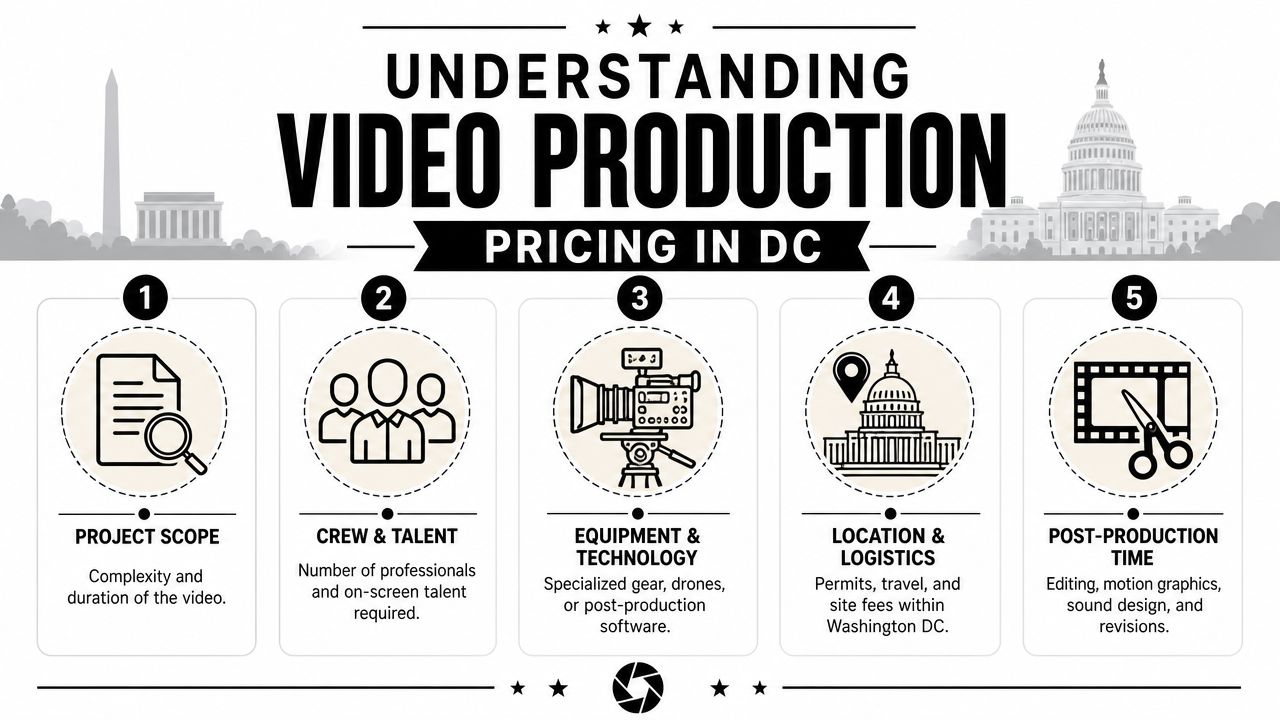
That range isn't random. It reflects very different production realities.
What pushes a project up the ladder
Here's the practical version.
| Project type | What usually drives the cost |
|---|---|
| Simple interview video | One location, light crew, limited setup changes, clean edit |
| Brand promo with more polish | Additional camera setups, more direction, stronger graphics, more revisions |
| Multi-day campaign or documentary | Multiple locations, scheduling complexity, larger crew, narrative editing, extensive post |
A cheap proposal isn't automatically efficient. Sometimes it just means the scope hasn't been thought through. On the other hand, a large quote can be perfectly reasonable if the project includes multi-day logistics, location complexity, or a heavy post-production lift.
Budget for outputs, not just shoot day
Most founders budget for the filming day because it feels tangible. That's backward. Budget for deliverables.
If you need one final video, your spend profile is different. If you need the hero cut, three social edits, short paid clips, captions, vertical versions, and stills pulled for campaign use, your budget has to reflect post-production time and workflow planning.
Buying advice: Ask every vendor to break the proposal into pre-production, production, and post. If they can't show you where the money goes, don't sign yet.
That's also why studio infrastructure can be such a good financial lever for recurring content. If the environment is already dialed in, you're not paying to rebuild the shoot from scratch every time. A controlled in-house studio setup often makes ongoing content far more predictable than location-heavy production.
The biggest pricing mistake I see is simple: clients buy a single polished asset when what they really needed was a system for continuous publishing. That's not a production problem. That's a planning problem.
A Smarter System for Your Signature Content
Hiring a traditional production company for one important local project can be the right move. No argument there. If you need a campaign video on Capitol Hill, event coverage near the convention center, or a documentary-style shoot across multiple DC locations, bring in the field team.
But if you're producing ongoing thought leadership, a branded show, or a founder-led content series, the one-off model starts to work against you.
One-off production versus a content system
A one-off project is built around a milestone. A content system is built around consistency.
That means different priorities:
- One-off project: creative concept, location execution, standalone final cut
- Content system: repeatable set, recurring workflow, batch capture, faster publishing
- Show format: series identity, audience retention, platform-specific edits, archive value
Entrepreneurs often confuse the two. They hire a premium team for a single production, get something that looks great, then stall because there's no repeatable process behind it.
That's where a studio-first model makes sense.
Why batching wins
If your brand lives on short-form clips, interviews, podcast episodes, and recurring social posts, you should batch aggressively. Record multiple assets in one session. Build templates. Keep your set, lighting, and camera language consistent. Treat your content like a media operation, not a random act of marketing.
For creators planning a short-form strategy around recurring clips, this TikTok content guide for small businesses is useful because it pushes you to think in formats, not just in isolated posts.
A system like that also makes tool selection easier. Your editing stack, asset naming, caption workflow, publishing cadence, and review process all become more manageable when the production environment is stable. If you're refining that setup, these content creator tools and workflow ideas are worth reviewing.
What this looks like in practice
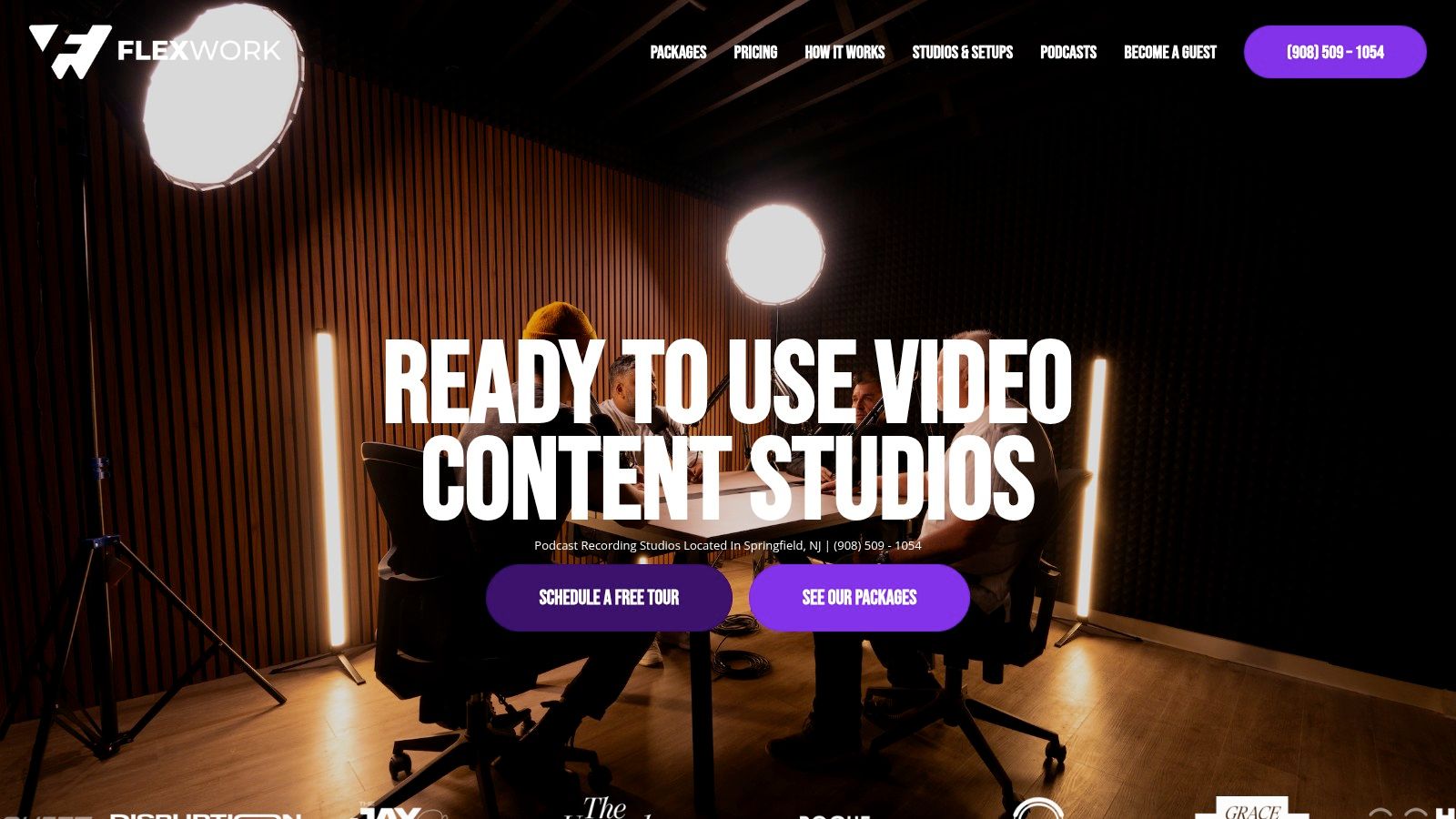
This is the model many modern brands need: a controlled studio, recurring production days, and a post-production workflow built to turn one session into a lot of usable output.
That's where Flexwork Podcast Studios fits as one option. Its service mix includes studio rentals, podcast production packages, Content Day sessions, editing, and podcast websites. The useful part strategically is the packaging. Content Days are $3000/day and include 20 edited reels or 60 pro photos. For brands building a show with growth support, the Market, Manage & Produce My Podcast tier starts at $1500 per episode with a 20-episode growth commitment. Podcast websites are $5000 plus hosting.
Here's the studio model in motion:
If your content goal is repetition, polish, and fast repurposing, this setup is usually smarter than hiring a fresh crew for every episode or social batch. Not because field production is bad. Because it's the wrong operating model for recurring studio-native content.
Your Vetting Checklist for Any Video Partner
A nice portfolio gets a company on your shortlist. It shouldn't get them the contract.
What separates a smooth production from a frustrating one usually isn't talent alone. It's process discipline, communication habits, and whether the team can translate your business need into an actual production plan.
The five things to check before you hire

Use this checklist in every discovery call.
- Style fit matters first. Don't ask whether their work looks good. Ask whether it looks like the version of your brand you're trying to become. Clean and competent isn't enough.
- Process clarity beats charisma. A charming producer who can't explain approvals, revisions, scheduling, and delivery will create chaos later.
- Local judgment counts. In DC, logistics can get annoying fast. You want a team that understands the city, not one improvising around permits and access.
- Team structure should be obvious. Who's directing, who's shooting, who's editing, who owns communication. If the answer is fuzzy, expect gaps.
- Budget transparency is essential. You don't need the cheapest quote. You need the quote that makes the scope legible.
Questions worth asking out loud
Ask these directly. Good vendors won't flinch.
- What happens if the brief changes after pre-production?
- How many rounds of revisions are included?
- Who will be on set and in post?
- What deliverables do you recommend from a single shoot?
- What tends to slow projects down on the client side?
That last question is especially useful. Mature teams answer it well because they've seen the pattern before.
If a vendor can't challenge your brief, they probably can't strengthen it either.
The red flags most clients miss
Some warning signs are obvious. Others are subtle.
| Red flag | Why it matters |
|---|---|
| They talk mostly about cameras | They may be underweight on strategy |
| They can't define approval steps | Your timeline will slip |
| They promise everything immediately | They may be overselling capacity |
| They avoid discussing post-production | That's where many projects fall apart |
The best partner usually sounds calm, specific, and operational. Not flashy. Not desperate. Just clear.
Insider Tips for Filming in Washington DC
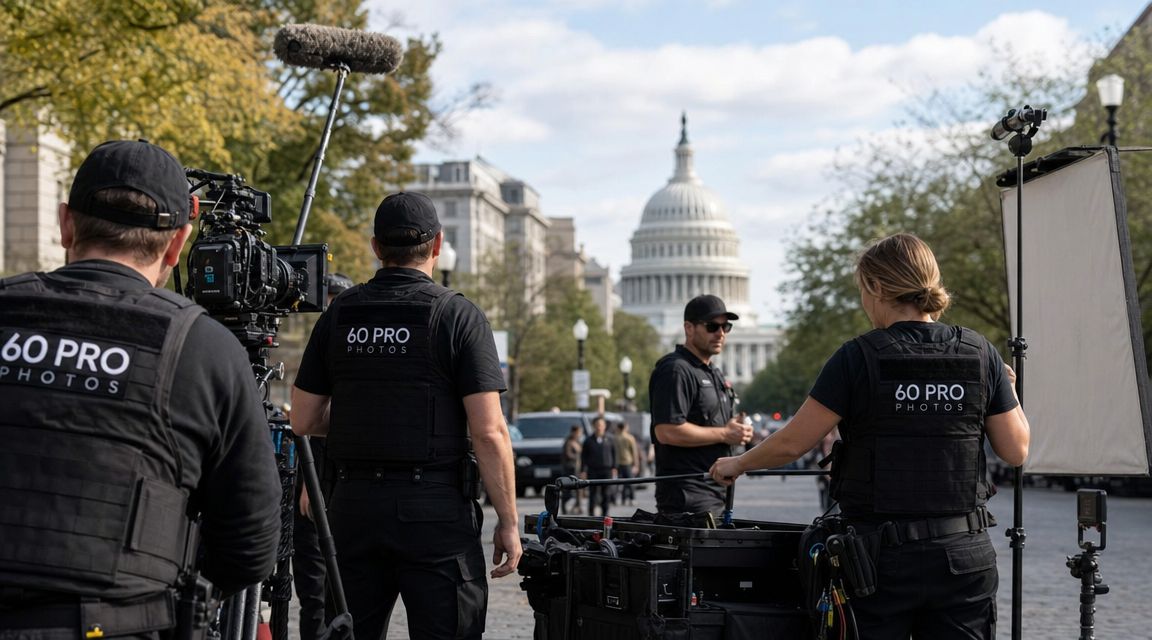
Filming in DC looks glamorous in mood boards. In real life, it's a city of restrictions, crowds, timing issues, and location tradeoffs. That doesn't mean you avoid shooting here. It means you plan like an adult.
Permits can shape the creative
A lot of founders think location choice is just an aesthetic decision. In DC, it's often a logistical one first.
Federal land near the National Mall and monument areas can involve National Park Service coordination. Street-level activity may trigger city considerations, including transportation or police coordination depending on the setup. Even when your team handles that, you should understand the consequence: permit needs can affect date flexibility, crew footprint, and whether your “simple shoot” stays simple.
This is one reason studio production keeps winning for recurring content. You remove variables.
The city looks different at production speed
Some places look iconic in a scout deck and become a headache on shoot day.
- Georgetown waterfront: Beautiful background. Also busy.
- The Wharf: Great energy, but crowd control can get ugly.
- Downtown corridors: Strong institutional look, but timing matters.
- Monument-adjacent zones: High visual value, higher planning load.
If your content depends on clean audio, controlled pacing, and multiple takes, public locations can eat time fast.
You don't choose a DC location because it's famous. You choose it because it supports the message without hijacking the schedule.
Small operational choices make a big difference
I'd push every client to think about these early:
- Audio first: Traffic, sirens, foot traffic, and HVAC can ruin an otherwise sharp visual setup.
- Call times matter: Earlier shoots usually give you cleaner backgrounds and better control.
- Wardrobe should match the environment: A founder in a stiff suit at a casual waterfront setup can look oddly disconnected.
- Lighting needs planning: Outdoor DC footage changes character quickly as the day moves. For studio work, understanding better lighting setups for video recording helps you spot quality when reviewing a plan.
Most of the “mystery” of production is really just logistics handled early. The more your concept depends on public space, the more those details affect budget and final quality.
Invest in a Partner Not Just a Project
Choosing a video production company in Washington, DC is a strategy decision disguised as a creative one.
If you need a one-time local production with field logistics, permits, locations, and a strong on-site crew, hire for that exact need. Don't overcomplicate it. Get the right local team, define the deliverables, and execute cleanly.
If you're building a brand that publishes regularly, stop pretending a string of one-off shoots is a strategy. It isn't. It's expensive improvisation. You need a repeatable environment, a consistent visual language, and a workflow that turns one recording session into multiple publishable assets.
That's the main divide in this market. Some vendors are built for projects. Others are built for systems.
Your job is to decide which game you're playing.
If your business lives on recurring interviews, founder-led video, podcast episodes, social clips, or a show format, choose the partner that can support output over time. Look for process, packaging, and post-production discipline. Ask how they'll help you publish consistently, not just how they'll make one video look expensive.
That's how you protect budget and build momentum at the same time.
If you're building a podcast, branded show, or repeatable content system, Flexwork Podcast Studios offers studio rentals, production support, Content Days, and podcast growth services that can help you move from scattered content to a structured publishing workflow.