Sky Hi Studios Review: Is It Right for You?
 August 2, 202619 Minutes
Sky Hi Studios is a real option, but it's not automatically the right one. It was founded in 2013, and that kind of longevity tells you it has staying power, but you still need to compare location, services, and booking fit before you hand over your episode.
A lot of podcasters get this backwards. They focus on the room name, then wonder why the audio feels flat, the session runs long, or the final product still needs rescue in post. Flexwork Studios works well for creators who want a polished production workflow, but the bigger lesson is simple, the studio you book should match the way you publish. If you're still comparing spaces like they're all the same, you're probably paying for the wrong thing.
Why Choosing the Right Podcast Studio Matters More Than You Think
Every podcaster eventually learns the same hard lesson, a studio is never just a room with a mic. It shapes how you sound, how your guest relaxes, how efficient your session feels, and how much cleanup you'll need later. If the space is awkward, the gear is flaky, or the support is weak, you don't just lose time, you lose momentum.
That's why I tell creators to judge a studio on four things, not one. Sound quality matters. So does the actual equipment list. Booking flexibility matters more than many admit. And support services, editing, branding, distribution, can turn a decent recording into something that's ready to publish without a second round of chaos.

Practical rule: if a studio can't clearly explain what's included, assume you'll have to fix gaps yourself.
That's why tools like the Rooy Development AI podcast generator can be useful for planning, but they don't replace a good production environment. The point isn't to find the fanciest place. It's to find a space that protects your time and makes your show sound intentional.
For a sharper framework on the DIY vs. pro decision, this breakdown from Flexwork's studio versus DIY guide is worth reading before you book anything.
What to Know About Sky Hi Studios Before Booking
Sky Hi Studios in Marlborough, Massachusetts is built around movement, not podcast production. Its stated offering includes pole fitness and dance, flexibility, conditioning classes, floor dance, Liquid Motion, hand balancing, and other movement formats. That matters because it tells you exactly what kind of business this is, and what kind of session it is built to handle.
If you are booking for movement-based content, performance visuals, or a branded shoot that benefits from an active physical environment, Sky Hi makes sense. If you need a dedicated podcast room with a full production workflow, you should look harder at a studio that is designed around audio and post-production from the start. A studio can be good without being the right studio.
The location is straightforward. The studio sits at 289 Elm Street, Unit 114 inside the Antico Business Center, right off I-495 and Route 20, which makes it easy to reach from the wider Boston area. That kind of access matters when you are bringing in guests, crew, or equipment, because a studio that is easy to find saves you the kind of hassle that slows a session down before it starts. The Sky High Studios FAQ page also reinforces that the space is run with a clear class-and-studio structure, which is useful context if your project fits that model.
Its FAQ page gives you the practical details you should read before you book anything. Sky Hi lists a minimum age of 15 years, requires written parental or guardian consent for anyone under 18, and says classes are taught barefoot. Those policies are normal for a movement studio, and they tell you the room is set up for a specific kind of use. If you are expecting a conventional podcast set, that is your cue to keep looking.
A studio's real value shows up in the friction it removes. If you have to guess about policies, gear, or room format, you are already losing time.
For readers comparing studio types, Flexwork's look at what makes a great podcast studio is a useful contrast because it frames the space around production outcomes, not just floor space.
Sky Hi Studios vs Flexwork Podcast Studios
The question is not whether Sky Hi Studios is a decent space. It is whether the space fits the job you need done. Sky Hi carries a movement and performance identity, while Flexwork Podcast Studios in Springfield, NJ is built as a creator-led production hub with turnkey podcast and video studios, professional-grade audio and cinema equipment, and support that extends into sound mixing, video editing, motion graphics, show branding, distribution, and growth-focused marketing. That gap affects every part of the booking decision.
Location and accessibility
Sky Hi's Marlborough location works well for the greater Boston metro corridor because it sits right off I-495 and Route 20. That is a practical advantage if your guests, crew, or equipment are already coming from that side of the map.
Flexwork serves the NJ and NY metro creator base from Springfield, NJ, which makes more sense for shows that run on repeat guest bookings and efficient production days. If your team wants a place that behaves like a content operation instead of a simple room rental, the Flexwork comparison of NJ podcast studios lays out the value difference in plain terms.
Equipment and production support
Sky Hi's public materials point toward classes and movement formats rather than a detailed podcast equipment stack. That works if your project is visual, performance-driven, or built around a branded shoot with a body-based angle. It falls short if you need clarity on the audio chain, edit workflow, and delivery consistency.
Flexwork is set up for creators who need the whole production moving in one place. You are not just renting a room, you are getting a workflow that can handle capture, polish, and publication support. For a show that needs video clips, branded assets, and distribution help, that is a very different kind of studio.
Services and support
The difference is easy to see. Sky Hi operates like a specialty studio with a strong movement identity. Flexwork works as a podcast production ecosystem. It offers studio rentals, podcast production packages, Content Day sessions, and podcast websites, so the creator is not left stitching the project together afterward.
If you are choosing between a one-off rental and an operational partner, the call is straightforward. A studio like Flexwork is built for repeatable publishing. Sky Hi is better treated as a niche space that can fit a specific creative format, not a full-stack podcast workflow. That distinction matters more than most studio brochures admit.
Pricing structure
The only pricing figure in the available brief tied to Flexwork is the Market & Manage tier starting at $1500 per episode with a 20-episode growth commitment. That signals an offer built around ongoing growth, not just time in a room. The comparison chart for Sky Hi lists $3000/day, but that figure comes from the provided comparison asset rather than a published Sky Hi rate, so it should be treated as directional when you are weighing value.

If a studio's offer is broad but vague, expect to do more of the production management yourself.
For a closer read on what you are getting in New Jersey, this Flexwork pricing comparison is more useful than a generic studio checklist.
Who Each Studio Is Built For
Sky Hi Studios makes sense for creators whose project lives closer to movement, performance, or visual expression than straight podcast operations. If your show includes dance, body work, or a physical brand aesthetic, the space can support that kind of energy. It's a studio with a distinct identity, and that identity is the point.
For solo podcasters who just need a quiet, repeatable setup, the better move is usually a podcast-first studio. If your show relies on clean audio, fast turnaround, and a reliable production workflow, a space like Flexwork is the more practical choice because it's designed around the act of publishing, not just recording. For teams, that difference gets even sharper.
One useful rule of thumb is this, if you're making content for the camera and the microphone at the same time, choose the studio that already thinks like a production team. That's the lane where workflows for AI podcast editing start to matter, because editing speed only helps when the capture process is already clean.
Best fit by creator type
- Movement-led creators: Sky Hi is the more natural fit if your content depends on choreography, flexibility, or a physically expressive environment.
- Audio-first podcasters: Flexwork wins because the workflow is built for recording, editing, and distribution, not just room access.
- Video-first brands: Flexwork is the stronger choice because it supports visual storytelling and post-production without making you piece everything together later.
- Business-minded teams: Flexwork is the obvious pick if the podcast is part of a broader marketing engine and not just a creative hobby.
Choose the studio that removes the most steps from your process. That's the one that saves money in the real world.
If you're deciding based on show format, this guide to choosing the right NJ podcast studio for your setup is the right next read because it forces the question most creators skip: how many moving parts does your production have?
Smart Booking Tips for Your Next Studio Session
Start by asking what's included, not what's available. A lot of creators waste time assuming a studio package covers gear, monitoring, and post-production, then discover the add-ons after the invoice lands. Ask for the exact gear list, the room rules, and the handoff process before you commit.
Once you tour the space, check how the room feels in use, not just how it photographs. Sit where the guest will sit. Look at the sightlines. Test whether the environment supports your format or just looks good in a listing. The right studio should feel easy the moment you walk in.
What to confirm before you pay
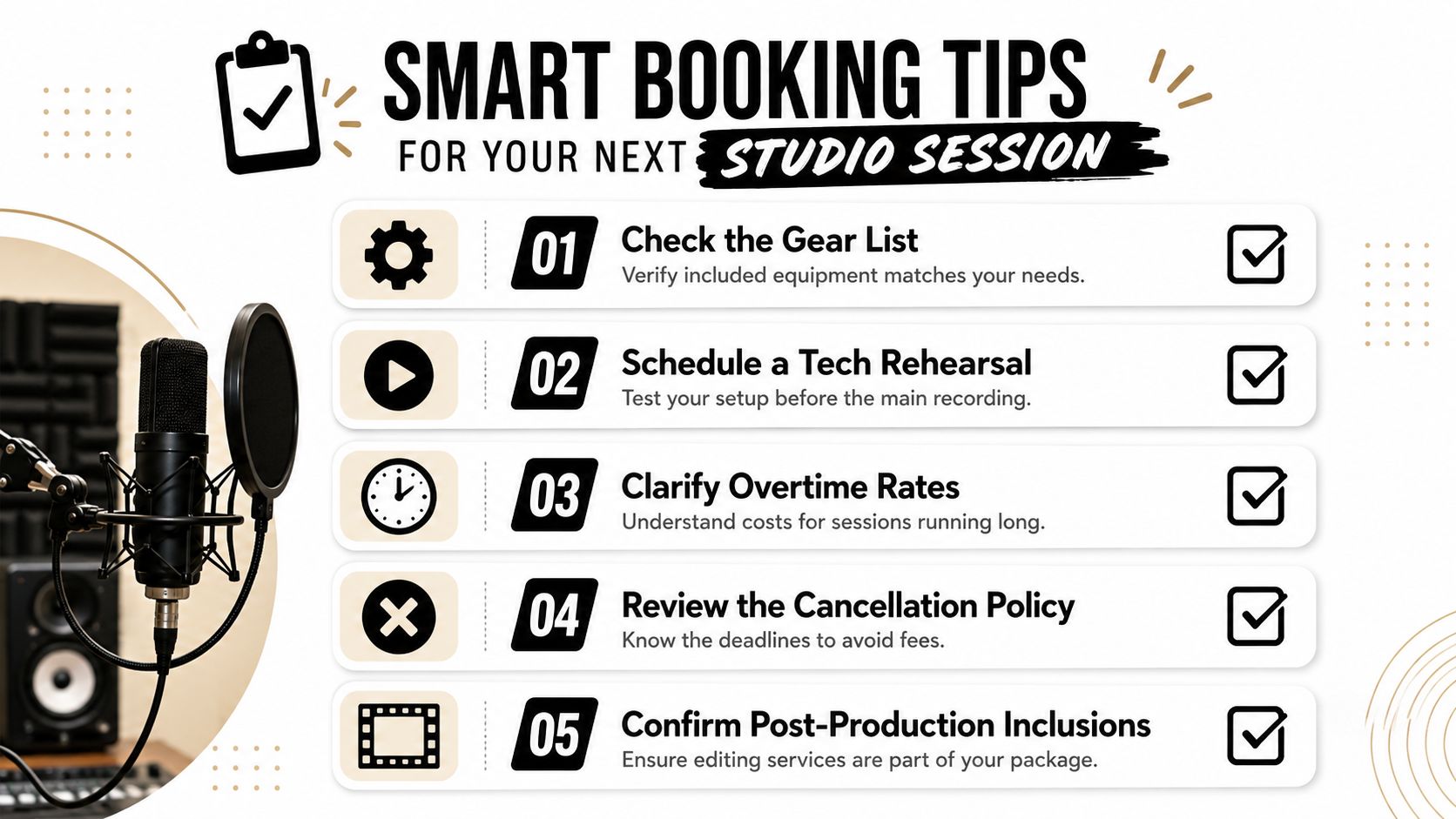
- Check the gear list: Verify the microphones, monitors, and recording tools match your show format.
- Schedule a tech rehearsal: Do a quick test before the session starts so you're not troubleshooting on the clock.
- Clarify overtime rates: Ask how the studio handles a session that runs long.
- Review the cancellation policy: Know the deadline before fees kick in.
- Confirm post-production inclusions: Make sure editing, exports, or file delivery are included.
The smartest creators also plan for the boring stuff. Bring backup notes, a charged backup device, and a clean guest brief. If you're recording interviews, send your questions ahead of time and cut anything that sounds like filler.
For a good studio etiquette refresher, Flexwork's booking and scheduling guide is helpful because it keeps the focus on efficiency, not guesswork.
Real-World Scenarios That Show How the Decision Plays Out
A new podcaster launching on a tight budget often thinks the cheapest room is the safest choice. That's usually backwards. If the space doesn't give you clean audio and enough support to finish strong, you'll spend more time fixing the episode than making it.
A better move for that creator is a studio that reduces mistakes and makes the first few episodes easier to publish. If the goal is to get on the air without becoming your own engineer, a podcast-focused operation is the more sensible choice. Sky Hi can still make sense if the content is movement-based or visually driven, but not if the show is trying to look and sound like a polished interview series from day one.
An established show scaling into video has a different problem. The recording itself is only half the job. You now need clips, editing, brand consistency, and a repeatable publishing rhythm, which is why a studio built around production support is the right answer.
A high-stakes interview series raises the bar even more. Guests notice the room, the sound, and the confidence of the team before you've asked the first question. If the studio feels scattered, the guest feels it too. If the studio runs like a production floor, the conversation gets better, and that's what makes the episode work.
Frequently Asked Questions About Booking a Podcast Studio
What should I expect on a first studio visit? A serious space should walk you through the room, the gear, and the workflow without making you guess. If you leave confused, that's your answer.
Is production support worth paying for? If your show needs editing, branding, or distribution help, yes. Cheaper room time isn't a deal if you still have to assemble the episode yourself.
Should I choose the closest studio? Not unless it also fits your format. Convenience matters, but production value and reliability matter more.
What's the biggest red flag? Vague answers about what's included. If the team can't tell you exactly how a session works, keep looking.
If you want a studio that treats podcasting like a production process, not a side room with microphones, Flexwork Podcast Studios is built for that job. It offers studio rentals, podcast production packages, Content Day sessions, and podcast websites, so you can move from recording to publishing without duct tape in the middle. Visit Flexwork Podcast Studios and book the setup that matches how serious you are about your show.