
Elevate Your Brand: Short Form Video Editing 2026
 June 23, 202625 Minutes
Headline: Short Form Video Editing That Builds Authority
Meta description: Learn the short form video editing workflow that turns podcasts into polished, high-retention clips that grow your brand.
URL slug: short-form-video-editing-podcast-clips
You recorded the episode. The conversation was smart, the guest was strong, and the full-length cut says exactly what your brand needed to say. Then you post a clip, and it disappears into the feed.
That's the frustration more creators are dealing with now. Long-form content still builds depth, but discovery happens in short-form. If your reels, shorts, and vertical clips feel like rushed leftovers, the market reads that instantly. The problem usually isn't effort. It's that turning a strong podcast or interview into a sharp, high-retention social asset takes a different editorial brain than producing the full episode.
Short form video editing has become a business skill, not just a post-production task. At a studio level, the work is less about flashy cuts and more about extracting the right moment, shaping the narrative, and packaging it for attention without making it feel cheap.
The Short-Form Mandate Why Your Content Needs a Cutting Edge
You publish a strong podcast episode, pull a quote you liked, add captions, and post it as a reel. The full conversation has substance. The clip still gets ignored because the moment was never shaped for cold-viewer attention in the first place.
That is the mandate for short-form now. Brands are not competing on volume alone. They are competing on how quickly they can turn expertise into a clear, watchable point of view inside a vertical feed.
According to HubSpot's video marketing findings, over 70% of consumers prefer short-form video to learn about products. That preference changes the job of editing. For creators with podcasts, interviews, webinars, and founder-led content, short-form editing is the system that converts existing media into discovery assets, audience trust, and qualified attention.
Authority now starts in the feed
For a new viewer, the clip often comes before the brand, the website, or the full episode.
A polished short can handle three business jobs at once:
- Introduce your point of view: Viewers can understand your angle in seconds.
- Signal production standards: Pacing, framing, captions, and sound shape perceived credibility fast.
- Pull people toward deeper content: The right excerpt creates enough tension and curiosity to earn the next click.
This is why repurposing long-form content needs editorial judgment, not just software speed. A raw excerpt may preserve the original conversation. It rarely preserves the strongest reason to watch.
Practical rule: Ask, “What tension, promise, or opinion can win attention in the first three seconds?” Then build the clip around that answer.
Discovery rewards precision
The best shorts cut like native content, even when the source was a 60-minute conversation. They start at the point of consequence. They remove setup that mattered in the full episode but slows down the clip. They use captions, reframes, and visual emphasis to support the idea, not distract from it.
That trade-off matters. Keep too much context and retention drops. Cut too aggressively and the clip loses clarity or trust. Professional short-form editing sits in that middle ground, where the story feels fast without feeling cheap.
For teams building a serious content engine, short clips should sit inside a broader video content marketing strategy. They are not leftover promotional assets. They are entry points that help your best ideas travel further than the original recording ever could.
Creators who grow from long-form content usually make the same shift. They stop treating editing as post-production cleanup and start treating it as distribution strategy.
From DIY Burnout to Professional Authority
DIY editing often starts with good intentions and ends with a calendar full of half-finished drafts. You pull selects from a podcast, drop them into CapCut or Premiere Pro, add captions, tweak the zooms, and then lose an hour deciding whether the hook should start two words earlier.
That kind of workflow drains people because it confuses activity with editorial clarity.

The problem isn't software
Most creators assume the missing piece is a better app, a faster preset pack, or one more viral editing trick. It usually isn't. The actual issue is that amateur workflows focus on visible polish before narrative control.
You see it in clips that have motion graphics, punch-ins, animated captions, and sound effects, but still feel forgettable. They're busy without being persuasive. They move, but they don't build.
A more useful way to judge a clip is this:
| DIY instinct | Professional instinct |
|---|---|
| Start with a visually interesting moment | Start with the strongest promise to the viewer |
| Keep most of the original exchange | Remove anything that weakens the point |
| Maintain constant intensity | Shape momentum so the viewer can follow the idea |
| Edit for style | Edit for retention and trust |
One of the clearest examples is pacing. A 2025 industry analysis of short-form content performance across TikTok and Instagram Reels found that videos with a structured pacing arc, starting fast, slowing around mid-video explanations, then re-accelerating before the end, achieved 18–25% higher completion rates than purely high-energy edits (Social Coach analysis). Most beginner tutorials still push nonstop speed, which can make educational or spoken-word clips feel exhausting.
Burnout comes from making every clip from scratch
Creators burn out when every reel feels like a fresh emergency. There's no repeatable selection process. No brand visual system. No decision tree for what deserves subtitles, when to cut to B-roll, or how to shape a CTA without sounding forced.
That's why professional authority looks calmer on screen. The editor isn't guessing. The choices are deliberate.
The audience can feel when a clip was assembled quickly versus designed to hold attention.
If you're comparing studio-level work to a solo late-night workflow, the difference isn't that one person cares more. It's that one system is built around standards.
A good breakdown of that trade-off shows up in this look at studio vs DIY podcasting and what you gain by going pro. The visual side of the argument matters, but so does the editorial side. Better content isn't just cleaner. It feels more certain.
The Studio Solution Accelerating Your Content with Flexwork
A founder records a strong 45-minute podcast, sends it to a freelance editor, and gets back ten clips that look clean but go nowhere. The issue usually is not effort or software. The issue is that no one shaped the session for short-form distribution before the record button was pressed.
That gap matters more now because long-form spoken content is feeding short-form channels at scale. A Global Business Journalism recap of a 2023 Edison Research report describes how branded podcasts are increasingly being repurposed into short-form video, which is why editors need to treat clip selection as a story and positioning job, not a trimming job (Global Business Journalism recap).
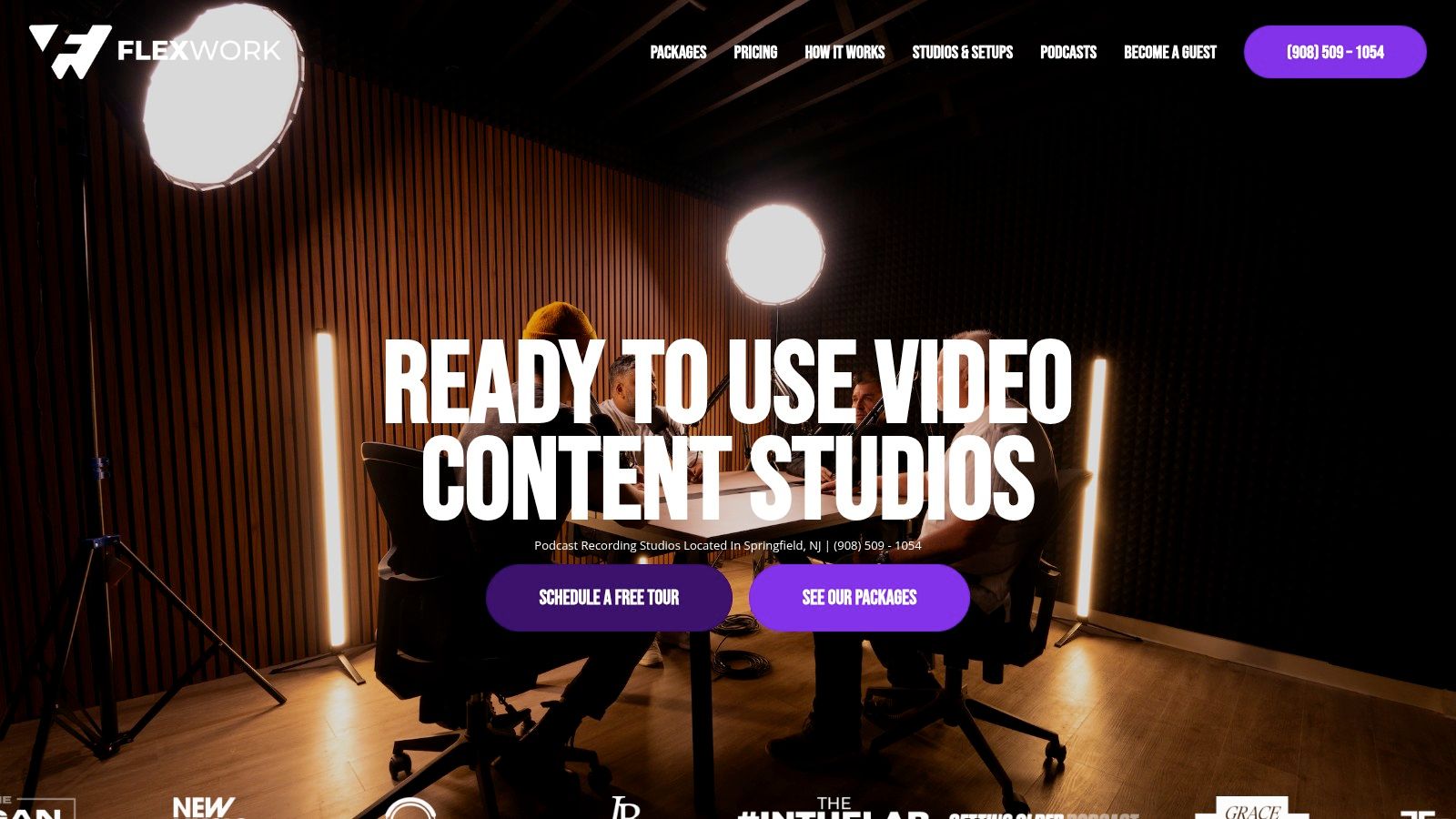
A studio setup solves that problem upstream. Recording, framing, audio, show structure, and post-production are planned together, so the editor starts with usable material instead of spending half the budget fixing preventable issues.
What a content day solves
One well-run production day can feed weeks of distribution if the session is built for extraction. That means clear topic blocks, repeatable framing, wardrobe continuity, planned hook lines, and enough variation in delivery to cut multiple angles from one conversation.
The commercial value is simple. Instead of posting when there is time, a creator can publish on schedule with a backlog that still feels intentional.
Content Days are priced at $3000/day and include 20 edited reels or 60 pro photos. That package makes sense for teams that already know their offer and need consistent assets around it. The win is not just output volume. The win is getting footage that can be turned into sales clips, authority clips, social proof, and retargeting creative from the same shoot.
It also creates continuity across the system:
- Visual continuity: set quality, lighting, framing, and captions stay consistent across every short
- Message continuity: each clip supports the same brand position instead of chasing disconnected trends
- Production continuity: the shoot, review process, and delivery schedule are built to work together
What ongoing production support changes
Batching helps. Ongoing support changes the ceiling.
Shows that publish every week need more than occasional editing. They need a workflow that keeps the on-camera performance, episode structure, thumbnails, cutdowns, and clip strategy aligned over time. That is how a podcast starts working like a growth channel instead of a content chore.
The Market, Manage & Produce My Podcast package starts at $1500 per episode with a 20-episode growth commitment. That structure fits brands that want recording, editing, packaging, and distribution support handled consistently, with short-form clips treated as part of the business model rather than leftover content.
Flexwork Podcast Studios offers studio rentals, podcast production packages, Content Days, and podcast websites, including production support tied to editing and short-form clip creation as part of podcast services.
Teams building that system also need the right post-production stack. A practical starting point is this guide to video editing software for short-form creators, especially if you are deciding what should stay in-house and what should move to a studio partner. If your clips are also being adapted for X, the MicroPoster guide to Twitter video uploads is useful for checking format constraints before export.
Clean capture changes the edit. Editors can spend their time shaping narrative, pacing, and retention instead of repairing room echo, poor framing, or disorganized footage.
That is the core studio advantage. It turns content production from a recurring scramble into a repeatable growth system.
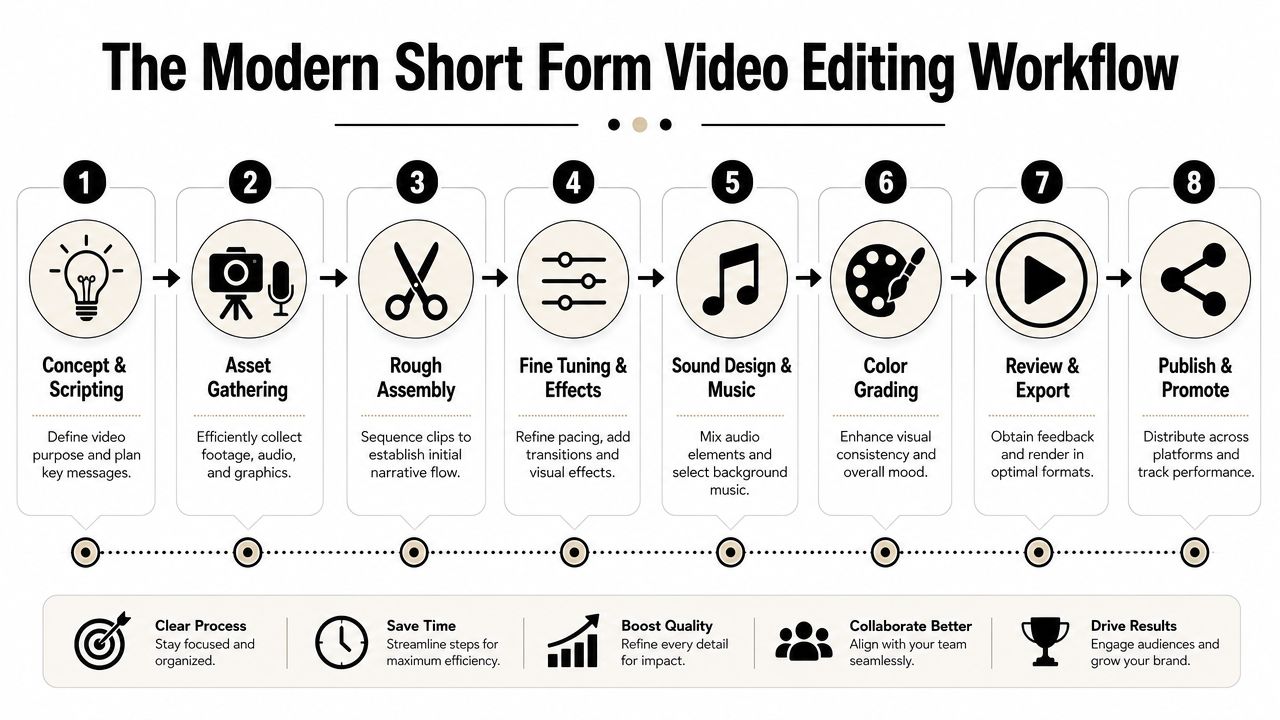
The Modern Short Form Video Editing Workflow
The strongest short-form clips usually feel effortless. They aren't. They come from a tight workflow that filters long-form material into a focused narrative.
Pre-production starts after the recording
If you're repurposing a podcast, interview, or panel, don't scrub the entire timeline looking for “good moments.” That approach wastes time and usually rewards the loudest soundbite instead of the most useful one.
Start by sorting for clip types:
Contrarian moments
These work when the speaker challenges a common belief. They make strong hooks because the viewer understands tension immediately.Compressed teaching
Look for moments where the speaker explains one idea cleanly in a short span. This often performs better than broad motivational clips because the value is obvious.Personal stakes
Stories land when something is on the line. A founder mistake, a client lesson, or a behind-the-scenes admission often creates emotional pull without needing theatrics.
A rough transcript helps. If your team is researching social clips or caption themes from posted content, tools for extracting Twitter video upload context and specs can also be useful on the distribution side, especially when tailoring versions for different platforms. The point is to make selection easier before the timeline gets crowded.
The edit lives or dies in the opening seconds
Once you've found the moment, the first task is structural. Don't begin with throat-clearing. Don't preserve the original pacing of the conversation if it delays the point.
When editors apply a three-beat structure, hook, conflict, payoff, within the first 3–5 seconds, platform analytics show a 15–25% higher chance of viewers watching past 10 seconds compared to unstructured edits (Wochit short-form editing tips).
A simple short-form structure looks like this:
| Beat | What it does | What to avoid |
|---|---|---|
| Hook | Creates immediate curiosity or relevance | Slow setup, greetings, context dumps |
| Conflict | Names the problem, mistake, or tension | Vague statements with no stakes |
| Payoff | Delivers the lesson, answer, or turn | Ending without resolution |
That doesn't mean every clip should feel dramatic. It means every clip needs shape.
Cut for the viewer who knows nothing about you. If the clip only works because someone already follows your show, the hook is too weak.
Pacing is a design choice
A lot of creators overcut. They strip every pause, add constant movement, and turn a useful point into visual caffeine. Other creators undercut. They preserve the rhythm of natural conversation in a context where that rhythm feels slow.
Professional pacing sits between those extremes.
Use a fast start to establish momentum. Then allow a brief moment of clarity when the speaker explains the key point. Then tighten again near the end so the conclusion lands with energy. That arc feels more human than permanent acceleration.
Helpful editorial choices include:
- Selective punch-ins: Use them when emphasis changes, not every few seconds.
- B-roll with a purpose: Cover edits, reinforce meaning, or reset visual attention.
- Captions that support reading: Clean line breaks and strong keyword emphasis matter more than novelty fonts.
- Silence trimming with restraint: Removing dead air is useful. Removing every breath can make the speaker feel synthetic.
Polish is where trust gets built
Most viewers won't name the technical reason a clip feels professional, but they notice the result. Crisp dialogue, consistent exposure, flattering skin tone, and legible captions all reduce friction.
The finishing pass usually covers:
- Audio cleanup: remove distracting noise, balance levels, and keep speech clear
- Color correction and grade: maintain consistency across camera angles and recording sessions
- Brand packaging: lower thirds, intro treatments, and end cards should feel intentional, not pasted on
- Export choices: vertical versions for feed-native use, with framing checked manually before release
If you're evaluating apps or deciding when to move into a more full-featured toolset, this review of best video editing software is a practical reference point. The software matters. The editorial judgment matters more.
Beyond the Cut Batching Templates and Repurposing
A podcast recording ends. Actual asset-building starts after that.
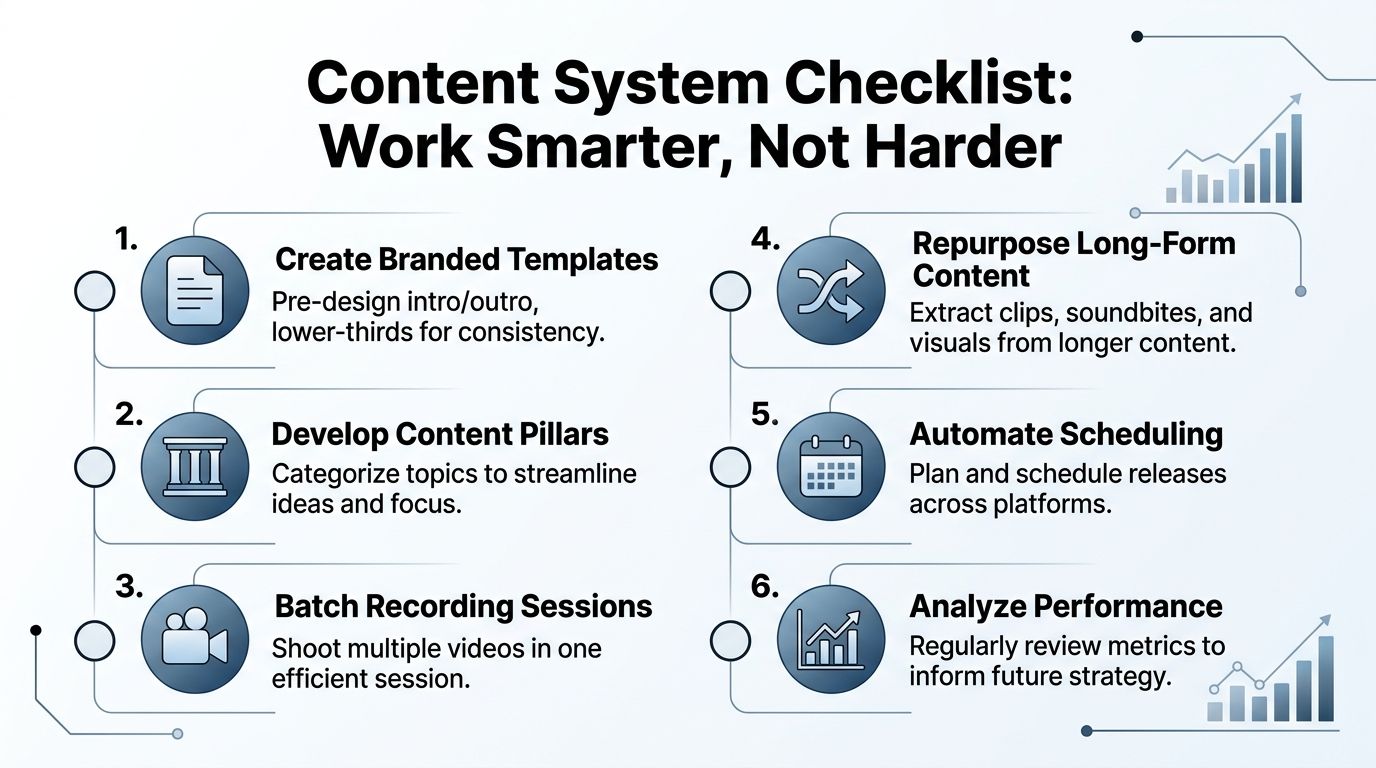
Teams hit a ceiling when they treat repurposing as clip extraction alone. Professional short-form systems are built around repeatability, editorial range, and speed under pressure. The goal is not to squeeze one episode into random cutdowns. The goal is to turn one strong conversation into a set of assets that each serve a clear business purpose.
Build templates before volume exposes the gaps
Templates protect judgment. They reduce avoidable decisions so the editor can spend time on pacing, hook strength, and framing the right moment for the right platform.
A practical short-form template kit usually includes:
- Caption rules: one font pairing, one highlight treatment, one safe zone for mobile viewing
- Intro and outro logic: defined use cases, so clips do not all open and close the same way
- 9:16 framing presets: especially helpful for multi-camera podcast footage and speaker swaps
- On-screen graphic standards: consistent handling for names, topics, pull quotes, and CTAs
That structure matters because batching breaks down fast when every clip needs fresh styling decisions. A good template system keeps the output recognizable without making it feel factory-made.
Batch by audience intent
Weak repurposing creates five versions of the same point. Strong repurposing builds a content spread from a single source conversation.
One episode can usually yield several different cuts:
- A sharp opinion clip that earns reach
- A tactical answer that earns saves
- A story-led moment that builds connection
- A contrarian take that invites comments
- A direct offer clip that supports traffic or conversions
That shift changes the value of editing. Instead of posting leftovers from a long-form episode, you are programming a short-form content line with different jobs to do.
For a practical framework, this guide on how to repurpose a single podcast episode into 10 pieces of content shows how to map one recording into a fuller distribution plan.
Working rule: Measure repurposing by the number of audience needs you can answer, not by the number of exports you can stack in a folder.
Research makes the batch better
The strongest repurposing systems study language, not just visuals. Editors and producers should track which phrases create curiosity, which objections show up in comments, and which explanations hold attention in the first few lines of a clip. If your team is reviewing creator hooks or spoken phrasing from platform-native content, tools for extracting TikTok text for research can make that analysis faster and more organized.
Short-form editing begins to act like a growth function. Each batch gives you evidence. You see which hook patterns fit the brand, which subject lines deserve a recurring series, and which moments from long-form content are strong enough to become assets across multiple channels.
Consistency usually comes from discipline, not constant originality. The creators who look prolific often run a tighter system.
Investing in Your Brand's Visual Voice
Short form video editing isn't an accessory anymore. It's part of how your brand speaks before anyone books, buys, or subscribes.
Viewers decide fast. Research on short-form engagement indicates that people choose whether to keep watching within the first 40–50 seconds, and videos that open with a hook, question, or emotional cue perform better (MotionBees short-form engagement notes). If your content spends that window warming up, you've already lost ground.
That's why professional editing is worth treating as brand infrastructure. It sharpens your message, protects your authority, and makes your long-form investment travel further. Good short-form work doesn't cheapen thoughtful content. It packages it so more of the right people see it.
Visual authority also starts before the edit. Framing, set design, and image quality affect how much the editor can enhance the final clip. If you're tightening the production side, this guide to best lighting for video recording is a smart place to start.
If you're ready to turn full episodes into polished short-form assets that support growth, explore the production options at Flexwork Podcast Studios. Book a studio tour, review the podcast packages, or start with a Content Day and build a stronger content engine from one well-produced session.