The 10 Best Podcast Website Builder Tools for 2026
 June 27, 202630 Minutes
Meta description: Compare the best podcast website builder tools for 2026 and learn when DIY works best versus hiring Flexwork Studios for a premium site.
URL slug: /best-podcast-website-builder-tools-2026
Primary keyword: podcast website builder
Secondary keywords: podcast website, podcast hosting website, podcast website design
Your Podcast Deserves a Professional Home Base
You've already spent money on the mic, the camera, the editing software, and the time it takes to publish consistently. Then a listener clicks through and lands on a weak website, a generic host page, or a link-in-bio that feels more temporary than premium. That disconnect costs you authority.
A podcast website builder fixes that, but not every creator needs the same kind of solution. Some need speed. Some need SEO depth. Some need a site that feels as polished as the show itself. And some are done stitching together tools and want a team to handle the whole thing.
That's where this list gets useful. You'll find the best podcast website builder options for 2026, from fast DIY platforms to a premium, done-for-you build from Flexwork Studios. If you're trying to decide whether to build it yourself, use your host's website, or invest in a custom brand hub, this will make the call much clearer.
If you're building on WordPress, site performance matters too. This guide on finding the right caching plugin is worth bookmarking before you go too far.
1. Flexwork Podcast Studios
You launch an impressive show, send a prospect to your site, and they land on a page that looks like a placeholder. That gap weakens the brand fast. Ambitious creators need to decide early whether they want a DIY podcast website builder or a professional site that supports revenue, authority, and growth.
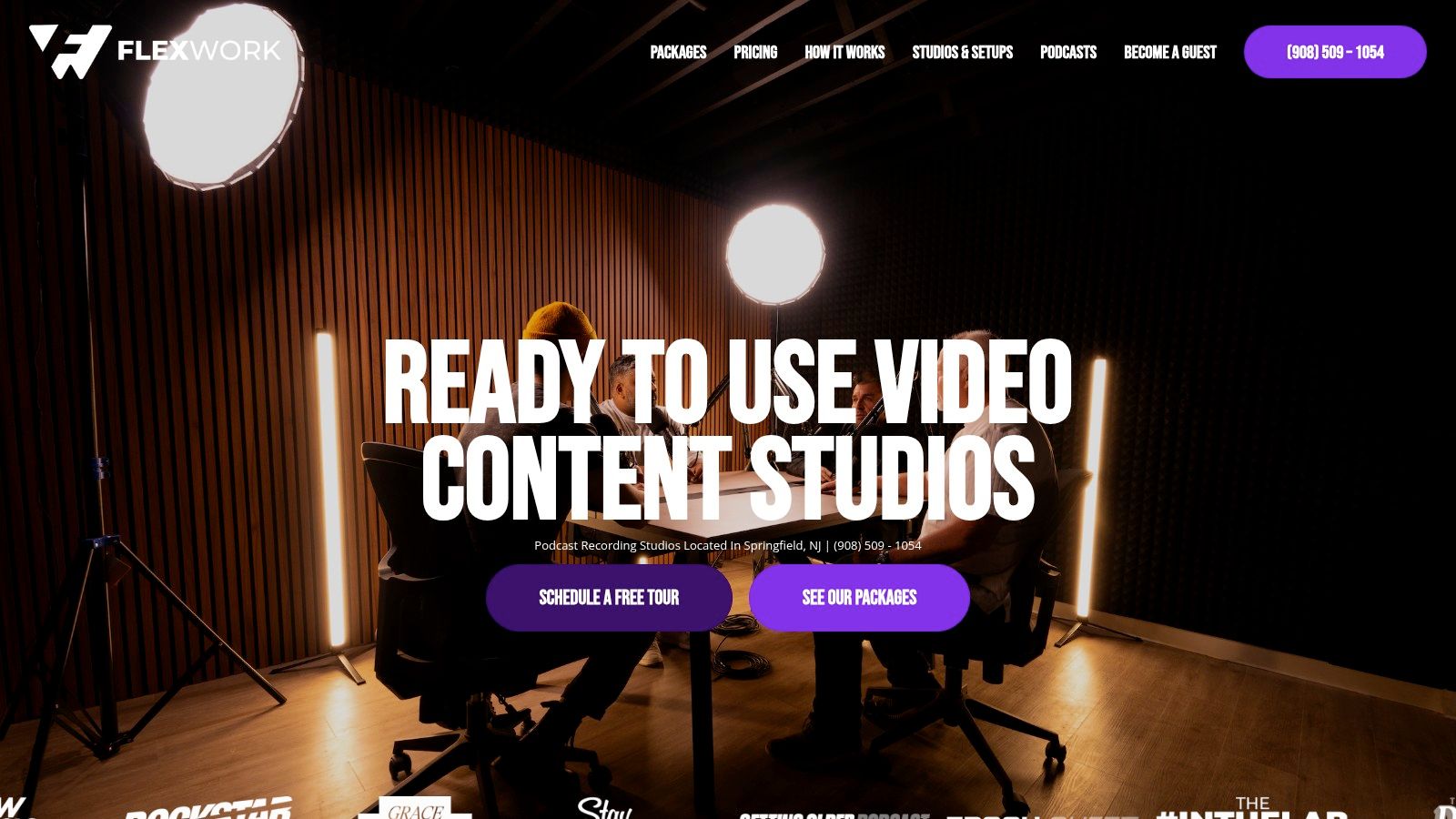
Flexwork Podcast Studios sits in a different category from the software tools on this list. It is a done-for-you option for creators who want the website, the production quality, and the brand presentation handled by one team. If your podcast supports a business, a personal brand, a speaking career, or a higher-ticket offer, that difference matters.
Best for serious creators who want the whole brand handled
Flexwork offers podcast websites for $5000 plus hosting, alongside studio rentals, production support, and larger growth services. If you also need short-form content, a Content Day is $3000/day and includes 20 edited reels or 60 pro photos. If audience growth is the priority, the Market, Manage & Produce My Podcast service starts at $1500 per episode with a 20-episode growth commitment.
A website rarely lives in isolation. It needs to connect to your show branding, your clips, your booking flow, your social rollout, your guest pipeline, and your conversion path. Flexwork is built for that full system, not just the website itself.
Practical rule: If your podcast helps you sell services, attract sponsors, book speaking work, or build a business, the website should not be your side project.
The strongest argument for Flexwork is not speed. It is judgment. DIY platforms can publish a clean podcast website quickly, but they still leave you making decisions about structure, messaging, design, calls to action, and how the site fits the rest of your brand. Flexwork removes that burden and gives you a polished result that feels aligned with a premium show.
Why Flexwork leads this list
A generic host page can handle listening. It usually falls short as a business asset. Flexwork is the better choice for creators who need a podcast website design that supports lead capture, brand credibility, and long-term growth.
Why it stands out
- Done-for-you execution: Recording, editing, motion graphics, distribution, marketing, and website creation run through one team.
- Studio-grade production: The Springfield facility is built for polished audio and video capture.
- Brand-first thinking: The site is treated as part of the larger creator business, not a disconnected add-on.
- Better fit for ambitious shows: You get a stronger digital presence than a basic podcast hosting website can usually deliver.
The tradeoff is clear. A DIY podcast website builder makes more sense if your budget is tight and your goal is to get online fast. Flexwork makes sense if you want a site that looks expensive because your brand needs to look expensive.
If you are still building the show itself and are not ready for a premium website yet, start by tightening the foundation with this guide on how to start a podcast from scratch.
2. Podpage
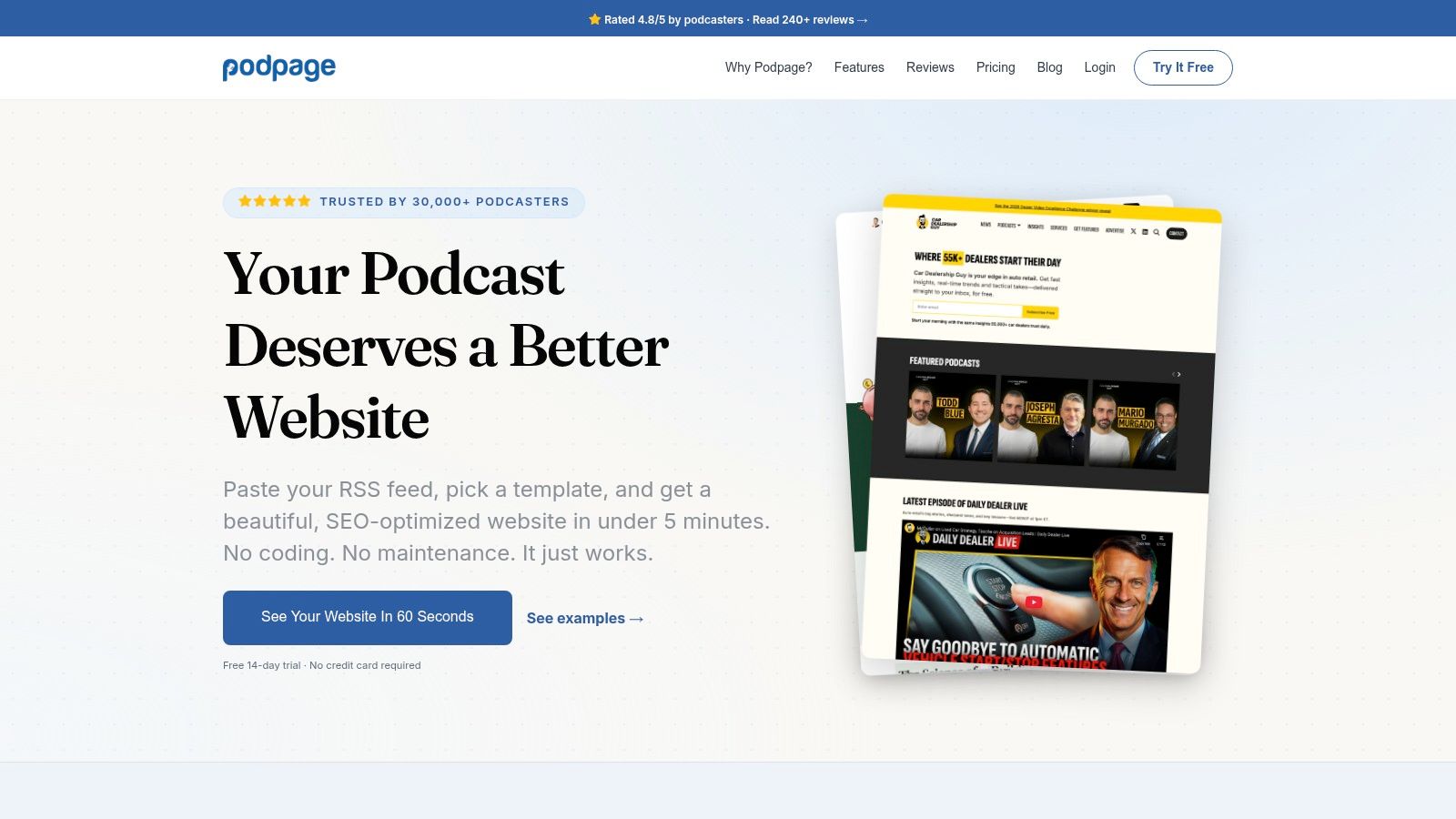
Podpage is the cleanest answer for podcasters who want a real website without becoming a website manager. Paste in your RSS feed, connect your branding, and the platform builds episode pages, guest pages, reviews, and email capture without forcing you into WordPress maintenance.
That simplicity is the appeal. You keep your existing host, and Podpage handles the presentation layer.
Why Podpage works so well
Its strongest advantage is focus. Podpage was made for podcasts, not adapted for them later. That means the details feel right: subscribe badges, imported reviews, voicemail widgets, guest intake forms, landing pages, and automatic episode updates.
The catch is that it isn't your host. You still need audio hosting somewhere else, and if you want a heavier e-commerce setup, it won't give you the same flexibility as a broad site builder.
For many solo creators, Podpage is the point where “I should really build a website” turns into “done by tonight.”
If you're still building the show itself, start with a solid launch foundation before you obsess over design. Flexwork's guide on how to start a podcast from scratch is a good companion read.
Best fit
- Fast launchers: You want a polished site quickly.
- Low-maintenance operators: You don't want plugins, updates, or dev work.
- Podcast-first brands: Your website exists to support episode discovery and audience capture.
Podpage isn't the most expansive platform in this roundup. It is one of the most efficient.
3. Beamly (formerly Podcastpage.io)
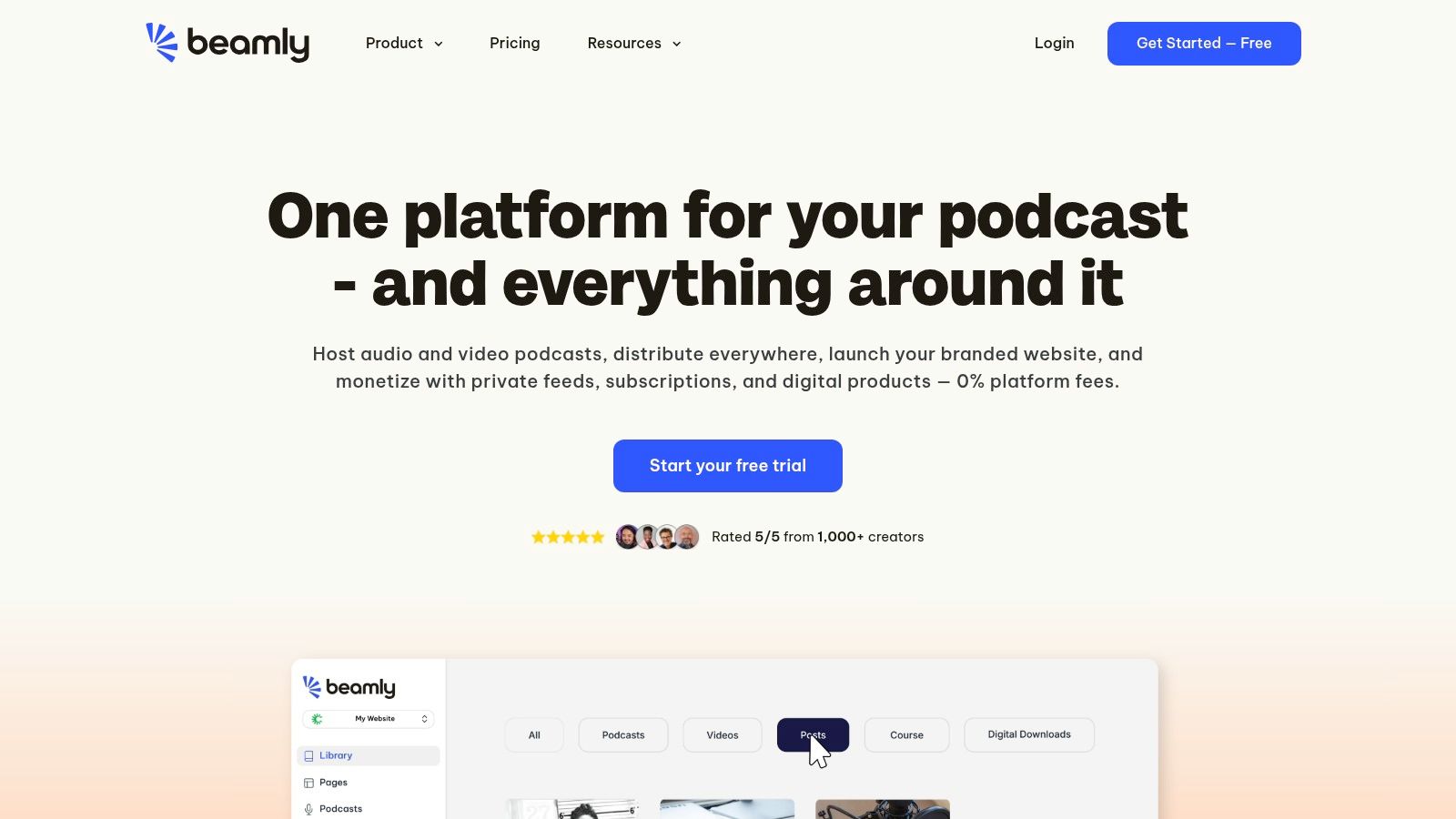
Beamly is for the creator who wants a website, hosting, memberships, digital products, and video in one branded hub. If your podcast is expanding into courses, private feeds, or paid community access, Beamly becomes more interesting than a basic site generator very quickly.
Its positioning is straightforward. This is a monetization-friendly platform built for media businesses, not just hobby shows.
Where Beamly earns its spot
Beamly combines AI-assisted website building with RSS-based site generation. You can sync an existing show or use its optional hosting, then layer on memberships, subscriptions, products, video, blog content, and YouTube imports.
That mix makes it more commercially ambitious than most podcast-specific builders. Stripe integration and 0% platform fees on creator sales will appeal to hosts building a business around their show. Multilingual and RTL support also gives it broader reach than many niche tools.
Choose Beamly if you want
- Monetization baked in: Memberships, subscriptions, and products matter to your model.
- Mixed-media publishing: You're producing more than just audio.
- One branded destination: You don't want your content and offers scattered across separate platforms.
The drawback is maturity. Beamly's ecosystem feels smaller than the biggest general website builders and oldest podcast hosts. You're betting on a focused platform rather than the broadest app universe.
Still, for business-minded podcasters, that trade can be worth it.
4. Transistor

Transistor is the smart pick for people running more than one show, building a podcast network, or thinking bigger than a single title. It's a hosting platform first, but its built-in websites are strong enough that many teams won't need a separate builder at all.
That's the key distinction. Transistor doesn't just give you a show page. It gives you a clean, professional home for an entire slate.
Best for networks and multi-show brands
You get one-click podcast websites, custom domains, auto-updated episode pages, embeddable players, private podcast options, dynamic ads, and a separate network website builder. That architecture is unusually useful if you're producing multiple shows under one umbrella.
It also offers unlimited shows on one account, which gives it a very different feel than single-show-first tools. If you're building a media company, an agency network, or a branded content lineup, Transistor has the right shape.
For creators still tightening up their gear before they scale, Flexwork's guide to the best podcast equipment for beginners is worth reading alongside your software choices.
A lot of podcasters outgrow single-show tools before they realize they've become a multi-show business.
The limitation is customization. The sites look polished, but they don't behave like a full content management system. If your long-term plan includes richer blog strategy, custom conversion pages, or a more editorial design language, you may eventually want a broader platform or a custom build.
For network-minded creators, though, Transistor is a strong call.
5. Captivate
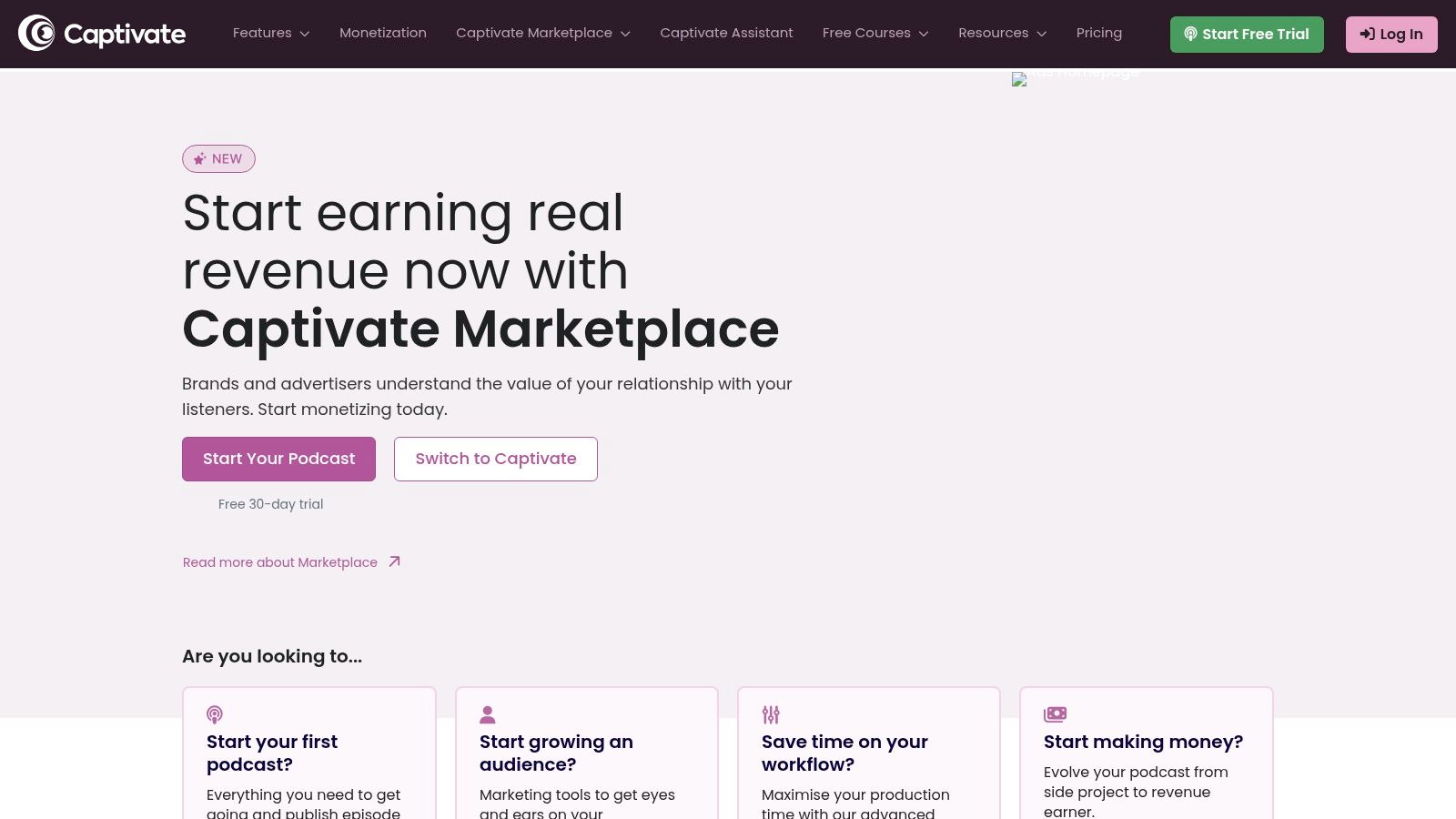
Captivate has always leaned into growth, and that focus shows in its website product. The platform's auto-generated podcast websites are clean, useful, and backed by a wider stack that includes dynamic content tools, memberships, private podcasting, analytics, and integrations.
If you want your host to act like a growth partner, Captivate deserves attention.
Why growth-minded hosts choose Captivate
A lot of hosting platforms gate useful features behind higher plans. Captivate's appeal is that it makes its full feature set available across plans, then ties pricing to download allowances rather than stripping out core functionality.
Its website builder won't replace a custom CMS, but it covers what most active podcasters need: custom domains, embeddable players, branded presentation, and a direct path from published episode to discoverable web page. The company also puts noticeable emphasis on creator education and growth resources.
The opportunity is bigger than many podcasters realize. The worldwide podcast audience is projected to reach 619.2 million listeners in 2026, while over 51% of marketers already use podcasts in their marketing strategy and 53% rank podcasts as the most effective marketing format, according to podcast audience and marketing data compiled by Podcastatistics. A serious website helps you capture that attention beyond the listening apps.
If audience growth is the result you care about most, Flexwork's guide on how to get more podcast listeners pairs well with a platform like Captivate.
Captivate is best for
- Growth-focused hosts: You want marketing features close to the publishing workflow.
- Private feed sellers: Memberships and private podcasting are part of the plan.
- Creators who want support: Education and community matter to you.
Captivate is less about design freedom and more about momentum.
6. Buzzsprout

Buzzsprout remains one of the easiest platforms for beginners to understand. That matters. A tool that gets you publishing consistently will beat a more powerful one that you keep putting off.
Its premium website for each show is part of that simplicity. You won't get a highly custom site experience, but you will get a polished, listener-friendly home that doesn't require technical babysitting.
The best low-friction option for first-time podcasters
Buzzsprout handles the basics well: website setup, subscribe links, transcripts on paid plans, directory submission, stats, custom players, and optional tools like Magic Mastering and Cohost AI. The platform feels intentionally approachable, which is a strength if you're launching your first serious show.
This is not the platform for heavy customization. It's the platform for momentum. Get the show live, look professional, and avoid getting stuck in setup mode.
If your audio still needs polish after recording, Flexwork's podcast audio editing service can close the quality gap faster than trying to fix everything yourself inside your host dashboard.
Why creators like Buzzsprout
- Simple interface: You can figure it out fast.
- Strong onboarding: Documentation and support are easy to follow.
- Good-enough websites: Plenty for standalone shows that don't need custom architecture.
The tradeoff is that some advanced AI features and mastering tools cost extra, and plan limits may matter if you publish a lot. But if you want a reliable starting point, Buzzsprout earns its place.
7. Podbean

Podbean is one of the longest-running names in podcasting, and it shows in the breadth of what it offers. Hosting, built-in websites, monetization options, dynamic ads, premium content, subscriptions, and video support on higher tiers all live inside one platform.
That breadth makes Podbean appealing for creators who want one account to cover a lot of ground.
A versatile option for budget-conscious growth
Its website builder is template-based, lacking extensive customization, but it's enough for many podcasters who need a clean home with a custom domain, additional pages, and straightforward episode publishing. Podbean also works well for creators testing more than one revenue path.
If your show mixes audio and video, or you want a practical way to step into premium content without adding several outside tools, Podbean can make sense. It also has network and multi-show capabilities, which gives it more upside than a basic solo-show host.
Podbean is a strong middle-ground choice when your priorities are breadth and convenience, not pixel-perfect design.
The downside is the interface. First-time users may find it busier than newer, cleaner platforms. If you value minimalism, some of the alternatives above will feel more elegant.
Still, Podbean offers a lot in one place, and that counts.
8. Simplecast

Simplecast is for the creator or team that wants mature infrastructure, clean analytics, and a website that looks modern without much effort. It doesn't pretend to be the most customizable platform in the category. It aims to be reliable, polished, and professional.
That's a good fit for branded podcasts and teams that care about clean operations.
A polished pick for professional teams
The included show website comes with a custom domain and secure HTTPS, plus embeddable players and unlimited storage and uploads. On higher tiers, ad insertion gets more serious through AdsWizz integration, which makes Simplecast more compelling for organizations thinking about monetization at scale.
Its show sites index episode content cleanly and present well. That's important for podcasts that want a respectable web presence without spinning up an entirely separate website stack.
The main limitation is design range. If your brand needs stronger visual storytelling, richer conversion flows, or more editorial content around each episode, you may outgrow the builder. For many teams, though, that restraint is exactly what keeps things moving.
Simplecast doesn't overcomplicate the decision. If you want stable hosting plus a sleek website, it does that job well.
9. Castos
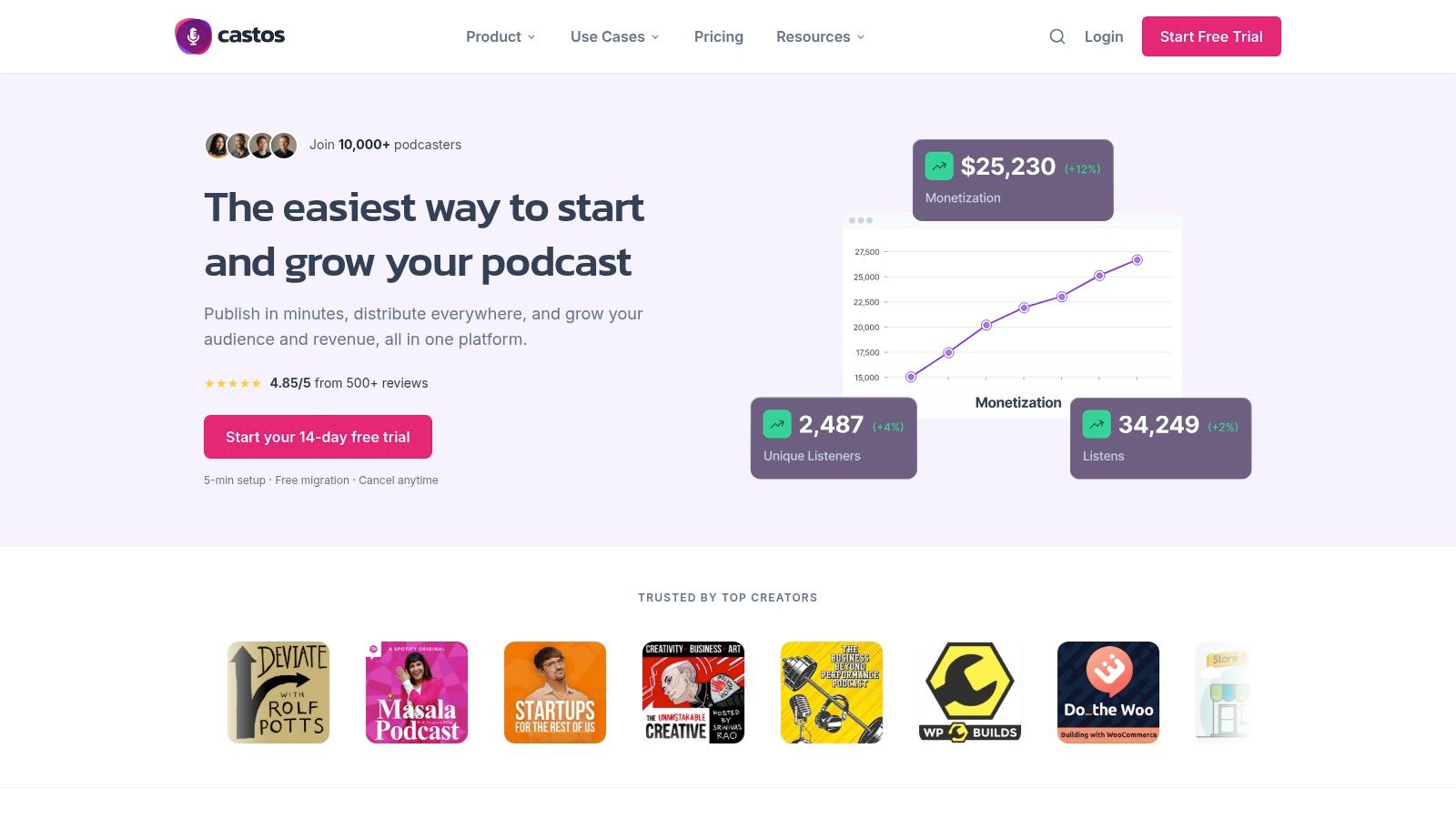
Castos is a smart bridge platform. It gives you a hosted site now, but it also keeps the door open to deeper WordPress control later through Seriously Simple Podcasting.
That flexibility matters more than people think. Many podcasters start by wanting ease, then later want ownership and customization.
Best if WordPress is in your future
Every paid plan includes a free customizable podcast website with custom domain support. You also get unlimited episodes and downloads on paid plans, plus WordPress integration and YouTube republishing automation.
WordPress still leads the website market. In May 2026, WordPress.org accounted for 41.9% of all websites globally and held 59.5% of the CMS market, according to AI website builder and CMS market data cited here. That makes Castos especially attractive for podcasters who want a straightforward hosted site today and a realistic path into WordPress later.
Castos makes sense for
- Future customizers: You want a low-friction start and more control later.
- WordPress-leaning creators: You already know that ecosystem.
- Teams that want flexibility: Hosted simplicity now, broader ownership later.
The hosted site themes aren't as expansive as a full CMS, and advanced marketing often requires external tools. But as a transition-friendly option, Castos is one of the smartest picks here.
10. Libsyn

Libsyn is the veteran choice. It has been around long enough to earn trust from podcasters who care about reliability more than novelty, and its current audio and video plans keep it relevant for modern publishing needs.
Every plan includes a customizable website, which gives you a bundled option if you want hosting and a web presence from one established provider.
A dependable choice for teams and established shows
Libsyn includes custom domain support, IAB-verified analytics, multi-user access, and monetization options such as host-read ads, automatic ads, and Podroll. Video support on select plans also helps if your show is moving toward a broader content mix.
That makes it especially useful for teams. If multiple people touch the show, multi-user access matters. If your monetization strategy is starting to mature, Libsyn has the infrastructure to support that path.
For creators aiming at ad revenue, Flexwork's guide on how to get podcast sponsors is a smart next read.
Established tools often win because they remove surprises. Libsyn fits that profile.
The compromise is design freedom. Its website customization is more basic than specialist builders, and storage or hour-based plan models won't suit every publishing style. But if you value stability and bundled essentials, Libsyn still deserves respect.
Top 10 Podcast Website Builders, Feature Comparison
| Service | Core offerings | Quality & experience | Best for | Key differentiator & Pricing |
|---|---|---|---|---|
| Flexwork Podcast Studios | Turnkey capture + pro post (audio/video), branding, marketing | Broadcast‑grade studios, creator‑led team, fast reliable execution | NJ/NY metro creators, shows scaling to multi-show slates, creators wanting full service | Full-service studio + in-house digital marketing & guest network; transparent packages, schedule a tour for pricing |
| Podpage | Automated podcast websites from RSS (episode pages, guest forms) | Polished, low‑maintenance sites, podcast-specific widgets | Podcasters who want a professional site fast without WP upkeep | Fastest path to a podcast site; subscription plans |
| Beamly (ex‑Podcastpage.io) | RSS site builder + optional hosting, memberships, product sales | Branded all‑in‑one hub, supports video and courses | Creators monetizing with memberships/courses or selling products | 0% platform fees for sales, optional hosting; paid plans with 14‑day trial |
| Transistor | Podcast hosting + one‑click websites, unlimited shows per account | Professional sites, strong analytics, network features | Networks, multi-show accounts and growing publishers | Unlimited shows, network site builder; tiered pricing based on downloads |
| Captivate | Hosting + Captivate Websites, marketing tools and growth education | Growth‑focused tools, all features on every plan | Creators prioritizing audience growth and marketing | Growth education + marketing features included; pricing by downloads |
| Buzzsprout | Beginner-friendly hosting, premium site, transcripts, add-ons | Very easy setup, strong support and docs | New podcasters who want simple publishing workflow | Upload quotas on plans; optional AI show notes and mastering add‑ons |
| Podbean | Hosting with customizable sites, monetization, video on higher tiers | Feature‑rich and budget‑friendly, some UI complexity | Creators mixing audio & video, monetization seekers | Built-in marketplace, subscriptions, dynamic ads; tiered plans |
| Simplecast | Scalable hosting, clean customizable show website | Mature, reliable platform with advanced analytics | Professional and enterprise shows | Unlimited storage, professional ad insertion on higher tiers |
| Castos | Hosting + free show website, deep WordPress integration | Flexible hosted site or WordPress migration path | Teams wanting a hosted start and WP control later | Free site per show + Seriously Simple Podcasting WP plugin; friendly pricing |
| Libsyn | Veteran hosting with customizable website, audio+video plans | Established reliability, IAB‑verified analytics, multi‑user access | Long-running shows, teams, publishers exploring video & monetization | Storage/hour pricing options, monetization tools and distribution reach |
From Builder to Brand: Choose Your Path to Growth
You can launch a podcast site tonight and still look underbuilt six months from now. That gap is the primary decision.
A DIY builder solves speed. It gives you a home for episodes, show notes, and basic discovery. If that is your goal, choose the platform that gets you live fast and keep the project moving.
A serious brand site does a different job. It positions you for sponsors, premium guests, consulting leads, speaking opportunities, and higher-value offers. That is why the right choice is not just about features. It is about what the podcast needs to do for your career or business, a distinction explored in this analysis of discovery versus brand destination strategy.
If your budget is lean, pick a builder and publish. Podpage is the best fit for fast setup. Beamly is the better choice if you plan to sell products, memberships, or services on the same site. The hosting-led options, including Transistor, Captivate, Buzzsprout, Podbean, Simplecast, Castos, and Libsyn, make sense when convenience, analytics, team access, monetization, or WordPress compatibility matter more than custom brand presentation.
Analysts at Mordor Intelligence expect continued growth in the website builder market. The reason is obvious. Creators want more control over how their work is presented, found, and monetized.
A builder gets you online. A premium service helps you look established.
Your show also needs to live on a hosting platform with a valid RSS feed before a dedicated podcast website builder can import episodes, metadata, and show notes, as The Podcast Host explains in its podcast website builder overview. After that, the decision is simple. Do you need a site that archives your content, or one that strengthens your brand and helps close bigger opportunities?
For creators with more time than money, DIY is the right call. For creators using a podcast to support a business, build authority, or sell high-ticket work, done-for-you usually produces the better return.
Flexwork Podcast Studios is built for that second group. Instead of handing you a template, it develops the site around your positioning, goals, and audience experience. That can include production, editing, short-form content, marketing support, and the visual system that helps create an identity that stands out.
If you want the fast, affordable route, choose a builder and ship. If you want your podcast to present like a premium media brand, Flexwork Podcast Studios is the stronger investment.