
51 Newark Street Hoboken NJ: Flexwork Studio Details 2026
 June 30, 202618 Minutes
Meta title: 51 Newark Street Hoboken NJ Studio Details
Meta description: Searching 51 Newark Street Hoboken NJ? Learn what the building offers, where it falls short for creators, and what a real studio setup needs.
URL slug: /51-newark-street-hoboken-nj-studio-details
Your interest in 51 Newark Street Hoboken NJ indicates you're probably not looking for an address just to satisfy curiosity. You're trying to answer a sharper question. Can this place work for your podcast, your video show, your content workflow, and your brand?
That's the issue. Many creators prioritize square footage, neighborhood, and rent. Then reality hits. A nice building in Hoboken can still be unsuitable for producing polished content. The room might be small, the sound might bounce, and the entire setup might compel you into DIY production when what you need is a professional ecosystem that handles recording, editing, packaging, and launch support.
The Search for the Perfect Creator Space
You typed in 51 Newark Street Hoboken NJ because you're seeking a powerful resource. You want a place that feels credible, convenient, and capable of helping you create content that looks like a serious brand built it.
That instinct is right. The mistake is assuming the address itself is the asset.
A lot of founders, coaches, and podcasters confuse a flexible room with a functional production environment. They see a Hoboken location, imagine a microphone on a desk, and think they've solved the problem. They haven't. The room is only one piece. The production system matters more.
If you're comparing options, it helps to study how other creators evaluate best podcast studios before committing to a space. That kind of comparison forces you to think beyond rent and start judging workflow, sound quality, booking flexibility, and post-production support.
For anyone focused on location first, it's also worth looking at the broader idea of office space in Hoboken and then asking a tougher question. Is this an office, or is it a place that can help you publish content people will remember?
The search usually starts with real estate. The smart decision starts with output.
A Guide to 51 Newark Street in Hoboken

51 Newark Street sits in a part of Hoboken that attracts people who want proximity, visibility, and access. On paper, that makes it attractive. In practice, you need to understand what the building is.
According to the Hoboken Historical Museum property record, 51 Newark Street in Hoboken, New Jersey, housed at units 51–53, was originally constructed in 1901 as a bank and office building, marking it as a historic commercial property over 125 years old. That history matters. It tells you the building was designed around traditional commercial use, not modern content production.
What the building offers
The property functions as a mixed-use building with both residential and commercial units. Available listing details from Compass for Unit 404/405 and related units show how compact these spaces are.
Here's the practical snapshot:
| Feature | Detail |
|---|---|
| Building type | Historic mixed-use property |
| Original purpose | Bank and office building |
| Commercial example | Unit 404/405 at roughly 350 square feet |
| Residential example | Unit 505 at approximately 500 square feet |
| Rental examples | Studio listings #506 at $1,000 and #501 at $1,100 |
| Location note | Commercial office listing notes southwest corner views of New York City |
Those details are useful if you're evaluating the address for a small office, a compact studio apartment, or a basic workspace near Manhattan-facing views.
What those details mean for a creator
The building's appeal is clear. It's historic. It's established. It has small-format units that can work for solo professionals.
But creators should read those listings with discipline. A 350 square foot office can be enough for meetings, admin work, or a private desk setup. It doesn't automatically translate into a room that can support polished interviews, multi-angle video, guest sessions, or repeatable branded production.
Decision filter: Don't ask whether you can physically fit a desk and a mic into the room. Ask whether the room supports the standard your audience expects.
That's the difference between renting space and building media assets.
Why a Generic Office Is a Trap for Creators

Creators get into trouble when they settle for a room that's “good enough.” That phrase kills quality fast.
The hard truth is simple. A generic apartment or office doesn't become a production studio because you bring in a microphone, a ring light, and ambition. It becomes a room full of compromises.
According to StreetEasy building details for 51 Newark Street, off-market units at 51 Newark Street include studios at $1,000–$1,100 base rent with no acoustic treatment, professional audio equipment, or video production capabilities, making it unsuitable for broadcast-quality podcast or video content creation. That's not a minor drawback. That's the entire game.
The hidden costs nobody mentions
A standard room creates extra work at every stage:
- Sound problems: Bare walls, windows, and hard floors make voices sound harsh or hollow. Your guest can be brilliant and the episode will still feel amateur.
- Visual inconsistency: Natural light shifts. Desk lamps fail. Cheap backdrops wrinkle. Your clips won't match from one recording day to the next.
- Setup fatigue: Every session becomes logistics. Move furniture. Test cables. Fix framing. Recheck levels. Then tear it all down.
- Brand drag: If your show looks patched together, your audience assumes the business behind it is patched together too.
That's why so many creators burn out. They don't just create. They become their own facilities manager, camera operator, audio fixer, editor, and quality-control department.
What “good enough” actually gets you
A generic office might handle email, planning, and Zoom calls. That's it. Once you want polished long-form video, social clips, guest interviews, and reliable publishing, the room starts fighting you.
A stronger benchmark is studying what a purpose-built environment includes in in-house studios. That's where the contrast becomes obvious. Professional production spaces remove friction. Generic rooms multiply it.
Most creators don't need more hustle. They need fewer preventable problems.
If your content is tied to your business, then your recording environment isn't an afterthought. It's part of your product.
The Professional Studio Non-Negotiables
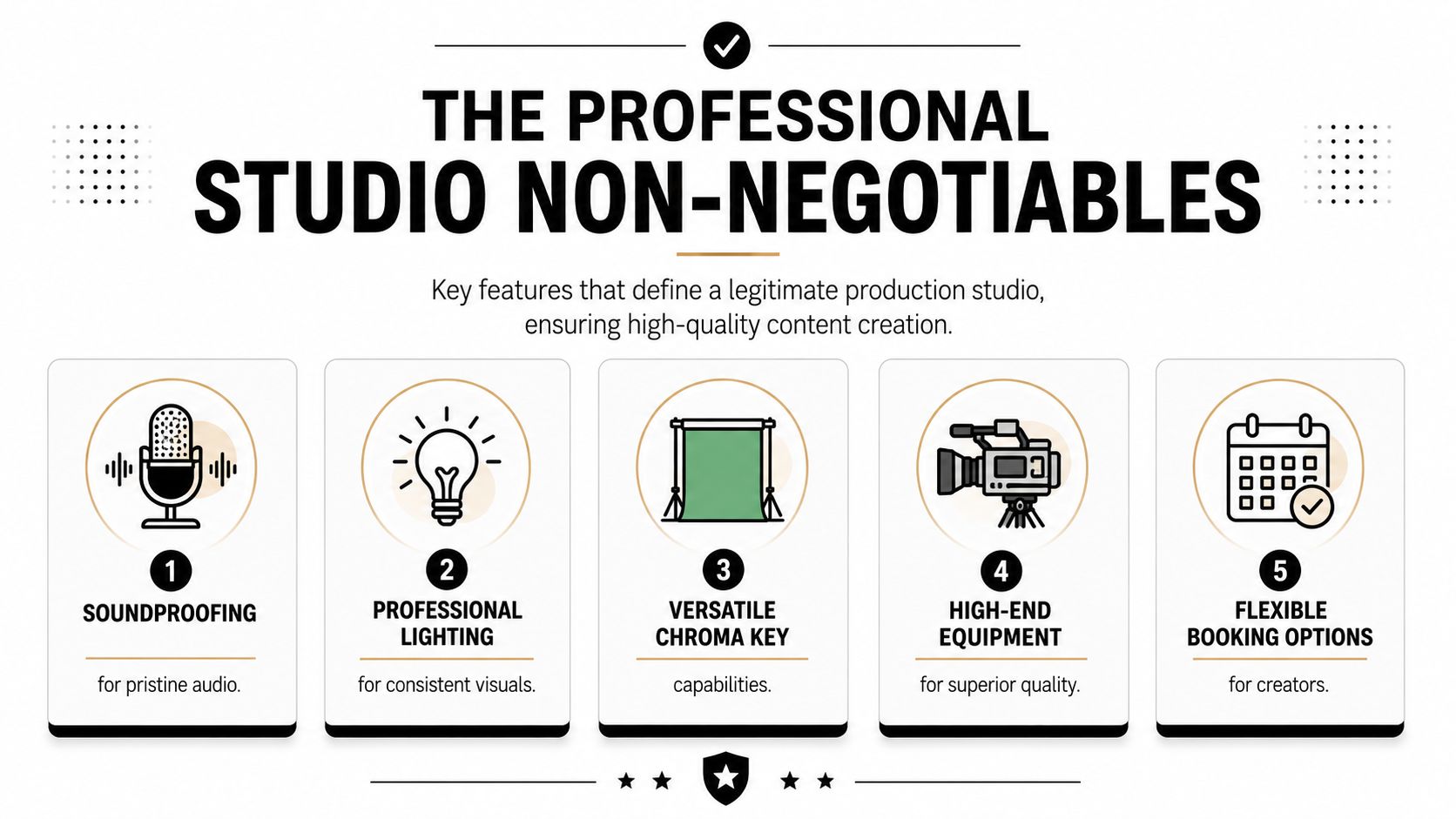
If you're evaluating any recording space, stop thinking like a renter and start thinking like a producer. A professional studio has standards. If those standards aren't present, you're buying hassle.
The baseline market signal is straightforward. A New Jersey podcast studio listing on Peerspace shows podcast rental studios in the New Jersey market operate with transparent hourly pricing models starting at $75 per hour for acoustically treated video and audio production rooms, with a 2-hour minimum booking requirement. So the question isn't whether professional setups exist. They do. The question is whether the room you're considering meets the threshold.
Your checklist for a real studio
- Acoustic treatment first: If the room isn't designed to control echo and unwanted noise, nothing else matters. Audio quality is the credibility test.
- Lighting that repeats well: You need a setup that looks consistent every time, not a room that changes with weather or window light.
- Camera readiness: A professional room should support clean framing and polished visual capture without improvisation.
- Set flexibility: Your content shouldn't look identical forever. Different conversations and brand moods need different backgrounds and layouts.
- Booking convenience: A good studio works with your schedule, not against it.
How to judge value instead of chasing cheap
Cheap space often becomes expensive content. You pay less for the room, then lose time fixing bad footage, cleaning up poor audio, and apologizing for inconsistent output.
A smarter way to evaluate options is to compare the full creation workflow. This guide for modern content creators is useful because it widens the lens beyond gear and pushes you to think about systems, not just tools.
For a more studio-specific benchmark, this breakdown of what makes a great podcast studio is the kind of standard creators should use before signing anything.
Practical rule: If a space can't help you produce polished content fast, it's not a creator asset. It's just overhead.
The Flexwork Solution From Concept to Launch
The right move isn't finding a room and hoping you can turn it into a brand machine. The right move is using a production ecosystem that already knows how to capture, package, and ship content at a professional level.
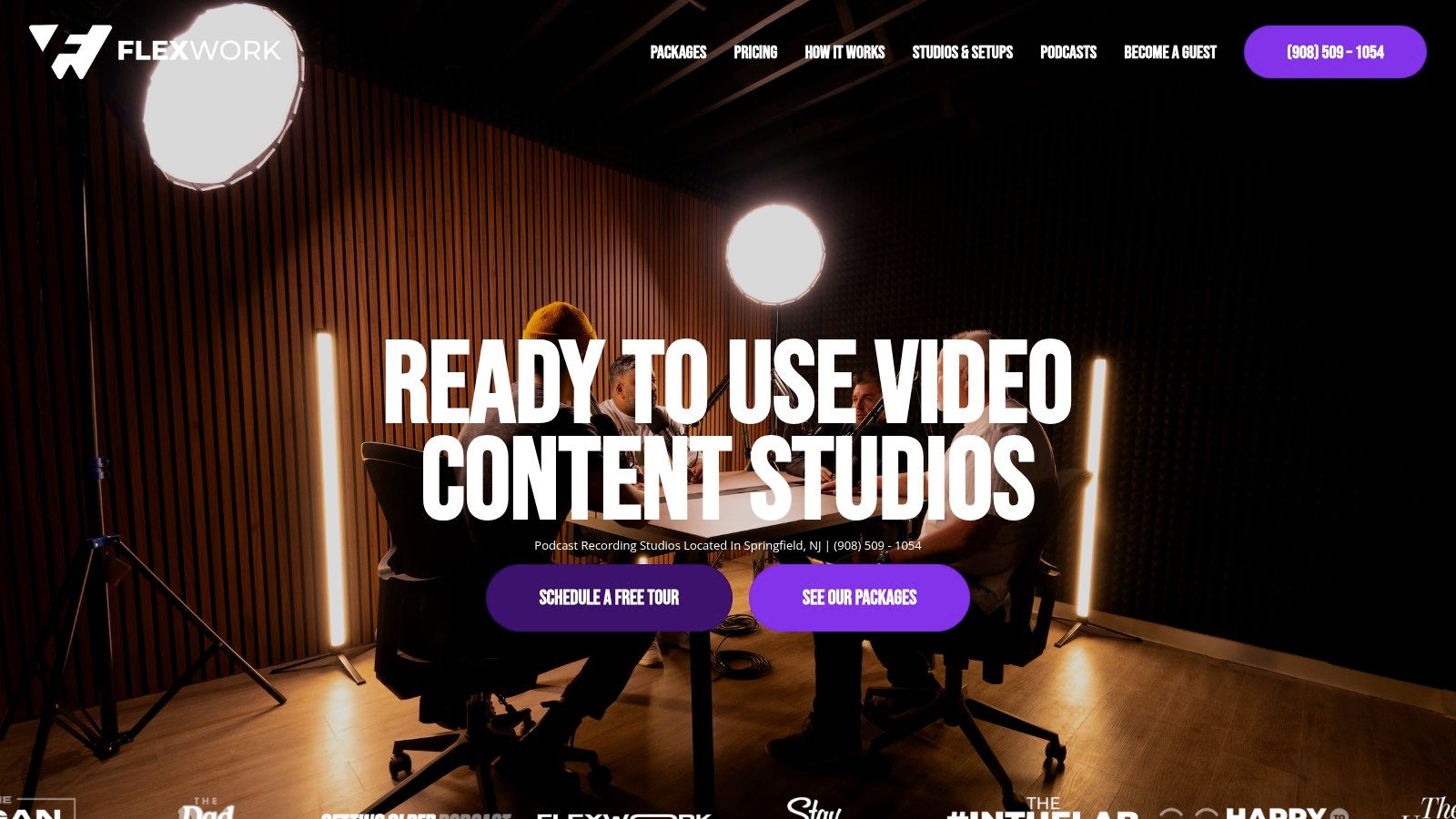
That's where the difference becomes practical. You're no longer trying to solve acoustics with furniture or create a premium look out of an ordinary office. You're stepping into an environment built for podcasts, video, shorts, and content days that need to look finished, not experimental.
What a full-service setup changes
The production side matters as much as the room. According to Flexwork pricing details, on-site executive producer services for podcast episodes command premium hourly rates of $250 per hour, providing a dedicated producer to direct the episode flow, while advanced 4K video recording upgrades are available for $100 per day. That tells you something important. Serious production isn't just about access to a room. It's about access to direction, oversight, and better execution.
That's also why packaged services beat piecing things together yourself.
A Content Day at $3000/day includes 20 edited reels or 60 pro photos. That's efficient if you want a batch of polished assets for launches, campaigns, or thought-leadership content.
A podcast website is $5000 plus hosting. That matters when your show needs a real home, not just a link in your bio.
The Market, Manage & Produce My Podcast tier starts at $1500 per episode with a 20-episode growth commitment. That's the package for creators and brands who aren't dabbling. They want momentum, consistency, and professional support across production and promotion.
What end-to-end support looks like
The strongest packages go beyond recording and handle the bottlenecks that usually slow creators down. Full-service podcast production packages in the market are described with deliverables like guest booking services, professional headshots, multi-step video editing, offshore publishing capabilities, and sponsorship strategy development in a $1,000 package on Flexwork Studios' Facebook package listing. The point isn't just the price tag. It's the model. Real growth happens when the studio supports the show after the cameras stop.
If you're still in launch mode, studying how to launch a podcast helps clarify what needs to happen before, during, and after production.
Here's a closer look at how that kind of studio experience feels in motion:
A polished show isn't built by accident. It's built by a room, a process, and a team that know what they're doing.
Stop Searching for a Space and Start Building Your Brand
Your audience won't reward you for renting an interesting address. They'll reward you for publishing strong content on a consistent schedule.
That's why the search for 51 Newark Street Hoboken NJ should end with a better conclusion than “maybe I can make this work.” If your content matters to your business, “make this work” is too low a standard. You need a setup that supports authority, speed, and repeatability.
The market is already telling you what creators want. According to MLSGuide coverage tied to 51 Newark Street, 65% of aspiring podcasters in urban markets seek studios offering integrated editing and distribution, not just recording rooms, a need that passive office spaces like 51 Newark Street fail to meet. That's the shift. People aren't just looking for four walls. They want an ecosystem.
The better question to ask
Don't ask, “Can I record here?”
Ask these instead:
- Will this space elevate my brand?
- Can it help me publish faster?
- Does it reduce my workload after recording?
- Will the content look and sound consistent every time?
If the answer is no, keep moving.
For founders and marketers thinking about the bigger picture, this perspective on brand awareness for digital marketers is useful because it reinforces the same idea. Visibility doesn't come from random output. It comes from brand consistency.
If you're serious about authority, the production environment has to support the identity you want the market to see. That's also why it helps to tighten your positioning with a clearer framework for how to brand your business.
A weak room creates weak assets. A professional ecosystem creates amplified results.
If you're done settling for “good enough,” explore Flexwork Podcast Studios and book a tour. The fastest way to grow your show is to stop forcing a generic space to do a studio's job.