
Your Venice Coworking Space Guide for Creators
 July 2, 202626 Minutes
If you're hunting for a Venice coworking space, you're probably after more than a desk. You want a place that looks good on camera, doesn't sabotage your audio, lets you take calls without apologizing for background noise, and makes your work feel bigger than a laptop balanced between a coffee and a charger. That's the Venice promise. However, the actual experience is usually less cinematic.
For creators, the problem isn't finding a beautiful room. Venice has plenty of those. The problem is finding a workspace that supports actual production. Podcast recording, client interviews, batch content days, editing, livestreams, brand shoots. Those needs expose the gap between lifestyle coworking and creator infrastructure fast. That's why smart creators stop asking for a cooler desk and start asking better questions about acoustics, stability, and what kind of work the space was built to support.
The Venice Dream Versus the Workspace Reality
You can feel the pitch of Venice before you even open your laptop. Sunlight. Clean design. Good coffee. People who look like they've already closed three brand deals before noon. It's easy to think the right Venice coworking space will sharpen your routine and upgrade your output in one move.
Then the workday starts.
The “creative” common area turns into a constant stream of calls. The room with the best light has terrible echo. The quiet booth is booked. The Wi-Fi is fine until you need to upload. You try recording a clean intro and realize the room sounds like a restaurant with nicer chairs. For a writer, that's annoying. For a podcaster or video creator, it's a direct hit to quality.
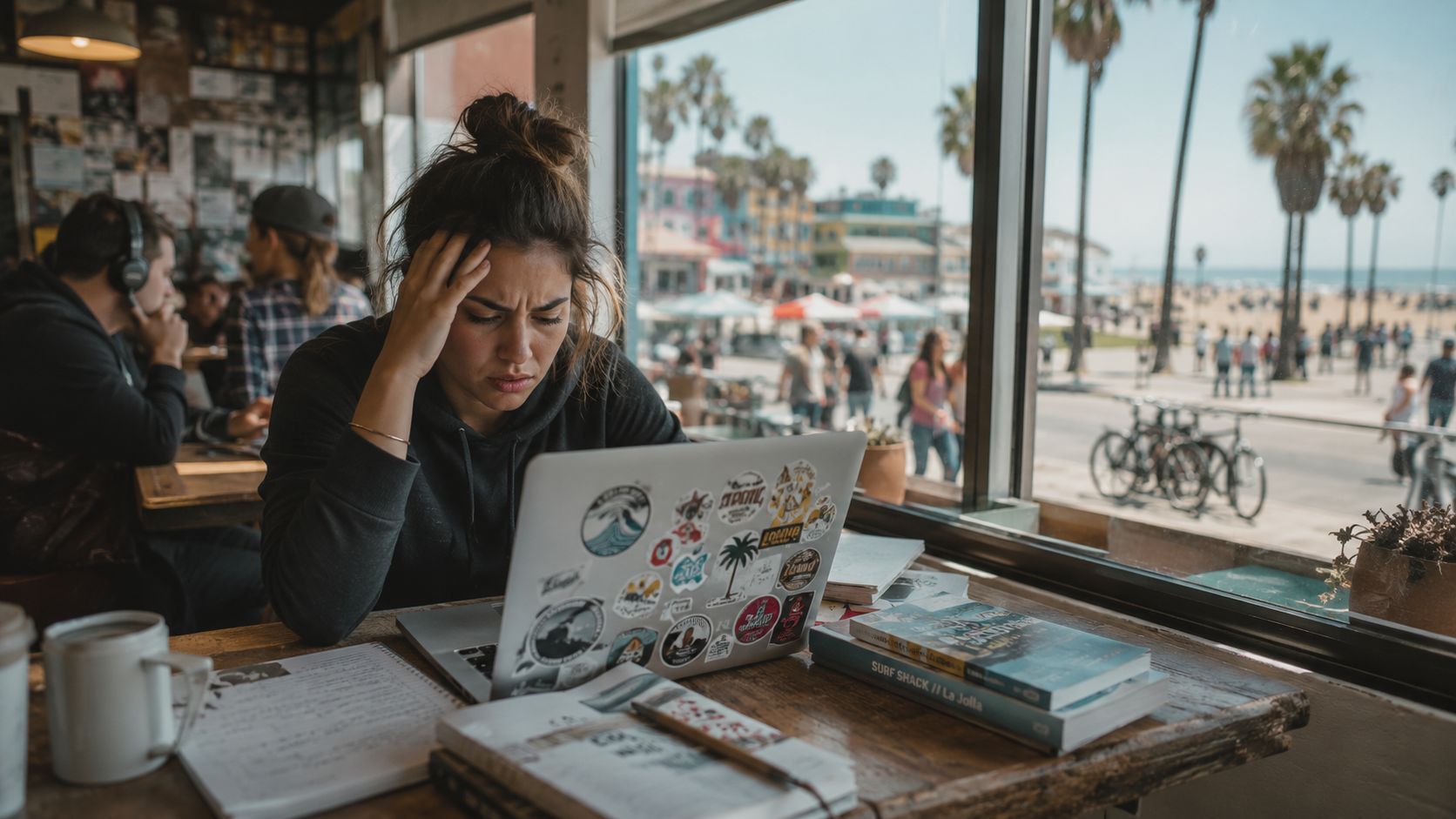
A lot of creators blame themselves at this point. Wrong workflow. Bad gear. Poor planning. Usually it's the room. Venice sells atmosphere. Production work needs control.
Reality check: A stylish workspace can still be a bad recording environment, a bad editing environment, and a bad client-facing environment.
That's the line often missed. A creator doesn't just need somewhere to work. A creator needs somewhere to make work. Those are different categories. If your income depends on content looking polished and sounding clean, your workspace isn't a backdrop. It's part of the production chain.
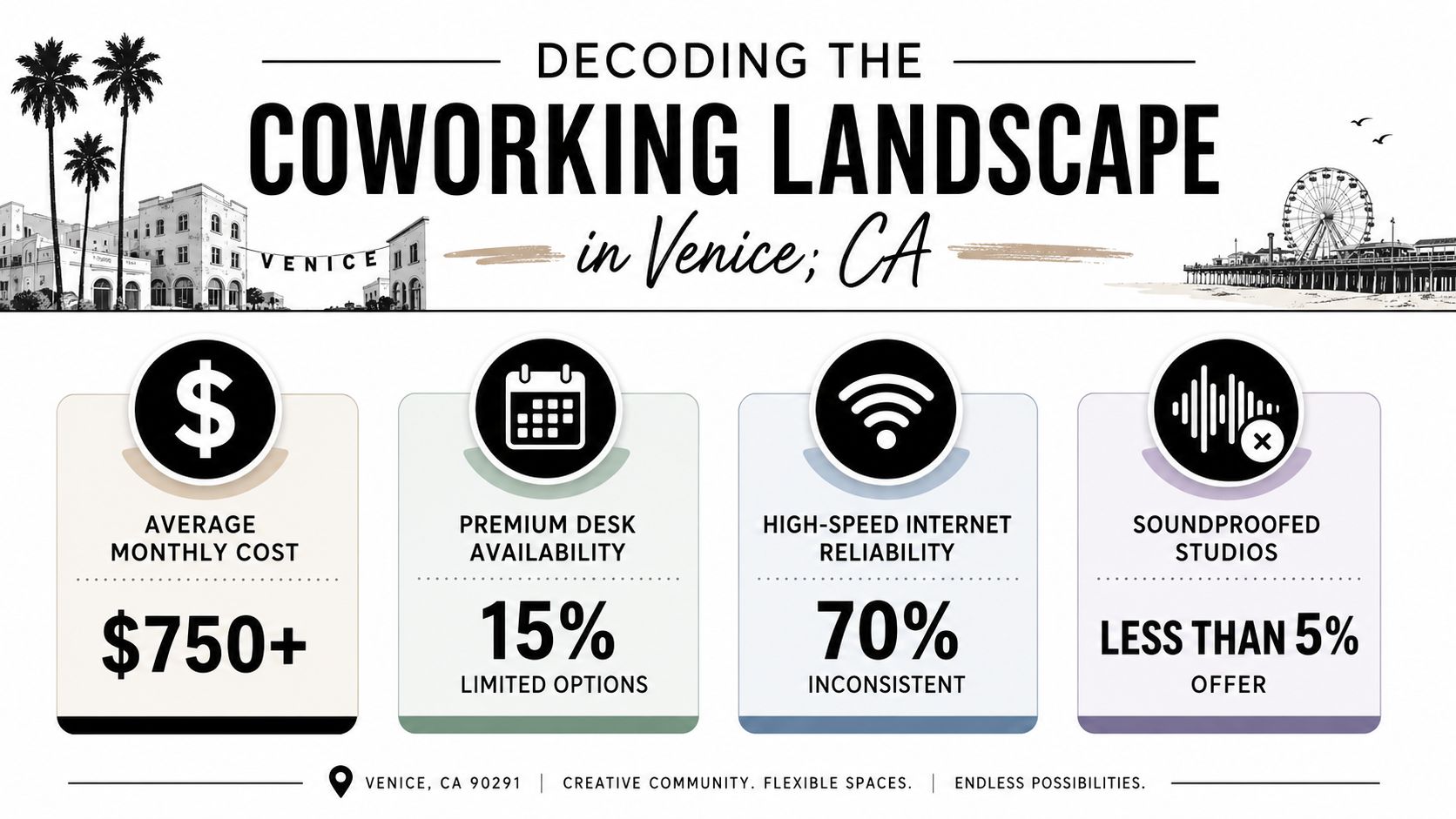
Decoding the Coworking Landscape in Venice CA
Venice sits inside the broader flexible workspace boom, but it behaves like a premium micro-market. That matters because creators often walk in thinking they're comparing desks, when they're really entering a pricing structure built around events, premium aesthetics, and short-term bookings.
According to Peerspace's Venice coworking listings, larger venues average $431 per hour, smaller spaces average $188 per hour, and the overall average is $508 per hour. Those are not casual numbers. They tell you Venice doesn't price space like a utility. It prices space like an experience product.
What the pricing tells you
A standard creator mistake is treating hourly cost as the whole equation. It isn't. High hourly pricing usually means one of two things:
- The space caters to premium short-term use rather than repeat creator workflows
- The room's visual appeal is doing a lot of the selling, whether or not the setup supports recording or post-production
If your work involves planning recurring shoots, weekly podcast sessions, or regular content batching, that pricing model gets painful quickly. You're not buying continuity. You're buying access.
For comparison, creators looking at the East Coast often realize they can get a more production-minded setup through alternatives like a New Jersey coworking option built around real working sessions, rather than paying Venice premiums for atmosphere first and utility second.
Why small teams get squeezed
The harder problem isn't the sticker price. It's stability.
Industry discussion around coworking operations points to occupancy stability as a major challenge, with many operators prioritizing larger teams and events. That creates a hidden risk for solo creators and small teams, who can get pulled in by drop-in offers or low-friction trials without any real guarantee of long-term continuity, as noted in this coworking operator discussion on Reddit.
That's why Venice can feel inconsistent even when the branding is polished. The space may love your day pass. It may not be designed around your next six months.
If you record every week, desk instability isn't a minor inconvenience. It breaks routine, setup consistency, and output quality.
Venice works best for a narrow use case
A Venice coworking space can be a smart fit if you need temporary presence, meetings, or a visually strong place to work between other commitments. It's a weaker fit if you need repeatable production conditions.
That distinction saves a lot of frustration. Venice isn't failing you. It's often serving a different customer than the creator who needs clean audio, dependable access, and room to produce at a professional level.
Choosing Your Space From Open Desks to Private Suites
Most coworking operators present their options like a simple ladder. Hot desk. Dedicated desk. Private office. Suite. For creators, that framing is too shallow. The right choice depends less on privacy in the abstract and more on what your weekly workflow demands.
Open desk
Open desks work if your output is mostly admin. Writing outlines, answering email, booking guests, reviewing edits with headphones on. They're weak for any task that creates noise or needs acoustic control.
If you're a podcaster, open desk setups usually introduce friction all day long. You can't predict who's taking calls nearby. You can't lock in a sound profile. You can't leave a setup in place. That means every recording task becomes temporary and compromised.
Dedicated desk
A dedicated desk looks like a middle ground, and sometimes it is. You get consistency, a place to keep gear nearby, and a home base that reduces setup fatigue. But don't confuse desk consistency with production readiness.
You still share the same air, noise, and interruption pattern as everyone around you. If management shifts priorities toward larger bookings or events, your “stable” setup can start feeling conditional. That's part of why Hoboken coworking options built around more predictable professional use often appeal to creators who've been burned by casual coworking churn.
Private office
Private offices sound like the obvious answer. Sometimes they are. But a lot of creators overestimate what a closed door solves.
A private office may give you visual privacy, call privacy, and more control over your schedule. It does not automatically give you usable acoustics. If the walls are light, the room is reflective, and the HVAC or hallway noise bleeds through, you're just paying more for a quieter-looking problem.
Rent privacy if you need privacy. Don't assume you've rented production quality.
Private suite or team room
This can work for agencies, small media teams, or creators with a real shooting calendar. The benefit is less about prestige and more about control. You can leave lighting packed, keep props or mics nearby, and run a repeatable content workflow.
The catch is obvious. Cost rises fast, and many suites are still just offices, not production spaces.
A quick creator filter
Use this simple lens before you sign anything:
| Space type | Best for | Weak spot for creators |
|---|---|---|
| Open desk | Admin work, writing, light meetings | Noise, no recording control |
| Dedicated desk | Routine, consistency, solo planning | Shared acoustics, limited privacy |
| Private office | Calls, focused work, client meetings | Untreated sound, false sense of readiness |
| Private suite | Team workflows, recurring content days | Expensive if the room still isn't studio-ready |
If your business runs on content, don't shop coworking categories the way a consultant or startup founder would. Your workflow is different. You need a space that supports performance, capture, and polish, not just occupancy.
The Creator's Non-Negotiables Acoustic and Tech Essentials
A lot of creators tolerate bad rooms because they've never been told what a good room requires. They judge a space by furniture, windows, and whether the lobby feels expensive. None of that tells you if your podcast will sound clean.
Professional-grade acoustic quality has a clear benchmark. According to Framery's office acoustics guide, ambient noise should stay between 35–45 dB(A) and reverberation time should be controlled to 0.6–0.8 seconds. Standard open offices average 53–54 dB(A), which hurts speech intelligibility and increases distraction. That's the practical reason your voice sounds less focused in an ordinary coworking environment even when your microphone is decent.

Absorption isn't the same as isolation
Stylish coworking spaces often deceive people. They add rugs, couches, curtains, and soft panels. That can make a room feel calmer. It does not mean the room blocks sound.
Soft materials help absorb reflections. They reduce slap, brightness, and some of the harshness you hear in bare rooms. They don't stop hallway conversation, HVAC rumble, or the person laughing through a sales call on the other side of a thin partition. For serious content work, you need both absorption and actual isolation.
If you want a good creator-friendly primer on improving your recordings before you hit publish, Isolate Audio's guide for creators is worth your time. It's useful because it connects room quality to the final listener experience, not just gear choices.
What to ask before you book
Don't ask whether a space is “quiet.” Everyone says yes. Ask questions that force specifics.
- Ask about the room itself: Is there dedicated acoustic treatment for recording, or is it just furnished nicely?
- Ask about sound bleed: Can you hear calls from adjacent rooms, hallways, or common areas?
- Ask about control: Can you shut off or minimize noise sources during a session?
- Ask about internet behavior: Upload speed and consistency matter more than a pretty Wi-Fi sign if you're backing up footage or livestreaming.
- Ask about lighting: Natural light is great until it shifts mid-shoot. You need stable options.
The baseline for real content production
Here's the simplest way to think about it. A creator-ready room should support these five things without improvisation:
Clean voice capture
Your audio should sound controlled before editing starts.Predictable visuals
Light, framing, and background should be repeatable.Reliable uploads
Footage has to move fast when deadlines are real.Comfort for longer sessions
Content days run long. Cheap seating and awkward desk height wear you out.A workflow after recording
The best spaces don't just help you capture. They help you move into editing, clipping, and publishing.
Practical rule: If you need plugins and aggressive cleanup to rescue every take, the room is failing before your talent or your gear does.
For creators serious about premium output, standard coworking amenities aren't enough. You need infrastructure. If you want a more detailed breakdown of what proper treatment looks like in practice, this guide on how to soundproof a room for flawless audio is a useful reference point.
The Flexwork Solution A Studio Built for Creators
Once you stop looking for a desk and start looking for a production environment, the conversation changes. You're no longer comparing coffee bars, lounge aesthetics, or whether the meeting room has a ring light tucked in a cabinet. You're comparing whether the space helps you create finished work.
That's where a studio model wins.

A purpose-built studio gives you a different kind of value. Instead of patching together a desk, a conference room, your own camera kit, rented audio gear, freelance editing, and whatever corner is quiet enough that day, you get one system designed for content capture and delivery. That matters more than people admit. Fragmented production is expensive even when the line items look small.
Dedicated audio-only podcast studio sessions elsewhere typically range from $75 to $150 per hour, with full-day rates starting at $550 and going up to $1,000+ for standard setups, according to CTRL Collective's podcast studio cost guide. That context is useful because it shows what creators are already willing to pay for a room that's built for sound, not just styled for work.
Why the studio model is cleaner
A proper creator studio collapses multiple problems at once:
- The room is built for capture
- The visual setup is already considered
- The gear chain is professional
- The post-production path is clear
- Your content day has momentum instead of friction
That's why creators who are scaling don't just rent square footage. They buy reliability.
If you've ever looked at examples of spaces designed to elevate your content production, you've seen the shift firsthand. The best creator environments aren't generic offices with trendier furniture. They're operational systems for output.
The difference between workspace and service stack
This is the part most coworking brands can't replicate. A desk rental is a location product. A creator studio is a service product plus an environment.
That distinction matters when your goals include:
- launching a show
- producing recurring reels
- recording guest interviews
- building a branded content engine
- outsourcing editing and distribution without sacrificing quality
A generic coworking setup usually leaves you to solve those pieces yourself. You book the room, source the people, manage the edits, chase revisions, organize graphics, and figure out distribution. That's a lot of hidden labor for something people casually call “recording.”
A more complete model can include studio rentals, hands-on production support, batch filming, editing, and marketing infrastructure. If you're building a podcast brand instead of just testing a hobby, that bundled setup is easier to justify than it first appears.
After all, a single well-run Content Day can replace weeks of scrambling. In a premium studio context, Content Days are $3000/day and include 20 edited reels or 60 pro photos. A serious growth play goes further. Podcast websites are $5000 plus hosting, and the Market & Manage tier starts at $1500 per episode with a 20-episode growth commitment. Those numbers sound substantial until you compare them with the cost of bad output, repeated reshoots, and a scattered vendor stack.
Here's a closer look at how a creator-ready environment operates in practice:
Who should make the switch
Not everyone needs a studio-first setup. But you probably do if any of these are true:
- Your content represents your brand revenue: Coaches, consultants, founders, and agencies can't afford amateur presentation.
- You record often: Repetition magnifies every flaw in a weak room.
- You're tired of DIY bottlenecks: Editing, audio cleanup, and coordination steal more time than most creators expect.
- You want one place that can scale with you: The right setup should handle a first episode and a full slate.
A Venice coworking space can make you feel productive. A studio built for creators can make you publish at a higher level.
Your Booking Checklist Tips for Vetting Any Space
Before you book any workspace, test it like a producer, not a tourist. Good branding hides bad operating conditions all the time. You need proof.
Start with the loudest possible scenario. Book or tour during the busiest part of the day, not the calmest. If a room barely works at peak activity, it doesn't work.
Questions that cut through the sales script
Use these when you evaluate any room:
- Can I hear the room before I commit: Record a voice memo, clap once, and listen for echo, ring, or bleed.
- What happens outside this door: Ask what sits next to your room. Hallway traffic matters.
- How stable is access: If your schedule depends on recurring use, ask how repeat bookings are handled.
- Can I upload footage fast enough: Don't settle for “fast Wi-Fi.” Test the workflow that matters to you.
- Is there a place to continue after recording: Editing, clipping, file transfer, and client review all need a next step.
The best trial isn't a tour. It's a live working session with your real gear and your real deadlines.
A practical scorecard
Give each category a simple pass or fail:
| Checkpoint | Pass if… |
|---|---|
| Audio | Your test recording sounds controlled without heavy cleanup |
| Privacy | You can work and record without constant interruption |
| Continuity | The space can support recurring use, not just one-off drop-ins |
| Tech | Uploads, calls, and backups run without drama |
| Workflow | The room helps you finish work, not just start it |
If a space fails two or more of those, keep looking.
And if your search expands beyond a general office and into dedicated recording environments, start with a place built for the assignment. A professional podcast studio rental should already solve the problems you're still trying to diagnose during a coworking tour.
Upgrade from Workspace to Production Hub
The coworking industry is growing fast. The U.S. sector expanded by 15% between January 2025 and January 2026, adding over 22.5 million square feet of space, according to Yardi Kube's coworking market update. That growth is real, and it reflects a lasting shift in how people work.
But more flexible space doesn't automatically mean better creator space.
That's the decision point. If your brand depends on content, stop judging environments by whether they feel creative and start judging them by whether they support professional output. A Venice coworking space may still be useful for meetings, planning days, or temporary work sessions. It's often the wrong final answer for creators who need dependable audio, visual control, and a production pipeline.
Your next upgrade isn't a nicer desk. It's a production hub.
That's the standard serious creators should use now. Not “Can I work here?” Ask, “Can I produce here, repeatedly, at the level my audience expects?” If the answer is shaky, move on. If you're ready for a studio-grade environment with the right infrastructure behind it, start by exploring a dedicated podcast production studio.
If you're done settling for spaces that look inspiring but slow your output, take the next step with Flexwork Podcast Studios. Book a studio session, explore production packages, or schedule a tour and build your next show in a space designed for serious creators.