
Podcast Recording Services: Your Guide to Pro Production
 April 30, 202633 Minutes
SEO title: Podcast Recording Services Guide for Growth
Meta description: Podcast recording services can turn a DIY show into a real business asset. Learn what to look for and how to choose wisely.
URL slug: podcast-recording-services-guide
Primary keyword: podcast recording services
Secondary keywords: professional podcast studio, podcast production services, podcast studio rental
You’ve probably hit the same wall most serious podcasters hit. The ideas are strong. Guests say yes. Episodes go out. But the show still feels harder to run than it should. Audio varies week to week. Editing eats your nights. Video clips look inconsistent. Growth feels slower than the effort you’re putting in.
That’s the moment when podcast recording services stop being a “nice to have” and become a business decision.
Podcasting is not a side-channel anymore. The global market is projected to reach USD 171.45 billion by 2030, and global listeners are expected to surpass 600 million in 2026, according to Research and Markets podcast industry projections. More opportunity brings more competition. Strong ideas alone don’t carry a show as far as they used to.
If you’re building a personal brand, a client acquisition channel, or a media property, quality matters because perception matters. And if you’re in the NJ/NY area, the jump from DIY to pro is easier than most creators think. A smart first step is understanding what you gain by going pro instead of staying with a home setup.
Your Podcast Deserves More Than a DIY Setup
A lot of creators mistake the DIY ceiling for a talent problem. It usually isn’t. It’s an infrastructure problem.
You start with a USB mic, a basic camera, and editing software you learned on the fly. That setup works at first because momentum matters more than polish when you’re proving you can stay consistent. Then your standards rise. Your audience notices little things. So do sponsors, clients, and guests.
One week your room sounds boxy. The next week your remote guest is too quiet. Then you spend a Saturday fixing mouth noise and cutting awkward pauses instead of preparing your next interview. You’re still publishing, but the show starts controlling your schedule instead of supporting your goals.
The move to professional production usually happens when a creator decides the show needs to help the business grow, not just exist.
That shift matters because podcasting has become a real commercial media channel. The people who win aren’t always the funniest or the loudest. They’re often the most consistent, easiest to listen to, and easiest to trust.
Professional podcast recording services offer significant advantages. Better audio. Better video. Better workflow. Better guest experience. Better output from the same intellectual property.
And that changes how your show is received. A polished episode doesn’t just sound better. It signals that your brand is organized, credible, and worth returning to.
The DIY Ceiling Why Your Podcast Is Not Growing
If your show has plateaued, the problem usually lives in one of three places. Production quality, production capacity, or production strategy. DIY setups strain all three.
The broader market is moving toward higher standards. Corporate podcasting alone is projected to grow at a 21.09% CAGR, according to IMARC Group’s podcasting market analysis. That matters even if you’re not a corporation. It means more branded shows, more polished competitors, and a more demanding listener baseline.
Quality problems hurt trust fast
Listeners are generous about content. They’re not generous about friction.
If levels are uneven, room echo is obvious, or the video looks dim and improvised, your audience has to work harder to stay with you. That’s a problem because podcast consumption is intimate. People hear every distraction. They notice when a guest sounds distant. They notice when cuts feel abrupt. They notice when one camera angle looks great and the second one looks like an afterthought.
None of that means your ideas are weak. It means your presentation is leaking authority.
A business coach with sharp insights can still sound amateurish in a reflective room. A founder with real expertise can still look unprepared if the set, lighting, and framing don’t support the message. Your audience doesn’t separate content from packaging as much as creators like to believe.
DIY editing steals time from the work that actually grows the show
Many promising podcasters stall out at this stage.
Recording is the visible part. Post-production is the drag. Audio cleanup, video sync, clip selection, titling, thumbnails, social formatting, upload workflows, show notes, and distribution admin can turn one episode into a multi-day task. That’s manageable for a hobby. It’s destructive for a business asset.
When you spend all your time producing the show, you stop leading the show. Guest outreach slips. Promotion becomes rushed. Episode concepts get repetitive. Momentum weakens.
Here’s the hard truth. Most hosts shouldn’t be the engineer, editor, clip strategist, publisher, and creative director all at once.
Growth stalls when your workflow can’t scale
A weak workflow creates a weak release pattern. A weak release pattern kills audience habit.
If every episode depends on you finding a quiet hour, troubleshooting cables, re-recording intros, and then editing late at night, you don’t have a content engine. You have a bottleneck. That bottleneck gets worse as soon as you try to add video, remote guests, sponsorship reads, or team members.
The most frustrating part is that the show can still look active from the outside. Episodes go live. Clips get posted. But internally, everything feels fragile.
A simple comparison makes it clear:
| Setup choice | What usually happens |
|---|---|
| DIY recording at home | Flexible, inexpensive at first, but inconsistent sound and heavy editing overhead |
| Studio rental only | Better environment and gear, but you still own planning, direction, and post-production |
| Full podcast recording services | Recording, engineering, editing, packaging, and growth support work together |
Practical rule: If publishing one episode throws off the rest of your week, you’ve outgrown a DIY workflow.
That’s why so many creators eventually stop asking, “Can I do this myself?” and start asking the better question: “Should I still be doing this myself?”
Deconstructing Professional Podcast Recording Services
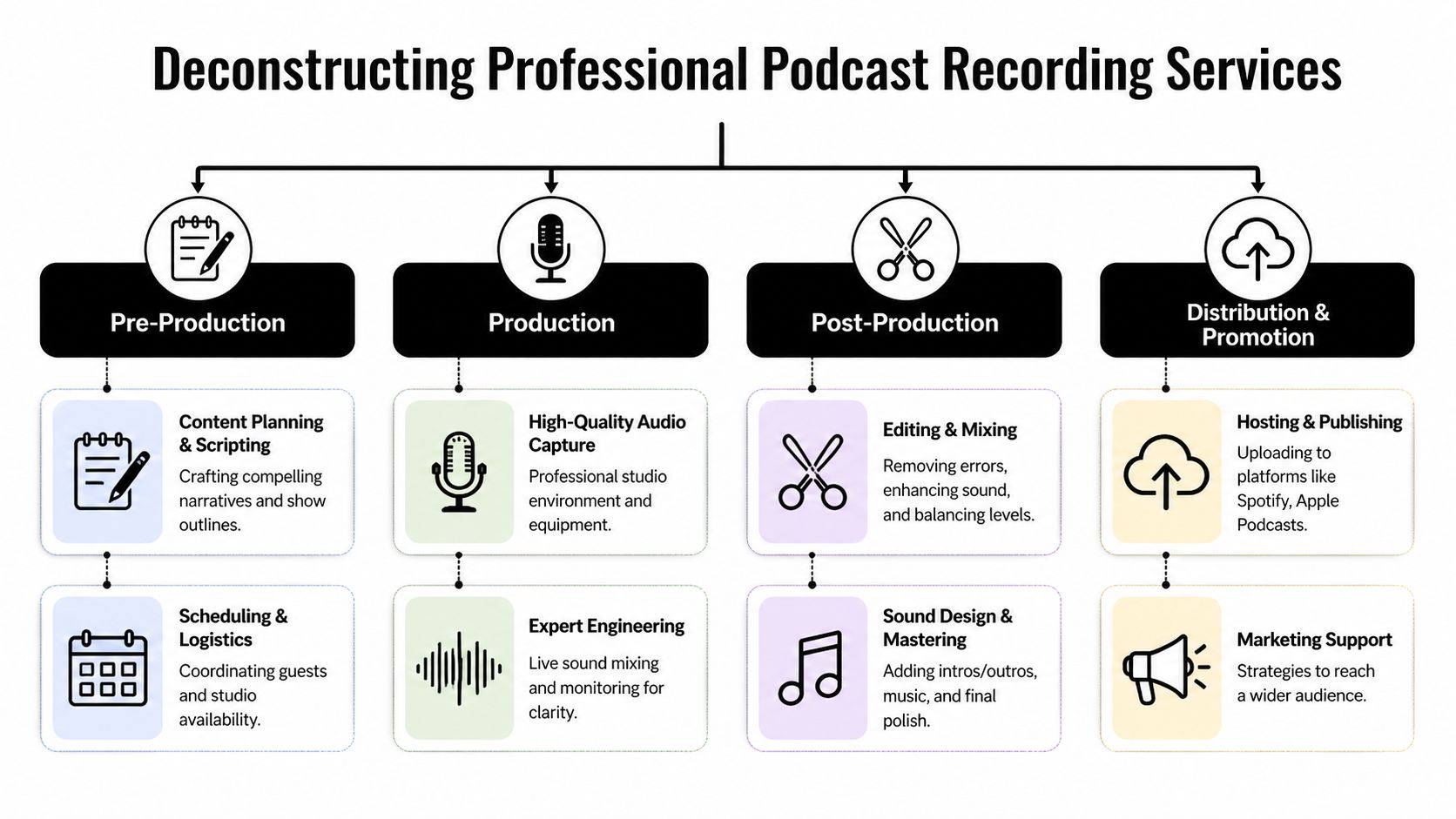
“Podcast recording services” often brings to mind renting a room with nice microphones. That’s only one piece of it. Real service means building a repeatable system from planning to publishing.
A useful benchmark is a facility that handles capture, post, and rollout under one roof, like a dedicated podcast production studio built for both audio and video workflows.
Pre-production shapes whether the session works
Bad podcast sessions usually fail before anyone hits record.
Pre-production includes topic shaping, guest coordination, scripting, rundown creation, set planning, and scheduling. If you’re recording multiple episodes in one day, this part becomes even more important because fatigue shows up fast when there’s no plan for pacing, wardrobe changes, segment flow, or clip moments.
At minimum, good podcast recording services should help you answer:
What are you recording today
A standalone interview, a solo teaching episode, a seasonal batch, or a video-first show all need different prep.Who needs to be where
In-studio guests, remote guests, camera operators, and producers shouldn’t be improvising logistics.What assets are you extracting
Full episodes, vertical clips, teasers, stills, and branded cutdowns should be decided before recording.
If your show lives on multiple platforms, it also helps to think ahead about how to create social media video podcasts from long-form conversations without turning every clip into a separate editing project.
Production is more than pressing record
A studio session should reduce risk. That means acoustically treated space, dependable signal flow, proper mic technique, clean monitoring, and someone paying attention in real time.
The room matters because untreated spaces add reflections and inconsistency that software can’t fully rescue. The gear matters because your show needs reliable multitrack capture, not just a single mixed file. The engineer matters because hosts rarely catch the technical issues that ruin an otherwise strong conversation.
Look for production setups that include:
- Acoustic treatment instead of just decorative panels
- Pro microphones and interfaces built for spoken-word clarity
- Multi-camera recording if video is part of your growth plan
- Live engineering so gain, guest levels, and remote feeds are monitored as you record
A great session should feel calm. That’s a service outcome, not luck.
Post-production is where the show becomes a product
Amateur recordings often reveal their limitations. Editing isn’t only about removing mistakes. It’s about pacing, intelligibility, consistency, and brand tone.
Strong post-production usually includes:
| Stage | What it does for your show |
|---|---|
| Audio editing | Removes distractions, tightens pacing, balances voices |
| Mixing and mastering | Makes the episode sound consistent across platforms and listening environments |
| Video editing | Creates a polished full-length episode and cleaner visual flow |
| Motion graphics | Adds title cards, lower thirds, and branded identity |
| Clip extraction | Turns one session into reusable short-form content |
The best producers also know what not to edit. Overprocessed podcasts sound sterile. Underprocessed ones sound careless.
Distribution and promotion determine whether the work compounds
A polished episode still needs packaging. That means publishing, metadata, thumbnails, show notes, website placement, and clip deployment.
Most creators underinvest here. They’ll spend hours recording and then rush the title, skip discoverability basics, and post a random clip with no real strategy. That breaks the chain.
A podcast becomes an asset when each episode is built to travel. Not just to publish.
That’s why complete podcast recording services matter. They don’t stop at the studio door. They turn one recording session into a media workflow your brand can scale.
The Flexwork Solution From Recording to Revenue
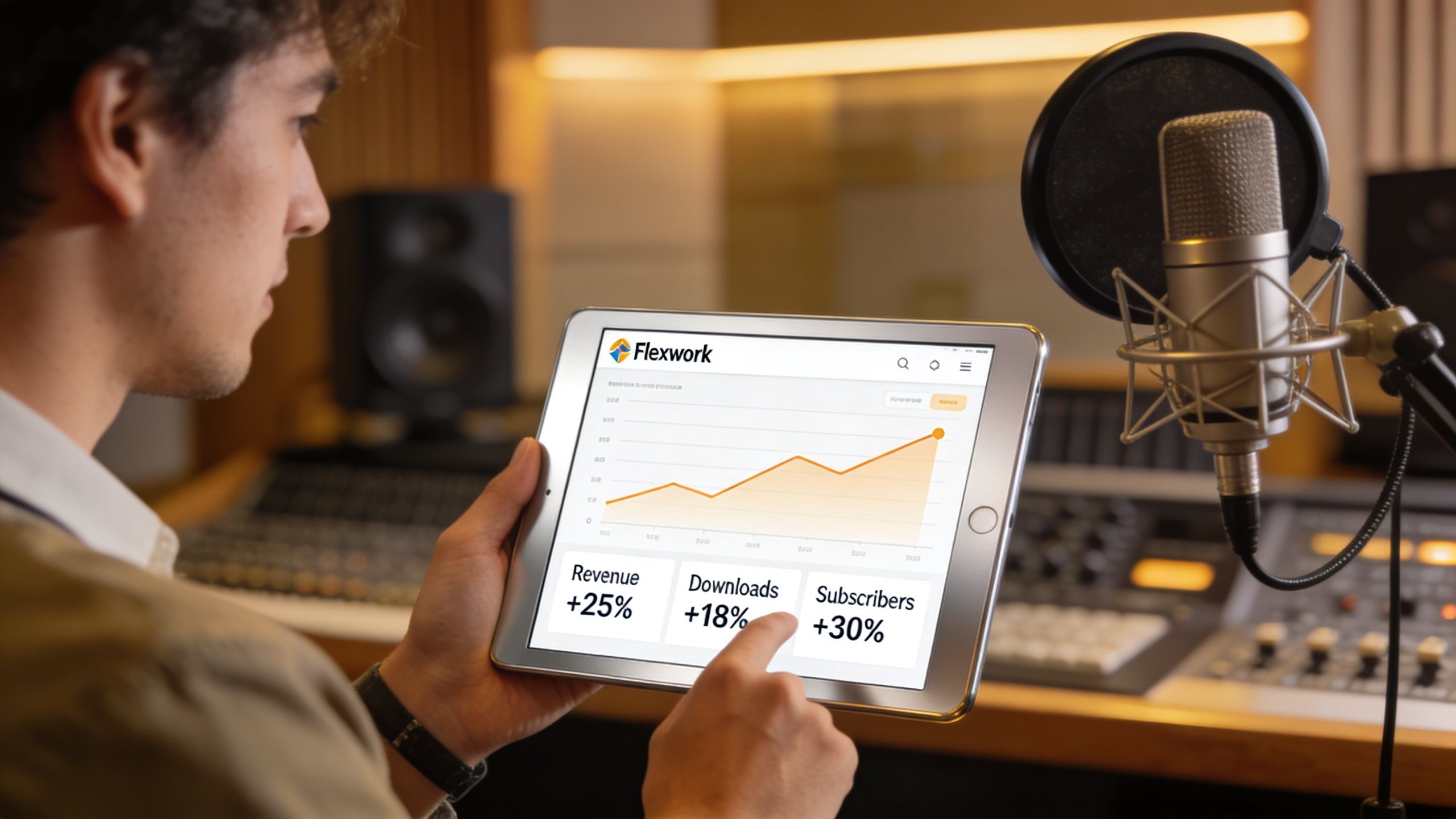
A lot of studios can record a conversation. That’s not the same as helping a show produce business value.
The primary question is whether the service model matches the stage of your show. If you need a clean place to record, a rental can work. If you need the show to support lead generation, authority building, and brand consistency, you need a production partner with marketing capability.
Match the package to the job
If you already have a format, know how to host, and mainly need polish, a producer-led package makes sense. For instance, a package like Be My Podcast Producer earns its keep. You’re not paying for gear access. You’re paying to stop wasting attention on tasks that dilute your actual role as the host.
That kind of package is useful for creators who want:
- Sharper visual storytelling for YouTube and social
- Cleaner editing decisions that preserve personality
- Consistent episode packaging so the brand feels deliberate
- A smoother session flow because someone else is managing the technical load
If your goal is growth, not just output, you need more. That’s where a package like Market, Manage & Produce My Podcast becomes the stronger move. It starts at $1500 per episode with a 20-episode growth commitment, and that framing is important. Serious growth usually comes from consistency and systems, not one-off bursts.
Revenue doesn’t come from recording alone
Podcast advertising revenue grew 28% year over year to $2.3B globally, according to Channel511’s podcast revenue analysis. That doesn’t mean every show should chase ads. It means the commercial side of podcasting is getting more mature, and shows with clean production, smart packaging, and distribution discipline are better positioned to benefit.
For business owners, the payoff often comes through authority and demand generation first. A polished show can support client trust, sales conversations, speaking opportunities, and referral momentum long before direct sponsorship enters the picture.
That’s why the add-ons matter.
- Content Days cost $3000 per day and are built for batching. If you hate the constant scramble of weekly production, this is one of the smartest ways to regain control.
- Podcast websites start at $5000 plus hosting. That matters if you want your show to live on owned media instead of floating between platform profiles.
- Marketing support matters because a strong episode with weak rollout is still underperforming.
If you’re thinking beyond audio, it also helps to understand how to transform audio into video in a way that fits modern content distribution instead of posting static-waveform leftovers.
Treat the show like a media asset
This is the mindset shift most creators need. Your podcast is not just content. It’s a reputation engine.
A business-ready show should do at least four things well:
Reflect your brand clearly
People should hear and see the level you operate at.Create reusable media
One recording session should support multiple channels.Stay consistent without burning you out
The system matters as much as the episode.Connect to an actual business goal
Pipeline, visibility, authority, retention, or audience development.
For creators who want that full stack approach, podcast monetization strategy guidance is often the missing layer. Recording quality gets attention. Business design creates return.
One factual example in this category is Flexwork Podcast Studios, a Springfield, NJ facility that offers studio rentals, production packages, Content Day sessions, podcast websites, and growth-focused support for audio and video podcasts. That kind of integrated setup is what turns a show from a recurring task into an operational channel.
How to Choose the Right Podcast Studio for You
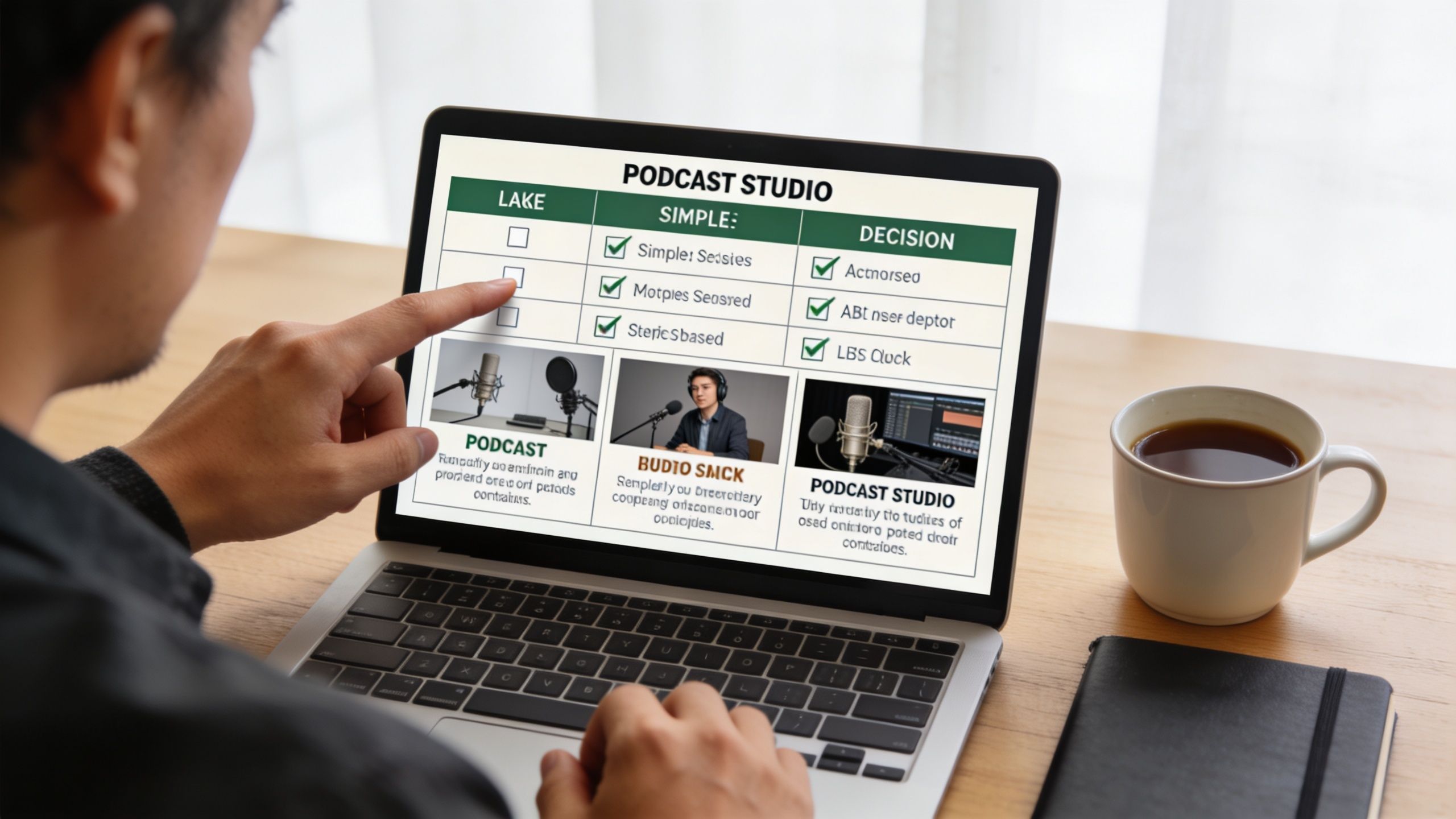
You book a guest with real audience pull. The conversation is strong. Then the episode goes live with room echo, uneven levels, and a remote guest who sounds like they called in from a tunnel. That one bad production decision hurts retention, weakens trust, and makes the show harder to monetize.
Choose a studio the same way you would choose any revenue-facing partner. It needs to protect your brand, support your format, and reduce production risk.
A useful starting point is learning what makes a great podcast studio from an operator’s perspective. Once you know how a studio functions, polished marketing stops being persuasive.
Start with the room, not the gear list
Studios love to advertise microphones. Serious hosts ask about the room.
Acoustic treatment matters because your audience hears the room before they notice the mic model. A reflective, untreated space makes voices sound brittle, distant, or boxy. That lowers perceived quality fast, especially if you are building a business show where authority and clarity matter.
Ask for raw samples from that exact room. Not a highlight reel. Not a montage. One clean clip from a normal session tells you more than a gear list ever will.
Ask what format they record and deliver
A studio should answer technical questions without confusion. If they cannot explain their capture and delivery process in plain language, they are not ready to support a serious show.
According to Cloud Studios Seattle’s podcast studio tech specifications, professional podcast rooms commonly record uncompressed WAV files at 48kHz/24-bit. That recording standard gives editors more control when cleaning dialogue, balancing speakers, and fixing small issues before they become audible quality problems.
Ask this directly:
“Do you record each speaker on isolated tracks at 48kHz/24-bit WAV, or do you only provide a mixed file?”
You want isolated tracks. They make interruptions, crosstalk, guest level issues, and cleanup far easier to handle.
Screen for spoken-word workflow, not flashy equipment
Podcast production has different needs than music tracking or generic video shoots. The room should support conversation first.
Studios built for podcasting often use consoles like the RØDECaster Pro or Zoom PodTrak P8 because they simplify multihost sessions, remote call-ins, live monitoring, and backup capture. Those details matter because they reduce mistakes during recording and save time in post.
Use this checklist before you book:
Enough XLR inputs for your real format
A studio set up for two people will slow down a four-person panel.Closed-back monitoring for every active speaker
Good monitoring helps catch clipping, bleed, and bad guest audio before the session is over.A backup recording path
Professional studios plan for card failures, software crashes, and routing mistakes.A producer or engineer who can run the room live
Hosts should focus on the conversation, not signal flow.
Judge post-production by deliverables
“Fast turnaround” is weak positioning. It says nothing about what you get.
Ask for a defined list of outputs. That should include audio editing, loudness leveling, video switching if applicable, clip selection, titles, revisions, and delivery timelines. If a studio stays vague here, expect confusion later. Confusion turns into delays. Delays kill consistency, and consistency is what gives a show commercial value.
Here is the difference:
| Question | Weak answer | Strong answer |
|---|---|---|
| What does editing include | “Basic cleanup” | Clear audio, video, clip, and graphics deliverables |
| How are revisions handled | “We’ll figure it out” | Defined revision rounds and approval process |
| Can you support distribution assets | “We can send files” | Platform-ready clips, titles, formatting, and exports |
Studios that define scope clearly usually run better sessions too.
Hybrid recording should be part of the plan
A lot of business podcasts now mix in-studio hosts with remote guests. That is normal. It also creates failure points if the studio treats remote recording like an afterthought.
Ask how they handle pre-session tech checks, browser-based recording platforms, guest monitoring, and local backup capture. Ask what happens if a guest has unstable internet or poor mic technique. Ask whether the engineer can hear the remote feed separately from the room mix.
Those answers matter because guest quality affects more than the listening experience. It affects whether a strong interview becomes a usable asset for clips, sponsorships, sales follow-up, and repurposed content.
The video below gives useful context on what a more professional setup can look like in practice.
In NJ and NY, logistics affect output
Convenience sounds minor until it starts breaking your schedule.
If your studio is difficult to reach, guests arrive rushed, teams show up late, and batch days run behind. That is not a comfort issue. It is a production efficiency issue. In the NJ and NY market, location, parking, building access, and prep space all affect whether you can record consistently enough to grow.
Check for these basics:
- Simple travel access for guests and team
- Parking or clear building entry instructions
- Enough time and comfort for batching multiple episodes
- Prep or waiting space for wardrobe, notes, or client coordination
Pick the studio that makes publishing easier every week, not the one that looks best in photos. The right room protects your time, sharpens your brand, and gives your show a better chance to hold attention long enough to create real business return.
Beyond the Mic Real-World Podcast Success Stories

You book a strong guest, block off two hours, record the episode, and still end the day with files to sort, fixes to request, clips to chase, and no clear publish plan. That is the point where a podcast stops being a creative outlet and starts needing real production infrastructure.
The consultant who stopped self-producing
A business consultant had the right ingredients from the start. Clear positioning. Strong guest access. Real expertise. What she lacked was operating capacity.
Every episode pulled her away from client work. Home recording meant setup, troubleshooting, retakes, file wrangling, and editing decisions she should never have been making herself. Once she moved to a producer-supported setup, the show became repeatable. She could batch interviews, stay focused as a host, and publish on schedule.
The biggest gain was not convenience. It was revenue protection. Her podcast stopped stealing time from the business and started supporting it.
The creative duo who batched a season
Two hosts with great chemistry were stuck in reactive mode. One week they were adjusting lights. The next week they were revising thumbnails, chasing edits, and trying to maintain a release calendar that kept slipping.
They switched to a content day model and recorded a season in planned blocks. That changed the economics of the show. One studio day now produced full episodes, social clips, video assets, and a cleaner handoff into post-production. Their brand started looking sharper because their process got sharper first.
That is what professional service buys you. Fewer one-off decisions. More usable assets per session. Better consistency across every audience touchpoint.
Creators grow faster when the show runs like a media asset, not a weekly scramble.
The host with remote guests who needed a better system
Hybrid recording is now standard for many business podcasts. The format works well, but only when someone is actively managing the technical side. If no one is checking guest audio, handling backups, and monitoring the session in real time, the host pays for it later in editing, missed moments, and weaker final content.
That was the issue for a coaching show booking guests from multiple cities. The interviews were strong, but the production quality kept varying. Once the host recorded in a professional studio with a clear remote workflow, the episodes became far more usable. Fewer interruptions. Cleaner files. Better clips. Better retention.
That last point gets ignored too often. Audio quality is not just a technical preference. It shapes whether people keep listening long enough to trust you, share the episode, join your email list, or buy. If you want to see what that kind of production discipline looks like in practice, this behind-the-scenes look at a New Jersey podcast studio gives useful context.
These examples all point to the same lesson. Professional podcast recording services are not a cosmetic upgrade. They help you publish consistently, protect your time, strengthen brand perception, and turn each recording session into content that can drive growth.
Frequently Asked Questions About Podcast Services
What’s the real difference between a studio rental and a full-service production package
A studio rental gives you the room, the setup, and sometimes basic support. You still own the creative direction, the session flow, and often the post-production. A full-service package adds the people and process that turn a recording into a finished media asset. If you want less friction and greater efficiency, the package is usually the smarter choice.
Can I bring my own producer or editor to a studio session
Usually, yes. Good studios should be able to work with your existing team as long as expectations are clear. If you already trust your own producer, that can be a strong setup. Just make sure the studio’s workflow, file delivery, and session rules match how your team works.
How much creative control do I keep with podcast recording services
You should keep a lot. A good production partner sharpens your vision. They shouldn’t replace it. The best relationships are collaborative. You bring the voice, point of view, and audience understanding. The production team brings technical execution, structure, and packaging discipline.
Do I need video from day one
Not always. But if your audience discovers creators through social platforms or YouTube, it’s smart to build with video in mind early. Retrofitting a purely audio show into a video-first strategy later can be messy.
Are podcast recording services worth it for a small business show
If the show supports authority, client trust, recruiting, partnerships, or brand reach, yes. The point isn’t to make the podcast look expensive. The point is to make the podcast reliable, credible, and reusable across your marketing ecosystem.
Conclusion Invest in Your Voice
The jump from DIY to professional production isn’t about chasing polish for its own sake. It’s about removing friction from a channel that can compound for your brand for years.
Podcast recording services make sense when your show has a job to do. Build authority. Support demand. Deepen audience trust. Create media that keeps working after the recording session ends. Once that’s the goal, trying to hold the whole production stack together by yourself stops being efficient.
The creators who level up fastest usually make one key decision. They stop treating production as an afterthought and start treating it as part of the product.
If you’re serious about building a show that sounds sharper, looks stronger, and fits into a real business strategy, invest accordingly. The market is crowded. Your voice still matters. But presentation, consistency, and execution are what help that voice travel.
If you're ready to move your show out of the DIY phase, book a tour or explore the production options at Flexwork Podcast Studios.