

How to Become a Thought Leader: Step-by-Step Guide
 April 29, 202630 Minutes
Good creators hit a frustrating point. The audience is decent, the episodes are solid, the clips look fine, and yet your name still isn’t carrying weight in the rooms that matter. People consume your content, but they don’t cite you, invite you, or buy because of your perspective.
That gap is the difference between being visible and being trusted.
If you want to learn how to become a thought leader, stop obsessing over follower count and start building authority people can use. Thought leadership is not motivational posting. It’s not recycled hot takes. It’s a repeatable system for turning your expertise into a brand that influences decisions, opens doors, and supports premium offers. The creators who pull this off usually have one thing in common. They pair sharp ideas with infrastructure that lets them publish at a high level consistently.
The Creator’s Ceiling and the Path to Influence
A lot of talented podcasters stall in the same place. They know their subject. They’ve built enough momentum to prove the concept. But their content still feels like content, not authority.
That usually happens when the work stays trapped at the “helpful” level. You post opinions, interviews, and clips, but you haven’t built a body of work that tells people, “This is the person shaping how this topic gets understood.”

That shift matters because decision-makers are paying attention. 51% of C-Suite executives report spending more than 1 hour per week reading thought leadership materials, and 60% of decision-makers are willing to pay a premium for companies that demonstrate clear authority in their field, according to thought leadership trends tracked by NYTLicensing.
If you’re trying to grow a consultancy, agency, personal brand, or podcast-led business, this is the market signal. People with budget are actively looking for informed voices.
Why good content still gets ignored
Most creators don’t have an expertise problem. They have a positioning problem.
They talk too broadly. Their audio or video quality undercuts their message. Their publishing rhythm disappears for weeks. And they confuse “I’m posting consistently” with “I’m building a clear argument in public.”
Thought leadership starts when your audience can predict your point of view before you say it.
If you want to develop industry influence, study how real authority is built. Not through louder content, but through clearer thinking delivered repeatedly in formats people consume.
What changes when you become a thought leader
You stop sounding like another creator in the feed.
You become the person who explains the category, reframes the problem, and gets invited into bigger conversations because your content makes people think better. That’s the path out of the creator ceiling.
Define Your Authority Not Just Your Niche
A niche is a topic. Authority is a position.
A lot of people choose a lane and assume that’s enough. It isn’t. “Marketing,” “wellness,” “founder stories,” “real estate,” and “career advice” are not authority positions. They’re crowded shelves. If you want to know how to become a thought leader, you need a defensible point of view inside the category.
That means saying something more useful than what everyone else is saying.
Stop claiming a category and claim a problem
The fastest way to blur your brand is to describe yourself by format or industry only. “I host a business podcast” tells nobody why they should care. “I help founders fix the communication breakdowns that stall growth” is stronger because it names a problem.
Start with these questions:
What problem do people repeatedly bring to you?
Not what you enjoy discussing. What they trust you to unpack.Where do you disagree with the lazy consensus?
Your authority sharpens when you challenge bad assumptions with evidence from experience.What do you know operationally that outsiders don’t?
Practitioners hold an advantage over commentators.What can your audience act on immediately?
Thought leadership has to be usable. Empty insight dies fast.
That last point is non-negotiable. Effective thought leadership requires delivering “novel insights on a topic” and “insights that your audience can take action on,” as outlined in this thought leadership strategy framework from B2 Communications.
Run a contrarian audit
Before you record another episode, audit the conversation around your field.
Look at the topics everyone repeats. Then look at the questions nobody is answering well. You’re not searching for novelty for its own sake. You’re searching for useful tension.
Use a simple three-column review:
| Topic area | What the market keeps saying | What you believe instead |
|---|---|---|
| Leadership | Culture solves retention | Managers lose people when expectations stay vague |
| Podcast growth | More clips equals more growth | Better message clarity beats volume without positioning |
| Branding | Be everywhere | Own one association first, then expand |
This forces you to turn experience into stance.
Practical rule: If your take could be swapped with ten other creators in your niche, it’s not a thought leadership take yet.
Build a thought leadership matrix
You need a working document. Not vibes.
Create a matrix with four inputs:
Your lived expertise
Client work, operator experience, team leadership, market exposure, repeated patterns you’ve seen firsthand.Audience pain points
Frictions your audience complains about, misunderstands, or spends money trying to fix.Proof assets
Stories, frameworks, before-and-after process examples, guest interviews, workshops, and recurring questions from your audience.Content angles
The themes you can return to repeatedly without sounding repetitive because each angle solves a different layer of the problem.
At this point, many creators realize they don’t need a broader niche. They need a tighter thesis.
If you’re still clarifying that thesis, this guide on how to define your brand niche is useful because it pushes you past generic self-branding and toward sharper market positioning. You can also pressure-test your message against your visual and verbal identity using Flexwork’s article on how to brand your business.
Pick three repeatable points of view
Don’t build your authority around random inspiration. Build it around a small set of repeated ideas.
A strong creator brand usually has three core arguments:
A belief about the problem
Example: most companies don’t have a content problem, they have an insight problem.A belief about the method
Example: long-form conversation is the fastest path to trust because it reveals how you think.A belief about the outcome
Example: authority should lead to pipeline, partnerships, and premium positioning.
Those beliefs become the spine of your episodes, posts, guest pitches, and sales conversations.
What authority sounds like
Authority sounds specific. It sounds earned. It sounds like someone who has done the work, seen the mistakes, and can explain what matters without padding every sentence.
It does not sound like trend summaries.
When people ask how to become a thought leader, they usually want a content tactic. However, the answer comes earlier. Define what intellectual territory you’re willing to own, then defend it in public over time.
Build Your Signature Content Engine
Creators burn out when every piece of content starts from zero. Thought leaders don’t create that way. They build a content engine that turns one strong idea into a coordinated stream of assets.
At this point, authority stops being a creative mood and becomes an operating system.
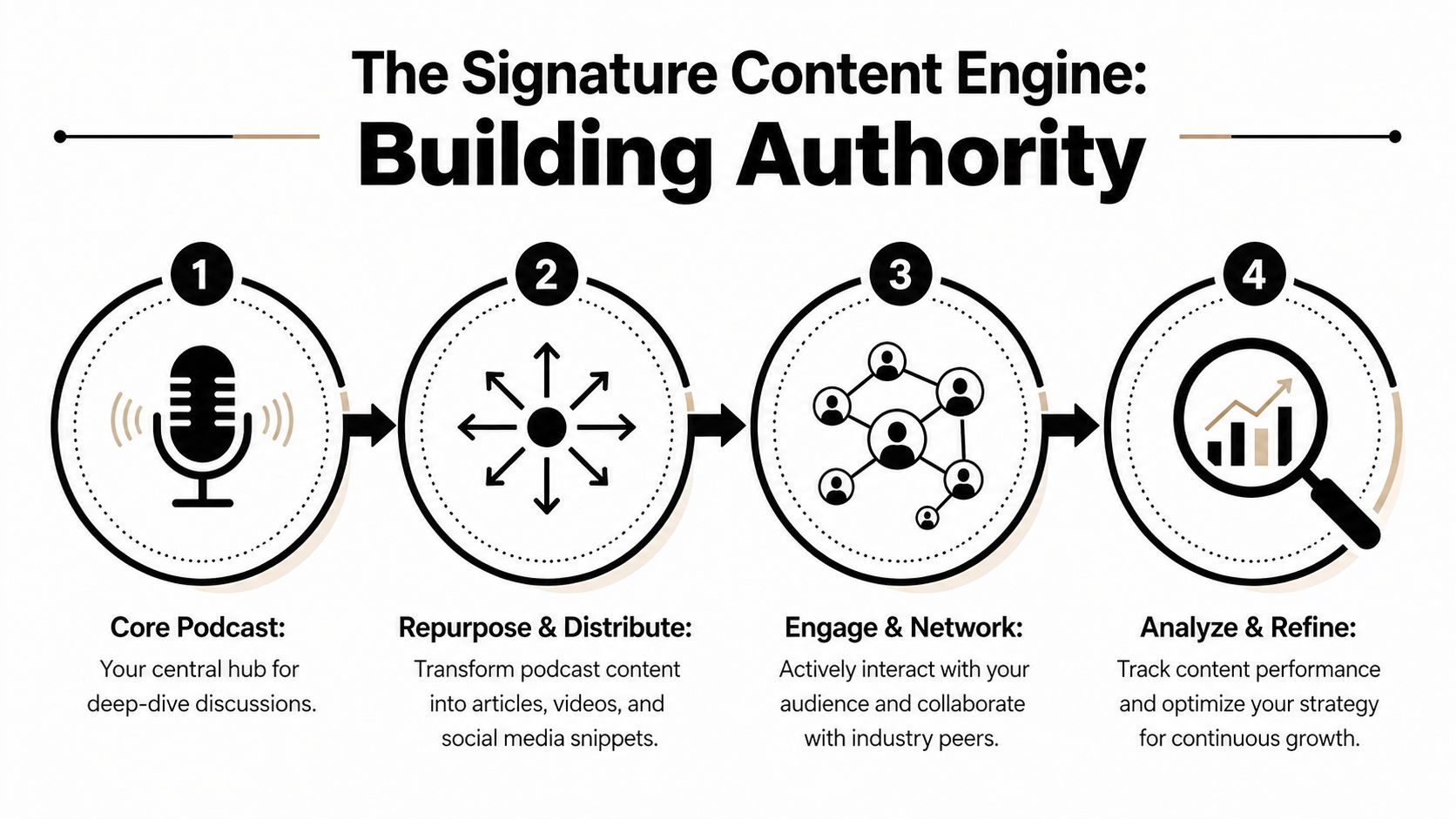
You do not need to be everywhere. You need a central format that lets you go deep, then a repeatable way to split that depth into smaller pieces people can discover, save, and share.
Choose the hub first
For most experts, the hub should be a podcast or video podcast.
Why? Because long-form conversation shows judgment. It captures tone, nuance, and pattern recognition in a way short posts rarely can. It also gives you raw material for every other channel.
A strong hub episode can become:
- A short-form clip series for Instagram Reels, LinkedIn video, TikTok, or YouTube Shorts
- A blog article built around the strongest teaching point
- A quote carousel pulled from one sharp line
- An email that reframes the core argument for subscribers
- A guest booking asset you send to prospects to show the quality of your conversations
- A sales enablement piece your team shares with leads who need conviction
This is how one recording session starts compounding.
Cadence matters more than bursts
Random intensity doesn’t build authority. Cadence does.
Failing to maintain consistent communication is a top reason audiences disengage, and thought leadership is built “post by post, comment by comment,” requiring sustained output over 6-12 months to shift perception and build a reputation, according to NYTLicensing’s guidance on demonstrating thought leadership.
That doesn’t mean publishing nonstop. It means choosing a rhythm you can defend.
A practical cadence looks like this:
| Core asset | Publishing rhythm | Repurposed outputs |
|---|---|---|
| Podcast episode | Weekly or bi-weekly | Clips, audiograms, article, email |
| Solo insight video | Weekly | Transcript post, quote graphics |
| Guest interview | Ongoing | Outreach asset, social proof moments |
Build around a batch workflow
The easiest way to stay consistent is to stop producing in real time.
Record in batches. Plan in themes. Edit in systems.
A clean monthly workflow often looks like this:
Map four episode themes
Tie them back to the three core arguments you defined earlier.Record two or more episodes in one session
This cuts setup fatigue and keeps your visual identity consistent.Tag standout moments during or right after recording
These markers save hours in post-production.Create a distribution pack for each episode
Title options, show notes, clips, captions, thumbnail directions, and one article angle.Schedule the release sequence
Don’t drop the full episode and disappear. Stretch the conversation across the week.
If you want a practical model for turning one recording into a full stack of assets, this breakdown of how to repurpose a single podcast episode into 10 pieces of content is worth using as an internal production checklist.
Your engine needs format discipline
A lot of repurposing fails because creators treat every channel the same.
They post a random clip everywhere, use the same caption on every platform, then wonder why nothing sticks. Format discipline fixes that.
Use each channel for its job:
- LinkedIn is for perspective and professional relevance.
- Instagram is for fast pattern interruption and visual identity.
- YouTube supports search, binge behavior, and deeper discovery.
- Email turns passive audience attention into owned relationships.
- Your website becomes the archive where your authority lives.
If you need a useful operational reference for content systems that boost your content reach and retention, apply it at the workflow level, not just the posting level.
The real bottleneck is production friction
Most creators don’t quit because they run out of ideas. They quit because execution gets ugly.
The mic setup fails. The lighting changes. Editing drags on. Titles get rushed. Clips don’t get exported. Then the publishing rhythm collapses.
Consistency is rarely a motivation issue. It’s usually a systems issue.
Your content engine should reduce decisions, reduce friction, and protect quality. Once that happens, your ideas finally get enough repetition to become associated with your name.
The Pro-Level Production Difference
Smart creators underestimate how much production quality shapes perceived authority.
People won’t always say, “I clicked off because the lighting was bad” or “I don’t trust this person because the audio sounds hollow.” They just leave. Or worse, they mentally file you under amateur before they’ve absorbed a single useful idea.
That’s the hidden tax of DIY production.
DIY often costs more than it saves
Doing everything yourself feels efficient at first. Then the actual costs show up.
You spend energy troubleshooting gear instead of preparing sharper questions. You lose hours to editing. Your visual identity changes every time you record. Guest experience gets inconsistent. The output starts looking like content assembled in fragments rather than a serious media property.
This matters more when your content is supposed to support consulting, speaking, recruiting, partnerships, or higher-ticket services. If your presentation feels improvised, your expertise feels less valuable.
What a professional setup actually fixes
A pro setup does more than make things look cleaner. It removes variables.
You get reliable sound, controlled lighting, stable framing, and a production environment built for repeatability. That changes how you perform on camera and how your guests respond. It also shortens the path from recording to publishing.
For creators who want to understand the gear side before upgrading, this guide to the best microphone for podcast recording is a useful baseline. It’ll quickly show you why the “good enough” setup often becomes the ceiling.
Use the right production model for your stage
Not every creator needs the same support. Some need a room and reliable equipment. Others need an entire operating partner.
Here’s a simple way to think about the options.
| Service | Best For | Key Deliverables | Investment |
|---|---|---|---|
| Hourly studio rental | Creators who can self-produce but need a polished recording environment | Acoustically treated studio, professional recording setup, controlled visual environment | Varies by rental booking |
| Content Day | Founders, coaches, and creators who want to batch brand assets fast | $3000/day, including 20 edited reels or 60 pro photos | $3000/day |
| Market, Manage & Produce My Podcast | Hosts building a serious media brand with growth goals | Production, editing, distribution, and growth support with a structured rollout | Starts at $1500 per episode with a 20-episode growth commitment |
| Podcast website build | Creators who need a credible home base for discovery and conversion | Custom podcast website and publishing infrastructure | $5000 plus hosting |
One practical option for this kind of support is Flexwork Podcast Studios, which offers studio rentals, production packages, Content Day sessions, and podcast websites from its Springfield, New Jersey facility.
Why batching wins
If your calendar is packed, the most effective strategy is batching.
A full content day lets you record long-form episodes, solo videos, guest spots, and short-form assets in one controlled environment. That’s not just convenient. It’s how you keep brand consistency across everything your audience sees for the next several weeks.
A lot of creators try to piece this together from home, coffee shops, borrowed offices, and makeshift sets. The audience can tell. So can potential clients.
Amateur execution weakens expert thinking. Professional execution gives your ideas the frame they deserve.
The business case is simple
Thought leadership only works if you publish enough high-quality material for people to recognize your pattern of thinking. That requires infrastructure.
Not glamorous infrastructure. Useful infrastructure.
Reliable recording conditions. Fast post-production. Clear visual identity. A process that turns expertise into assets without draining the person who has to deliver the expertise. If your current setup makes publishing harder than it should be, that setup is no longer a badge of scrappiness. It’s a bottleneck.
Amplify Your Voice and Build Your Network
Publishing is not distribution. Posting is not reach. If the right people never encounter your ideas, your authority stays invisible.
That’s why strong thought leadership includes a deliberate amplification plan. The content itself has to be sharp, but it also has to travel through networks where buyers, collaborators, media contacts, and future guests already pay attention.

Thought leadership is effective because it moves decision behavior. 95% of hidden decision-makers become more open to sales outreach after engaging with thought leadership, and 75% of executives explore previously unconsidered products or services based on strong content, according to this roundup of thought leadership statistics from DSMN8.
That should change how you think about your podcast. It’s not just media. It’s market access.
Borrow credibility on purpose
If you’re still building authority, don’t wait until you feel established to reach out to respected guests. Book them now.
A good guest strategy does three things at once:
Expands your audience by association
Their presence signals relevance.Improves your content quality
Better guests create stronger conversations and more quotable moments.Raises your status through context
If you consistently host thoughtful discussions with smart operators, people start placing you in that peer set.
The key is to be selective. Don’t chase names only. Chase guests whose expertise sharpens your own positioning.
Turn every episode into a networking asset
A podcast is one of the few outreach tools people want to say yes to. Use that.
Invite potential partners, clients, industry operators, authors, and niche experts into a conversation built around your area of authority. Then keep the relationship going after the recording. A great episode can become the start of a referral relationship, a speaking introduction, a collaboration, or a future deal.
If your broader growth plan includes creator partnerships and cross-platform exposure, these influencer marketing strategies offer a practical lens for thinking beyond one-off guest appearances.
Distribute for the room you want to enter
A lot of creators share clips without asking who the clip is for.
That’s a mistake. The same insight should be framed differently depending on the audience.
Use distribution intentionally:
| Channel | Best use | What to publish |
|---|---|---|
| Professional reach and B2B credibility | Opinion clips, lessons, guest insights | |
| Discovery and brand identity | Strong visual snippets, behind-the-scenes moments | |
| YouTube | Search and long-term discoverability | Full episodes, segmented highlights |
| Relationship depth | Recaps, point-of-view notes, offers |
Here’s a useful example of how authority grows when creators publish with purpose, not just frequency:
Don’t neglect discoverability
Great conversations disappear when they aren’t packaged for search.
That means clear episode titles, descriptive summaries, useful keywords, named problems, and consistent topic signals across your podcast feed, site, and social posts. If your show is about leadership for creative founders, say that plainly. If it’s about pricing strategy, hiring, or wellness for women in tech, encode that language into your titles and descriptions.
Searchability looks boring next to slick clips. It drives better long-term value.
A thought leader doesn’t just publish ideas. They make those ideas easy to find, easy to share, and easy to associate with their name.
From Influence to Income The Monetization Roadmap
A lot of people still believe authority has to come from traditional credentials first. Degrees, institutional logos, media pedigree, formal titles. That’s outdated.
For modern creators, operators, and niche experts, content can become the credential. In many cases, it’s the more persuasive one because people can watch it, hear it, and judge the quality of your thinking directly.
That’s the power of a serious podcast. It acts as public proof.
Your podcast is a credibility stack
If you’re building from scratch, think in layers.
A single episode won’t transform your market position. A body of work will. Each conversation, solo breakdown, guest interview, and client story adds another layer to what buyers and collaborators believe about you.
For creators building authority from scratch, a podcast becomes a credential, and the path to credibility without credentials comes from documenting case studies, interviewing recognized experts to borrow authority, and showcasing community-validated expertise, as explained in Roostervane’s thought leader guidance.
That framework is more useful than waiting for permission.
Monetization follows credibility, not attention alone
You do not need an enormous audience to monetize authority well. You need the right signals.
Those signals include:
Documented proof
Break down client results qualitatively if you can’t publish hard numbers. Show the process, the problem, and the shift.Recognized voices in your orbit
Expert guests, peer collaborations, and respected referrals all strengthen your market position.Clear service pathways
Consulting, advising, workshops, sponsorships, speaking, and premium products should connect naturally to the themes of your content.Visible audience trust
Comments, recommendations, repeat listeners, inbound invites, and warm introductions all count as credibility markers.
The practical offers thought leadership supports
Once your platform is coherent, monetization gets simpler.
You can command stronger consulting rates because prospects have already heard how you think. You can land speaking invitations because event organizers can evaluate your delivery in advance. You can sell strategic partnerships because your content has already defined the audience and perspective you bring.
If sponsorship is part of the roadmap, this guide on how to get podcast sponsors can help you think about alignment, positioning, and packaging.
Build offers around repeated questions
The easiest monetization opportunities usually come from questions your audience asks over and over.
Turn those into structured offers:
| Repeated audience question | Likely offer |
|---|---|
| Can you help us implement this? | Consulting or advisory package |
| Can you train our team on this? | Workshop or leadership session |
| Can you speak on this topic? | Keynote or panel appearance |
| What tools or process do you use? | Digital product, playbook, or paid resource |
This is why thought leadership is a business asset, not just a media identity. It reveals demand in public.
The market doesn’t pay for expertise alone. It pays for expertise packaged clearly enough to trust.
Don’t wait for credentials you can build yourself
The old model said you needed credentials first, then platform. The modern model often works in reverse. You publish thoughtful work, create a visible archive of your judgment, and the platform itself becomes evidence of expertise.
That only works when the content is sharp, consistent, and credible enough to support real business conversations. Otherwise, it’s just noise with branding.
Your Studio Is Waiting
Becoming a thought leader is a deliberate build. You define a point of view. You publish around it consistently. You package your ideas with enough quality that people trust them before they’ve even finished the first episode.
Most creators already have more expertise than they’re showing. What they lack is the structure to express it at the level their brand requires.
That’s the essential key. Not more random posting. Better positioning, better production, and a workflow that lets your ideas keep showing up long enough to matter.
If you’re serious about how to become a thought leader, treat your content like business infrastructure. The podcast, the clips, the site, the guest strategy, the archive, and the production environment all shape how your authority is perceived.
Your ideas already exist. They need a cleaner vehicle.
If you’re ready to turn expertise into a credible media brand, explore Flexwork Podcast Studios. Book a studio session, review the production options, or schedule a tour and build your next phase with infrastructure that supports consistent, professional output.