

How to Grow YouTube Channel Fast: 2026 Playbook
 April 28, 202632 Minutes
Meta title: How to Grow YouTube Channel Fast in 2026
Meta description: Learn how to grow youtube channel fast with smarter strategy, stronger videos, and a professional production system that scales.
URL slug: /how-to-grow-youtube-channel-fast
You’re probably doing too much.
You’re researching topics, writing scripts, setting up lights, filming, editing, cutting shorts, writing captions, designing thumbnails, uploading, posting to Instagram, and then checking analytics like they owe you an explanation. That workflow feels productive. It isn’t. It’s usually the reason talented creators stay small.
If you want to know how to grow youtube channel fast, stop treating your channel like a side hobby with heroic effort behind the scenes. Start treating it like a media brand with systems, standards, and advantages. Fast growth comes from consistent output, sharper positioning, stronger packaging, and a repeatable production engine. That’s what separates creators who stall from creators who scale.
From DIY Burnout to CEO Creator The Fast-Track Mindset
You finish one upload at midnight, then wake up to a list you already resent. Topic research. Script. Setup. Filming. Editing. Thumbnail. Title. Description. Clips. Distribution. Analytics. Repeat. That is not a creator workflow. It is a small media company running without staff.
Creators stall here all the time. They assume growth is slow because YouTube is crowded or the algorithm is unpredictable. More often, the channel is being built on a production model that cannot survive real life. If every video depends on your personal stamina, your ceiling stays low no matter how strong your ideas are.

That is why the DIY approach breaks down so quickly. Reaching traction on YouTube usually takes enough uploads, enough testing, and enough consistency to expose patterns. A creator who spends days wrestling each video into existence never gets enough at-bats. The channel does not fail from lack of ambition. It slows down because the workflow cannot support the publishing pace growth demands.
Burnout is a systems problem
Hustle can get a channel off the ground. It does a poor job of carrying a brand through months of consistent publishing.
Handle every task yourself and the cracks show up fast. Quality swings from one upload to the next. Publishing cadence becomes erratic. Your audience stops expecting you, and you lose the repetition needed to improve packaging, retention, and topic selection with any speed.
Practical rule: A growth problem often looks like a creativity problem, but usually starts with production capacity.
Serious creators operate differently. They protect their attention for the work that compounds: point of view, camera presence, audience insight, partnerships, and monetization. The repetitive work gets standardized, delegated, or removed.
The CEO creator makes sharper decisions
The next version of you does not win by proving you can do everything alone. They win by deciding what deserves founder-level attention and what belongs inside a production system.
That usually means:
- Owning the vision: You define the niche, message, format, and brand standard.
- Guarding high-value energy: Your best hours go to ideas, delivery, and revenue-driving decisions.
- Building repeatable operations: Editing, repurposing, scheduling, file management, and post-production follow a process instead of a mood.
This shift matters more than creators admit. Once you stop acting like the intern, editor, producer, strategist, and distributor at the same time, the channel starts behaving like a real asset.
If you want to grow a YouTube channel fast, remove the friction that keeps good strategy trapped in a chaotic workflow. Fast growth comes from publishing strong videos often enough for momentum to build, and that requires support.
Solo execution feels admirable. It performs poorly.
A lot of promising channels plateau for the same reason. The creator overinvests in tasks that feel productive but do not increase output. They tweak gear for hours, overedit early videos, rebuild their process every week, and treat every upload like a custom project.
That approach costs more than money. It drains creative stamina, delays publishing, and keeps the channel stuck in low-volume experimentation.
The better model is operational. Batch recording. Clear templates. Standard thumbnail logic. Defined roles. Reliable post-production. A recognizable format your audience can identify in seconds. Professional support accelerates that shift because it shortens the distance between a good idea and a finished asset. That is where services like Flexwork become a real advantage, especially for creators balancing content with client work or a company. This perspective on growing a podcast while running a business solo lines up with the same principle. Capacity sets the pace.
You do not need more motivation. You need a cleaner operating model.
Fast YouTube growth favors creators who treat the channel like a brand worth building properly. DIY effort can get you started. Professional production and strategic support help you scale without burning out on the way there.
Your Unfair Advantage A Professional Production System
A professional production system doesn’t just make content look better. It makes growth possible.
When creators say they want faster channel growth, what they usually mean is this: they want to publish more often without lowering quality, they want every video to feel more premium, and they want the back end of content production to stop eating their week. That’s exactly what systems solve.
The right setup gives you speed, consistency, cleaner branding, and the ability to think beyond the next upload. If you’re recording in a controlled environment and handing post-production to specialists, you free yourself up for the work that drives the brand. Better ideas. Better delivery. Better collaborations. Better monetization strategy.
What a real production system changes
A good system removes decision fatigue.
You stop asking where to film, whether the audio is usable, how to light the set, how to sync cameras, how to cut clips for short form, and whether your visuals look credible enough for the audience you want to attract. Those choices get solved in advance.
That matters because growth on YouTube rewards repeated execution. You want a channel that can produce on schedule, not one that relies on bursts of inspiration.
- Studios remove setup friction: You show up and record.
- Production support removes post bottlenecks: Editing, clipping, graphics, and formatting no longer depend on your nights and weekends.
- Strategic support improves content yield: One recording session can feed multiple assets instead of one isolated upload.
If your recording day creates only one piece of content, the problem isn’t effort. It’s architecture.
For creators serious about video podcasting or authority-building content, a professional environment also upgrades perception. Clean visuals, controlled sound, and polished edits signal that you take your platform seriously. Audiences notice that before they ever subscribe.
Flexwork Studios Growth Packages at a Glance
| Service | Ideal For | Key Deliverables | Investment |
|---|---|---|---|
| Hourly studio rental | Creators who want a fast, polished place to record without building a home setup | Acoustically treated studio, professional-grade audio and video capture, turnkey recording environment | Custom booking based on session needs |
| Content Day | Founders, podcasters, and creators who want to batch assets in one focused shoot | 20 edited reels or 60 professional photos in one day | $3000/day |
| Podcast website build | Hosts building a more premium digital home for their show and brand | Custom podcast website build, plus hosting costs | $5000 plus hosting |
| Market, Manage & Produce My Podcast | Brands and creators treating growth like a serious business function | Production, management, and growth support with a long-term content engine | Starts at $1500 per episode with a 20-episode growth commitment |
For creators comparing options, the smartest entry point often depends on what’s slowing you down right now.
If recording logistics are the headache, a polished studio environment changes the game immediately. If your real issue is content throughput, a batch model boosts your capacity. If you’re already publishing but need an actual audience growth engine around the content, management and marketing support become the most significant factor for expansion.
A turnkey recording setup like this video podcast studio is valuable because it shortens the path from idea to finished asset. That time savings compounds quickly across a quarter.
Speed is a brand advantage
Creators tend to think quality and speed are opposites. In practice, the right system improves both.
Batching content in a dedicated setting gives you visual consistency. Working with an editor improves pacing and packaging. Motion graphics and asset libraries create a recognizable style. A website gives your show a stronger conversion path. A managed growth package helps your content connect to an actual audience-building plan rather than floating around in isolation.
That’s the unfair advantage. Not magic. Not hacks. Just that edge.
The creator who still does everything manually can absolutely make great work. They just can’t usually make enough of it, with enough consistency, for long enough. The creator with a production system gets to stay in their zone of genius while the machine keeps moving.
Nail Your Content Strategy Before You Record
A creator sits down to film, full of energy, with a clean set and solid gear. Two hours later, they have footage that still will not grow the channel because the topic was too broad, the angle was weak, and the video had no clear job to do.
That is the main bottleneck.

Fast YouTube growth starts with strategic clarity before production starts. The creators who scale fastest do not just record more. They choose better topics, build repeatable formats, and use support around strategy and production so every shoot creates brand assets, not just another upload.
Pick a niche viewers can understand instantly
Your niche needs to pass a simple test. A new viewer should be able to describe your channel in one sentence.
Broad labels fail that test. “Business,” “lifestyle,” and “marketing” do not signal who the content is for or why someone should subscribe. Clear positioning does. “Content strategy for coaches,” “YouTube growth for podcasters,” or “strength training for professionals over 40” gives the audience immediate context and gives you a sharper editorial filter.
That clarity improves every decision after it. Topics get tighter. Titles get stronger. Collaborations get easier to evaluate. Your library starts to feel connected instead of random.
Use this filter before you approve any video idea:
- Exact viewer: Can you name the person this video is for?
- Specific problem: Does it answer a question, solve a frustration, or advance a clear goal?
- Brand fit: Does it reinforce your authority in one lane?
- Expansion potential: Can it lead to a series, follow-up, or related clip set?
If the idea fails two of those four tests, cut it.
Build three content pillars and protect them
Strong channels are predictable in the right way. Viewers return because they know the value they will get.
Three pillars are enough for most creators:
Search-driven education
Tutorials, how-tos, frameworks, and explanations tied to active demand.Point of view content
Reactions, breakdowns, contrarian takes, and strategic commentary that sharpen your brand.Proof content
Case studies, behind-the-scenes footage, client wins, guest conversations, and process videos that show your expertise in action.
This structure keeps the channel focused while still giving you creative range. It also makes production easier to systemize, which is exactly why strategic support matters. A professional team can help you map episodes to pillars, batch the right formats, and keep the channel aligned with your business goals instead of your mood that day.
Use search demand to guide topics, not control them
Keyword research should shape your topic selection. It should not flatten your voice.
Start with YouTube Search Suggest to see how your audience phrases problems. Then validate those ideas with tools like Ahrefs, TubeBuddy, or VidIQ. Pair search demand with your own expertise and point of view. That is how you build videos people are already looking for without sounding generic.
A smart workflow borrows from an effective content strategy for SEO. Start with audience intent, choose a target query, define the angle, and decide how the topic fits your larger content ecosystem before you record.
Use this pre-production checklist:
- Primary query: What phrase should this video have a chance to rank for?
- Intent: Does the viewer want steps, examples, comparisons, or a decision framework?
- Differentiation: Why is your version more useful, more current, or more credible?
- Repurposing plan: What clips, shorts, quotes, or follow-up videos can come from this shoot?
For creators who want stronger retention as well as stronger strategy, this guide on creating story-driven content that holds audience attention connects topic planning with the narrative choices that keep viewers watching.
Guest selection should support growth, not vanity
Guest episodes work best when they serve a strategic purpose. Audience overlap matters. Subject-matter depth matters. Clip potential matters.
YouTube’s creator guidance on building community supports the broader point that collaboration and audience connection can expand reach when the fit is right. That gives guest-driven creators a real advantage, especially in expertise-based niches where trust and distribution both matter.
Do not book guests for perceived status alone. Book guests who help you reach the right audience and create stronger content.
A good guest usually checks four boxes:
- They speak to the same viewer you want to attract.
- They bring a specific perspective your audience cannot get from everyone else.
- They create useful contrast, tension, or clarity in the conversation.
- They are likely to share the finished video and the clips around it.
Plan every shoot as a content asset stack
One shoot should create a library, not a single post.
A long-form interview can become a full YouTube episode, several Shorts, quote graphics, teaser clips, email content, and follow-up topics. A solo teaching session can produce a flagship video plus multiple cutdowns built around objections, examples, or quick wins. This is how smart creators grow faster without burning out. They treat production like a brand system.
That is also where professional support changes the pace of growth. With the right studio, editorial planning, and post-production team behind you, strategy stops living in a Google Doc and starts turning into consistent, high-output publishing. That is the shift from creator chaos to a real content engine.
The Science of Virality Hooks SEO and Thumbnails
Virality is not mystical. It’s packaged relevance.
A video gets a chance when people click. It keeps getting chances when people keep watching. That’s why the three most important creative decisions happen before someone hears your second sentence. The topic, the title, and the thumbnail decide whether you get the click. The hook decides whether you deserve it.
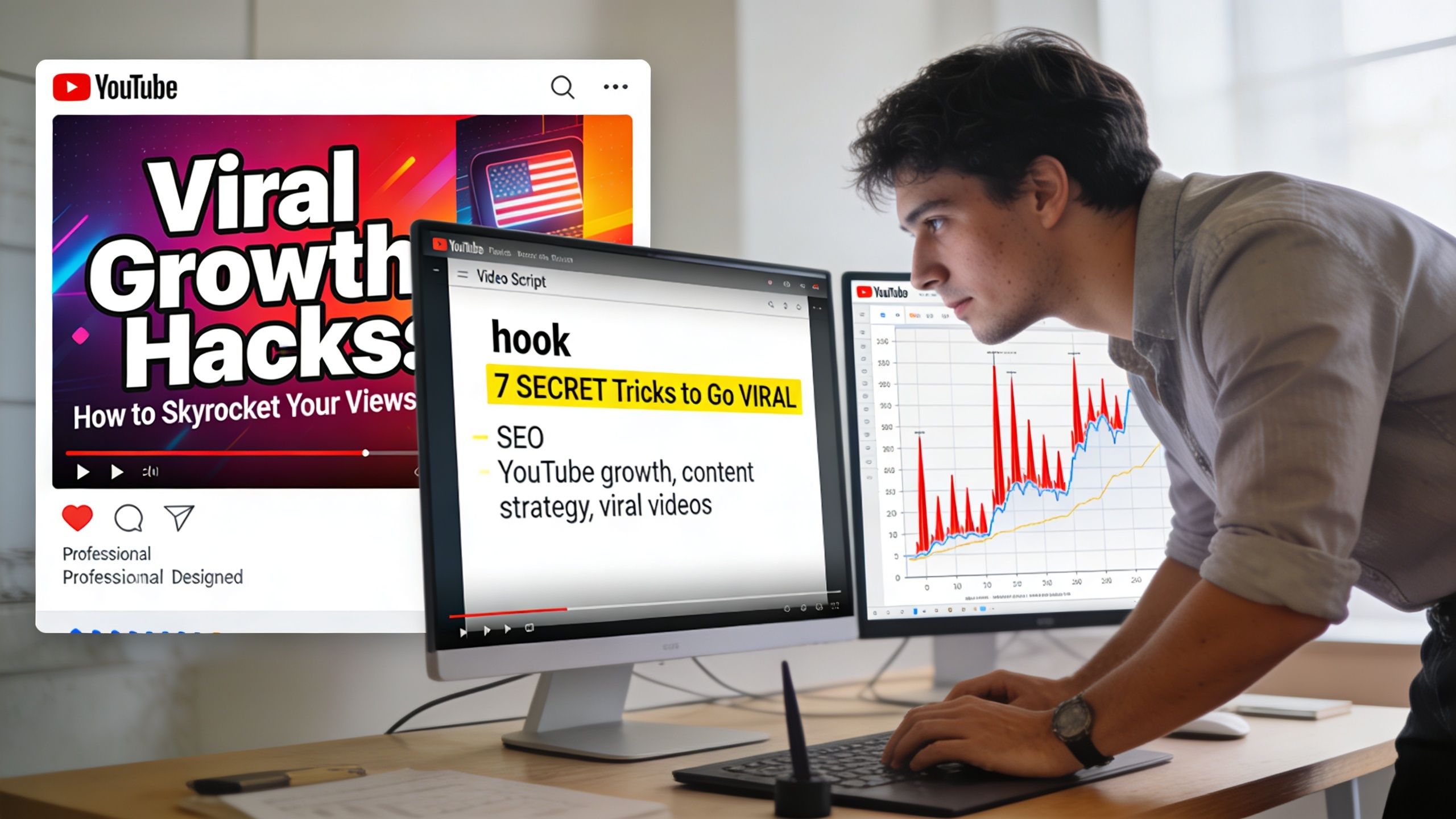
Top-performing YouTube channels consistently achieve an 8-12% click-through rate and an average view duration over 4:55. They do that by mastering hooks that secure over 50% audience retention at the 30-second mark and by using SEO to target high-volume keywords, according to this guide on YouTube channel growth benchmarks.
Those numbers tell you exactly what matters. Packaging and retention.
Hooks win or lose the video
Your opening should create immediate clarity and immediate tension.
That means no long intro, no self-indulgent preamble, and no throat-clearing about who you are. Start with the strongest claim, sharpest problem, or most desirable outcome in the video.
Weak hook:
“Hey everyone, welcome back to the channel, today I want to talk a little bit about…”
Strong hook:
“If your videos get impressions but no clicks, your thumbnail is probably doing the damage.”
The second version tells the viewer what’s at stake and why they should stay.
Use one of these hook types:
- Contrarian hook: Challenge common advice.
- Outcome hook: Lead with a result people want.
- Mistake hook: Name the error costing viewers progress.
- Curiosity hook: Open a loop you’ll close quickly.
Watch this test: If the first sentence can be removed without hurting the video, it shouldn’t be there.
Titles should promise value, not summarize the video
A title is not a label. It’s a pitch.
You want the viewer to know what the video is about while feeling a reason to click now. Good titles usually combine a topic, a benefit, and a curiosity gap. They don’t try to sound clever. They try to sound useful.
Compare these:
- “Podcast Episode 14 With John Smith”
- “How Founders Turn One Podcast Into Weeks of Content”
The second one is searchable, specific, and benefit-driven. It also speaks to a target audience. That’s the bar.
If you want a broader framework for aligning discoverability with content packaging, this guide to an effective content strategy for SEO is worth reviewing.
Thumbnails should do one job
The thumbnail’s job is not to explain everything. It’s to trigger the click.
Strong thumbnails are usually simple. One focal point. High contrast. Limited text. Clear emotion or a strong visual signal. If the title carries the topic, let the thumbnail carry the intrigue.
A few practical rules:
- Use one idea: If the design communicates three ideas, it communicates none.
- Prioritize readability: Tiny text dies on mobile.
- Choose contrast: Dark on light or light on dark. Make it obvious.
- Show stakes: Faces, gestures, screenshots, and before-after cues can all work.
Creators often sabotage good videos with generic thumbnails that look like templates. Clean doesn’t mean bland. It means deliberate.
For channels that want a more premium visual identity, motion support matters. This breakdown of how to create motion graphics is useful because polished visual systems make your videos and supporting assets feel more memorable.
SEO is packaging discipline
YouTube SEO isn’t just keywords in the title. It’s coherence.
The title, opening, spoken language, description, chapters, tags, and surrounding metadata should all point to the same topic. When your packaging is aligned, YouTube understands where to place the video. When it’s messy, the platform has to guess.
Use a simple structure:
- Put the core keyword idea in the title naturally.
- Reinforce the topic in the first lines of the description.
- Say the core phrase or close variants in the video itself.
- Build playlists around topic clusters so videos strengthen each other.
Here’s a useful example to study:
When a video is packaged well, every element agrees on the promise. The viewer knows what they’re getting. The algorithm gets a cleaner signal. That’s not luck. That’s craft.
The best-performing videos feel inevitable
When you look at a high-performing video after the fact, it often seems obvious. Of course people clicked. Of course they watched.
That’s the effect you want. Not flashy for the sake of it. Inevitable.
A strong concept paired with a sharp title, a clear thumbnail, and a disciplined opening doesn’t guarantee a hit. But it puts your video in the small group that deserves a real chance. That’s the science behind growth. Less random creativity. More intentional packaging.
Amplify Your Reach Promotion and Analytics
Uploading is the midpoint, not the finish line.
A lot of creators publish, post once on Instagram, and then move on emotionally to the next video. That leaves growth on the table. The better approach is to treat every upload like the center of a promotion and learning loop. Your long-form video feeds short-form clips. Those clips drive attention back to the main channel. Analytics tell you what resonated. The next video gets smarter because the last one gave you data.
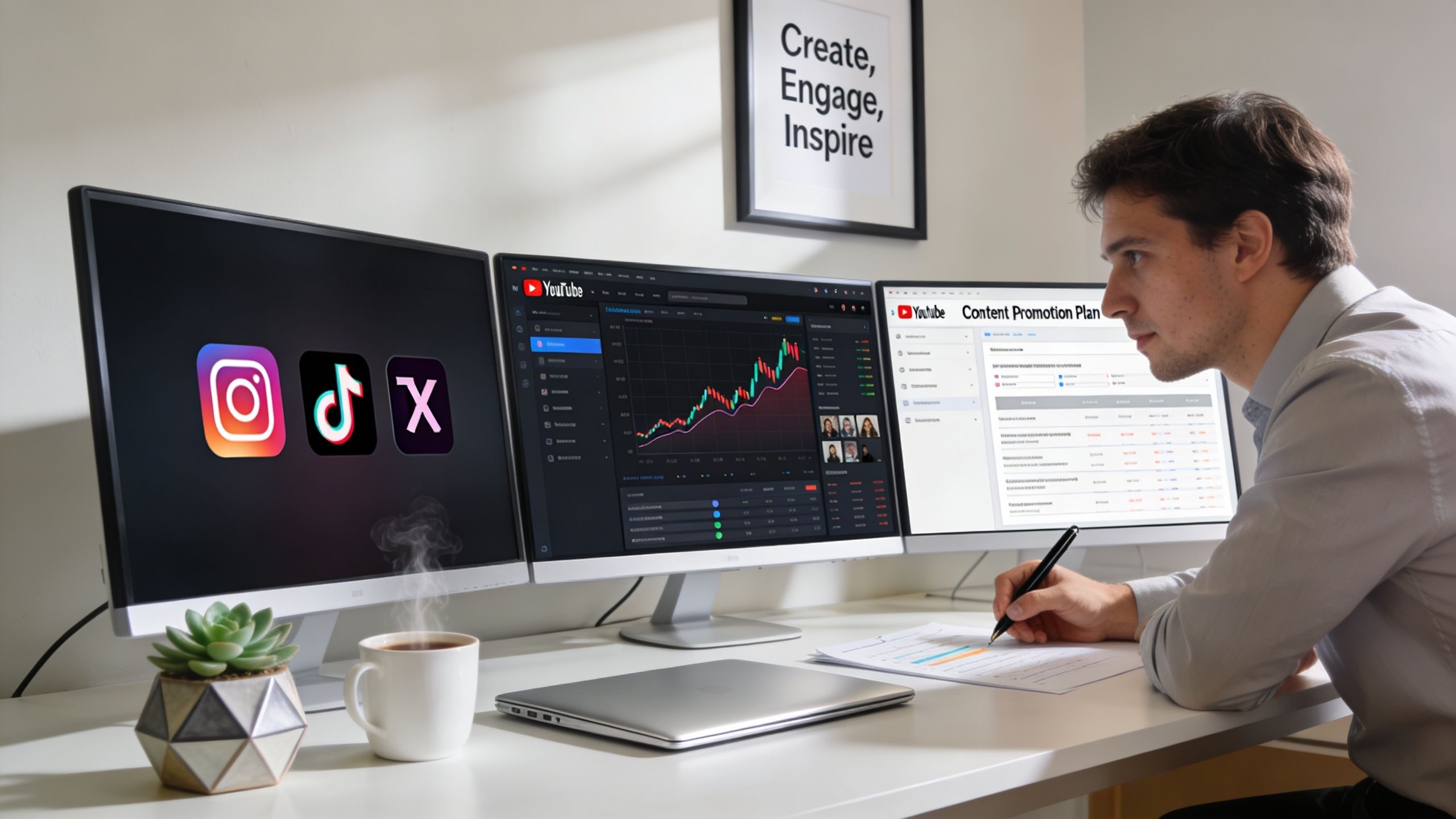
YouTube’s 2025 algorithm update provides an initial visibility boost to new creators. To sustain that momentum, consistent weekly posting matters. Channels that also cross-promote to drive 1,000+ external views in the first 48 hours can see up to 10x growth in impressions, according to this analysis of the YouTube algorithm.
That should shape your behavior immediately. Don’t just publish. Launch.
Turn one video into a distribution burst
Every long-form upload should create a short-term attention spike across multiple surfaces.
That usually includes:
- Shorts from the strongest moments: Pull conflict, surprise, utility, or a clean soundbite.
- Platform-native clips for Instagram and TikTok: Edit for speed and standalone clarity.
- Email or community posts: Give your existing audience a reason to watch early.
- Guest amplification: If another person appears in the content, make sharing easy for them.
This is especially important for podcasters and interview-driven creators. A single conversation can produce clips with different emotional and tactical angles. One might be a hot take. Another might be a practical lesson. Another might be a personal story. Each clip can reach a different segment of your future audience.
If you’re building without showing your face much, this guide for faceless YouTube channel growth is a useful reference because the promotion principles still apply even when the format changes.
The first audience for a video is rarely YouTube alone. It’s your network, your guests, your email list, and your existing social channels.
Read analytics like an operator
The creators who grow fastest don’t stare at dashboards for validation. They look for decisions.
Start with the basics:
- Traffic sources: Where are people finding the video?
- Top videos: Which topics and formats are pulling disproportionate interest?
- Audience retention: Where do viewers stay, and where do they leave?
- Watch time trends: Is the overall pattern improving over time?
- Subscriber movement: Are specific videos attracting the right audience?
These metrics tell you what to repeat, what to fix, and what to stop.
If viewers keep dropping after your intro, your hook is weak. If browse traffic is low but search traffic is strong, your packaging may need stronger curiosity. If one topic clearly outperforms others, build the next cluster around it. You don’t need more opinions. You need clearer pattern recognition.
Build a repeatable growth loop
Success lies in connecting production, promotion, and analytics into one operating rhythm.
A simple growth loop looks like this:
- Publish the long-form video with strong packaging and clear metadata.
- Distribute clips immediately across Shorts and off-platform channels.
- Watch early signals like retention shape, traffic source mix, and click response.
- Extract lessons about topic selection, opening structure, guest chemistry, and visual packaging.
- Feed those lessons into the next recording batch.
That loop turns every upload into both content and research.
For brands and creators who want a more organized approach, a stronger video content marketing strategy matters because random posting doesn’t create compounding momentum. Systems do.
Promotion works best when it’s designed in advance
Most creators treat promotion as a post-upload chore. That’s backward.
The strongest channels plan distribution before the shoot. They know what moments are likely to become clips. They know which quote cards or visual snippets could work on LinkedIn, Instagram, or email. They know whether a guest can help extend reach. And they know what metrics they’ll review after launch.
That planning changes the recording itself. You ask better questions. You leave cleaner pauses for edits. You create stronger transitions. You say things in clip-friendly language. The content becomes easier to market because it was built for distribution from the start.
Operating principle: Don’t publish and hope. Publish, distribute, study, and refine.
Fast YouTube growth comes from that discipline. Not from one big break, but from repeated launches that get sharper each round.
If you’re ready to stop running your channel like a side project and start building it like a serious media brand, Flexwork Podcast Studios is the kind of partner worth knowing. From turnkey studio sessions and Content Days at $3000/day to podcast websites at $5000 plus hosting and the Market, Manage & Produce My Podcast package starting at $1500 per episode with a 20-episode growth commitment, they help creators move faster without sacrificing polish. Book a tour, explore the packages, and build a content engine that can keep up with your ambitions.