
Motion Graphics Animation Service: A Creator’s Guide
 August 25, 202625 Minutes
You've spent months refining the show: the guest chemistry is strong, the edit is tight, and the weekly publishing rhythm finally feels sustainable. Then a new listener finds an episode and sees a static cover, an awkward promo cut, or an intro that feels disconnected from the rest of the brand. The audio may earn attention, but visual consistency earns trust before the first sentence plays.
A motion graphics animation service turns that gap into a repeatable content system. Instead of commissioning isolated animations, you can build a visual language for intros, lower-thirds, quote clips, sponsor bumpers, and social assets. This guide breaks down what studios deliver, how production works, which pricing models make sense, and how Flexwork Studios connects motion graphics with podcast production, studio rentals, Content Day sessions, and podcast websites.
Why Your Show Deserves Better Visuals
A successful podcast can still look unfinished. An independent host might publish thoughtful interviews every week while using a different thumbnail style for every guest, cutting vertical clips without a clear visual hierarchy, and relying on a logo that never appears anywhere except the cover image. The audience experiences the show as a collection of disconnected posts rather than a recognizable media property.
That matters because discovery happens visually. A potential listener may encounter a Reel, a YouTube thumbnail, a sponsor mention, or a guest announcement before hearing the episode itself. If the visual treatment feels improvised, the viewer has less reason to assume the production behind the microphone is disciplined.
Production rule: Audio builds loyalty. Visual systems make that loyalty easier to recognize, share, and sponsor.
The fix isn't to decorate every second with movement. Strong motion graphics clarify structure, identify people, emphasize ideas, and give recurring content a consistent opening and closing rhythm. A clean guest name animation can make an interview clip feel finished. A restrained quote treatment can turn a strong observation into an asset that works on Instagram, LinkedIn, and a podcast website.
Start with the static foundation. Your podcast cover art design should establish the typography, color logic, image treatment, and spacing rules that motion designers will carry into video. Once those rules exist, animation becomes a natural extension of the brand rather than a collection of attractive effects.
The most useful question isn't, “Can you make this look exciting?” Ask instead, “What should the viewer understand, remember, or do because this element moves?” That question separates a production asset from visual noise.
What Motion Graphics Really Means
Motion graphics is graphic design choreographed over time. It animates typography, icons, shapes, logos, and compositions so the viewer's eye follows a message in a deliberate order. It's different from character-led animation because the central task is usually communication, identity, or information rather than a narrative built around animated characters.
Static design answers, “What does this look like?” Motion design answers, “How does it enter, behave, transition, and leave?” A logo can resolve from separate shapes. A guest's name can slide into a lower-third while the camera remains on the interview. A key phrase can build word by word as the host delivers it.
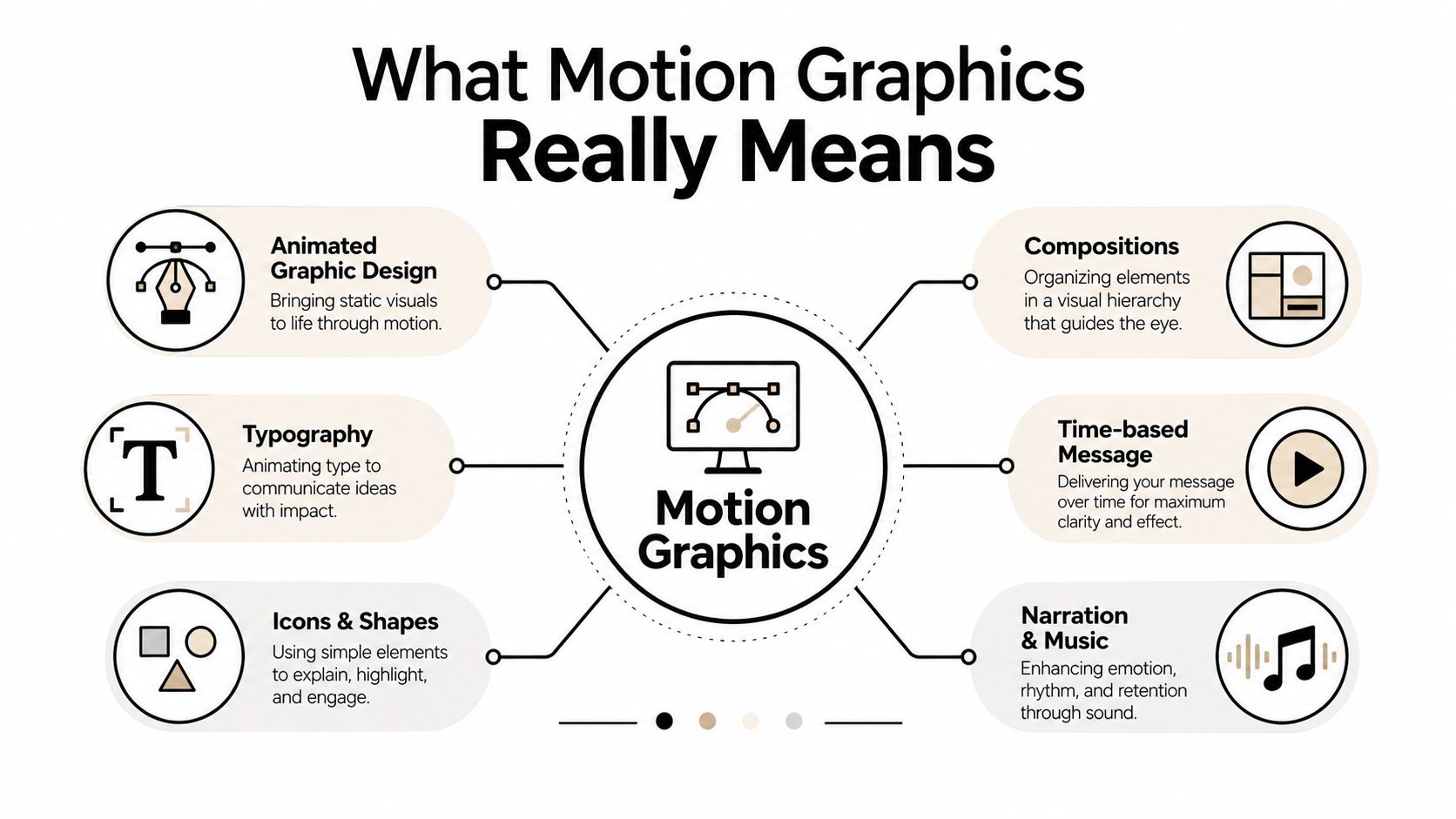
Studios usually build these elements as a motion system. The system defines how titles enter, how long they remain readable, how transitions behave, and how brand colors interact with footage. That approach lets a show introduce a new guest without inventing a new visual treatment every week.
The difference between design and movement
A static quote card can identify a useful idea. Kinetic typography can control the order in which the viewer reads it, match emphasis to the speaker's delivery, and create a stronger short-form edit. Neither approach is automatically better. The right choice depends on whether movement improves comprehension or merely adds activity.
Format also matters. A comparative study reported average load times of 4.58 ms for Lottie, 6.62 ms for JSON, 15.10 ms for GIF, and 95.53 ms for MP4, making lightweight vector or data-driven animation attractive for web interfaces and embedded experiences. The comparison of animation loading performance is useful when a podcast website needs responsive loops rather than full video playback.
For creators comparing automated options with a studio workflow, it's sensible to compare AI motion graphics tools, then judge the output against your brand rules, not just the speed of the first draft. Flexwork's practical motion graphics creation guide also shows why asset preparation and timing decisions matter as much as the final render.
Core Deliverables You Should Expect
A serious motion graphics animation service sells a reusable kit, not a single attractive clip. The kit should support the way your show publishes, from full episodes to short vertical excerpts and sponsor placements.
The assets that carry the most weight
An animated logo or stinger gives the show a recognizable bookend. It might appear at the start of an episode, at the end of a trailer, or between major segments. The best version is short, legible, and flexible enough to work over a clean background or edited footage.
Lower-thirds identify hosts, guests, roles, and companies without forcing the audience to search for context. A well-built system keeps names, titles, colors, and animation behavior consistent across every interview.
Kinetic typography gives spoken ideas a visual shape. A strong guest quote can become a Reel with emphasis words, line breaks, and pacing designed for silent viewing. Transition packs and segment dividers create structure, but they shouldn't turn every edit into a showcase of wipes and effects.
| Deliverable | Typical Duration | Where It Appears |
|---|---|---|
| Animated logo or stinger | Short opening or closing beat | Episode intros, trailers, sponsor packages |
| Lower-third system | Brief identification sequence | Interviews, YouTube episodes, livestreams |
| Kinetic quote treatment | Short excerpt sequence | Reels, TikTok, Shorts, LinkedIn clips |
| Segment divider | Short chapter marker | Long-form episodes and recap edits |
| Social promo template | Adaptable short-form asset | Vertical and square social posts |
| Waveform or cover loop | Repeating visual treatment | Podcast feeds, websites, audio promos |
The technical handoff matters as much as the animation. Ask for rendered masters plus modular templates, editable source files, font information, color references, and usage notes. A template that only the original animator can operate isn't a system. It's a dependency.
Build for the next episode
Your lower-third should work for the next guest, not just the current one. Your quote template should accommodate a short statement and a longer passage without destroying hierarchy. Your social package should be designed for the formats your editor will publish.
That's where motion and post-production need to meet. Flexwork's video podcast editing service is relevant when the same team must apply the motion kit repeatedly across edited interviews, social cutdowns, and episode deliverables.
The Production Process From Brief to Final Cut
Good motion work feels smooth because the production team resolves difficult decisions early. The process usually starts with a creative brief covering the show's audience, tone, platform requirements, existing brand assets, references, and intended use. The client should also clarify whether the studio handles scriptwriting, voiceover casting, music licensing, and final distribution.
From concept to approved direction
Styleframes come next. These are still images showing how the finished motion language might look before anyone animates it. A storyboard or animatic then tests sequence, timing, and screen direction. That stage is where the client should approve the visual idea, not after a full animation has already consumed production time.
Asset preparation follows. Designers organize logos, typography, icons, footage, and illustrations so the animator can work without rebuilding the brand from scattered files. After Effects is common for two-dimensional motion and compositing, while Cinema 4D supports more involved three-dimensional work. Figma-driven workflows can be useful when the project closely follows interface design or product screens.

Where the client should focus
The studio owns creative development, asset preparation, animation, sound design, internal quality control, and delivery preparation. The client owns the brand inputs, factual accuracy, consolidated feedback, and approvals.
A practical review sequence looks like this:
- Approve the direction: Sign off on styleframes before animation begins.
- Lock the timing: Review the animatic or rough timing before detailed polish.
- Consolidate feedback: Send one clear revision list through one decision-maker.
- Check every format: Review wide, square, and vertical exports where applicable.
- Approve the handoff: Confirm source files, rendered masters, fonts, and usage guidance.
Two or three revision rounds are often built into professional scopes, but the exact number must appear in the agreement. A sixty-second explainer may take multiple weeks, while a branded package spanning several episodes requires a broader schedule. Don't accept a timeline until the team has confirmed script status, voiceover, music, footage, feedback windows, and delivery formats.
Teams using automation should still protect the review stages. Resources that explain how to scale product video production with AI can help with throughput, but automation doesn't replace art direction, brand judgment, or factual review. Flexwork's video production workflow is the kind of operational reference worth examining before you approve a recurring package.
Pricing Models and What They Actually Buy You
Motion graphics pricing becomes easier to judge when you identify the buying unit. You might be purchasing one finished animation, a library of reusable elements, reserved monthly capacity, or specialist time for revisions. Those are different products, even when a vendor describes them with the same phrase.
The requested pricing ranges for this market include $1,500 to $8,000 per project, $150 to $500 per asset, monthly retainers of $3,000 to $12,000, and hourly work at $75 to $200. Those figures are useful planning references, but the quote should still connect each fee to a defined scope.
| Pricing Model | Typical Range | Best For |
|---|---|---|
| Per project | $1,500 to $8,000 | One-off intros, trailers, or launch packages |
| Per asset | $150 to $500 | Lower-thirds, title cards, and modular elements |
| Monthly retainer | $3,000 to $12,000 | Recurring promos, cutdowns, and sponsor assets |
| Hourly | $75 to $200 | Small changes, overflow, and technical revisions |
Match the model to your publishing rhythm
Per-project pricing suits a new show building its visual foundation. You'll know what you're buying, and you won't commit to a recurring volume before the production rhythm is proven. The weakness is repeated bidding. Every new request can restart the scope conversation.
Per-asset pricing works for a defined list of lower-thirds, quote treatments, or transitions. Ask whether the fee includes concept development, revisions, source files, and alternate aspect ratios. A low unit price can become expensive when every variation is treated as a separate deliverable.
Retainers make sense when a show produces regular episodes and promotional content. They reserve capacity and can reduce the friction of repeated briefs, but they're wasteful if you don't have a dependable stream of assets. Hourly work belongs to small changes and overflow, not to a brand system that should have been planned upfront.
For early budgeting, a video budget planning tool can help organize production categories. Flexwork's New York City video production services are another relevant option for creators who want motion graphics considered alongside filming, editing, and distribution rather than priced as an isolated afterthought.
Use Cases for Podcasts and Video Content
Motion earns its place when it solves a recurring content problem. A podcast has many of them. The audience needs to identify the show quickly, understand who is speaking, follow the structure of a long interview, and find the strongest ideas in a crowded short-form feed.
An animated logo can replace a static title card and give each episode a recognizable entry point. Keep it restrained. A long opening sequence delays the content people came to hear, while a compact stinger can establish identity without competing with the host.
Lower-thirds are more valuable in video interviews than many creators realize. They identify a guest when a clip is separated from the full episode, which matters when someone encounters the excerpt on YouTube or LinkedIn without previous context. A consistent name treatment also makes a multi-guest season feel like one publication.
Turn conversations into a visual library
The strongest podcast motion systems support several layers of output:
- Episode identity: Animated intros, outros, segment markers, and cover loops.
- Guest clarity: Lower-thirds, credentials, company identifiers, and pronunciation notes where needed.
- Idea extraction: Kinetic typography for memorable lines, definitions, comparisons, and practical advice.
- Promotion: Episode trailers, sponsor bumpers, launch announcements, and recap sequences.
- Brand continuity: Matching motion rules across video thumbnails, newsletter graphics, and the podcast website.
A transcript makes this system more useful because the editor can locate quotable moments and convert them into designed clips. Podcast SEO also depends on text-based assets. A practical podcast SEO workflow recommends stable episode pages, optimized titles, full transcripts, episode metadata, and PodcastEpisode structured data.
Your website should act as the controlled home base for those assets. It can hold transcripts, guest links, sponsor information, email capture, merchandise links, and embedded episodes instead of forcing every audience relationship through a social platform. The guidance on why podcast websites remain relevant reinforces that ownership matters, while podcast website strategy shows how one destination can support discovery and retention.
Short-form motion should also reflect the platform. One 2026 social-content article reports that short-form video generates 2.5x more engagement than long-form content. The analysis of animated social media content supports treating animated cutdowns as a planned publishing stream, not leftover material from the main edit.
How to Evaluate Vendors Without Getting Burned
Price is a poor shortcut for judging a motion graphics animation service. A cheap quote can exclude source files, alternate formats, sound design, revisions, or the time required to adapt the system for new episodes. A higher quote can also be wasteful if the vendor is selling decorative effects instead of useful assets.
Treat the shortlist like a casting call. Ask each vendor to show work that resembles your actual needs, not only cinematic reels. You should see intros, lower-thirds, animated logos, quote treatments, explainers, and social exports in a quality level that matches your recording setup.
The questions that expose weak production
Use the first call to establish operational facts:
- Scope: How many deliverables are included, and what counts as a revision?
- Ownership: Will you receive editable source files and organized project assets?
- Formats: Are horizontal, square, vertical, transparent, and caption-safe versions included?
- Process: Who approves styleframes, animatics, and final renders?
- Capacity: Can the team support recurring episode and promo output?
- Communication: Will one producer manage reviews, deadlines, and issue resolution?
- Recovery: What happens when footage arrives late, a script changes, or an export fails?
The last question should be more direct than most buyers expect. Ask the vendor to describe a project that went sideways and explain how the team recovered. Strong production partners can discuss missed assumptions, revised scopes, technical problems, and communication without hiding behind polished language.

Vendor test: If a studio can't explain its revision policy, file handoff, and recovery process before the contract, it won't become clearer after the invoice.
Also verify who does the work. Some shops keep strategy in-house and pass production through a changing chain of contractors. That model can function, but it creates more points where your visual rules can drift. A single producer, shared review board, and documented style guide usually create a cleaner relationship than scattered email threads.
Bringing It All Together With Flexwork Studios
Motion graphics becomes more valuable when it sits inside the same production system as recording, editing, branding, and distribution. A show shouldn't need one vendor for filming, another for lower-thirds, a third for social cutdowns, and a fourth for website updates if those handoffs create inconsistency and delay.
Flexwork Podcast Studios offers studio rentals, podcast production packages, Content Day sessions, podcast websites, editing, motion graphics, animation, and show branding from its Springfield, New Jersey production hub. For a creator, the practical benefit is coordination. The same visual rules can carry from a filmed episode into a Reel, a sponsor bumper, a website episode page, and a newsletter asset.
The service structure can support different stages of growth:
- Launch work: Establish the logo animation, lower-third system, title cards, and social templates.
- Recurring production: Apply those assets to weekly episodes, guest clips, trailers, and sponsor placements.
- Content Day output: Capture a concentrated batch of material, then turn it into edited and animated short-form assets.
- Growth support: Pair production with podcast websites, distribution, and audience-focused marketing.
Content Days are priced at $3000 per day and include 20 edited reels or 60 professional photos, according to the stated service offering. Podcast websites are $5000 plus hosting, while the Market & Manage tier starts at $1500 per episode with a 20-episode growth commitment. Those offerings solve different problems, so don't buy a larger package unless your publishing plan can use the output.
The broader market supports this shift toward recurring production. The motion graphics market is estimated at about US$110.0 billion in 2026 and projected to reach US$230.0 billion by 2033, implying an 11.1% CAGR across that forecast period, according to Persistence Market Research's motion graphics market outlook. A separate animation-market compilation places the broader animation industry at US$436.24 billion in 2024, with a projection of US$895.71 billion by 2034 at a 7.46% CAGR, and identifies 3D animation as 44.16% of global share in 2024. The animation market analysis published by GlobeNewswire places North America at 33.97% of the global animation market in 2024.
The strategic conclusion is simple. Buy a motion system that your team can reuse, then connect it to the filming and publishing rhythm that keeps the show visible.
Flexwork Podcast Studios combines professional studio rentals, podcast production packages, Content Day sessions, editing, motion graphics, animation, and podcast websites for creators building a consistent media brand. Visit Flexwork Podcast Studios to explore the right production package, book a studio session, or start a conversation about turning your next recording into a complete library of branded visual content.