

How to Start a Business Podcast: The 2026 Growth Guide
 May 15, 202628 Minutes
Meta title: How to Start a Business Podcast
Meta description: Learn how to start a business podcast built for ROI, authority, and growth with a smarter launch plan and professional production support.
URL slug: /how-to-start-a-business-podcast
Primary keyword: how to start a business podcast
Secondary keywords: business podcast launch, podcast production for businesses, branded podcast strategy
You've been thinking about starting a business podcast for months.
You know the upside. A great show can sharpen your authority, open doors to better conversations, and give your brand a voice people choose to spend time with. But then reality hits. You need a concept, a format, a recording setup, a publishing workflow, short-form clips, guest coordination, and something that doesn't look or sound like a rushed side project.
That's where most founders stall. They don't lack ambition. They lack a clean path from idea to polished execution. If you're serious about how to start a business podcast, treat it like a brand asset from day one. That means clear positioning, consistent production, and a show built to support real business goals. Before you touch a microphone, get your brand fundamentals straight with this guide on how to brand your business.
Introduction Your Podcast as a Brand Asset
A business podcast isn't content for content's sake. It's a reputation engine.
The founder who wins with podcasting usually isn't the one with the most gear or the loudest launch. It's the one who understands what the show is supposed to do. Build trust. Deepen authority. Create better conversations with customers, peers, and industry voices. Support sales without sounding like a sales pitch.
That distinction matters because podcasting is crowded. By May 2022, there were nearly 2.9 million podcasts in production, according to Listen Notes, and Statista projected podcast listeners would surpass 160 million in 2023 after growing by roughly 20 million listeners per year. Statista also reported that in 2022, 62% of the U.S. population age 12+ had listened to a podcast, 38% were monthly listeners, and 28% were weekly listeners in this podcasting for businesses overview.
So yes, there's demand. There's also noise.
Practical rule: Don't launch a podcast because podcasts are popular. Launch because you have a sharp point of view and a specific audience worth serving.
If your show feels broad, generic, or improvised, people will hear that immediately. If it feels intentional, clean, and well-produced, they'll connect your voice with competence.
Your Podcast Blueprint Before You Press Record
A founder blocks out a Saturday, buys a mic, records a pilot, and realizes halfway through that the show has no clear audience, no repeatable structure, and no business purpose. That launch was already in trouble before the record light turned on.
The planning stage decides whether your podcast becomes a brand asset or another abandoned side project. If you want authority, leads, and strong guests, build the show on strategy first. Gear comes later.
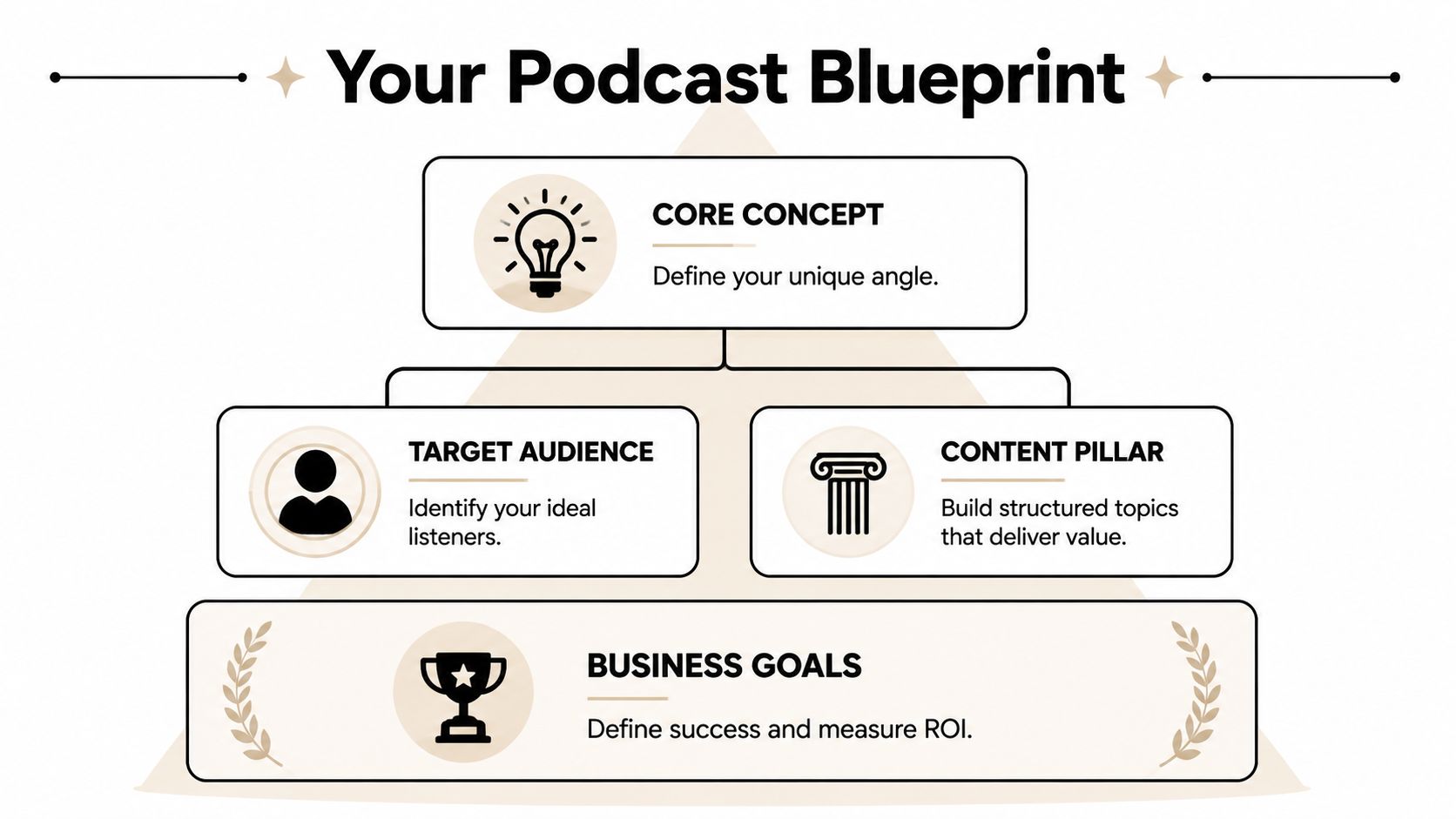
Choose a position your market can recognize
Broad business podcasts disappear fast. The title sounds generic. The promise is vague. The episodes drift.
Pick a lane your company has earned the right to own. That usually sits at the intersection of three things: your expertise, your buyer's problems, and the conversations that support revenue. A founder serving SaaS executives should not publish a show that could just as easily belong to a life coach, agency owner, or career influencer.
Use a simple test. If a qualified stranger sees your show name and episode titles, they should know who it serves, what problem it addresses, and why your perspective is worth their time.
Sharp positioning also makes the rest of your content operation easier. The same principle shows up in these real-world content strategies from Raven SEO, where focused themes produce stronger results than scattered publishing.
Define the listener with buying intent in mind
Listener avatars filled with hobbies and personality traits are not enough. Build for the audience that matters to your business.
Ask better questions:
- What pressure is this person under right now?
- What decision are they trying to make?
- What level of expertise do they already have?
- What would make them trust your brand after one episode?
Format follows audience. A senior operator wants clarity, examples, and sharp editing. A founder evaluating service partners wants judgment, pattern recognition, and proof that you understand expensive problems. A premium podcast should sound like it respects the listener's calendar.
Pick a format that supports consistency and authority
Your format should serve the show's goal, not your ego.
Interview shows are useful for relationships and borrowed authority, but they depend on guest quality and scheduling discipline. Solo episodes give you direct control and stronger thought leadership, but only if you can teach with structure. A hybrid model is usually the right call for business owners because it gives you reliability, variety, and room to respond to timely topics without waiting on a guest.
Keep the format tight enough to repeat without friction. If you want examples, study different podcasting genres and formats and choose one you can sustain for a full year, not just a launch month.
Episode length should match listener behavior. Busy professionals will give you 20 to 30 strong minutes more often than they will give you 55 unfocused ones.
Build content pillars before you build episodes
Founders often start with topic ideas. Start with pillars.
Content pillars create editorial discipline. They stop the show from drifting into random interviews and recycled opinions. They also make guest selection easier because you know what kinds of conversations fit the brand.
A strong business podcast usually runs on three to five pillars. For example:
- industry trends and commentary
- operator lessons and case studies
- buyer questions and objections
- founder perspective and decision-making
- practical tactics your audience can apply
Those pillars should connect directly to your commercial goals. If they do not help attract the right audience, strengthen authority, or support sales conversations, cut them.
Plan the first run of episodes before launch
Do not launch with one polished pilot and a vague idea of what comes next. Build an opening slate.
Map at least the first 8 to 10 episodes before publishing anything. That process exposes weak ideas early, shows whether your pillars have range, and gives your production team enough visibility to create a cleaner release schedule. It also helps you spot balance. You do not want ten episodes that all answer the same question in slightly different ways.
Your pre-production plan should include:
- your show promise in one sentence
- three to five content pillars
- a list of episode concepts tied to each pillar
- target guests for the first stretch of production
- a realistic publishing cadence
- clear business outcomes, such as relationship-building, lead generation, or category authority
Serious founders separate from hobbyists in this phase. A professional studio can pressure-test this blueprint before a single recording session, which saves time, protects your brand, and keeps the show aligned with ROI from day one.
Pre-production is not admin work. It is brand strategy with a microphone attached.
The Production Crossroads DIY vs Professional Studio
A founder records three episodes at home, spends two late nights fixing audio, scraps half the video because the lighting looks off, and delays the launch again. The problem was never the idea. The problem was choosing a production setup that could not support the standard the brand needed.
That decision matters more than new hosts expect.
DIY podcasting looks inexpensive at the start. The actual cost shows up in wasted founder time, inconsistent quality, repeated setup issues, and episodes that are technically finished but not strong enough to publish with confidence. If your show is supposed to build authority and create business opportunities, that trade is poor from the start.
What DIY actually puts on your plate
Running your own setup means handling every layer of production pressure yourself.
You are booking the recording, checking the room, monitoring sound, framing the shot, catching guest issues, organizing files, managing edits, reviewing exports, and solving small technical problems that keep stealing attention from the conversation. That workload does not make you more strategic. It pulls you away from the work only you can do.
A simple comparison makes the choice clear:
- DIY setup: lower upfront spend, higher friction, slower output, uneven presentation
- Professional studio: reliable capture, stronger audio and video, faster turnaround, better consistency
- Producer-led support: the strongest option if your goal is authority, efficiency, and a show you can keep publishing without draining internal time
Production quality shapes brand authority
Business podcasts are judged as brand assets, not side projects.
Prospects notice poor sound. Guests notice disorganized sessions. Buyers notice when the visuals, edits, and host delivery feel improvised. None of that reads as resourceful. It reads as low-standard.
Production quality signals how seriously you take your company. A polished show makes your brand feel credible before a listener acts on a single idea. It also gives your team more usable content, because clean recordings produce stronger clips, better social assets, and fewer compromises in post-production. If you want a direct breakdown of the tradeoffs, read what you gain by choosing a professional studio over DIY podcasting.
If the show is meant to support revenue and reputation, amateur production weakens the result before the first episode is released.
Choose the setup that matches the outcome
Professional support makes sense fast if your podcast has a real business job to do.
Use a studio or producer-led team if any of these apply:
- Your audience includes buyers, investors, or referral partners
- You want video episodes and short-form clips
- You need a consistent publishing process
- Your calendar cannot absorb technical work
- Your brand positioning depends on polish
Founders building premium brands should stop asking how to launch as cheaply as possible. Ask which setup gives the show the best chance to become a credible, repeatable business asset.
For a serious business podcast, that answer is rarely DIY.
The Flexwork Advantage Your Turnkey Production Partner
Two founders can start with the same idea and end up with very different shows.
The first founder wants a podcast that looks polished, sounds clean, and reflects the quality of the brand. That person doesn't need a hobby setup. They need a team that can capture the episode properly, shape it into something watchable, and keep the brand presentation consistent across platforms.
The second founder wants all of that, plus growth infrastructure. They want the show to support pipeline, guest relationships, distribution, and ongoing promotion. That's a different level of operation.

One path is polish
If your main problem is execution, a producer-led setup makes sense.
Creator-focused support, such as a “Be My Podcast Producer” style engagement, becomes valuable in this context. You show up prepared. The production team handles capture, sound, visuals, editing flow, and the details that separate a serious show from a DIY experiment. You don't waste momentum learning every tool. You stay in your lane and deliver the message.
That model works especially well for consultants, founders, agency leaders, and professionals building authority in a niche market.
One practical option for this kind of recording and production support is Flexwork Podcast Studios, which offers turnkey studio production, acoustically treated recording spaces, and support for audio, video, and short-form content capture.
Another path is growth operations
Some hosts need more than production. They need a content engine.
That's where a managed service model matters. A package like Market, Manage & Produce My Podcast is built for businesses that want the podcast tied to audience growth and demand generation. The author's brief specifies that this tier starts at $1500 per episode with a 20-episode growth commitment. That pricing makes sense when the podcast isn't treated as a side project, but as a recurring marketing asset with strategic oversight.
Here's the difference in mindset:
| Need | Producer-focused support | Market and manage support |
|---|---|---|
| Recording quality | Yes | Yes |
| Editing and polish | Yes | Yes |
| Distribution help | Often | Yes |
| Growth strategy | Limited | Central |
| Demand generation focus | Light | Strong |
If your company wants a podcast that contributes to business development, managed support is usually the better fit.
Content Days change the economics of launch
The most efficient founders batch.
Instead of squeezing one episode into a chaotic week, they stack production and leave with multiple assets. That's why Content Days at $3000/day, including 20 edited reels or 60 pro photos, are so useful for new show launches. One intensive shoot can give you launch episodes, social clips, promo assets, and visual brand material without dragging production across a month of half-finished tasks.
That kind of day is especially effective when you're launching a video-first business podcast, filming brand intros, and building your first month of promotional content at once.
Premium production isn't about vanity. It's about removing friction so the show actually ships and keeps shipping.
There's a huge difference between spending money on gear and investing in a workflow that keeps your show alive.
Crafting and Launching Your First Episodes
A founder records a strong conversation, posts it once, and then watches it disappear because the episode had no structure, no visual plan, and no launch assets behind it.
Avoid that mistake. Your first episodes need to prove that your show deserves attention and that your brand belongs in a premium lane.

Use a repeatable episode structure
Early episodes win on clarity.
Use a format you can repeat without sounding mechanical:
Cold open
Lead with the sharpest insight, tension point, or result. Earn attention in the first 30 seconds.Brief host setup
State the topic, who it helps, and why the listener should stay.Main segment
Organize the conversation in a clear sequence. Problem, decision, lesson, application.Close
End with one memorable takeaway and one direct next step.
For solo episodes, work from a tight outline. For interviews, guide the guest toward a business outcome, not a life story. If your delivery needs more discipline, use this guide on how to write a podcast script.
Direct the session like a production, not a casual chat
Strong episodes are shaped before the cameras roll.
Set the purpose of the episode in one sentence. Send guests a short prep sheet with timing, talking points, wardrobe notes, and the questions you care about most. Choose the call to action before you record so the conversation can support it naturally.
Audio branding matters too, but keep it restrained. Review these background tracks for podcasters if you want music that supports the show without distracting from the message.
Protect your own energy. Don't record between back-to-back meetings and expect premium results.
Record for distribution, not just for the podcast feed
Your first episodes should produce more than one full-length file.
Plan every session so it can supply the full episode, platform clips, guest share assets, and short-form video for LinkedIn, YouTube, and Instagram. That means using clean framing, consistent lighting, natural eye lines, and deliberate pauses that make editing faster. It also means speaking in complete thoughts so strong moments can stand alone outside the full episode.
This is one reason serious business podcasts benefit from a studio partner early. A professional setup gives you footage and audio that can carry your brand across every channel from day one.
A strong launch also benefits from seeing how other creators handle on-camera communication and pacing.
Batch your launch assets in one go
Publishing one polished episode is not enough. You need repeated visibility in the first few weeks.
Use your launch sessions to batch the assets that keep attention on the show after release:
- Trailer clips: Short pieces that explain the promise of the podcast
- Founder videos: Clear statements about who the show serves and why it exists
- Guest soundbites: Moments guests will want to repost
- Visual assets: Photos for your site, social profiles, landing pages, and episode art support
A Content Day proves its worth. At $3000/day, with 20 edited reels or 60 pro photos, it turns one recording block into a launch package with real range. You leave with episodes, promotional clips, and branded visuals that support authority instead of forcing you back into scramble mode after every publish date.
Strong launches are built on a stack of ready-to-publish assets, not one episode and a hope that people notice.
Growing Your Show and Measuring Real Business Impact
A business podcast starts paying off when it drives conversations with the right people. Downloads matter, but they are not the main event. Brand authority, qualified demand, strategic relationships, and sales momentum are.
Many founders miss this and end up producing a respectable show with no business direction. Fix that early. Decide what the podcast is supposed to do for the company, then build the format, guest list, calls to action, and distribution around that goal.
Tie the show to business outcomes
A serious B2B podcast should support pipeline, positioning, and partnerships. Analysts at CXL make that case clearly in this guide to business podcast strategy, pointing to lead generation, relationship-building, CTAs, landing pages, and guest planning as core parts of a revenue-minded show.
That standard should shape every editorial decision.
Do not book guests because they seem interesting in the abstract. Book guests who put you in the right rooms. Choose people who reach your buyers, strengthen your authority, sharpen your category position, or create a reason for a valuable relationship to start. A premium business podcast is not a random interview series. It is a business development channel with media attached.
Your CTA should reflect that. Invite listeners to a focused next step, not a vague “follow along” ask. Send them to a specific page, offer, waitlist, consultation, or resource that matches the topic of the episode.
Track signals that matter
The KPI set should be tight and useful.
Start with a handful of indicators that connect attention to action:
- Landing page visits from episode links: Measures intent from listeners who want more.
- Inbound inquiries that mention the podcast: Shows influence on buying decisions.
- Guest relationships that turn into meetings or referrals: Shows network value.
- Email signups tied to episode CTAs: Shows conversion from audience to owned attention.
- Traffic to your show hub or company site: Shows cumulative discovery over time.
If your team also distributes clips across social channels, use a framework that helps you calculate social media returns so promotion is judged by business impact, not just views.
Build infrastructure around the show
A premium podcast needs a destination you control. That usually means a dedicated show hub or podcast website with episode pages, guest profiles, calls to action, and clear paths into your business.
A dedicated podcast website, which can be a key part of that infrastructure, often represents an investment starting around $5000 plus hosting. Treated properly, that is not a design extra. It is part of the conversion system. It gives your audience one place to listen, explore, subscribe, and take the next step.
Pair that with a managed production and growth system, and the show stops behaving like a side project.
| Layer | Purpose |
|---|---|
| Podcast episodes | Build trust and authority |
| Short-form clips | Drive discovery and sharing |
| Landing pages and website | Capture attention and convert intent |
| Guest strategy | Expand network and relevance |
| Managed promotion | Keep the show visible consistently |
If you are investing $1500 per episode in a managed growth commitment, expect measurable business value. The show should support awareness, relationships, and business development with a clear reporting rhythm behind it.
A business podcast should create conversations that lead to meetings, referrals, subscribers, partners, and clients.
If it only gives you more content to post, the strategy is too weak.
If you want a sharper, more professional path to launching your show, book a tour or start a conversation with Flexwork Podcast Studios. A strong business podcast starts with clear strategy, disciplined production, and a setup built to support authority from the first episode.