
Top Podcast Management Services for NY & NJ Creators
 May 17, 202623 Minutes
Meta description: Podcast management services help creators fix quality, growth, and time bottlenecks. Learn what to buy and when to upgrade in NY and NJ.
URL slug: /podcast-management-services-ny-nj
Primary keyword: podcast management services
Secondary keywords: podcast production company, podcast producer near me, podcast studio New Jersey
You're good on mic. Your ideas are strong. Guests keep saying, “That was great, when does it go live?” Then the actual work starts. Editing at midnight. Chasing cover art updates. Uploading files across platforms. Rewriting show notes because the first version sounds flat. By the time the episode is out, you're already behind on the next one.
That's the point where a podcast stops feeling like a creative outlet and starts exposing your operating limits.
A lot of talented hosts stay stuck there for too long. They assume podcast management services are a luxury add-on. They're not. They're the system that turns a promising show into a credible media asset. If you're building a brand, selling expertise, or trying to own a lane in your market, polished execution matters as much as your voice. If you need a sharper content foundation before you scale, this piece on creating compelling content that captivates your audience is a smart place to start.
From Passion Project to Polished Production
A common story goes like this. A founder launches a podcast to build authority. The first few episodes are exciting. Friends share them. Guests say yes. Then the workload multiplies.
Audio sounds different every week. Clips don't get posted consistently. Publishing slips from Tuesday to Friday to “sometime next week.” Nothing is broken, exactly. But nothing feels tight either.
That's usually not a motivation problem. It's a management problem.
Practical rule: If your show depends on your personal hustle for every episode to ship, you don't have a media system yet.
Professional podcast management services solve that gap. They bring structure to planning, recording, editing, publishing, and performance review. More important, they remove the friction that keeps strong shows looking smaller than they are.
For ambitious creators in the NY and NJ market, the shift isn't from amateur to celebrity. It's from scattered to intentional. That's the level where better guests say yes, brand partnerships start making sense, and your content begins to compound instead of disappear.
What Are Podcast Management Services Really
Many creators define podcast management too narrowly. They assume it only involves editing the audio and uploading the file. In reality, that is merely one slice of the job.
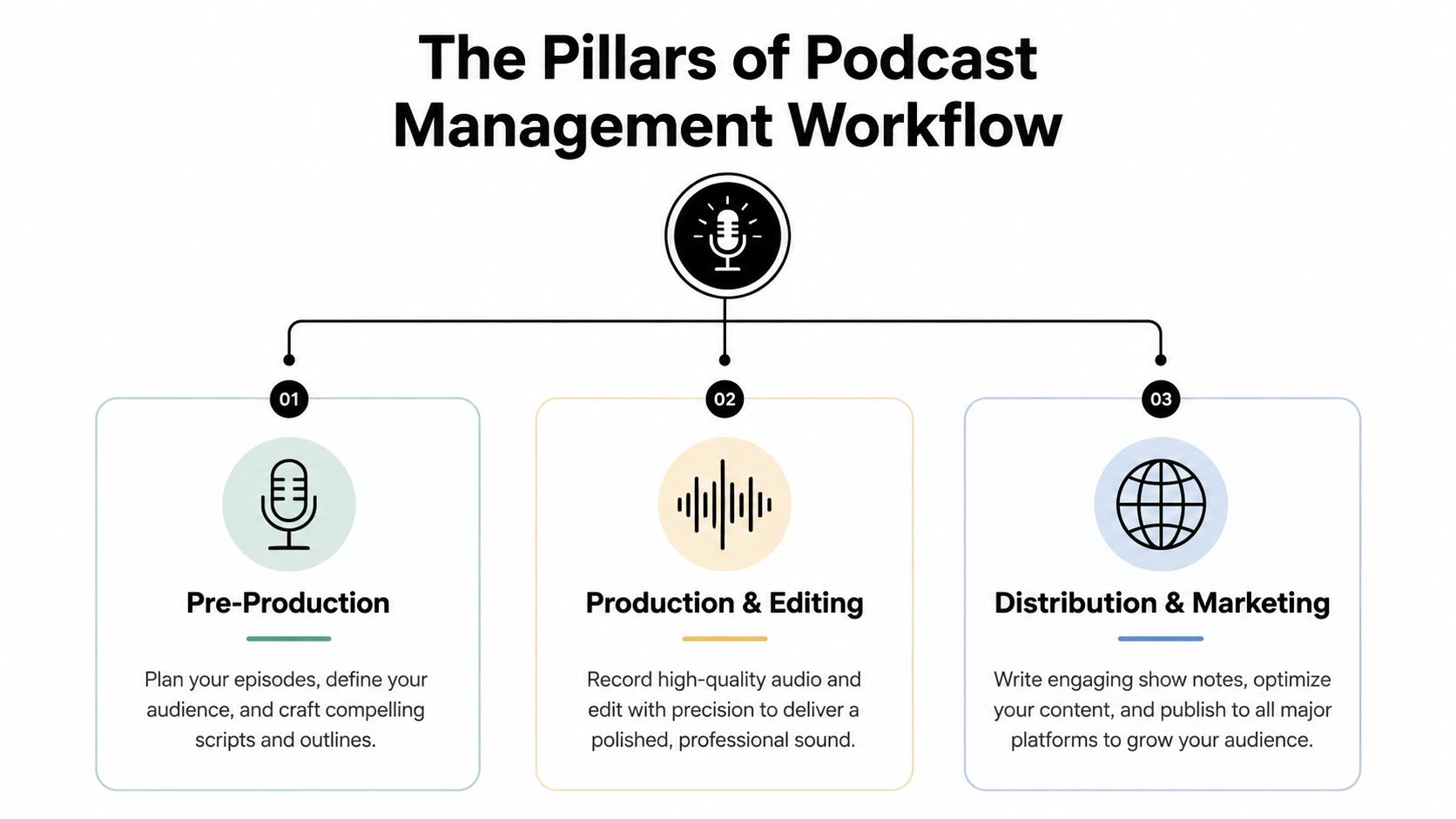
Real podcast management services cover the full operating chain. That includes planning the show, capturing it cleanly, shaping it into something people want to finish, and getting it distributed in a way that's consistent and measurable.
Pre production sets the ceiling
If the planning is weak, the edit can't save the episode.
Pre-production includes show positioning, episode planning, guest coordination, scripting support, run-of-show prep, and asset organization. A smart team uses this stage to decide what the episode is trying to do. Is it building authority, generating leads, deepening community, or creating short-form content opportunities?
A strong manager also protects the host from avoidable chaos. That means confirming guests, collecting headshots and bios, aligning talking points, and keeping the conversation on-brand without making it stiff.
Production and editing shape the experience
Listeners decide here whether you sound credible.
Professional management typically includes multitrack editing, noise cleanup, EQ, compression, limiting, and loudness normalization. According to Rise25's breakdown of production workflows, polished shows are often mastered to common playback targets such as about -16 LUFS for major platforms like Spotify and Apple Podcasts, and poor loudness consistency can increase listener drop-off because the show feels less professional. The same workflow also covers RSS feed management and directory submissions so publishing doesn't turn into a manual mess across platforms, as outlined in this production services breakdown from Rise25.
That technical work matters even more when the podcast also feeds a video strategy. One recording session can become a full content stack if the team knows how to cut for different formats. If you want a sharper sense of what that repurposing process looks like, this guide on podcast clipping for startup founders is worth reading.
For creators comparing local options, a podcast production company near you should be able to explain its workflow in plain language, not hide behind vague promises about “full service.”
Distribution and post launch make the show real
A podcast that isn't distributed reliably is just a folder of unfinished work.
Post-launch management includes show notes, title optimization, publishing cadence, platform delivery, clip scheduling, and performance tracking. It's operational, but it's also strategic. A clean distribution system keeps your show consistent. Consistency is what audiences trust.
Here's the practical checklist of what “management” should include before you sign anything:
- Planning support: episode concepts, outlines, guest prep, and scheduling
- Technical production: recording oversight, audio cleanup, mixing, and mastering
- Publishing operations: RSS handling, platform submission, metadata, and release scheduling
- Content repurposing: social clips, video edits, thumbnails, graphics, and short-form assets
- Performance review: analytics interpretation and recommendations for future episodes
If a provider only edits the file and sends you a download link, that's not management. That's outsourced labor.
The True ROI of Professional Podcast Management
The biggest mistake creators make is measuring podcast management by one question. “Will this get me more downloads?” That's too small.
To get the most value, you need to use your resources wisely. You buy back time. You raise the quality of every public touchpoint. You stop relying on trial and error for every production decision.

Time matters more than most hosts admit
If you're the host, editor, social producer, scheduler, and publisher, the show is stealing hours from the work only you can do.
That hidden cost is usually bigger than the invoice for support. Founders should be closing deals, refining offers, building partnerships, and getting in front of better rooms. Creators should be recording, developing ideas, and staying visible. Neither should be losing momentum because a waveform needs cleanup or an episode description still isn't done.
The best-managed shows don't ask the host to become a production department.
Brand perception is a business asset
Listeners make fast judgments. They hear room echo. They notice volume jumps. They see weak thumbnails and delayed releases. None of that feels minor to the audience. It all signals whether the show is serious.
This matters in a market projected to reach US$38.36 billion in 2025 and US$131.13 billion by 2030, with over 4.5 million podcasts available and a global listener base estimated at 584.1 million according to these podcasting market projections and listener figures. More opportunity is good news. More competition is the price of entry.
A polished show doesn't just sound better. It positions you differently. Clients, partners, guests, and sponsors experience your brand through the details.
Better systems create better growth decisions
Growth doesn't come from posting louder. It comes from knowing what's working and doing more of it with discipline.
A good management partner studies patterns across guests, topics, publishing windows, platforms, and clip performance. Then the show improves on purpose. For creators who want a tactical promotion layer on top of production, this tactical blueprint for growing your audience offers useful ideas for distribution and visibility.
If monetization is part of the plan, your show also needs enough consistency and positioning to make sponsor conversations credible. This article on how to get podcast sponsors is useful once your operations are stable.
A short explanation of the investment mindset helps:
| Return area | What changes | Why it matters |
|---|---|---|
| Time | The host spends less energy on admin and technical cleanup | More room for selling, networking, and recording |
| Perception | Audio, video, branding, and release cadence feel consistent | Stronger authority with guests, clients, and partners |
| Growth | The team can review what topics and formats perform best | Fewer random decisions, better editorial choices |
How to Choose the Right Podcast Partner
Most buyers compare podcast management services the wrong way. They compare package size. More deliverables, more channels, more extras. That sounds smart, but it often leads to overpaying for work that doesn't solve the actual problem.
A better question is simpler. What's the actual bottleneck in your show right now?
Content Allies points to the core issue well. Most articles list services but don't answer the buyer's real question: what deliverables actually move the needle? Their useful framing is that the right fit matches the show's real bottleneck, whether that's production quality, distribution, guest booking, or marketing. You can read that perspective in this agency comparison guide from Content Allies.
If your bottleneck is quality
You need production rigor, not a giant marketing bundle.
Look for clean sample work. Ask how they record. Ask what happens in post. Ask how they handle multicam video if your show is visual-first. If they can't explain their audio and video standards clearly, keep looking.
Use this standard when evaluating a podcast producer near you: they should be able to show you what “better” sounds and looks like before you buy.
If your bottleneck is growth
You need strategic distribution and feedback loops.
That means platform publishing consistency, clip workflows, topic refinement, and analytics that influence future episodes. You don't need vanity deliverables that look busy but don't shape outcomes.
Ask direct questions:
- What gets reviewed after launch: downloads, retention, platform mix, clip performance, or none of the above?
- How do you decide future topics: based on audience response, host preference, or whatever gets recorded first?
- What happens to each episode after publishing: does it become clips, graphics, outreach material, or just sit on Spotify?
If your bottleneck is time
You need operational support that removes decisions from your plate.
That means calendar coordination, guest communication, publishing, asset management, and a repeatable release process. If you still have to project-manage the vendor every week, you haven't really outsourced anything.
Buy the service that removes your constraint. Don't buy the package with the longest feature list.
A quick buyer matrix helps:
| Your bottleneck | Priority deliverables | Low-value extras to question |
|---|---|---|
| Quality | studio capture, editing, mastering, visual polish | oversized marketing add-ons before the show is polished |
| Growth | analytics, clips, distribution, packaging, topic strategy | random social volume with no performance review |
| Time | guest ops, publishing, admin, scheduling, asset management | features that still require heavy host oversight |
The best partner isn't the one with the flashiest sales page. It's the one whose workflow closes your biggest gap.
The Flexwork Solution From Concept to Launch
Once you know your bottleneck, package selection gets much easier. You stop shopping emotionally and start buying infrastructure.
For creators whose main issue is quality, the right move is usually hands-on production support in a controlled environment. That means clean capture, a reliable engineer, consistent set design, and post-production that turns a rough conversation into something broadcast-ready.
Match the service to the stage
If you've already proven you can show up and record, but the show still feels uneven, producer-led support is the logical next step. That's where a package like Be My Podcast Producer makes sense. The value isn't that someone “helps” you. The value is that someone owns the production standard.
If your issue is bigger than quality, and you need execution across publishing, promotion, and ongoing management, then a more complete package is warranted. Flexwork Podcast Studios offers a Market, Manage & Produce My Podcast tier that starts at $1500 per episode with a 20-episode growth commitment, along with related services such as studio rentals, production support, Content Day sessions, and podcast website builds.
That structure fits creators who don't need a freelancer. They need an operating partner.
What a full ecosystem should include
A serious management setup should connect production with measurement. CacheFly's analytics overview makes the key point: podcast management isn't just admin support. It's a loop of distribution, measurement, and iterative content improvement, where teams track downloads, listener demographics, retention, platform behavior, and delivery performance to guide future decisions through podcasting analytics and metrics.
That's the difference between shipping episodes and building a show.
A useful package stack often looks like this:
- Producer support for polish: ideal when the show concept is solid but the final product lacks consistency
- Management support for scale: better when publishing, growth tasks, guest coordination, and reporting are slowing everything down
- Content Day intensives: $3000/day and includes 20 edited reels or 60 pro photos
- Podcast website builds: $5000 plus hosting, useful when the show needs a home base for authority, discoverability, and lead capture
My recommendation for serious creators
Don't jump to the biggest package because it sounds impressive. Start with the service level that addresses your constraint, then upgrade when the next bottleneck appears.
If your episodes already sound good but never go out on time, buy management. If the show ships regularly but doesn't produce enough usable content for the rest of your brand, book a Content Day. If the podcast feels disconnected from your business, build the website and tighten the conversion path.
That's how professionals scale media. They fix the choke point, then move to the next one.
The Local Edge Why NJ and NY Podcasters Choose Flexwork
Remote support is useful. A physical production home is different.
For NJ and NY creators, in-person recording changes the entire rhythm of the show. Conversations feel sharper in a treated room. Guests take the session more seriously when they walk into a real set. The host can focus on delivery instead of troubleshooting cables, camera angles, and room noise.
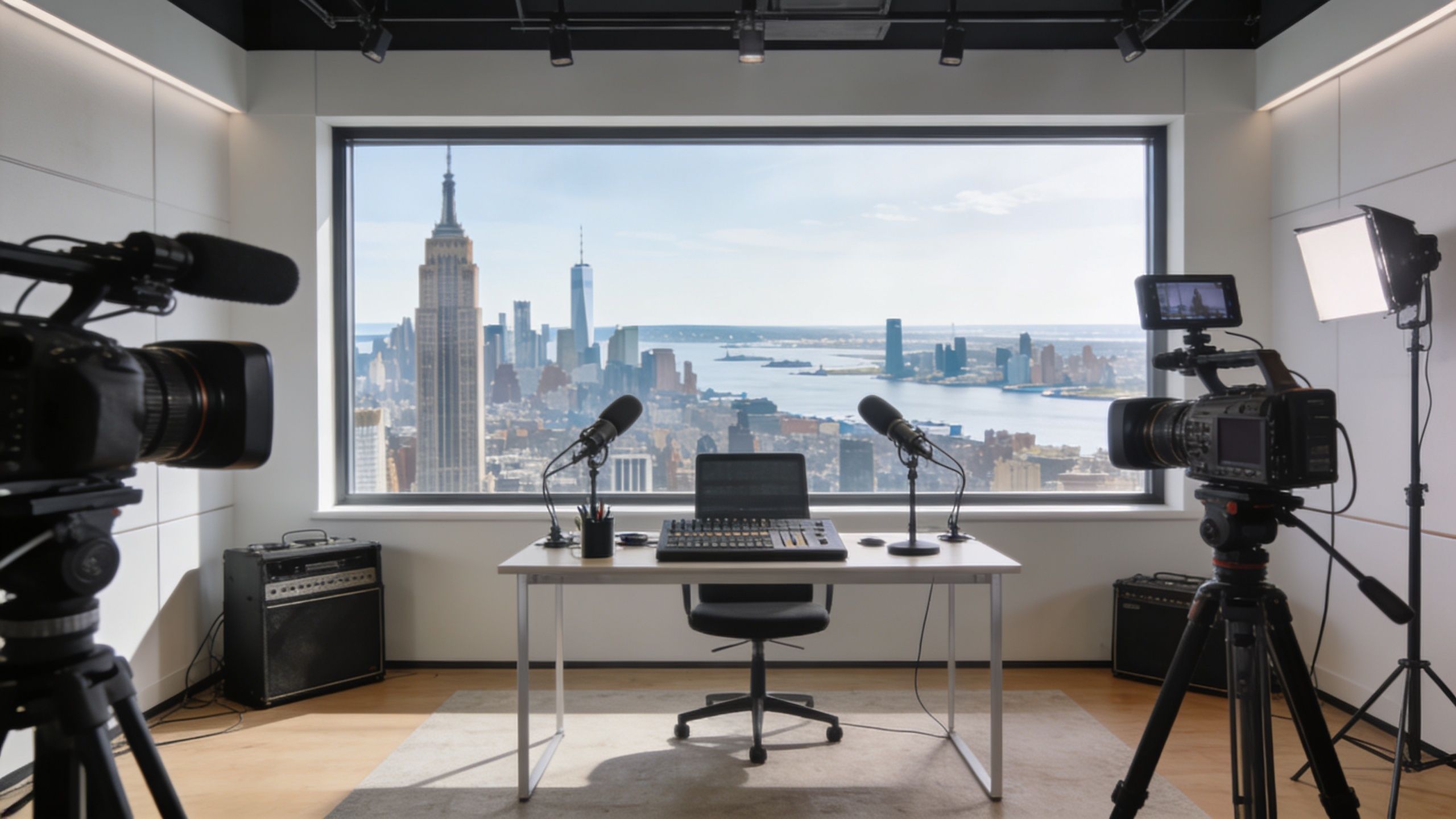
There's also a speed advantage. A local studio makes batch recording possible. You can bring in multiple guests, capture long-form episodes, film short-form assets, and leave with a content library instead of one isolated recording. That's especially valuable for business owners and creators who need efficient production windows.
The environment matters too. You don't build a modern media brand from a setup that feels temporary. A polished studio gives the show a stronger visual identity and gives guests a better experience. That tends to improve the performance of the conversation itself.
For anyone weighing local options, this roundup of the best podcast studios is a useful benchmark for what an in-person recording experience should offer.
A studio shouldn't just give you a room. It should remove friction, improve performance, and make the content look worth paying attention to.
Your Next Steps Explained
A few questions usually come up at this point.
How much creative control do I keep
All of it where it counts. A good management partner should improve your execution, not flatten your voice. You should still own the message, the tone, the guest point of view, and the strategic direction of the show.
What kind of growth should I expect
Expect better consistency, stronger presentation, and clearer decision-making first. Growth usually follows when the show becomes easier to trust and easier to distribute. Anyone promising instant audience explosions is selling fantasy, not management.
Can I start small and upgrade later
That's the smartest path for most creators. Fix the biggest problem first. If quality is the issue, start there. If you're buried in admin and publishing, solve that. Once the show feels stable, layer on repurposing, marketing, or a website.
How do I know I'm ready
You're ready when the DIY approach starts costing more than it saves. That cost might show up as missed releases, weaker guest experiences, inconsistent quality, or time pulled away from your business. Once that happens, management becomes a growth decision, not a convenience.
The creators who build durable shows don't wait until they're burned out beyond repair. They install better systems early and let those systems compound.
If you're ready to turn a promising show into a disciplined content engine, explore Flexwork Podcast Studios and book the next step that matches your bottleneck. A studio tour, a production package review, or a focused Content Day can give your podcast the structure it's been missing.