
Podcast Editing Services: Elevate Your Show in 2026
 May 14, 202623 Minutes
Meta description: Professional podcast editing services in 2026. Learn what to expect, what to pay, and how to choose a partner that handles editing and distribution.
URL slug: /podcast-editing-services-2026
Primary keyword: podcast editing services
Secondary keywords: podcast production partner, podcast distribution, video podcast editing
Your show is working. The conversations are good, the guests are better, and people are starting to take you seriously. Then the production pileup hits. Raw audio files sit in a folder. Video tracks drift out of sync. A passing siren ruins a great answer. Your “quick edit” turns into a late-night marathon that steals time from booking guests, selling offers, and growing the show.
That's the point where DIY stops being scrappy and starts being expensive.
Professional podcast editing services exist to remove that bottleneck, but most creators still shop for them the wrong way. They compare rate cards, ask for turnaround time, and ignore the bigger issue. Editing is only part of the job. The primary benefit is finding a partner that helps you record cleanly, shape the episode well, and get it released without chaos. If you're evaluating that move now, Flexwork's perspective on audio editing support is a useful starting point.
Introduction
A lot of ambitious creators hit the same wall. The show starts as a smart side project. Then it becomes a real brand asset. Suddenly you're not editing one casual episode on a Sunday. You're managing audio, video, clips, titles, metadata, upload deadlines, and the quiet panic that comes from knowing your content quality now reflects your business.
That pressure is justified. Your podcast doesn't just carry your voice. It carries your positioning.
Podcast editing services solve more than technical mess. They protect pacing, clarity, and consistency. They keep your show from sounding homemade when your ambitions are not. They also create room for better use of your time, which matters more than most creators admit.
For serious hosts in the NJ and NY market, the strongest move isn't hiring the cheapest editor. It's choosing a production workflow that eliminates preventable problems before they ever reach post.
The DIY Ceiling Why Your Podcast Needs Professional Editing
Most creators wait too long to outsource editing because they think the issue is effort. It isn't. The issue is opportunity cost.
Every episode you edit yourself asks you to become a cleanup specialist, mix engineer, story producer, and quality controller. That might feel efficient at first. It usually turns into a drag on consistency. You publish later, second-guess more, and avoid recording as often as you should.
The market doesn't forgive that for long. The podcast category is crowded, and audiences have options. According to Backlinko's podcast statistics, there are over 619.2 million podcast listeners worldwide, 2.9 million shows on Apple Podcasts, 53% of US listeners prefer video podcasts, and 79% of consumption happens on mobile. The same source notes that editing often takes 2 to 6 hours per episode. That's not side work. That's a recurring production job.
DIY doesn't just cost time
The obvious cost is your calendar. The less obvious cost is how amateur friction shows up in the final product.
A DIY episode often carries small defects that listeners feel even if they can't name them:
- Uneven volume: One speaker sounds strong, the other sounds distant.
- Dead air and sluggish pacing: Great ideas lose momentum because nobody tightened the conversation.
- Distracting video cuts: Visual jumpiness makes the show feel less credible.
- Listener fatigue: Background hum, mouth noise, or bad room tone pushes people out.
None of those issues sound catastrophic on paper. Together, they lower trust.
Practical rule: If editing keeps delaying your publishing schedule, you don't have an editing problem. You have a growth problem.
Quality is now part of your brand
The rise of video podcasts changed the standard. Audio alone used to carry more of the weight. Now the audience sees your set, your lighting, your cut points, your graphics, and whether your production feels deliberate or improvised.
That's why professional editing isn't a vanity spend. It's brand control.
There's also a psychological shift that serious creators need to make. Editing isn't the highest-value use of a founder's attention. Guest outreach is. Sponsorship development is. Sales is. Strategic content planning is. If you're still spending nights removing filler words manually, you're keeping yourself in the technician role when your business needs you in the operator role.
If you're still weighing studio support against doing it all yourself, this breakdown of studio vs DIY podcasting makes the tradeoff plain. DIY gets a show started. It rarely helps a show scale.
Decoding Podcast Editing Services What To Expect
Good podcast editing services should feel concrete, not mysterious. You should know exactly what you're paying for and why it matters.

At the base level, a professional editor takes raw files and turns them into a finished listening experience. That usually includes cleaning noise, balancing speaker levels, tightening pacing, mixing in intros and outros, and exporting a platform-ready file. Better providers add show notes, transcripts, ID3 tagging, and social clips.
The core edit
This is the part most creators think they understand, but they usually underestimate the craft involved.
A proper edit handles the mechanical cleanup first. That means removing obvious distractions like background noise, harsh breaths, pops, long pauses, and rough transitions. Then it moves into feel. The editor shapes the episode so it sounds intentional, not merely corrected.
Here's what to look for in a standard deliverable:
- Audio cleanup: Remove room noise, hiss, clicks, and other distractions.
- Dialogue balancing: Make every speaker easy to hear without constant volume changes.
- Pacing edits: Tighten rambling answers, false starts, and repetitive tangents.
- Music and branding: Place intros, outros, stingers, and ad segments cleanly.
Loudness is not a small technical detail
One of the clearest signs of professional work is whether the episode is mastered to the right playback standard. Zencastr's guide to podcast editing notes that -16 LUFS is a critical benchmark used by major platforms like Apple Podcasts and Spotify. That target keeps volume consistent for listeners. If a file is too loud, platforms turn it down, which can introduce compression and distortion. If it's too quiet, the show sounds weak.
That standard matters because listeners don't care about your meters. They care that your show sounds stable, polished, and easy to follow.
If your episode forces someone to adjust the volume between your intro, your guest, and your ad read, the production is unfinished.
A practical way to audit providers is to ask how they handle mastering, normalization, and final exports. If the answer is vague, keep looking.
A more technical walkthrough can help if you want to understand the post side before hiring it out. These post-production best practices for podcast episodes cover the standards worth knowing.
The add-ons that actually move the business
Not every extra is fluff. Some add-ons directly improve reach and workflow.
High-value additions usually include:
| Service | Why it matters |
|---|---|
| Show notes | Help package the episode clearly for listeners and search visibility |
| Transcription | Supports accessibility, repurposing, and written content creation |
| Video clips | Turn one long-form episode into short-form distribution assets |
| Metadata prep | Makes publishing faster and less error-prone |
If a provider only promises “clean audio,” that's a narrow service. Useful, yes. Strategic, no.
Streamlining Your Workflow From Recording to Release
Editing quality starts long before the edit.
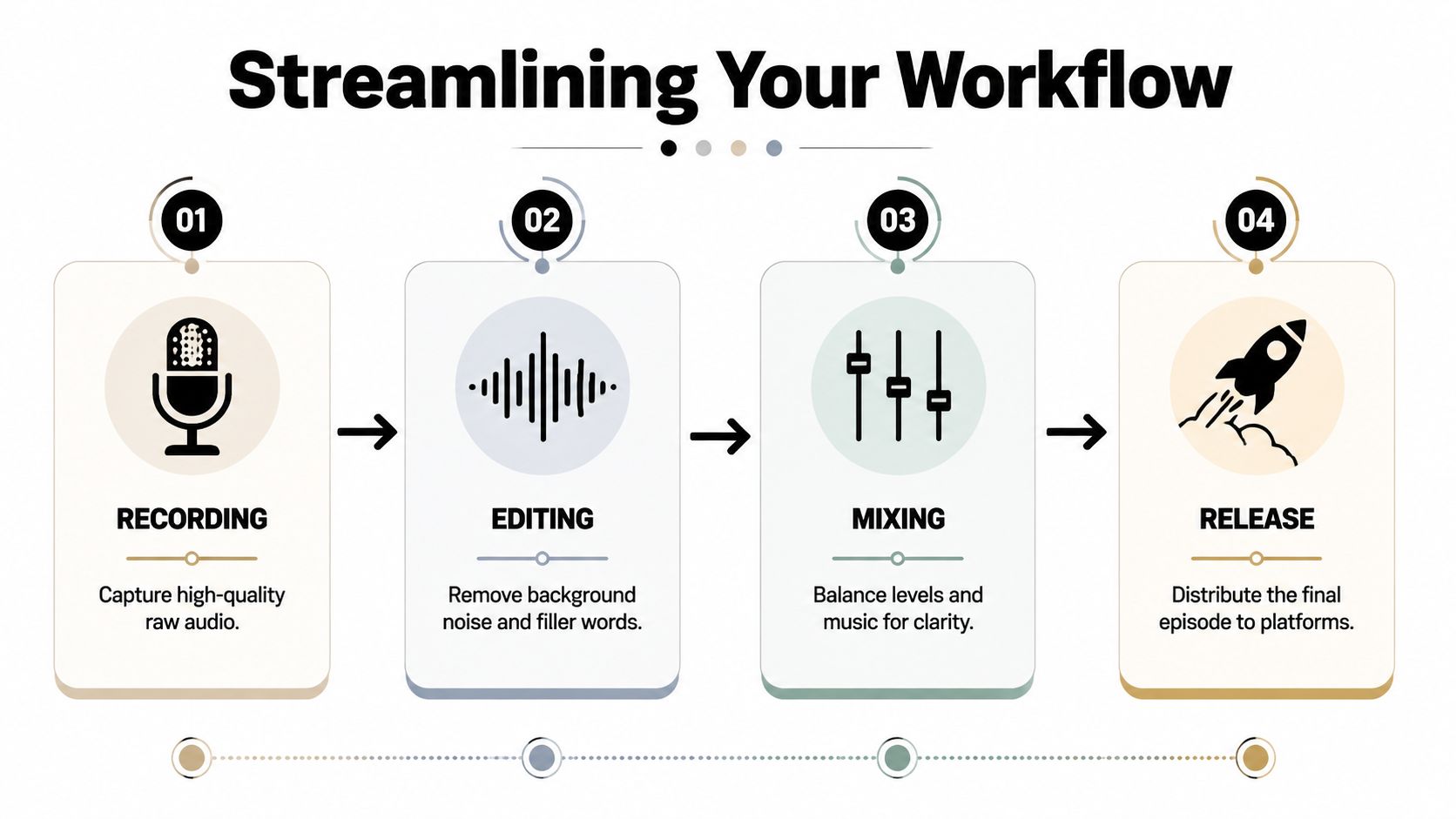
A fragmented workflow usually looks like this: record remotely, discover one mic was too hot, realize the lighting was off, fight sync drift, send giant files, wait for revisions, then scramble to create clips and upload everything before your planned publish date. None of that is rare. It's the normal outcome of treating recording, editing, and release as separate jobs handled by disconnected tools.
Recording quality decides editing difficulty
The cheapest way to “save money” is to create expensive post-production.
Remote-only setups often introduce problems that no editor can fully erase. Bad mic placement, reflective rooms, inconsistent internet, and weak camera framing all create cleanup work. Some issues can be softened. Some just become less bad.
A studio-first workflow changes the equation. When you record in an acoustically treated room with proper monitoring, quality gets built in at the source. That means fewer fixes, fewer revisions, and cleaner clips for social. It also helps with video-first production, where lighting, framing, and audio need to work together instead of being patched together later.
For creators batching interviews or social assets, a dedicated Content Day workflow for podcasters makes more sense than assembling random production days one at a time.
AI helps, but it shouldn't own your final cut
AI tools are useful. They're just not enough.
Music Radio Creative's podcast audio editing overview notes that AI tools like Adobe Enhance can help with basic cleanup, but they often struggle with multi-speaker conversations and can introduce artifacts. The same source notes that a human editor may spend around 3x the episode runtime cleaning tracks, balancing levels, and refining pacing. That's where narrative quality comes from.
Use AI for speed. Use humans for judgment.
That hybrid model works well when you want draft transcripts, rough cleanup, or first-pass organization. If you need a transcript early for notes or repurposing, a simple resource on how to convert MP3 to text can help you structure that step without overcomplicating your process.
Human editors hear the things automation misses. Interruption timing. Energy dips. A guest answer that should start ten seconds later. That's where the finished product gets its authority.
The workflow worth paying for
The strongest production model is simple:
- Record cleanly
- Edit with intent
- Package assets for distribution
- Release on schedule
That sounds obvious, but most providers only own step two. That's the mistake.
The Flexwork Solution Packages That Elevate Your Brand
The editing market has a wide pricing spread, and that spread tells you something important. Most services are not solving the same problem.
According to Podcast Insights' roundup of podcast editing services, rates often range from $50 to $300 per episode, while packaged services can run $100 to $800 per month. Their examples also show just how uneven the market is. Resonate Recordings lists a Standard Package at $59 per episode, Enhanced at $199 per episode, Enterprise starting at $349 per episode, and Custom at $625. Other providers span monthly plans like $97 per month for 4 episodes at Podcast Press, $349 per month at The Podcast Creative for editing, and $150 per episode for audio at Podcast FastTrack. Those options are useful reference points. They're also mostly editing-first offers.
That's not the same thing as a growth system.

Budget editing is a different category
If all you need is basic cleanup and an exported MP3, a low-cost editor can be enough. That's a valid choice for early-stage shows.
But creators with business goals usually need more than noise removal. They need editorial consistency, video polish, distribution support, clip creation, brand cohesion, and a workflow that doesn't require them to manage five freelancers. That's where premium production packages make sense.
The author brief for this article gives the clearest examples of how that premium tier is structured:
- Content Days at $3000 per day: include 20 edited reels or 60 professional photos
- Podcast websites at $5000 plus hosting
- Market, Manage & Produce My Podcast starting at $1500 per episode with a 20-episode growth commitment
Those numbers are not “expensive editing.” They represent a different operating model. You're buying production plus execution capacity.
Which package fits which creator
One useful way to think about package selection is role, not budget.
If you already know what your show is and need polished execution, a producer-led package is the right move. If your bigger issue is scale, distribution, and audience development, the market-and-manage category fits better.
A local studio and production hub like Flexwork Podcast Studios offers services in that second category: studio rentals, podcast production packages, Content Day sessions, post-production, distribution support, and podcast website builds. That's relevant if you don't want to hand off your files to one vendor, your clips to another, and your publishing to yourself.
Investment lens: Cheap editing buys file cleanup. Premium production buys momentum.
One more practical consideration. Once you start publishing clips, guest assets, and episode links consistently, your audience journey matters. If you need a cleaner way to centralize those destinations, a streamlined link-in-bio tool pricing guide is worth reviewing as part of your content stack.
How To Choose The Right Podcast Production Partner
A provider can sound polished on a sales call and still leave you doing half the work. Don't choose based on portfolio alone. Choose based on workflow ownership.

Bcast's discussion of podcast editing companies points to a common failure point: many services stop after delivering the final MP3, which creates a distribution gap. That leaves the creator responsible for uploads, scheduling, and promotion. A real production partner handles the full path to release.
Ask these questions before you sign
Use this list in every discovery call:
- What happens after the edit is approved? If they stop at file delivery, you still own the stressful part.
- How do you handle video? Audio-only support won't help much if your audience expects clips and full video episodes.
- What is your revision process? You need to know what's included and how feedback gets tracked.
- Do you support transcripts or show notes? These aren't minor extras. They improve publishing speed and content repurposing.
- How do you manage release timing? A polished episode that publishes late is still a workflow failure.
- Can you work from studio-recorded content as well as remote files? The answer tells you how adaptable they are.
Red flags that usually mean more work for you
Some warning signs show up fast:
| Red flag | What it usually means |
|---|---|
| Vague deliverables | You'll discover limits after the invoice |
| No mention of distribution | You'll still be uploading and scheduling yourself |
| No video or motion support | Your short-form strategy will stay fragmented |
| No process for file organization | Revision cycles will get messy fast |
Choose a partner, not a pair of hands
A good editor improves episodes. A good production partner improves your operation.
That distinction matters most for busy founders, agencies, and hosts who don't want to manage vendors. If you want to compare service models in your area, this look at finding a podcast production company near you is a useful benchmark for what full-service support should include.
Your Podcast Editing Questions Answered
How much should I budget for podcast editing services
If you want basic editing only, the market includes providers charging anywhere from $50 to $300 per episode, with some monthly packages in the $100 to $800 per month range, as cited earlier from Podcast Insights. If you want production plus strategy, distribution, and marketing support, expect a premium tier. That's a different service category and should be judged by workflow ownership, not just editing hours.
What should I send an editor to get the best result
Send organized files. That sounds simple because it is.
Use this checklist:
- Separate tracks if possible: Give each speaker their own audio file.
- Notes with timestamps: Flag mistakes, pickups, ad placements, and standout clips.
- Brand assets: Intro music, outro music, logos, lower thirds, and naming conventions.
- Publishing details: Episode title, guest bio, links, and any required call to action.
Can editing help with podcast SEO
Yes, indirectly and meaningfully. Strong show notes make the episode easier to understand and publish. Transcripts create usable text for websites, search visibility, newsletters, and clip captions. Editing alone won't grow the show, but editing plus good packaging makes your content easier to discover and reuse.
What's the smartest next step if I'm overwhelmed
Stop trying to solve everything with one more software tool. Audit your workflow. Find out where the delay starts. If it begins at recording quality, fix the recording environment. If it begins after delivery, fix the handoff and distribution process. Most creators don't need more apps. They need fewer broken steps.
If your show has outgrown DIY production, book a tour or start a conversation with Flexwork Podcast Studios. A clean recording environment, strong post-production, and a release workflow that doesn't collapse under pressure will do more for your podcast than another month of editing everything yourself.