
Elevate Your Brand with Livestream Production Services
 May 16, 202623 Minutes
Meta title: Improve Your Brand with Livestream Production Services
Meta description: Learn how livestream production services protect your brand, improve quality, and help NJ/NY creators produce polished live content.
URL slug: /livestream-production-services-brand-value
Primary keyword: livestream production services
Secondary keywords: professional livestreaming, live video production, podcast livestream studio
The moment before you hit Go Live can feel bigger than it should. You've got a launch to announce, a guest lined up, a room full of expectations, and one quiet fear in the background. If the audio crackles, the video looks flat, or the stream drops, the audience won't remember your message first. They'll remember the stumble.
That's why livestream production services matter. They're not just about cameras and cables. They protect the way your brand is perceived when attention is highest and mistakes are most visible. For podcasters, founders, coaches, and media brands in the NJ and NY market, that difference shows up fast. A polished live stream signals control, credibility, and momentum. Even small issues can pull attention away from your ideas, which is why details like cleaner audio for recorded and live content often have outsized brand impact.
The High Stakes of Going Live
A live broadcast compresses your brand into one real-time experience. Viewers decide quickly whether they trust what they're seeing. If the stream feels improvised, your business can look improvised too.
That pressure is why DIY streaming often breaks down at the worst possible moment. One person is trying to host, monitor comments, watch battery levels, share slides, troubleshoot audio, and keep the show moving. That's too many jobs for one brain during a live event.
Practical rule: If the person on camera is also managing the stream, quality usually slips somewhere.
Professional livestream production services change the assignment. Instead of asking your content to carry weak execution, they create an environment where your ideas can land cleanly. For ambitious creators, that isn't extra polish. It's part of the product.
Beyond the Webcam What Are Livestream Production Services
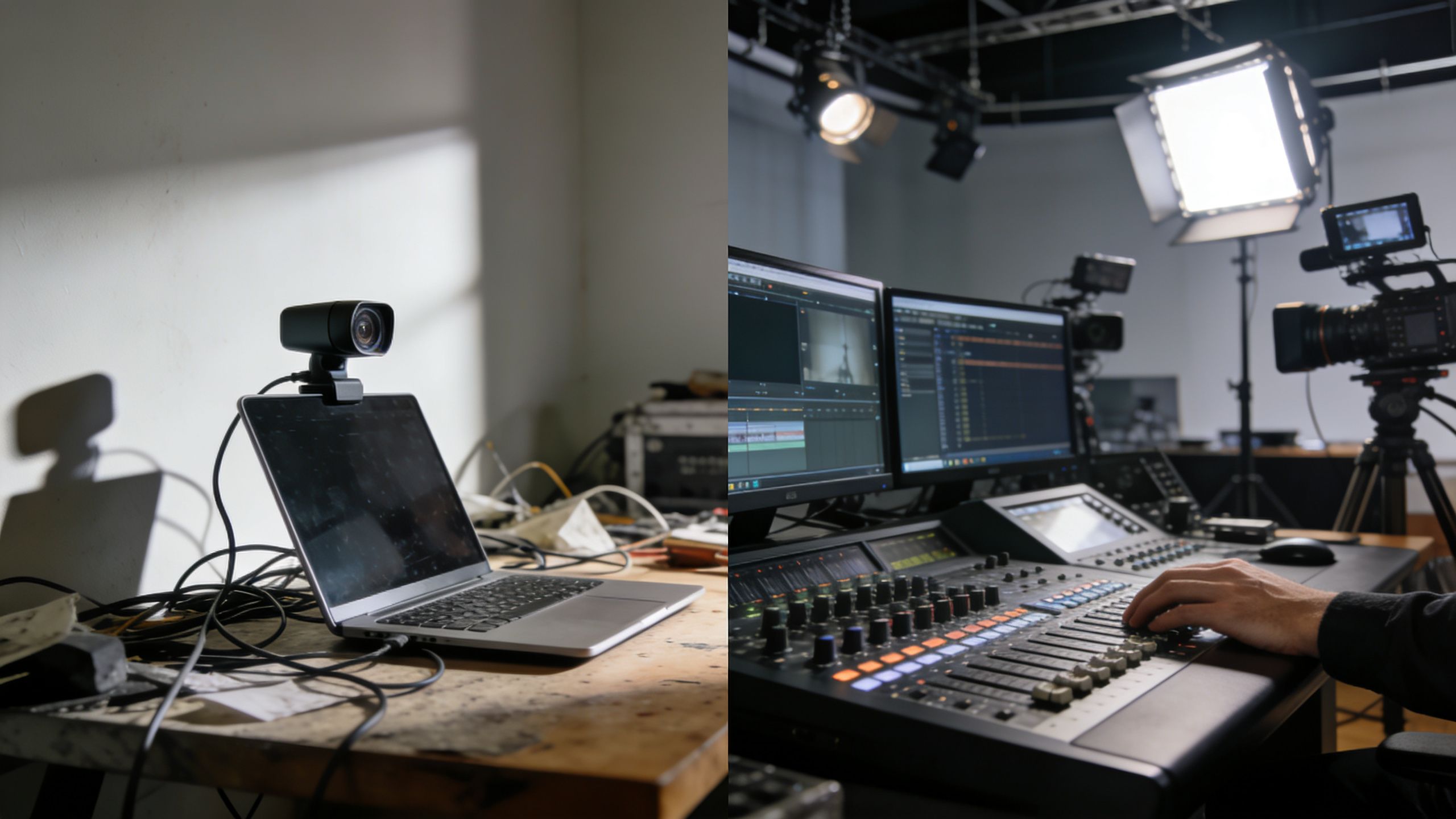
A webcam stream is capture. Livestream production services are direction, control, and delivery.
Think about the difference between cooking dinner at home and running service in a high-end restaurant. Both produce food. Only one has stations, timing, quality control, backup plans, and a team that knows exactly who handles what. Live video works the same way. The audience might only see the finished experience, but the smoothness comes from coordination behind the scenes.
What the service actually includes
At the professional level, this usually means a mix of planning, crew, gear, and platform management:
- Pre-show planning that maps the run of show, segment timing, guest flow, graphics, and cues
- Multi-camera coverage so the stream feels dynamic instead of static
- Live switching and graphics to move between angles, names, intros, clips, and branded visuals smoothly
- Audio management that keeps voices clear and levels consistent
- Encoding and stream delivery so the feed reaches the intended platform reliably
- Monitoring and backup thinking when something starts drifting in real time
This is one reason live content has become harder to fake well. Audience expectations rose with the category itself. The global live streaming market was valued at USD 87.55 billion in 2023 and is projected to reach USD 345.13 billion by 2030, with North America accounting for 32.60% of revenue, according to Grand View Research's live streaming market report. When a market reaches that scale, viewers stop treating live video as experimental. They expect it to work.
Why this matters for creators and service brands
For a podcaster or entrepreneur, the true value isn't technical bragging rights. It's brand insulation. A professional setup helps your message arrive without distraction, which is what buyers, sponsors, collaborators, and media partners notice.
If you're comparing platform options or trying to understand how organizations broadcast your services online, it helps to separate the software from the production itself. One distributes the stream. The other shapes whether the stream feels worth watching.
A proper studio environment also changes what's possible. A space designed for controlled sound, lighting, and camera placement gives you a better starting point than a laptop on a desk. For creators researching a video studio for rent in New Jersey, that difference usually becomes obvious the first time they compare clips side by side.
The Anatomy of a Flawless Livestream
The cleanest live streams don't happen because someone bought a nicer camera. They happen because the whole system was designed to behave under pressure.
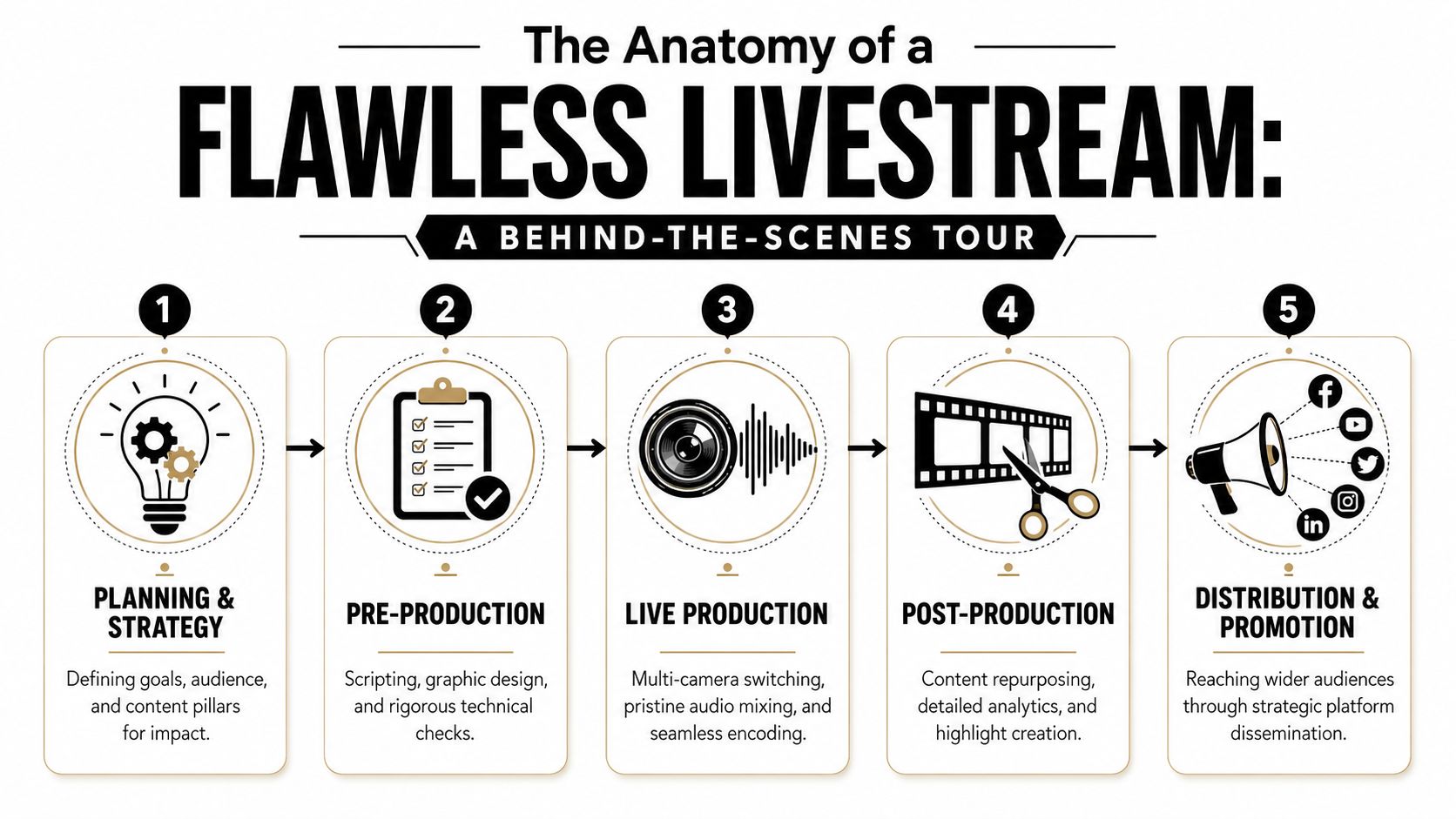
A useful way to think about it is in three layers. Before the show, during the show, and after the show. Problems usually start when teams obsess over the middle and ignore the other two.
Before the stream
Pre-production decides whether a live show feels intentional or scattered. During this phase, producers lock the run of show, identify who speaks when, prep lower-thirds, gather playback clips, define transitions, and test the signal path.
A broadcast-quality livestream is a systems-integration problem, not just a camera choice. Professionals use multiple camera angles, a dedicated switcher, and a pre-built run-of-show so they can cut between shots and graphics without losing continuity, as explained in this broadcasting workflow overview.
That sounds technical, but the audience benefit is simple. The show keeps moving. There's less dead air, fewer awkward handoffs, and a stronger sense that someone is in charge.
A rehearsal reveals more about your stream than your gear list does.
During the stream
Live production is where the coordination becomes visible. Camera operators or fixed cameras feed the switcher. Someone watches audio. Someone triggers graphics. Someone monitors the outgoing stream. Someone keeps an eye on timing and talent cues.
Here's what usually separates amateur output from pro-level execution:
| Area | DIY tendency | Professional approach |
|---|---|---|
| Camera coverage | One static shot | Multiple angles with intentional cuts |
| Audio | Built-in or lightly managed | Dedicated mics, live monitoring, backup thinking |
| Visual identity | Minimal branding | Titles, lower-thirds, intros, transitions |
| Internet | Shared connection | Dedicated connection with contingency planning |
| Host workload | Host does everything | Host stays focused on delivery |
Bandwidth matters more than many buyers realize. If you're planning your own setup, review these recommended streaming upload speeds before locking in your format. It won't replace a production plan, but it will help you ask smarter questions about infrastructure.
Lighting deserves the same respect as audio and switching. Viewers don't describe it in technical terms, but they feel it immediately. Controlled key, fill, and separation lighting helps faces look credible on camera, and a studio team that understands how lighting shapes video quality will save you from the flat, uneven look that screams “last-minute.”
After the stream
A live event shouldn't die when the broadcast ends. Good teams deliver a clean recording, identify standout clips, and turn the stream into on-demand assets that can keep working across social, sales, and content channels.
That's where the business value expands. One strong stream can produce teaser clips, guest promos, short-form moments, sponsor assets, and a full replay. The livestream becomes a content engine, not a one-time performance.
The Flexwork Solution for Turnkey Livestreaming
Most creators don't need to become live production specialists. They need a setup that lets them stay on message while the technical side is handled by people who already know the workflow.

That's why turnkey support is attractive in the first place. The U.S. live stream production services market contributes approximately USD 800 million annually, and internet-based streaming is the largest segment, according to this live stream production services market report. In practical terms, clients are increasingly paying for fewer variables, not more gear to self-manage.
What a turnkey setup solves
A good production partner reduces friction in four places:
- Environment: sound-treated rooms, controlled lighting, and space that looks intentional on camera
- Operations: crew support, switching, audio oversight, and livestream routing
- Creative continuity: branded visuals, polished framing, and a show format that feels coherent
- Repurposing: edited clips, social-ready assets, and follow-up content after the event
For business owners, this matters because live video often sits at the intersection of content and revenue. The stream may support a launch, a sponsorship, a campaign, or a community-building effort. If the technical side is shaky, the business goal gets harder to reach.
How this connects to existing creator workflows
A livestream rarely stands alone. It works better when it plugs into a broader content system. A studio day can create evergreen intros, sponsor reads, pre-recorded inserts, B-roll, and social clips that feed the live event. A structured package can also turn one appearance into a month of assets.
Flexwork Podcast Studios offers studio rentals, production support, packaged services, and add-ons like Content Days at $3000/day, which include 20 edited reels or 60 pro photos, plus podcast websites at $5000 plus hosting, and a Market, Manage & Produce My Podcast tier that starts at $1500 per episode with a 20-episode growth commitment. Those package details are laid out on the production packages page.
If you're weighing the business case for better capture quality beyond livestreaming, this IT perspective on business cameras is a useful companion read. It explains why camera quality affects how professional a brand appears long before anyone talks about creative style.
Buying insight: Most founders regret underproducing a launch more often than overpreparing for one.
How to Choose a Production Partner in NJ and NY
Price matters, but price alone is a weak filter. In live production, the smarter question is what failure will cost you if the stream goes sideways in front of clients, customers, guests, or sponsors.
Top-tier providers should be able to explain their approach to risk and redundancy clearly. They should also tell you how they handle backup connectivity and who is responsible if a stream fails, which is a major dividing line between amateur and professional operators, as noted by Broadcast Management Group's live streaming services overview.
Questions worth asking before you sign
Use this checklist when you talk to any team in the NJ and NY market:
- Who owns the live workflow? Ask who calls cues, who watches audio, and who monitors the outgoing stream.
- What's your backup plan? You want a direct answer on connectivity, recording backup, and what happens if a feed drops.
- Have you handled my format before? A podcast-style panel, a launch event, and a remote guest interview all create different pressure points.
- How do you manage remote guests? Guest audio, timing, and screen layout can get messy fast without a system.
- What happens after the event? Ask what recording files, clips, or edits you receive and when.
- Who is my point of contact? A clear lead prevents confusion when show day gets tight.
What matters specifically in this market
NJ and NY projects often move fast. Venues can be tight, schedules can shift, and access windows can be narrower than expected. A production partner who understands local logistics will usually ask better questions earlier. They'll want to know load-in timing, room acoustics, camera sightlines, and whether the event is staying in-studio, on-site, or hybrid.
There's also a style factor in this region. Audiences here are used to strong media presentation. They may not know the name of the switcher or the mic type, but they know when something looks thin, sounds cheap, or feels disorganized.
A simple evaluation framework
Here's a cleaner way to compare providers:
| Criteria | What to look for |
|---|---|
| Reliability | Clear redundancy answers, not vague reassurance |
| Fit | Evidence they understand your format and audience |
| Communication | One lead, fast decisions, organized prep |
| Production value | Strong audio, lighting, framing, graphics |
| Content utility | A plan for replay, clips, and post-event use |
If you're starting local, reviewing a podcast production company near you in New Jersey can be a good entry point because many of the same skills carry over into polished livestream execution.
Livestreaming in Action Creator Use Cases
The easiest way to understand the value of professional live production is to look at how different creators use it.
The podcaster with a season finale
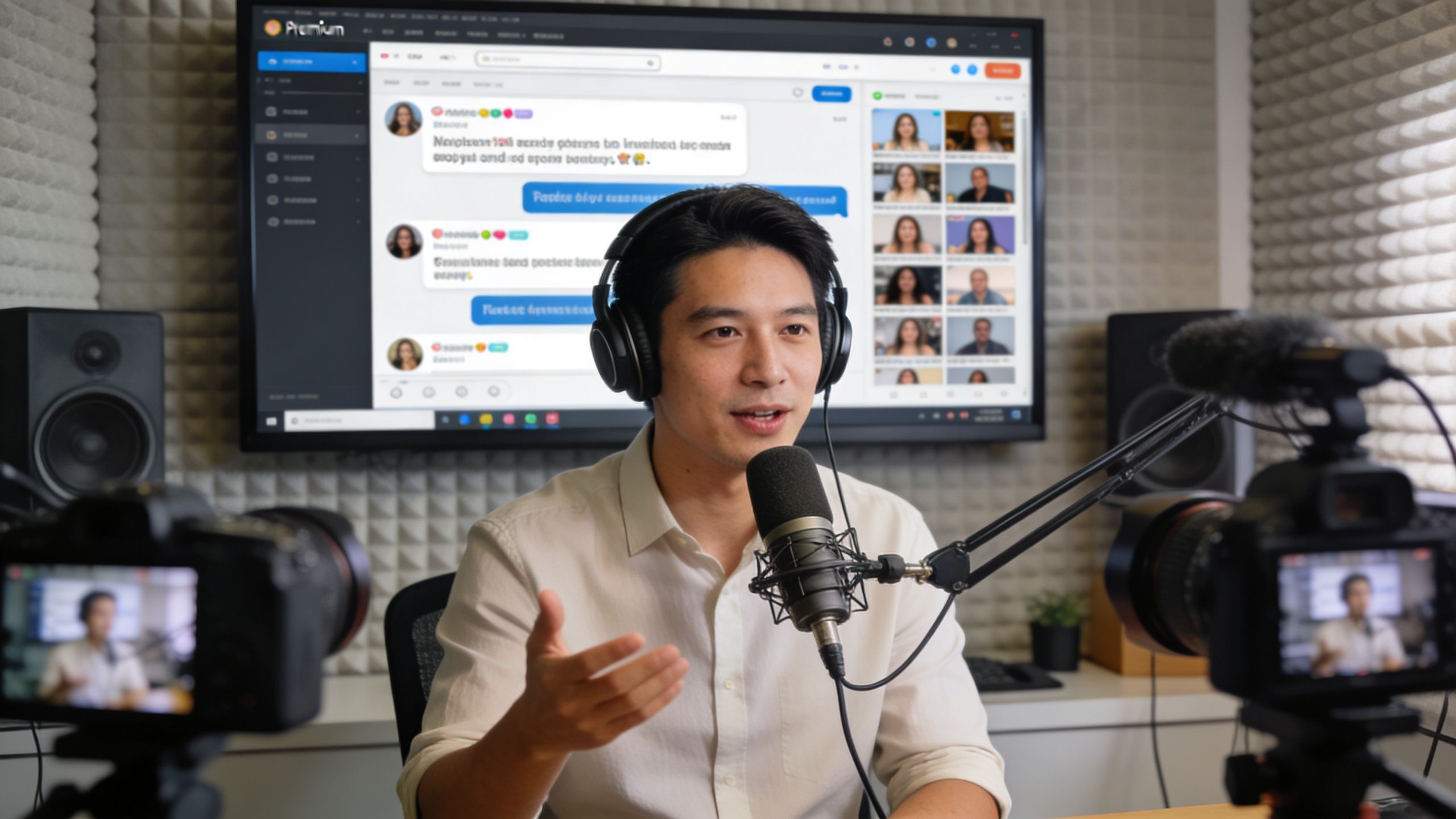
A two-host show wants to turn its season finale into an event. They bring in a remote guest, add branded opening visuals, run multiple camera angles, and save a clean recording for replay. The audience gets a real experience instead of a webcam call that happened to be public.
What changes is the perceived scale of the show. It feels bigger, more sponsor-ready, and more intentional.
The founder with a launch to protect
An entrepreneur is releasing a book, program, or product line. Instead of relying on a laptop stream from a living room, they build a short live event with pre-recorded inserts, a moderated Q&A, and crisp audio. That structure lets them present like a brand, not just a person with an announcement.
The launch gets a cleaner first impression. That matters when media contacts, collaborators, and future clients may all be watching the same event.
The brand building thought leadership
A company creates a recurring live series featuring internal experts and invited guests. The visual identity stays consistent, the host gets more comfortable over time, and each session produces clips for social and sales follow-up. The stream becomes an ongoing authority asset rather than a one-off experiment.
The strongest live series don't just fill a calendar slot. They teach the audience what level of quality to expect from the brand.
Frequently Asked Livestreaming Questions
What's the difference between a livestream and a webinar platform
A livestream is the broader production and delivery format. A webinar platform is one type of tool that may host or distribute a presentation-style event. The distinction matters because webinar software alone doesn't solve production quality. You still need strong audio, clean visuals, switching, moderation, and a reliable show flow.
How much does a professional livestream typically cost
The answer depends on scope. A studio-based stream with a controlled set, a small guest count, and a simple run of show costs differently than an on-location event with multiple cameras, graphics, remote guests, and backup connectivity requirements.
What matters more than a generic quote is the production design behind it. Ask what's included. Crew, switching, audio, graphics, rehearsal time, clip delivery, and platform support all shape the true value.
How do I get better audio and video quality
Focus on the entire capture chain. Professional-quality results come from high-resolution cameras, dedicated microphones with redundancy, three-point lighting, and a dependable encoder, as outlined in this livestreaming production guide from Perlow Productions. Poor audio is often more jarring to viewers than minor video imperfections.
A few upgrades usually matter more than creators expect:
- Use dedicated microphones: Don't rely on laptop or camera audio for an important stream.
- Light faces intentionally: Even good cameras struggle when lighting is uneven.
- Test the full signal path: Don't just test the mic. Test the mic, switcher, platform, monitoring, and recording workflow together.
- Plan for backup: Redundancy is part of quality, not a separate issue.
Can I repurpose a livestream after it ends
Yes, and you should. A single live session can become replay content, short clips, promos, quote graphics, and future teasers. Teams that plan for this before show day get more value than teams that treat the stream as disposable.
Is a studio always better than streaming from my office or event venue
Not always. A studio gives you control, which usually means fewer variables around sound, light, and layout. But some events need the energy of a live room or physical audience. The better question is which location best supports the purpose of the stream without creating unnecessary risk.
Elevate Your Content with Flawless Livestreaming
Going live puts your brand under a brighter light than almost any other content format. That's why livestream production services are worth treating as a strategic investment, not just a technical line item. They help protect the moment when your audience is paying the most attention.
For podcasters, founders, and thought leaders in the NJ and NY market, a true upgrade isn't only visual polish. It's confidence. You can focus on the conversation, the pitch, the guest, or the audience because the system around you is built to hold.
Professional livestreaming works best when the production disappears and the message stays.
If you're planning a live show, launch, or branded content series, Flexwork Podcast Studios is one place to explore studio rentals, production packages, and turnkey support for polished video and podcast content.