
How to Find Podcast Guests That Actually Convert
 August 18, 202626 Minutes
You've got the guest topic, the intro is sourced, and the mix is clean. Then recording day arrives, and the second chair is empty. That gap creates more than an awkward calendar problem. It slows publishing, weakens the episode's distribution potential, and forces you to search from scratch every time a booking falls through.
Learning how to find podcast guests is less about discovering famous names and more about building a reliable funnel. You need a clear guest profile, multiple sourcing channels, a disciplined outreach process, and a production plan that makes participation easy. Flexwork Studios supports that workflow in Springfield, New Jersey, with studio rentals, production packages, and a curated guest network for NJ and NY hosts who want to spend less time chasing replies and more time recording strong conversations.
The Empty Chair Problem and Why Guests Matter
Your recording room is ready, the outline is approved, and the publishing slot is fixed. Then the guest cancels. The backup has not answered, and one empty chair forces you to rebuild the episode plan under deadline pressure.
That failure starts earlier than recording day. Guest sourcing works as a funnel: attract possible guests, screen for fit, book enough conversations to absorb cancellations, and keep qualified candidates in reserve. Treating it as a last-minute content decision leaves no room for trade-offs. A recognizable name may bring reach but offer a thin conversation, while a lesser-known operator may provide the sharper story and stronger audience connection.
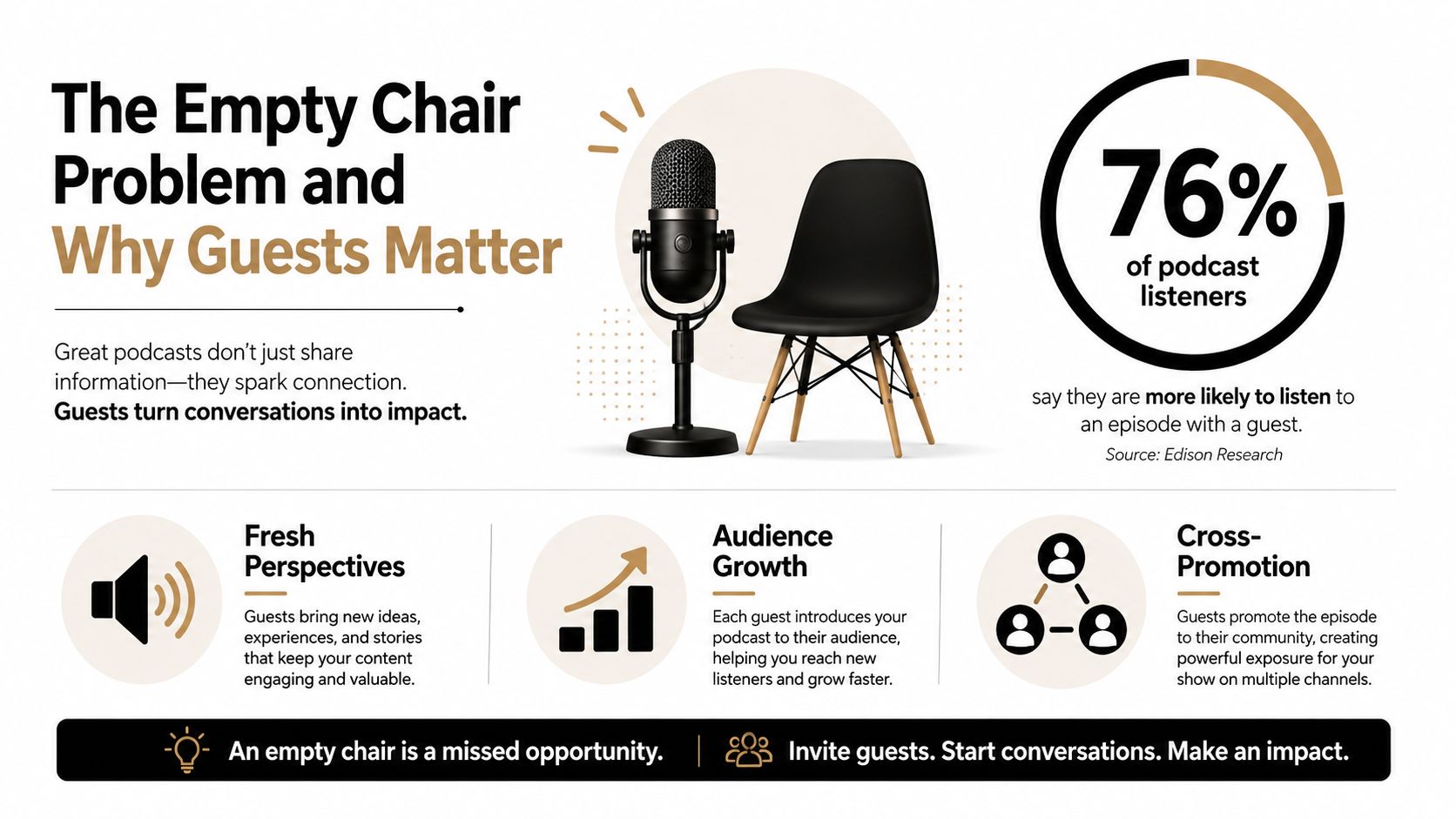
Guest episodes also support distribution. Pew Research found that 76% of 434 top-ranked podcasts on Apple and Spotify featured at least one guest in 2022. The same analysis counted more than 7,000 individuals and almost 11,000 guest appearances across roughly one-third of episodes released that year. Pew's podcast guest findings indicate that interviews are a common programming format among high-performing shows.
An analysis of Rephonic data reported by Inside Radio found that podcasts with guests reached an average of about 6,500 estimated weekly listeners, compared with just over 5,000 for podcasts without guests. Inside Radio's analysis of guest-format listenership does not establish that guests alone caused the difference. It does support a practical decision: booking belongs in the show's distribution system, because a guest can introduce the episode to another community through promotion and shared credibility.
Build the pipeline before the deadline
A working pipeline protects the calendar without lowering your standards. It gives you time to compare established experts with emerging voices, local founders, creators, and practitioners who can explain a problem from direct experience.
The operating rule is simple:
A booked calendar comes from a repeatable funnel, not a heroic search performed the night before recording.
For NJ and NY hosts, Flexwork Studios in Springfield, NJ combines a recording environment with access to a curated guest network. That network can shorten discovery and help hosts pursue volume without paying the full cold-outreach tax for every booking. Sourcing, production, and scheduling still require judgment, but they no longer have to begin from separate systems.
Define Your Guest Profile Before You Search
A full LinkedIn tab can create the illusion of progress. Without a defined guest profile, the search expands indefinitely and the calendar still has gaps. Set the show's requirements before reviewing names, so every prospect enters the same funnel and earns a clear next step.
Start with the topic pillar, then narrow it to a useful audience angle. “Business,” “wellness,” and “creativity” are categories, not booking criteria. A workable angle might cover building a service business without a large team, designing sustainable creative routines, or scaling a local brand through video.
Define the audience problem in practical terms. Who listens? What are they trying to accomplish? Which experience could help them choose, avoid a mistake, or take action? A guest should connect the topic to that problem. Job title is secondary to the story, evidence, or perspective the person can bring.
Write the guest persona in one paragraph. Include working context, expertise, communication style, and likely audience overlap. For example, you might seek a New York founder with a thoughtful hiring process, a New Jersey creative director who can explain client acquisition, or a marketing leader who turns strategy into practical steps.
Turn the persona into a screening card
Use the criteria in Respona's podcast outreach checklist to build a consistent candidate card:
- Industry relevance: Does the person fit the show's central subject?
- Proven results: Can they discuss concrete work, decisions, or outcomes?
- Audience overlap: Will the discussion matter to current listeners?
- Willingness to promote: Are they likely to share the finished episode with their community?
- Audio quality: Can they communicate clearly in the recording environment?
Score candidates against the same criteria, then listen to at least one previous appearance before sending an invitation. Check clarity, pacing, curiosity, and the ability to explain an idea without turning every response into a sales pitch. A polished profile can still produce a weak interview.
Keep the brief visible
Place the persona, topic boundaries, preferred episode angles, and screening criteria at the top of the pipeline. A spreadsheet, Notion, Airtable, or project board will work. The important part is one shared record where every prospect receives the same review.
The same discipline improves public positioning. Hosts building authority around a clear point of view can use this personal brand guide to align the show, guest choices, and online presence. Teams that source guests for several episodes can also adapt the guide for marketing agencies on lead lists to define fields, segments, and follow-up ownership.
For NJ and NY hosts, Flexwork Studios in Springfield, NJ combines a recording environment with access to a curated guest network. That network can shorten discovery and support volume without the cold-outreach tax attached to every booking. A Content Day or polished podcast website can then package each conversation around a consistent audience promise.
Where to Find Guests Across Channels
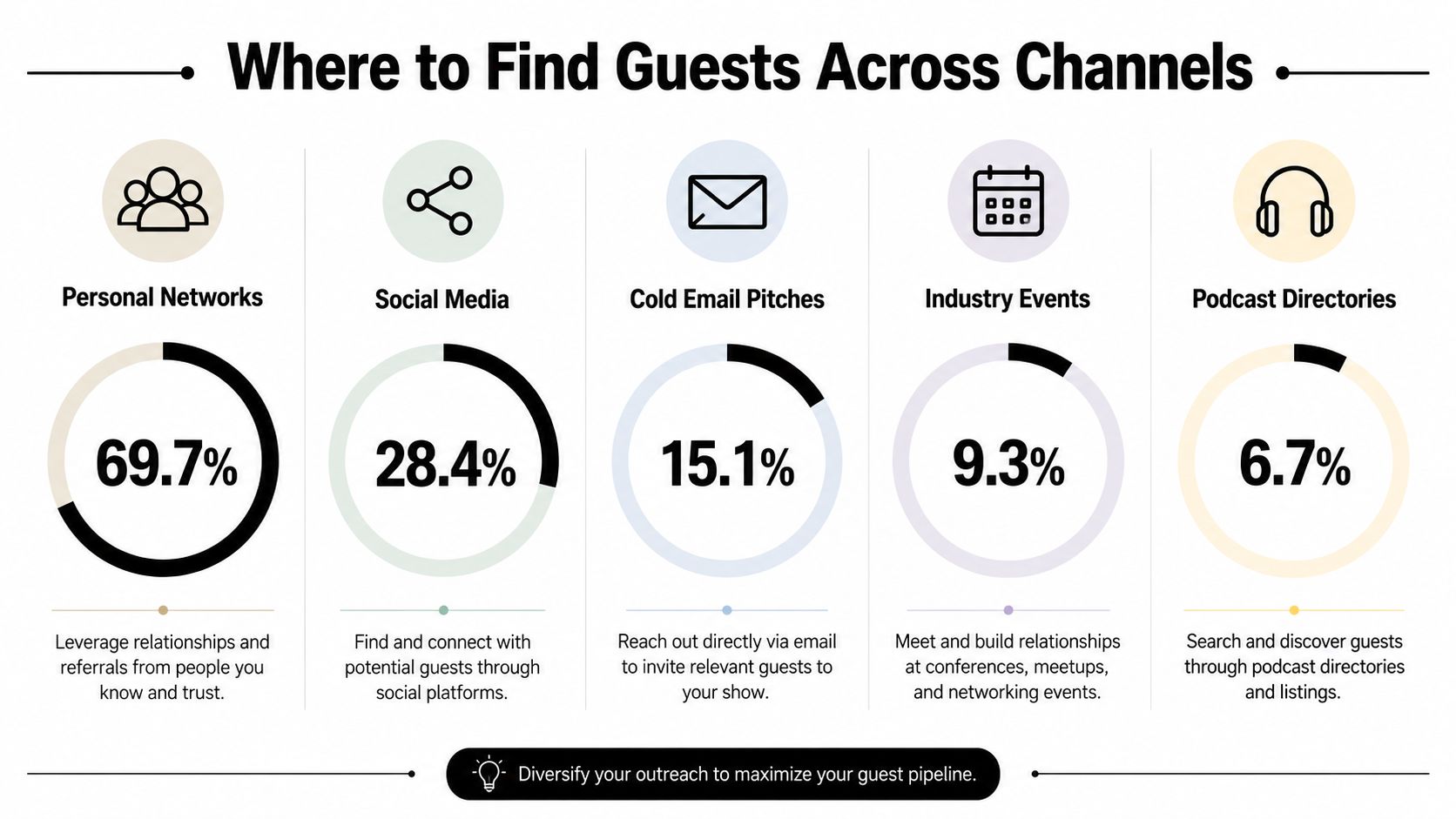
A full recording calendar rarely comes from one source. Your existing relationships can produce quick introductions, social platforms expose specialists outside your immediate circle, and marketplaces widen the pool at the cost of more screening. Treat guest sourcing as a funnel: attract relevant names, filter for fit, then keep enough qualified prospects moving toward an invitation.
A previous comparison of booking channels showed that personal networks, social media, cold outreach, referrals, guest platforms, and PR agencies all contribute to discovery. The practical lesson is simple. Relationship capital remains valuable, but producers who rely on one channel create avoidable gaps in their pipeline.
Start with people who already know your work
Personal networks shorten the trust-building stage. Ask clients, collaborators, former colleagues, local founders, and other hosts for a recommendation tied to a specific topic. “Who knows how to build a service business while staying hands-on with clients?” will produce better leads than “Do you know anyone interesting?”
Past guests can extend that network. After recording, ask for two people who could continue the conversation, and explain the angle you want to explore. A precise request gives the guest enough context to make an introduction immediately.
Search where expertise is visible
LinkedIn is more useful when you search for evidence instead of job titles. Combine topic terms with signals such as recent posts, conference appearances, newsletters, or detailed responses to industry questions. Those signals help separate active practitioners from people whose profiles only repeat broad positioning.
Twitter/X lists can track speakers from niche conferences and recurring discussions. Facebook groups and Reddit communities often surface practitioners who answer difficult questions without presenting themselves as public experts. Their explanations may offer stronger interview material than a polished biography.
A repeatable prospecting system also needs consistent fields for topic fit, audience relevance, proof of expertise, and contact status. Use targeting and list quality templates to structure the list before it fills with names that have no clear reason for inclusion. Social research can also support broader influencer marketing strategies when the show is building relationships beyond individual bookings.
Use marketplaces and curated networks selectively
Matchmaker.fm and Podbooker can speed up discovery when you accept remote interviews or want to compare several profiles quickly. Their trade-off is volume. More profiles create more work checking audience fit, communication quality, topic relevance, and actual availability.
For NJ and NY hosts, Flexwork's curated guest network adds a local option to the funnel. It can provide pre-vetted possibilities while producers plan relevant episodes, reducing the cold-outreach tax when the show needs volume. A practical channel mix may include warm referrals, social research, a marketplace, and the curated network. You do not need every source. You need a steady flow of qualified prospects that protects the recording calendar.
Outreach That Books the Episode
A qualified prospect can still ignore a weak invitation. Long introductions, generic compliments, and vague topic ideas force the recipient to work out the value before deciding whether to reply. Treat outreach as a funnel: move a candidate from awareness to interest, then to a clear booking action.
Start with warm introductions. Ask existing guests, clients, peers, and community contacts whether they can connect you with a relevant person. Warm referrals usually require less trust-building than cold messages, but they are limited by the size and relevance of your network. Cold outreach creates volume, at the cost of research, follow-up, and more unanswered messages.
Use a short, specific invitation
Your pitch should answer five questions quickly:
- Who are you and what show do you host?
- Why did you choose this person?
- What specific topic would you like to discuss?
- How much time should they expect?
- What is the easiest way to reply or book?
A practical template looks like this:
Subject: Guest idea for [specific topic]
Hi [Name],
I host [show name], a podcast for [audience]. I'm reaching out because your work on [specific project or point of view] would make a useful conversation about [proposed topic].The recording takes [expected time commitment], and I'd guide the discussion around [two or three angles]. If it sounds relevant, you can reply here or choose a time at [booking link].
Best,
[Name]
Personalization should identify the reason for contact, not become an essay. Mention the interview, post, talk, or project that led you to the candidate. Give the proposed topic enough substance to interest someone who does not yet know the show.
Follow up without becoming noise
One message rarely produces a dependable booking flow. Build follow-up into the system and make each touch useful. A later message can clarify the angle, offer a simpler reply, or give the candidate an easy way to decline without friction.
Use a simple 14-day sequence:
- Day 1: Send the personalized invitation.
- Day 4: Add one useful angle or clarify why the topic fits.
- Day 8: Offer a low-friction reply, such as interest, timing, or referral.
- Day 14: Close the thread politely and leave the door open.
Track the prospect, channel, last contact, response, fit score, and next action in one spreadsheet. Hosts building a broader distribution plan can also review this guide to grow your podcast audience, especially when guest promotion belongs in the original conversation.
For NJ and NY hosts who need volume without carrying the full cold-outreach tax, Flexwork's curated network can shorten the discovery stage. Its podcast guest booking process provides structured support around finding and scheduling guests, while the producer retains control over fit and episode direction.
Vetting and Qualifying Every Candidate
Replies create a new problem. A full inbox can look like progress while hiding weak fits, unclear communicators, or guests who expect the episode to function as an advertisement.
Use a five-part scorecard, but let the conversation quality decide the outcome. The criteria from the Respona checklist are practical because they balance relevance with execution. A brilliant résumé doesn't help if the guest can't explain their thinking or engage with a listener's real problem.
The five questions that matter
Industry relevance comes first. A guest can be impressive and still be wrong for the show. Check whether their current work connects naturally to the topic pillar you defined.
Proven results don't require fame. Look for projects, decisions, lessons, or experiences the guest can unpack. “I've helped companies grow” is weak preparation. “I changed the onboarding process and learned where it failed” gives the host something to explore.
Audience overlap determines whether the conversation feels useful rather than decorative. Review the guest's newsletter, social posts, community participation, or previous interviews for evidence that they speak to people similar to your listeners.
Willingness to promote should be discussed before the recording. Ask which channels they use and whether they're comfortable sharing the finished episode, clips, or images. Promotion shouldn't be assumed just because someone accepted an invitation.
Audio or on-camera quality depends on the format. Listen to or watch at least one previous interview before extending an offer. You'll hear whether the candidate gives concise answers, tells stories, handles follow-up questions, and sounds comfortable in conversation.
Apply a clear yes or no rule
Use a quick review block to listen to one prior interview, read the candidate's recent work, and complete the scorecard. Don't spend an hour rationalizing a weak fit because the person has a recognizable title.
Disqualify the guest when the topic is forced, the answers are promotional, or the communication style doesn't fit the show.
That rule protects the audience and the producer. Hosts who want practical help sharpening the conversation can use these podcast interview tips before the pre-call.
A curated guest network can reduce the initial screening burden, but it doesn't remove editorial responsibility. The host still owns the final decision, the episode angle, and the standard the audience experiences.
Scheduling, Prep, and Recording Day
A guest who says yes still needs a frictionless path to the microphone. Scheduling, preparation, and recording logistics should feel organized from the first confirmation message.
Use Calendly or a similar booking tool with pre-qualifying questions. Ask for the guest's preferred name and pronunciation, role, website, social links, recording location, accessibility needs, and the topic they most want to discuss. Those answers give you useful material before the pre-call and prevent avoidable corrections after publishing.
Send a shared prep document with the recording date, expected duration, show description, guest bio, conversation themes, technical requirements, and promotion expectations. Ask the guest to complete it 48 hours before recording so you have time to adjust the outline and flag anything that needs clarification.
Make the prep document do real work
Avoid sending a rigid list of questions that turns the conversation into an interrogation. Give the guest a handful of themes, then identify the story or decision behind each one. Include the opening question, the audience takeaway, and any subjects that should remain outside the conversation.
The day-of checklist should cover:
- Identity details: Confirm the guest's name, title, links, and preferred pronunciation.
- Conversation shape: Review the opening, core themes, and closing question.
- Technical readiness: Check the microphone, headphones, camera framing, lighting, and connection.
- Release details: Confirm episode timing, approval expectations, and promotional assets.
- Backup plan: Keep a phone number or alternate communication method available.
Recording in a professional environment solves more than sound quality. It gives the host a repeatable visual setting, dependable equipment, and a clear handoff when editing begins. Flexwork's Springfield, NJ studio combines acoustically treated rooms with broadcast-grade audio and cinema equipment, so the host can focus on the conversation rather than troubleshoot every level and connection.
For creators who want production support during the session, the Be My Podcast Producer package can place a producer in the workflow to manage the technical details and keep the recording moving. Studio rentals remain useful for hosts who want control, while production packages suit teams that need a more managed experience from setup through delivery.
Maximizing Guest Promotion Before, During, and After
Promotion should be part of the booking decision, not a favor requested after the episode is edited. A guest's distribution value depends on fit, credibility, and willingness to help the conversation travel beyond the original feed.
Discuss the plan before confirming the recording. Ask what the guest is comfortable sharing, which platforms they use, whether they can participate in a coordinated launch, and what links or calls to action matter to their audience. The conversation stays professional when both sides know what they're agreeing to.
Build a three-stage amplification plan
Before release, prepare a short announcement for the host and guest. Share the episode theme, recording image, release timing, and one question the conversation will answer. Give the guest copy they can adapt, not a paragraph they're expected to paste without thought.
At launch, publish the full episode with a small set of clips, a clear description, and one direct action for listeners. Coordinate the release window so the guest can share while the episode is fresh. Video-first shows should plan for on-camera presence and short-form moments during booking, not after production.
After launch, keep the episode useful. Send a follow-up email to your audience, resurface a strong clip, quote a practical takeaway, or connect the discussion to a later episode. A coordinated promotion plan keeps the guest relationship active and gives the episode more than one opportunity to earn attention.
Flexwork's content repurposing approach supports this workflow by turning a recording into assets designed for different channels. A Content Day costs $3,000 per day and includes 20 edited reels or 60 professional photos. Those deliverables can help a host plan a fuller month of promotion without asking the guest to carry the entire distribution load.
For teams focused on sustained growth, the Market, Manage & Produce My Podcast package starts at $1,500 per episode with a 20-episode growth commitment. Podcast websites are $5,000 plus hosting, which can give a show a permanent home for episodes, guest information, and search-focused content.
Treat guest sourcing as a complete funnel
The workflow is straightforward:
- Define the topic, audience, and guest persona.
- Source through networks, referrals, social platforms, marketplaces, and curated options.
- Pitch a specific conversation with a low-friction booking path.
- Vet the candidate through prior interviews and a consistent scorecard.
- Schedule, prepare, and record in an environment that matches the promise.
- Confirm promotion before the episode goes live.
That's the difference between filling a chair and building a show people want to follow. Flexwork Podcast Studios offers a creator-led Springfield, NJ studio, acoustically treated rooms, professional audio and cinema equipment, in-house digital marketing, podcast websites, production packages, and a curated guest network for hosts who want the entire system handled with care.
Flexwork Podcast Studios can help you source qualified guests, record in a polished NJ/NY production environment, and turn each conversation into a coordinated library of content. Visit Flexwork Podcast Studios to book a tour, explore production packages, or connect with the curated guest network.