
How to Brand Your Podcast from Naming to Launch
 August 7, 202629 Minutes
You can record a sharp episode, post it on schedule, and still watch the show vanish in a crowded feed. That usually isn't a content problem, it's a brand problem. The audience can hear your voice, but they can't describe what the show stands for, spot it instantly in a thumbnail, or remember why they should come back next week.
That's the core work of how to brand your podcast. Branding isn't a logo file sitting in a folder, it's a system that connects naming, positioning, visuals, sound, distribution, and promotion into one recognizable experience. In a creator-led studio like Flexwork Studios in Springfield, NJ, that system is built to travel across audio, video, clips, and launch assets without flattening the host's personality. The point is simple, make the show feel intentional before the first guest ever walks into the room.
Why Most Podcasts Sound Like Everyone Else
A lot of podcasts fail in the same quiet way. The host is consistent, the episode ideas are solid, and the recording quality is decent, but the show still feels generic once it hits Apple Podcasts, Spotify, or YouTube. That happens when branding gets treated like decoration instead of structure.
I've seen this with creators who can carry a conversation for an hour but can't sum up their show in one sentence. They have a name, a cover image, and an upload habit, yet nothing about the feed tells a listener what's different. Without a clear promise, every episode has to work harder than it should.
The fix starts with a measurable mindset. Branded-podcast work is commonly judged by retention rate and listen time, and one industry report found that 90% of brands were satisfied with their podcast results while 64% planned to sustain or increase podcast budgets in 2024, which is a strong sign that teams keep investing when the audience stays with the show (Signal Hill Insights). The same report also found that 72% of brands cited lead generation as a main post-launch benefit and 76% said thought leadership was a main pre-launch goal, so the shows that win are the ones built to build authority, not just awareness.
Practical rule: if a listener can't describe your podcast after one episode, the brand promise is too vague.
A good brand doesn't start with colors. It starts with a listener who knows what problem the show solves and why the host is worth trusting. That's where Flexwork's approach matters. The studio model supports creators who want a polished, repeatable presence without losing their own voice, and the rest of this guide follows the same logic, make the brand clear first, then make it look and sound consistent.
Start with the bigger picture in this overview of what modern podcasting looks like for creators and brands.
Define the Audience and Positioning Before the Name
Build the listener profile first
Naming comes after audience clarity, not before it. A show aimed at founders in one city should sound different from a show built for designers, coaches, or marketing teams, even if all four want growth. The sharper your listener profile, the less guesswork you have later when you decide on the title, tone, episode format, and the way the show will show up across clips, thumbnails, and the website.
Podcast advice from Adobe recommends benchmarking 3–5 niche competitors for episode format, tone, vocabulary, humor, pacing, and mood before you lock your brand system (Adobe branding tips for podcasters). That matters because the competition is not only other shows in your category, it is every feed a listener opens while half paying attention on a phone, on a desktop, or from a social clip. If you are building with Flexwork's production packages, Content Days, and podcast website builds in mind, this audience work also keeps the video plan aligned with the message instead of treating the visuals as an afterthought.
A clean way to write the positioning is to use one sentence:
- Who it's for, name the audience clearly.
- What it helps them do, state the outcome.
- Why this show is different, make the angle specific.
A weak version sounds like, “A podcast about business and creativity.” A stronger version sounds like, “A show for agency owners who want sharper client communication and a more confident public voice.” The second version gives direction for naming, guests, topics, clips, and visual style, and it also helps when you are planning a site build that has to explain the show fast.
What works: positioning built from pain points, behaviors, and attention patterns.
What doesn't: positioning built from a generic vibe or a color palette.
Test whether the niche can hold attention
The most useful branding question is not “Does this sound cool?” It is “Will the right audience recognize themselves in it?” The brief's research also points out that branding is a market-fit problem as much as a creative one, especially when you are serving a niche or underrepresented audience. That means you should pay attention to listener reviews, surveys, polls, and RSS mention monitoring after launch, not just the reaction from friends and collaborators.
Use that feedback to pressure-test your idea before you commit. If people cannot repeat your show's premise back to you, the positioning is still too broad. If they can repeat it but it feels interchangeable with five other podcasts, the angle needs more edge.
For broader business branding outside the show itself, a guide to business branding fundamentals gives useful context for deciding when a visual identity needs a reset, and it helps separate brand taste from brand function. That distinction matters on a podcast because the audience does not only see the logo once, they encounter the show in a trailer, in a guest post, in vertical clips, and on the podcast website.

The cleanest workflow is audience first, then pain points, then a single positioning sentence. If you reverse that order, the name usually gets cute before it gets clear. That is where shows lose recall, because the brand ends up sounding polished but not specific enough to carry across audio, video, and search.
Name Your Show and Lock the Episode Format
A podcast name has to do practical work. It needs to sound natural when someone says it aloud, read clearly in search, and hint at the promise of the show without making people decode the title first. A clever name that hides the topic usually loses ground in the feed, because people have to work too hard to understand what they are looking at.
I test names with a simple set of checks.
- Say it out loud twice. If it feels clunky in conversation, guests will avoid repeating it and listeners will forget it faster.
- Read it in a search bar. If it is too generic, it disappears into the crowd. If it is too abstract, it leaves people guessing.
- Scan the thumbnail. The title still has to make sense next to artwork and an episode label on a phone screen or a YouTube result.
- Match it to the format. An interview show can carry a different naming style than a solo teaching show or a hybrid series.
The format matters because podcast branding is repetition. The Podcast Host frames podcast identity around a unique value proposition, a clearly defined target audience, a consistent message, and creative brand assets (The Podcast Host). That holds up in practice because the format is part of the message, not a separate layer added later.
Choose a structure you can repeat
A show does not need to be long to feel substantial. It needs to feel familiar. Lock the episode structure early, then keep the opening, transitions, and closing pattern steady enough that listeners know what kind of experience they are getting. If the show is built for video as well as audio, that consistency matters even more, because the same format has to hold up on clips, livestream cuts, and the podcast website.
The Podcast Consultant recommends keeping 3–5 content pillars and controlling the intro so it stays under 30 seconds, or under 10 seconds for video podcasts (The Podcast Consultant). That is a branding decision as much as a pacing decision. Short intros keep momentum intact and stop the show from feeling overproduced before the conversation even starts.
The strongest results usually come from a format that can be repeated without friction across a Content Day shoot, a batch of social clips, and a podcast website build. Flexwork's guide to podcast genres and formats is useful here because the show type shapes how the brand shows up on screen, in search, and in guest booking conversations. In a creator-led studio, I have seen naming and format choices work best when they are simple enough to repeat across production packages, not just attractive on a logo mockup.
Your name, cover art, and episode format should all point in the same direction. If the title sounds premium but the structure feels random, the brand breaks. If the structure is tight but the title feels vague, discovery suffers. That is also where design support for rebrands can help, especially if the show title has to survive a bigger shift in positioning or a move from audio-first to video-first distribution.
Build a Visual Identity That Works on Every Screen
A podcast cover has to hold up in places where people barely pause. It needs to read as square artwork, then still make sense when it is cropped into a feed thumbnail, a reels cover, a YouTube result, or a podcast website header. The cleanest starting point is still a square file around 3000 x 3000 px, which Studio Cotton recommends as a practical base for podcast artwork (Studio Cotton).
Clarity wins over ornament here. Bold type, strong contrast, and a simple composition tend to get noticed faster than a crowded illustration, because viewers are scrolling past the image instead of studying it. That matters even more for a video-first show, where the same identity has to carry across thumbnails, lower thirds, short clips, and livestream overlays.
Keep the system simple enough to scale
A visual system works when it can be repeated without friction across a Content Day, a set of social clips, and a podcast website build.
- One primary font family, so titles and subtitles stay connected.
- One high-contrast palette, so the brand is easy to recognize at a glance.
- One treatment for the host's face or silhouette, so viewers know who they are seeing.
- One layout pattern for episode art, so the feed stays consistent instead of drifting from post to post.
Branding rule: if every episode card looks like it belongs to a different show, the system is too loose.
Flexwork's Content Day format is designed for that kind of consistency. At $3000/day, it includes 20 edited reels or 60 pro photos, which gives a creator enough material to keep branded content moving for weeks or months without rebuilding every asset from scratch. In practice, that matters because a strong visual identity is not held together by one cover image. It is supported by a library of clips, stills, and cutdowns that all feel like the same show.
If you are rebuilding an existing show, the cover often needs more than a light refresh. Some brands need a harder reset, especially when the old artwork no longer matches the way the podcast is being distributed on video and across social. In those cases, design support for rebrands can help you decide how far to push the change, and this guide to podcast cover art design fits naturally into the process.
| Asset | Recommended Size | Design Priority |
|---|---|---|
| Cover art | 3000 x 3000 px | Readability at small size |
| YouTube thumbnail | Platform-specific thumbnail use | Bold text and face clarity |
| Reel cover | Vertical crop-friendly layout | Instant recognition in scroll |
| Livestream overlay | Flexible widescreen composition | Brand consistency on motion |
Make the visual system work after launch
A podcast brand gets judged by repetition. If the artwork looks polished but the clips, website modules, and guest graphics all use different treatments, the show feels pieced together instead of built as a single system. That gap is where a podcast website build matters, because the site becomes another place where the same colors, typography, and framing need to hold up.
The practical test is simple. If someone sees the show on a phone, in a feed, and on a landing page, they should still know it is the same podcast. That is the job of branding across every screen.
Design Your Sound Identity From Intro to Outro
A podcast can look polished and still feel forgettable if the audio branding is weak. Listeners hear the intro, the transition cues, the host's pacing, and the close on every episode, so sound becomes the part of the brand they encounter most often. That is where recall gets built.
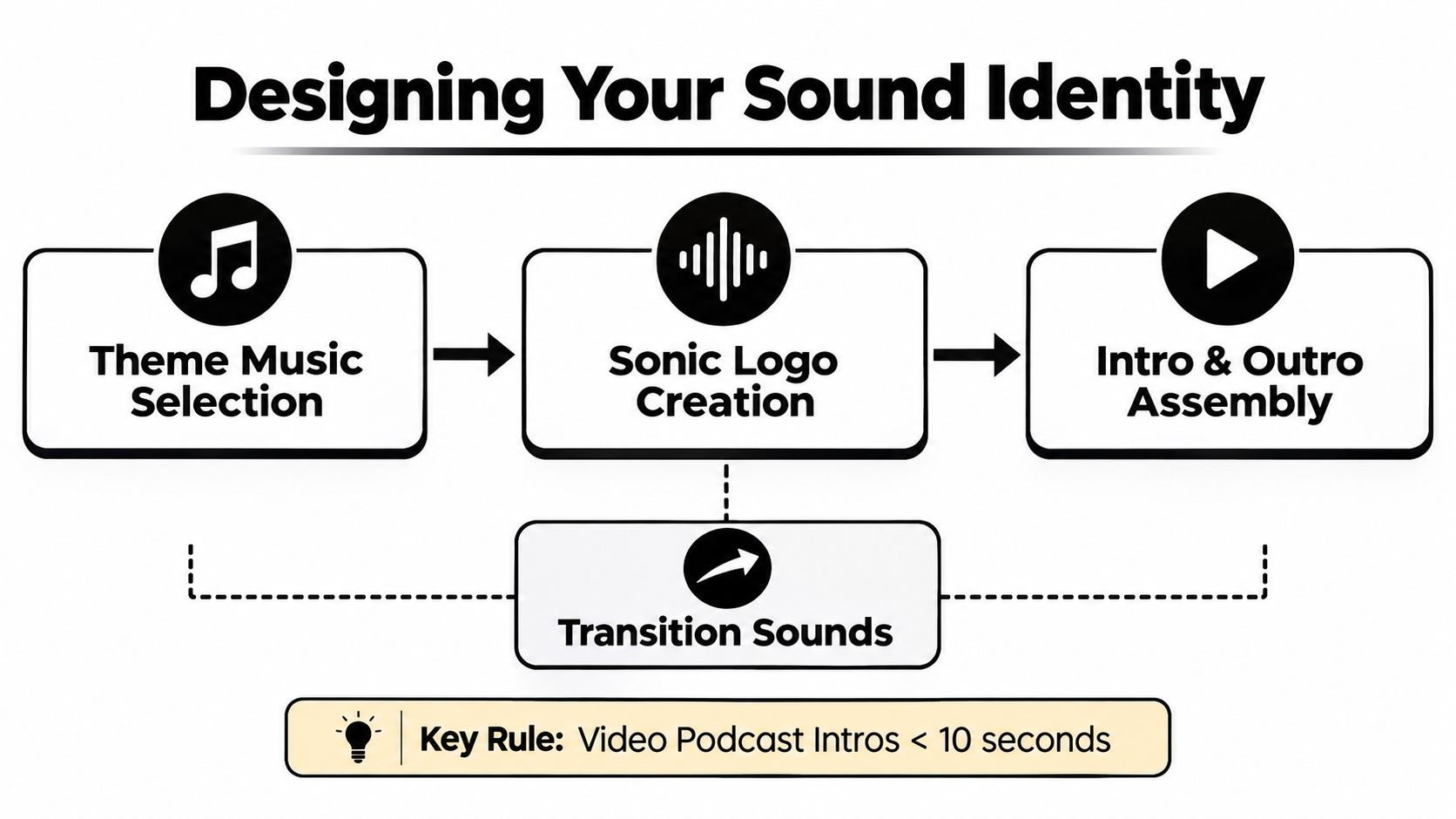
Good sound identity stays controlled. Start with music that matches the show's emotional tone, then add a short sonic logo or stinger that can return at the top of episodes and in clips. If you use transitions, keep them in the same family so the show feels designed instead of assembled from unrelated effects.
Rights come first before taste. If you are choosing music for a branded show, guide to podcast music licensing gives useful context before you commit to a track that cannot legally travel with your content.
Keep the intro short and the voice consistent
The practical rule here is simple, intros should stay under 30 seconds for audio and under 10 seconds for video podcasts. Anything longer starts to work against the brand, because listeners want a fast payoff, not a long setup. That timing also matters when the show is clipped for social or embedded on a website.
The host's delivery carries the brand from there. A steady cadence, a familiar opening phrase, and a disciplined outro create a pattern people recognize in the car, on a phone, or with the screen off. The show starts to feel like a place, not just a file.
Flexwork's acoustically treated rooms and production team help here because sound identity is easier to protect when the recording environment is already clean. A controlled room gives the intro, dialogue, and outro a consistent base from the first session, and that matters more than trying to fix everything after the fact in post.
The strongest audio brands do not ask listeners to remember everything, they give them a repeatable pattern to latch onto.
Turn the brand into a one-page style guide
Once the voice, look, and sound are set, capture them in a style guide. Keep it simple enough that a producer, editor, or guest coordinator can use it without translation.
A strong guide should include:
- Tone of voice, formal, relaxed, conversational, sharp, or polished.
- Vocabulary do's and don'ts, words the host uses often and phrases to avoid.
- Episode structure templates, opening, core segment, guest cue, outro.
- Guest onboarding rules, how guests are introduced and prepped.
- Clip editing standards, captions, pacing, and visual framing.
That document becomes the operational backbone when the show scales. If the host brings on a producer or hands off editing later, the brand still holds because the decisions are written down. The four brand pillars from The Podcast Host, value proposition, target audience, consistent message, and creative assets, are the framework the style guide protects.
For creators who are tightening recording quality and cleanup, Flexwork's audio quality resource is a useful companion before locking the final sound.
If the sound identity is sloppy, the whole brand feels cheaper than it should. If it is disciplined, the show sounds established before anyone checks the thumbnail.
Prepare Trailer, Distribution, and Launch Channels
A strong trailer does one job very quickly. It tells a new listener what the show is, why the host matters, and what kind of payoff they'll get if they subscribe. Keep it tight, usually somewhere around a minute or so, and make every sentence earn its place.
Distribution needs the same level of care. Riverside explains that creators upload audio or video to a hosting platform, then push the content to directories through an RSS feed, including Apple Podcasts, Spotify, YouTube, and Amazon Music (Riverside). That workflow matters because a branded podcast isn't just a recording, it's a published media asset that has to land in the right places.
Build the launch hub, not just a link
A podcast website gives the brand a home base that social media can't replace. It can capture email signups, embed the feed, and point listeners to trailers, show notes, and episode archives without forcing them to bounce around between apps. For creators who want that level of polish, Flexwork's podcast website package is $5000 plus hosting, which positions the show as a launch hub rather than a link-in-bio shortcut.
That matters because listeners don't always enter through the same door. Some start on YouTube, some on Spotify, some through a guest appearance, and some through a search result. A clean website keeps the brand coherent no matter where they land.
Practical rule: if the trailer, feed, and website don't tell the same story, the launch feels fragmented.
The launch checklist should include the trailer, the podcast page, the RSS setup, and clear calls to subscribe. Once that foundation is in place, the show looks like a brand, not a collection of uploads.

Promote With Social Clips, Guests, and PR
A brand only matters if people keep seeing it. Promotion is where the show stops being a private creative project and starts becoming an audience-growth asset, especially when clips, guests, and outreach all carry the same visual and verbal identity.
The easiest mistake is to treat launch week like the whole strategy. A sharper approach is to build a repeatable promotion engine around short-form clips, guest bookings, and cross-platform distribution. Revid.ai's guide on how to create engaging videos from podcasts is a good reminder that the clip is not a leftover, it's a core asset when the show is meant to travel on social.
Use clips to extend the brand, not dilute it
Short-form content works best when it reinforces the same positioning as the full episode. The visuals should echo the cover art, the captions should match the show's tone, and the hook should sound like the host. If the clips feel like they came from a different brand, they'll pull attention without building memory.
That's where the Market, Manage & Produce My Podcast package becomes relevant. It starts at $1500 per episode with a 20-episode growth commitment, and Flexwork's in-house digital marketing team handles the campaign end to end. For hosts who want audience growth tied to production quality, that setup keeps the brand voice consistent across episodes, clips, and outreach.
Use guest strategy to widen the brand without confusing it. The best guest bookings usually come from curated networks, aligned audiences, and a clear reason that person fits the show's promise. PR works the same way, the pitch has to explain the hook quickly enough that the outlet understands why the episode matters now.
Measure the metrics that tell the truth
Branding should be judged by what people do after they encounter the show. The metrics worth watching are retention rate, average listen time, completion rate, social mentions, and branded search lift, with visibility through Apple, Spotify, and YouTube analytics. Those numbers tell you whether the identity is pulling people deeper into the show or just generating a fleeting click.
One branded-podcast exposure has been associated with lifts in brand awareness by 89%, brand consideration by 57%, favorability by 24%, and purchase intent by 14% in independent research cited in branded-podcast coverage (IAB creator-economy guide). That's why consistent promotion matters more than a single spike at launch. The exposure only compounds when the brand shows up repeatedly in a form people can recognize.
A clean review cadence helps too. Check the show on a 30-60-90 rhythm, then refresh artwork, intros, or positioning if the data suggests fatigue. That doesn't mean rebranding every time numbers wobble, it means staying alert enough to protect the parts of the brand that listeners remember.
If you want the production handled by a team that treats branding as infrastructure, book a free tour at Flexwork Studios or look at the Be My Podcast Producer package before your next season goes live.
Flexwork Podcast Studios gives you the room, the production support, and the launch infrastructure to turn a podcast into a real brand instead of another disposable feed. If you want help with studio rentals, production packages, Content Day sessions, or a podcast website that supports the show from day one, visit Flexwork Podcast Studios and book a tour.