

Marketing Agency Pricing Packages Explained for Creators
 September 12, 202624 Minutes
You've spent the week recording, editing, writing captions, resizing clips, and trying to make every platform feel intentional. Then an invoice arrives with vague line items, the next month's scope changes, and your content still doesn't look as consistent as you want. For podcasters, founders, and upwardly mobile creators, the problem isn't finding an agency. It's understanding what marketing agency pricing packages buy.
This guide breaks down the six common pricing models, real market ranges, package tiers, hidden costs, and the questions that make proposals easier to compare. The creator lens matters because a podcast isn't just a campaign. It's a recurring production system involving recording, editing, visual content, distribution, brand consistency, and audience growth. Flexwork Podcast Studios in Springfield, NJ provides a useful context for connecting those agency economics to practical studio and production choices.
Introduction Why Pricing Packages Feel Confusing for Creators
A creator can start with an hourly editor, add a social media freelancer, hire a web designer, and still end up managing the entire operation. Each vendor may deliver competent work, yet the show can feel fragmented. Audio quality varies, visual branding drifts, clips arrive late, and the host spends more time coordinating production than developing ideas or building relationships.
That's where pricing confusion starts. One provider quotes an hourly rate. Another proposes a monthly retainer. A third offers a fixed package with a polished name but no clear revision policy. The cheapest headline number may exclude editing, paid distribution, software, guest coordination, or the reporting you need to decide what's working.
A strong package should feel less like a pile of tasks and more like a dependable operating system. You're paying for the people, process, judgment, and deliverables that keep your content moving without forcing you to become a project manager.
The useful question isn't “What does the package cost?” It's “Which responsibilities does the package remove from my plate, and what does it produce consistently?”
The market gives creators several reference points. A 2026 pricing benchmark places ongoing agency retainers broadly between $5,000 and $50,000 per month, while Clutch reports pricing across more than 100,000 agencies worldwide and average project costs in the $10,000 to $49,999 range, as detailed in this marketing agency pricing benchmark. Another 2026 benchmark places generalist agencies at $2,500 to $12,000 per month and growth agencies at $6,000 to $25,000 per month, reinforcing that scope, specialization, and channel count shape the offer.
You don't need to copy a traditional agency model to grow a show. You do need to understand how the model works, identify the deliverables that matter, and match the commitment to your current goals. The sections ahead give you a practical way to do that, including a creator-focused package template you can use on sales calls.
How Marketing Agency Pricing Really Works
Agencies bundle services because marketing outcomes rarely come from one isolated task. A strong campaign may require positioning before copy, creative before media placement, and reporting before the next optimization. Selling those pieces together gives the client continuity and gives the agency a clear operating rhythm.
Think of the difference between renting access to a production system and buying disconnected sessions. An hourly arrangement is like booking a personal training session whenever you feel stuck. A retainer is closer to a gym membership with planned coaching, equipment access, progress tracking, and a routine that keeps you from starting over every week.

The four ingredients behind most packages
Most ongoing packages combine four working layers:
- Strategy: Research, positioning, audience definition, campaign planning, and decisions about what deserves attention.
- Creative: Copy, design, video, photography, show branding, landing-page assets, and content adaptation.
- Media: Paid placement, distribution, channel management, and budget coordination where relevant.
- Reporting: Analytics, performance reviews, recommendations, and optimization based on agreed metrics.
A podcast version might begin with episode planning and guest positioning, move into a recorded conversation and edited video, then continue through short-form clips, captions, distribution, and performance review. The exact mix changes the price because every added channel introduces production, review, and management work.
Scope creates the price
A narrow package can be standardized. For example, an offer might cover a defined recording block and a fixed set of edited assets. A broader engagement may include strategy, multi-channel execution, website work, paid media, community management, and reporting. The more moving parts you include, the more valuable coordination becomes, but the more carefully the scope must be written.
Specialization matters too. A team managing paid campaigns may use an ad-spend-based fee, while a production team may charge for studio time, editing, creative direction, and delivery. Flexwork's marketing agency service illustrates the broader principle: buyers should evaluate the complete workflow, not just the visible task list.
Why retainers feel predictable
A fixed monthly retainer sets a recurring fee for a defined scope. It can include planned deliverables, recurring meetings, access to specialists, and a reporting cadence. That predictability helps a creator plan production and helps an agency reserve capacity.
Retainers still need boundaries. A clear package states how many assets are included, how revisions work, what happens when deadlines move, which platforms are covered, and which third-party costs sit outside the fee. Predictability comes from the contract, not from the word “retainer.”
The Six Pricing Models Every Creator Should Know
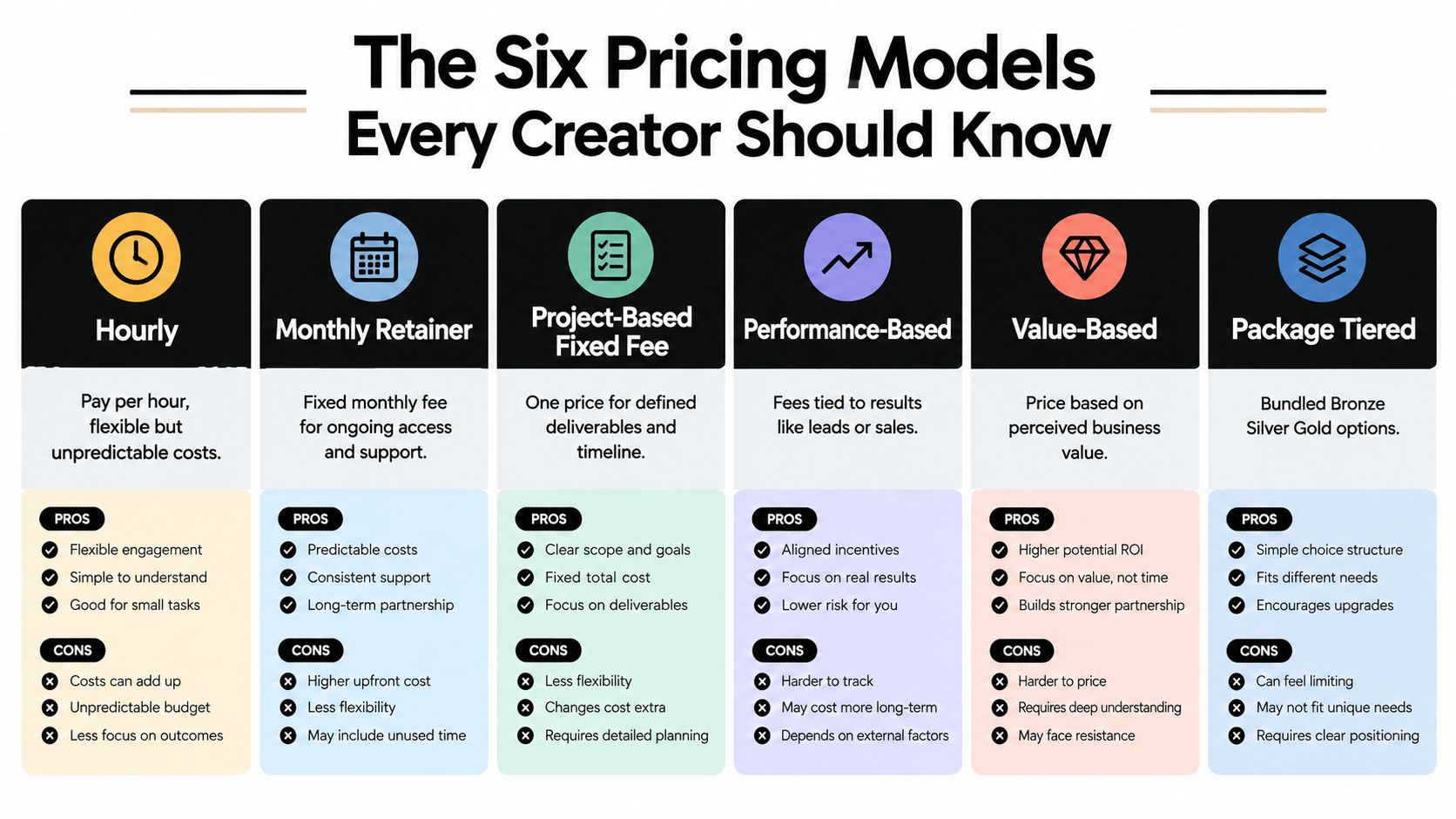
Creators usually encounter six pricing models: hourly, monthly retainer, project-based fixed fee, performance-based, value-based, and hybrid. A tiered package is the visible format placed over one of these structures. The model determines how payment connects to time, deliverables, outcomes, or risk.
Hourly pricing
Hourly pricing charges for tracked time. It suits consulting, audits, troubleshooting, or occasional production help when the scope is still uncertain. The tradeoff is a changing final bill, and speed can be difficult to assess.
A 2026 agency pricing study found that 36% of agencies charged $175 to $199 per hour and 32% charged $200 to $249 per hour, placing 68% in that combined range, according to Agency Pro's pricing statistics. The same source reports a 2024 national average of $82.66 per hour and a median of $84.40, illustrating how rates vary by specialization and market.
Monthly retainers
A monthly retainer provides ongoing access and defined work for a recurring fee. It fits a podcast with a regular publishing schedule, recurring social content, continuous SEO, or paid media management.
Retainers work best when the creator needs consistency, not just occasional rescue work.
For a creator, the practical question is whether the retainer reserves a dependable production rhythm. A turnkey studio package may apply the same logic through scheduled recording, editing, and delivery, provided those outputs are written clearly.
Project-based fixed fees
A fixed fee covers a defined outcome for one agreed amount, such as a website, brand system, launch campaign, or batch of video assets. It gives you a clear budget. Revisions, extra formats, and timeline changes should be specified before production begins, much like a recording block with a stated set of edited files.
Performance-based pricing
The agency's fee is connected to an agreed result, such as qualified leads, sales, or another measurable conversion. This can align incentives, but attribution must be clear. A podcast may build awareness, relationships, and trust without producing an immediately trackable transaction, so performance pricing will not suit every creator goal.
Value-based pricing
Value-based pricing reflects the perceived business value of the engagement instead of time or production volume. It may fit a major launch, premium positioning, or high-value funnel. The agreement needs clear assumptions about outcomes, ownership, responsibilities, and what the client considers meaningful value.
Hybrid pricing
A hybrid offer pairs a stable base with a variable component. A creator might pay a fixed production fee plus media management, or a retainer plus an agreed performance incentive. Monthly retainers remain common at 62%, while performance-based pricing was reported as growing 7% year over year and project-based pricing declining 3% year over year, according to Digital Applied's 2026 pricing analysis.
Commitment length also affects risk. SleekPost's explanation of no commitment pricing provides context for evaluating flexible arrangements. If you need a controlled recording environment rather than a broad growth engagement, review Flexwork's podcast studio rental rates and compare the included studio access, production support, and deliverables.
What Agency Packages Include and What They Actually Cost
A creator can pay for the same broad goal through very different scopes. A starter package may cover one channel, a set number of edits, limited meetings, and basic reporting. A growth package adds planning, coordination, and optimization. Full-service work can bring together senior strategy, several channels, creative production, media management, and detailed reporting.
Independent 2026 benchmarks place ongoing agency work in the US, UK, or Western Europe at about $2,500 to $30,000 per month. Small-business retainers often fall between $5,000 and $10,000, with a median range of $5,000 to $8,000, according to Searchlab's marketing agency cost guide.
Another guide places boutique B2B agencies at $3,000 to $5,000 per month, mid-market agencies at $5,000 to $25,000, and full-service agencies at $15,000 to $40,000 or more, as outlined in Agency Pro's agency cost breakdown.
Agency Package Tiers Compared by Price and Scope
| Package Tier | Typical Monthly Price | What Is Included | Best For |
|---|---|---|---|
| Narrow starter | $2,500 to $5,000 | A limited channel mix, standardized production, basic reporting, and defined support | Creators testing a repeatable workflow |
| Growth package | $5,000 to $25,000 | Strategy, multi-channel execution, creative coordination, optimization, and regular reporting | Established shows building a consistent audience system |
| Full-service engagement | $15,000 to $40,000 or more | Broader strategy, multiple specialists, creative production, media management, and deeper analytics | Brands and creator businesses with complex growth needs |
The table also explains why price alone gives an incomplete picture. A lower tier can solve a specific bottleneck, such as editing clips or managing one distribution channel. It becomes a poor fit when a creator expects that same fee to cover recording, post-production, publishing, audience growth, and campaign management.
Hourly rates and package design
Hourly economics sit behind many package structures. Agencies may sell time through retainers, fixed project fees, or value-based arrangements. For buyers, those choices appear as monthly service levels, milestones, revision limits, or defined deliverables rather than an internal timesheet.
Public price information remains limited. A 2026 index found that only 16% of listed agencies publish a price, with disclosed retainers ranging from $500 to $50,000 and a median disclosed retainer of $2,000, according to FindAgencyHQ's agency index. Ask what the package excludes, who handles revisions, how quickly the team responds, and whether strategy time is included.
For creators building a local audience, how The Leo Lair attracted local followers shows why relevance and distribution deserve attention alongside production quality. A podcast package should connect those pieces clearly, from recording support to finished assets and publishing tasks. Compare those creator-focused deliverables in Flexwork's package breakdowns, where the offer is organized around defined production outputs rather than an open-ended agency scope.
Podcast and Video Production Pricing Made Simple With Flexwork Studios
Traditional agency packages often separate strategy, creative, media, and reporting. Podcast production packages translate those same layers into a more tangible workflow: record the show, polish the episode, create visual assets, distribute the content, and support audience growth.
Start with the production unit
Hourly studio rental fits a creator who needs a professional setting, reliable equipment, and speed without committing to a broader marketing operation. It's the production equivalent of buying access to the room and tools while keeping editorial and distribution decisions in-house.
A Content Day creates a larger batch of assets from one planned session. Flexwork's 2025 Services PDF lists Content Days at $3,000 per day, including 20 edited reels or 60 professional photos. That's a productized structure: the investment is connected to a clear production day and a defined output rather than an open-ended time log.
Add the brand infrastructure
A podcast website gives the show a permanent home for episodes, positioning, guest information, and conversion paths. Flexwork lists podcast websites at $5,000 plus hosting, according to the same 2025 Services PDF. That belongs closer to a fixed-fee project because the scope should be defined around structure, design, copy, integrations, and launch responsibilities.
For a creator who wants a connected production workflow, Flexwork's podcast production services and pricing shows how recording, editing, branding, distribution, and marketing can be evaluated as one system rather than as disconnected invoices.
Match the package to the ambition
The Market, Manage & Produce My Podcast tier starts at $1,500 per episode with a 20-episode growth commitment, according to the 2025 Services PDF. It combines production with paid and organic marketing strategy, making it a longer-term, hybrid-style commitment for creators who want audience development considered alongside episode delivery.
Use this simple creator package template when reviewing any proposal:
- Core production: Where will recording happen, and who handles audio, video, editing, and delivery?
- Content output: How many clips, photos, episodes, captions, or formats are included?
- Brand layer: Does the package include show branding, motion graphics, templates, or a website?
- Distribution: Who publishes episodes, manages platforms, and coordinates promotional assets?
- Growth layer: Which marketing channels, audience actions, and reports are included?
- Commitment: Is the offer hourly, project-based, recurring, performance-linked, or hybrid?
The cleanest package is the one you can explain in a single paragraph without apologizing for missing details.
How to Evaluate Compare and Negotiate Any Package Like a Pro
A proposal should make responsibility visible. Before discussing a discount, ask the provider to separate what they'll deliver, what you'll approve, and what another vendor or platform must supply.
Read the scope before the price
Start with deliverables. Confirm episode length assumptions, recording time, edit style, number of short-form assets, revision rounds, turnaround expectations, publishing responsibilities, and approval deadlines. If the document says “social media support,” ask which platforms, what content format, and who writes the captions.
Third-party costs deserve their own line. Paid media budgets, stock licenses, hosting, software, talent, travel, and platform fees may sit outside the agency fee. PPC management is commonly priced at 10% to 20% of ad spend, according to Uley Marketing's 2026 US agency pricing benchmark, so separate media-buying fees from strategy, creative, analytics, and optimization.
Protect access and ownership
Request direct access to advertising accounts, analytics, podcast hosts, website platforms, and social profiles. Ask whether the agency owns the account, whether you receive editable creative files, and what happens to your assets if the relationship ends.
An audit clause can clarify invoices, platform charges, vendor costs, and media spend. You don't need adversarial language. You need enough visibility to understand where your money goes.
A polished proposal can still be incomplete. Treat exclusions, access rights, and exit terms as part of the product.
Use this sales-call checklist
- Scope clarity: Are deliverables, revisions, deadlines, and approval steps written down?
- Third-party costs: Are ad spend, hosting, stock assets, and platform fees excluded or included?
- Markup transparency: Does the provider explain vendor charges and markups?
- Ownership rights: Who owns accounts, source files, footage, designs, and website content?
- Performance metrics: Which KPIs will be reported, and how often?
- Exit terms: What's the contract length, notice period, cancellation policy, and asset handoff process?
For creators comparing a local production partner, Flexwork's podcast production company resource can help frame the conversation around studio access, production support, and deliverable ownership. Negotiate clarity first. A narrower package with precise boundaries is often more useful than a broad package that leaves every important detail open.
Choose Your Growth Package and Book With Flexwork Studios
The right marketing agency pricing package should match your current bottleneck. If you need a controlled environment and faster recording, hourly studio rental may be the cleanest choice. If you need a concentrated library of visual assets, a Content Day turns one production block into a defined batch of reels or professional photos. If your show needs a stronger home base, a podcast website creates a dedicated destination for the brand.
Creators pursuing sustained audience growth need to assess commitment differently. Flexwork's Market, Manage & Produce My Podcast package starts at $1,500 per episode with a 20-episode growth commitment, combining production with paid and organic marketing strategy. That structure makes sense when consistency, distribution, and ongoing creative quality matter more than occasional publishing bursts.
Flexwork Podcast Studios operates in Springfield, NJ, with acoustically treated podcast and video studios, professional audio and cinema equipment, editing, motion graphics, show branding, distribution, websites, and growth-focused marketing support. The useful comparison isn't between a cheap invoice and an expensive invoice. It's between a fragmented workflow and a defined production system that fits the way you want to grow.
Book a studio session, explore production packages, or request a tour through Flexwork Podcast Studios. Bring your publishing goal and preferred level of support, and the team can help you shape a clear package around recording, content production, branding, and audience growth.