

You've finally carved out time to record. The microphone is ready, your notes are open, and then the air conditioner starts humming, a neighbor closes a door, or your home office throws a bright echo back into every sentence. A soundproof booth for recording seems like the obvious answer, but the right solution isn't always a booth. It might be a carefully treated room, a purpose-built enclosure, or a professional studio session that lets you focus on the content instead of construction.
This guide breaks down how recording booths work, what their specifications really mean, and where comfort, ventilation, and workflow enter the decision. You'll also get a practical way to compare buying, building, and booking, with Flexwork Podcast Studios in Springfield, NJ, as an option for creators who want polished production without DIY burnout. By the end, you'll know what to check before spending money and when a studio rental can deliver better creative and business value.
Introduction Why Your Recording Space Makes or Breaks Your Sound
Maya runs a growing interview podcast from a stylish apartment. Her microphone is capable, her camera looks sharp, and her ideas are strong. Yet every recording begins with the same routine: pause for the elevator, wait for the traffic, stop when the HVAC kicks on, then edit out the room echo that makes the conversation sound distant.
That cycle drains more than time. It interrupts momentum, makes guests less natural, and turns a simple episode into a technical cleanup project. A soundproof booth for recording can reduce those distractions, but it won't automatically create a broadcast-ready result. The booth has to block external noise, control reflections inside the enclosure, provide usable airflow, and fit the way you create.
The first question isn't “Which booth should I buy?” It's “What problem am I solving?”
- Outside noise: Traffic, voices, plumbing, elevators, and HVAC systems can raise the recording's noise floor.
- Room reflections: Bare walls and hard surfaces bounce speech back toward the microphone, creating echo and a boxy tone.
- Workflow friction: A booth that's uncomfortable, cramped, or difficult to ventilate may discourage consistent use.
- Production demands: A solo voice-over needs a different setup from a two-person video podcast, a musical instrument, or a full Content Day.
If air-conditioning noise is your immediate challenge, start with practical guidance on how to reduce air conditioner noise before assuming you need a permanent enclosure. That diagnosis can prevent an expensive purchase that treats the wrong issue.
Flexwork Podcast Studios in Springfield, NJ, offers a different path for entrepreneurs and podcast professionals. Instead of owning every piece of infrastructure, you can record in acoustically treated rooms with professional audio and cinema equipment, then add services such as editing, branding, distribution, or short-form content support. The decision becomes less about owning a box and more about choosing the production environment that protects your time, quality, and creative energy.
What a Soundproof Booth for Recording Really Is and How It Works
A recording booth performs two separate jobs. The first is isolation, which limits sound traveling in or out. The second is acoustic treatment, which manages the sound produced inside. Confusing these jobs is the reason many buyers feel disappointed after installing foam panels or purchasing a booth marketed as “soundproof.”
Think of isolation as a security door. It creates a barrier between your microphone and the outside world. Mass, airtight seals, layered construction, and decoupled surfaces help reduce sound transmission. Treatment works more like interior design for sound. Absorptive materials reduce the reflections that would otherwise bounce between the walls and return to the microphone.
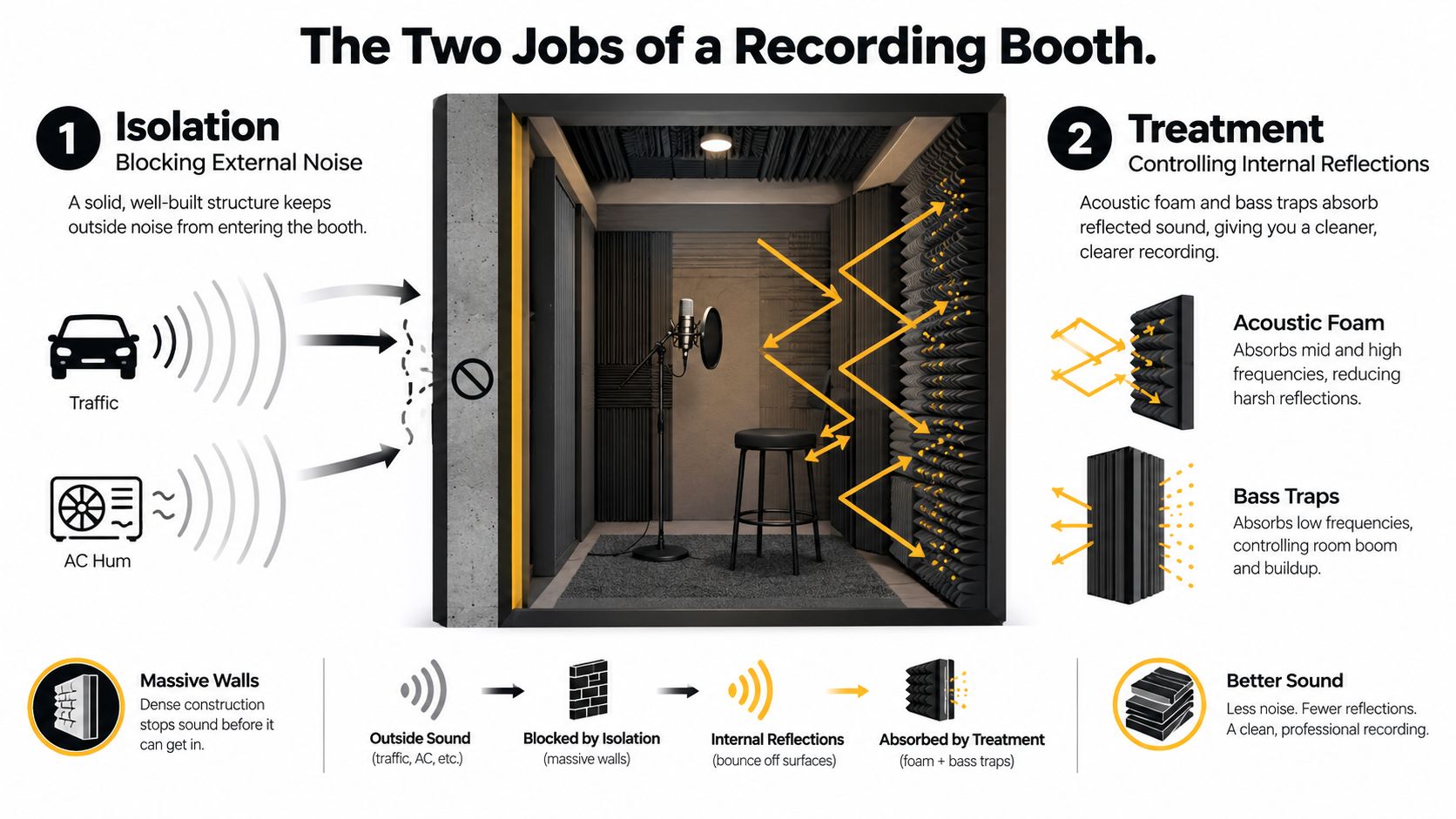
The targets behind a clean vocal
Professional vocal booths commonly target RT60 values of 0.1–0.2 seconds, which describes how quickly sound energy decays after a voice stops. They also aim for background noise around NR 10–15, while broader recording spaces often target NR 15–20 and control rooms around NR 15, approximately 20 dBA. These reference points are discussed in professional studio guidance connected with ISO 3382-2 and related recording-studio recommendations.
You don't need to memorize those labels. The practical translation is simple: speech should stop cleanly, pauses should stay quiet, and the microphone should capture your voice rather than the room's personality.
Geometry matters as much as the wall
A booth's dimensions influence how reflections behave. A commonly cited minimum vocal-booth footprint is about 2.0 m × 1.8 m, with a ceiling height of at least 2.4 m and a volume of 8.6 m³. Those dimensions illustrate why a booth isn't just a small box with thick walls. The enclosure needs enough usable geometry for the microphone, performer, lighting, movement, and controlled reflection patterns.
For a deeper look at the building principles behind isolation, review Flexwork's guide to how to soundproof a room. The important takeaway is that a successful recording environment balances barriers, seals, absorption, and proportions. Foam alone won't stop a truck outside. A heavy enclosure with a reflective interior won't necessarily produce an intimate vocal.
Types of Soundproof Booths Compared for Podcasters and Creators
Creators usually choose among four approaches: portable booths, prefab enclosures, DIY builds, and modular room-within-a-room systems. Each can make sense, but the best fit depends on your source, location, recording frequency, and whether you need one voice or a collaborative set.
Portable booths are attractive for voice-over artists, remote professionals, and creators who record in more than one location. They can improve reflection control and reduce some leakage, but they're rarely fully soundproof. Many portable and acoustic booths reduce noise or leakage by roughly 25–45 dB, depending on construction quality, as summarized by this 2026 guide to portable and professional acoustic booths. That's meaningful, but it isn't the same as total silence.
Prefab booths arrive as designed systems with walls, doors, ventilation, and treatment components. They offer a more predictable workflow than DIY and can suit solo podcasts, narration, and controlled vocal work. A modular room-within-a-room solution goes further by creating a separated enclosure, making it more appropriate when stronger isolation, louder sources, or multiple people are involved.
DIY construction can be the most adaptable route, especially when you already have a suitable room and practical building skills. It also carries the greatest risk of weak seals, poor ventilation, unsafe materials, and disappointing low-frequency performance.
| Booth Type | Isolation Level | Treatment Included | Best For |
|---|---|---|---|
| Portable | Moderate and highly variable | Often partial | Voice-over, travel, remote work |
| Prefab | Stronger and more consistent | Usually integrated | Solo podcasts and vocal recording |
| DIY | Depends on design and execution | You choose the materials | Budget-conscious owners with a suitable room |
| Modular room-in-room | Highest potential | Designed as a complete acoustic environment | Loud sources, multi-person work, serious studio use |
Use the table as a starting point, not a promise. Ask vendors for tested isolation results, frequency-specific data, door details, and ventilation noise. A product that performs well for speech may not contain bass-heavy music, a guitar cabinet, or an enthusiastic multi-person conversation.
Understanding STC NRR and Acoustic Treatment Inside the Booth
Acoustic specifications become useful once you connect each one to a real recording problem.
STC, or Sound Transmission Class, describes how effectively a building element blocks airborne sound across a defined testing method. A higher result generally means less external speech and room noise reaching the interior. Rw serves a similar role in many international specifications. One recording-acoustics guide places home and podcast studios around Rw 45–55 dB, while professional studios target Rw 55–65 dB, with room-within-a-room construction used toward the higher end. Those targets are outlined by Sound Zero's recording-studio acoustics guide.
NRC, or Noise Reduction Coefficient, addresses absorption inside the room. It tells you how much sound energy a material absorbs rather than reflects. A practical booth benchmark pairs STC 45 isolation with high interior absorption, such as NRC 0.90, for vocals, instruments, and voice work, according to this isolation-booth specification guide.
The useful distinction: STC helps keep the outside world away from the microphone. NRC helps keep your own voice from bouncing back into it.
Why frequency changes the result
Isolation isn't equally difficult across the frequency range. A single-walled booth research example reports attenuation of about 23.7 dB at 125 Hz, 30.7 dB at 250 Hz, and 54.7 dB at 8,000 Hz, showing why low-frequency noise is harder to block. Traffic rumble, HVAC vibration, and mechanical equipment can remain audible even when a booth handles higher-frequency sounds effectively.
A commercial booth line reports certified average isolation of 45–47 dB, with peak sound reduction reaching 62 dB depending on frequency. These figures show why construction layers and decoupling matter more than the presence of foam alone. Testing also matters. A standardized method for soundproof furniture ensembles and booths was completed after proposal work began in 2017, was internationally accepted in 2018, and was completed by 2020, creating a more consistent basis for comparing isolation claims. The commercial and testing context is documented by StudioBRICKS' recording-booth resource.
Before you buy, learn how to reduce background noise at the source and during editing. Software can help with residual noise, but it can't fully repair room reflections, distorted speech, or a ventilation system that runs through every pause.

For a practical explanation of what absorbers, diffusers, and bass control do in a working room, see Flexwork's guide to acoustic treatment. The goal isn't to collect impressive ratings. It's to create a room where speech stays intelligible, pauses stay quiet, and the recording needs less repair.
Size Ventilation and Comfort Essentials You Cannot Ignore
A booth can perform well on paper and still fail in daily use. If the performer feels cramped, overheated, poorly lit, or disconnected from the recording system, the enclosure becomes a barrier to consistency rather than a tool for better work.
A commonly recommended minimum vocal-booth footprint is about 2.0 m × 1.8 m, with at least 2.4 m of ceiling height and a volume of 8.6 m³, according to recording-studio design guidance. Treat those figures as a reference point, not a universal layout. A solo voice-over setup may need less movement than a video podcast with cameras, lights, a stool, a monitor, and a guest.

Ventilation can become the loudest problem
Sealing a booth reduces air exchange, so ventilation isn't an accessory. Builders commonly use lined ducts or baffled vents to move air while limiting sound leakage, as described in this soundproof-booth construction guide. A commercial isolation-booth specification lists ventilation noise at 22 dB(A), which provides a useful target when you're comparing systems.
Once the walls are highly isolated, a fan or duct can become the dominant sound during quiet passages. Ask whether the stated ventilation rating was measured inside the booth, how airflow is maintained, and whether filters can be replaced without dismantling the enclosure.
Check the details people forget
Before committing, inspect the parts that shape the actual session:
- Door seals: Look for continuous compression seals and a threshold that closes cleanly.
- Power and connectivity: Confirm outlets, microphone paths, camera connections, and cable routing.
- Lighting: Make sure the fixture doesn't add audible electrical or mechanical noise.
- Maintenance: Schedule filter checks and inspect seals for compression, gaps, or wear.
- Reconfiguration: Consider whether the booth can move if your team, lease, or studio layout changes.
A thoughtful layout can make a compact room feel intentional. Flexwork's podcast studio design ideas can help you think through camera positions, set styling, lighting, and creator workflow before you lock in a footprint.
Costs Installation and When Renting a Studio Beats Owning a Booth
Ownership looks attractive because it promises access whenever inspiration arrives. The full calculation includes more than the enclosure. You also need delivery, assembly, electrical work, ventilation, microphones, lighting, furniture, acoustic verification, repairs, and the time required to keep the system ready.
A booth-ownership comparison may show an illustrative range from $2,000 to $10,000 or more, while the broader ownership breakdown can extend from $500 to $15,000 or more, depending on configuration and installation. Those figures appear in the provided comparison visual and should be treated as planning context, not a universal quote.
Match the investment to your recording pattern
Owning can make sense when you record frequently, have a stable location, need private access, and can manage technical upkeep. It becomes harder to justify when your production includes multiple guests, video sets, frequent reconfiguration, or a need for editing and distribution support after the session.
Renting shifts the cost from infrastructure to output. Flexwork Podcast Studios provides studio access with acoustically treated rooms, professional-grade audio and cinema equipment, and production services that can include sound mixing, video editing, motion graphics, branding, distribution, and marketing support.
For creators building a content engine, the service structure can matter more than booth ownership:
- Content Days: $3000/day, including 20 edited reels or 60 pro photos.
- Podcast websites: $5000 plus hosting.
- Market, Manage & Produce My Podcast: starts at $1500 per episode with a 20-episode growth commitment.
Hourly studio rentals suit a focused recording session. Producer packages make more sense when you want polished visual storytelling and less post-production responsibility. A market and management engagement fits a host who wants production connected to audience growth rather than treating each episode as an isolated task.
The right question is not whether renting feels less permanent. Ask whether a booth will generate enough reliable use to justify its installation and maintenance, or whether a professional room lets you publish sooner with fewer technical decisions.
Your Checklist for Choosing the Right Soundproof Booth or Studio Solution
Use this checklist before you sign a purchase order, start construction, or reserve a recording date.
Start with the sound problem
- Identify the source. Is the issue outside traffic, voices, HVAC, reflections, or all of them?
- Separate isolation from treatment. Confirm that the proposed solution blocks external noise and manages internal reflections.
- Request tested performance. Look for STC or Rw data, frequency information, test conditions, and door-seal details.
- Ask about low frequencies. Mechanical rumble and bass are harder to isolate than higher-frequency sounds.
Test the room as a person, not just a microphone
- Check the footprint. Confirm that the booth fits the performer, microphone, camera, lighting, and furniture you use.
- Listen to ventilation. Ask for the in-booth dB(A) rating and find out how ducts are lined or baffled.
- Inspect comfort systems. Verify lighting, power, connectivity, airflow, temperature control, and filter access.
- Plan for maintenance. Include seal inspections, filter replacement, hardware checks, and cleaning in the ownership decision.
- Consider your content format. A portable vocal solution may suit narration. Video podcasts, louder sources, and guest sessions may require a larger prefab or modular environment.
- Price the workflow. Add editing, reels, photos, branding, publishing, and marketing before comparing ownership with a studio session.
A booth is a strong fit when you need frequent solo recording in one stable location and are prepared to manage the enclosure. A professional studio makes more sense when speed, camera-ready production, guest comfort, and post-production support matter as much as isolation. For a broader preparation framework, use this podcast production checklist before your next session.
Flexwork Podcast Studios gives New Jersey and New York metro creators a way to record in treated, sound-isolated rooms without taking on a construction project. You can tour the space, compare hourly rentals with producer support, and choose a package that matches your publishing goals.
Flexwork Podcast Studios offers acoustically treated recording rooms, professional audio and cinema equipment, Content Day production, and end-to-end podcast support for creators who want clean sound without booth ownership. Visit Flexwork Podcast Studios to schedule a tour, reserve studio time, or explore a production package built around your next show.