

Marketing Agency for Small Business: A 2026 Buyer’s Guide
 July 27, 202621 Minutes
The invoice lands, the campaign is live, and the numbers barely move. Traffic looks busy, the report looks polished, and you still don't know whether the agency did anything that matters. That's the problem with hiring a marketing agency for small business. You're not buying posts, decks, or meetings, you're buying a result you can defend in front of your own budget. Flexwork Studios leans into that logic with a production-first model for creators and small teams in the NJ and NY orbit who want deliverables they can see, measure, and use.
The Quarter Where Marketing Stopped Working
It usually happens in a boring week. The ads are running, the social calendar is full, and the agency email arrives with cheerful language and a pile of screenshots that don't answer the only question that matters. Did this bring in qualified leads, booked calls, or trial signups?
That's the moment most founders realize they hired activity, not accountability. The U.S. Small Business Administration says firms should describe their target market, set marketing and sales goals, and compare marketing costs to the revenue generated, which is the right way to think about the purchase from day one. The buying decision is about return, not applause. The rest of this guide is built around four questions that matter, which model fits, what it should cost, how to vet it, and how to tell if it's working.
A production-led shop like Flexwork Studios makes this easier to evaluate because the output is tangible. You can review episodes, reels, shorts, websites, and campaign assets instead of being handed a vague promise and a dashboard nobody outside the agency understands.
Practical rule: if the work can't be tied to a business metric, it's not a marketing system. It's a content habit with an invoice attached.
What a Marketing Agency for Small Business Actually Does
A real agency is not a magic growth machine. It is an outside team that plans, produces, and measures the marketing work a small business cannot staff internally or cannot execute well enough on its own. Small businesses hire agencies to drive qualified leads, booked calls, and trial signups, not to keep a feed active for its own sake.
If a founder is only buying activity, the agency can stay busy forever and still miss the business goal. Good agency work starts with the outcome and works backward from there. That means deciding which channel matters, what result it should produce, and how the work will be judged before the first post, ad, or script goes live.
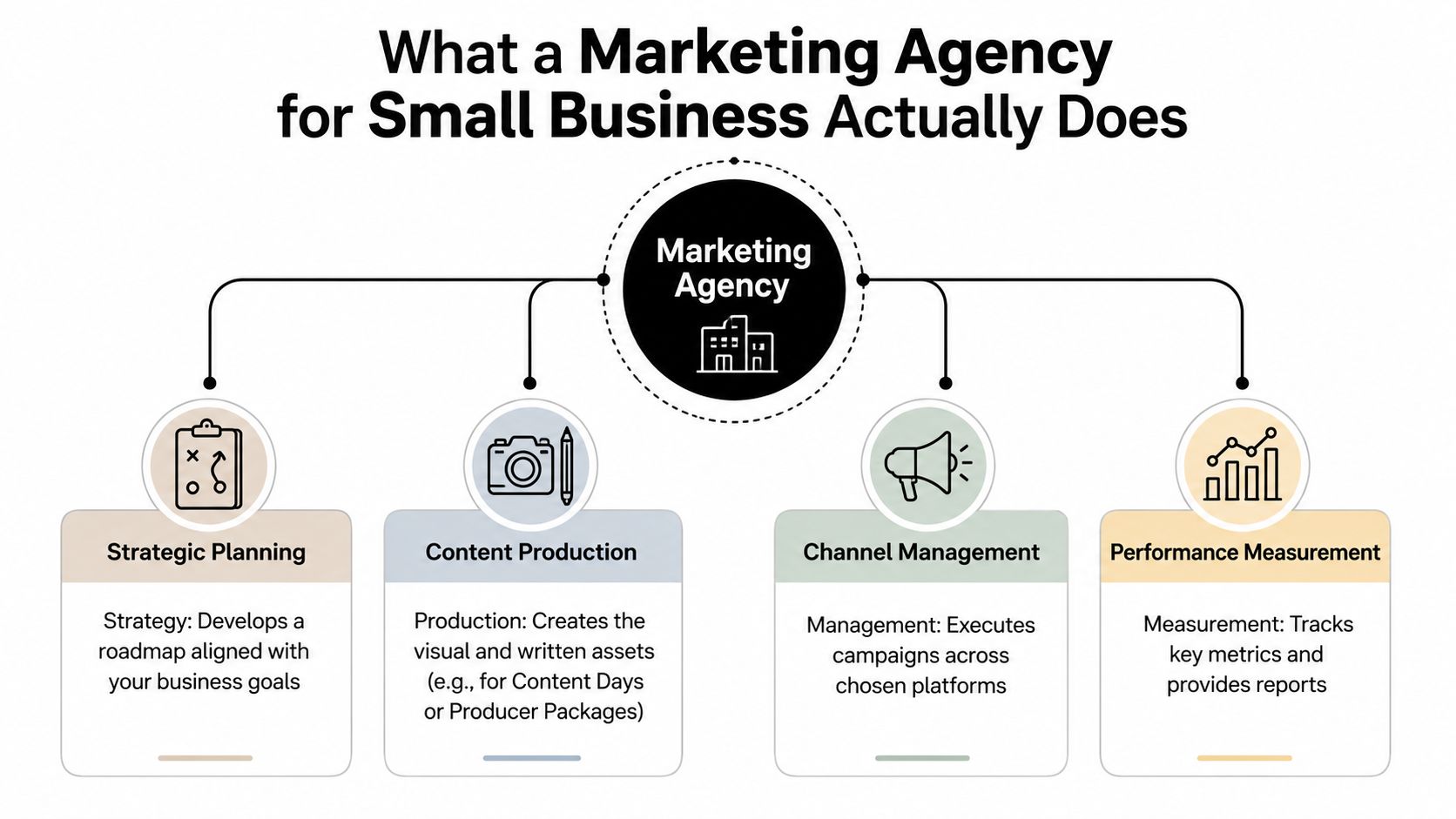
The four models you'll actually see
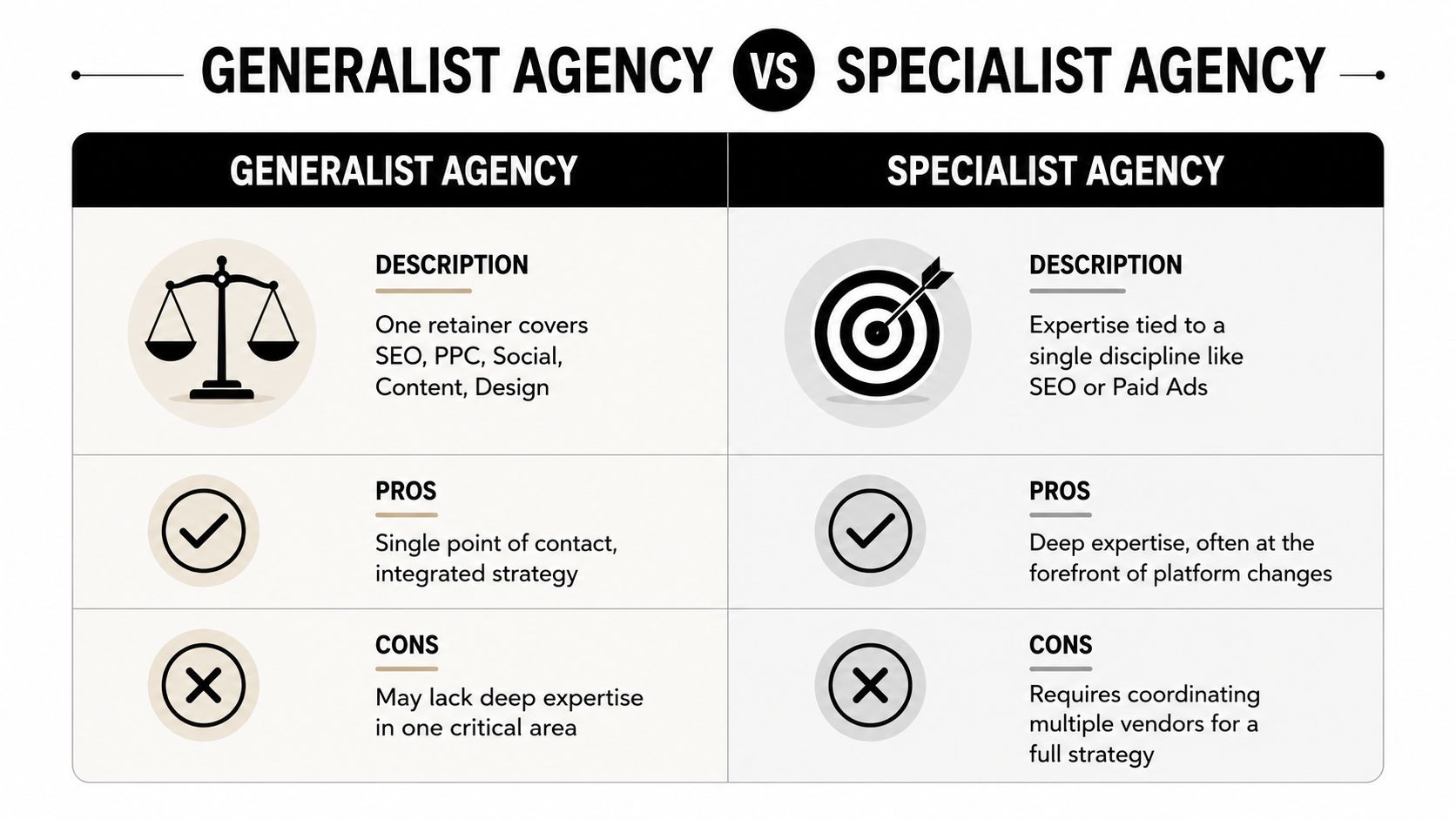
Full-service generalist. This is the agency that says it can handle SEO, paid ads, social, content, and design under one roof. A restaurant group that wants one partner for the whole stack often gets pitched this model, and it can work if one team owns the handoffs and the reporting.
Specialist channel agency. This firm lives inside one lane, like search ads, podcast production, or short-form video. A local coach hiring a team just to build authority through a video series is buying specialization, and that focus usually shows up in tighter execution and faster iteration.
Fractional or embedded team. This is a plug-in marketing department. A small startup with no in-house marketer gets strategy meetings, campaign management, and reporting without hiring full-time staff, which helps when the business needs leadership but is not ready to build the role internally.
Project-based studio. This model is built around a defined deliverable, such as a brand film, a launch campaign, or a podcast season. A content studio that records, edits, and packages a show is a clean example, and it is easier to evaluate because the output is visible from start to finish.
Good branding work makes every later agency conversation easier, which is why a practical branding guide belongs in the process early. If the agency cannot explain what business outcome the brand work should support, the relationship starts on weak ground.
The key distinction is simple. Agencies should be judged on what they move, not how busy they look. A clean structure on paper means nothing if the reporting never connects back to revenue.
Generalist Agency vs Specialist Agency
A generalist is useful when you need one team to coordinate several moving parts. A specialist is useful when one channel is the bottleneck and you want depth, not breadth. Small businesses get pushed toward the generalist option because it sounds safer, then discover they are paying for broad coverage and getting shallow execution.
Where generalists win
Generalists make sense if you want a single point of contact and you need help connecting multiple channels. A business with a messy handoff between brand, web, and paid media can benefit from one team owning the whole process. The tradeoff is simple, broad retainers often spread effort thin, and the reporting can get fuzzy fast.
Where specialists win
Specialists win when there is one urgent problem. If the issue is weak content quality, no video pipeline, or no podcast engine, a focused shop usually moves faster because the team repeats the same playbook and gets better at it. That matters when the budget is tight and the business cannot afford six disconnected experiments.
Flexwork is a clear example of the specialist model in practice, especially through its podcast production company page. The point is not that it covers every channel. The point is that it owns a narrow, measurable slice of the stack, production, packaging, and the content that follows, so a founder can judge output instead of listening to vague promises.
My take: if your problem is one choke point, do not buy a department. Buy the fix.
A solo creator usually needs the specialist. A business with multiple campaigns and no internal marketing lead often needs the generalist. The right choice comes down to accountability, channel focus, and whether the agency can show work that produces something you can measure.
2026 Pricing Benchmarks for Small Business Agencies
A founder who is comparing agency quotes should judge price the way the SBA suggests, by comparing marketing cost to revenue and checking whether the spend matches actual business outcomes. For firms under $5 million in revenue, a 2026 agency-evaluation guide says marketing budgets often land around 7% to 8% of revenue, with Gartner's 2026 broad average at 7.8%. That does not mean every company should spend that exact amount. It means quote shock should be measured against revenue and output, not gut feel. SBA marketing and sales guidance
What quotes usually look like
Small-business retainers usually cluster around $2,000 to $7,500 per month, while entry-level single-channel projects often start near $500 to $2,000. A quote below that range can work for a narrow task, but it usually cannot support senior strategy, content, media buying, and real reporting at the same time. A quote far above it only makes sense if the scope is unusually deep or the agency is acting like an embedded team.
What matters is whether the agency can tie the fee to a channel and a deliverable you can inspect. A vague monthly fee is hard to defend if you cannot point to a clear production rhythm, a publishing schedule, or a revenue-related metric the team owns.
How to sanity-check the proposal
Use this quick read on any pitch.
| Small Business Marketing Agency Pricing in 2026 | Typical 2026 Range | Best Fit |
|---|---|---|
| Entry-level single-channel project | $500 to $2,000 | One-off setup, audit, or launch support |
| Monthly retainer | $2,000 to $7,500 | Ongoing support with defined outcomes |
| Revenue-based planning benchmark | 7% to 8% of revenue | Small businesses under $5 million in revenue |
| Project deliverable example | Content Day at $3,000 per day | Shoot day with defined assets |
| Website build example | $5,000 plus hosting | Podcast website launch |
Flexwork's pricing page makes the difference between a retainer and a deliverable easy to see. A Content Day is quoted at $3,000/day and includes 20 edited reels or 60 pro photos, while podcast websites are $5,000 plus hosting. Those are project outputs, not fuzzy monthly promises.
The two pricing warnings I trust most are rock-bottom retainers and vague scopes. Cheap retainers usually cannot buy quality labor. Vague scopes make it impossible to tell whether the agency helped or just stayed busy.
The Vetting Checklist Every Founder Should Run
A shortlist is useless unless you can pressure-test it. I'd run every pitch through the same seven checks, in the same order, and I'd stop the conversation the moment the answers get slippery.

What good looks like
Industry and size fit. Good means they've worked with businesses close to your scale and complexity. Red flag, they only talk in broad categories like “we've done a lot of different things.”
Named account team. Good means you know who's leading strategy and who handles delivery. Red flag, you meet senior people in sales and never hear from them again.
Sample deliverables. Good means they'll show real reels, reports, photos, or campaign assets. Red flag, the portfolio is all mockups and no finished work.
Written scope. Good means deliverables, timelines, and responsibilities are spelled out. Red flag, the proposal sounds exciting but stays fuzzy on what gets shipped.
Transparent fee structure. Good means you can tell what you're paying for, what's included, and what's extra. Red flag, fees are bundled in a way that hides media spend or labor.
Reporting cadence. Good means the dashboard connects to revenue metrics like lead quality, customer acquisition cost, and conversion rate by channel. Red flag, the only numbers are reach and impressions.
Exit clause. Good means there's a clear 30 or 90 day way out if the fit is wrong. Red flag, the contract traps you before results are visible.
I'd also ask for two artifacts before signing. First, a recent client report with identifying details redacted. Second, a one-page measurement plan that names the metrics tied to revenue. If they can't produce those, they probably don't have a disciplined operating model.
Ask for proof, not reassurance. A polished pitch deck is not evidence.
Red Flags That Predict a Bad Fit
The fastest way to waste a quarter is to ignore the warning signs because the sales call felt friendly. A bad agency doesn't just miss targets, it usually tells you up front that targets won't matter.
End the conversation if you hear these
Guarantees of rankings or followers. No ethical agency can promise exact Google rankings or follower counts. If they do, they're selling fantasy.
Annual lock-ins without milestones. Long contracts without a performance-based exit are a power move, not a partnership.
Opaque fee structures. If "media" and labor are bundled together with no clean explanation, you won't know what's being optimized.
No named account lead. If nobody will own the account, nobody owns the results.
Generic decks. If the deck could be sent to any business in any industry, it's not a strategy. It's a template.
Resistance to sample reports. If they won't show you what reporting looks like, assume the reporting is weak.
The logic underneath all six is the same. If the agency can't explain how its work ties to qualified leads or booked calls, it's selling activity, not outcomes. That matters because one source notes that companies can save 10 to 20% by eliminating inefficient spend and reallocating it to higher-ROI activities, which makes measurement quality a direct profitability issue. Performance marketing insights on small and medium-sized businesses
For me, the simplest rule is this. If the agency can't tell you which metric will move, by how much, and by when, don't sign.
A Production-Led Agency Model in Practice
A specialist model works best when the deliverable is clear and repeatable, and the agency is accountable for shipping it. That is why podcast and video production often beats a broad retainer for small businesses that need assets they can publish, distribute, and review without chasing a new strategy call every week.
What the packages look like in the real world
Flexwork Studios in Springfield, NJ runs a production setup with acoustically treated rooms, cinema-grade equipment, in-house digital marketing, and a curated guest network. Its Be My Podcast Producer package is the straightforward entry point for creators and businesses that want broadcast-quality episodes, reels, and shorts without managing a production crew themselves. Its Market, Manage & Produce My Podcast package starts at $1,500 per episode with a 20-episode growth commitment, and it adds distribution, social campaigns, and growth strategy.
The model is easy to judge because the outputs are visible. You can count episodes, track edits, launch a podcast website, and see whether distribution and promotion support audience growth. You can also compare the studio process directly against the agency pitch, because the work is concrete instead of abstract. For a founder, that makes the review simpler. You are not guessing whether the agency stayed busy, you are deciding whether the content engine is producing enough to justify another season.
Flexwork's podcast production studio is the kind of offer that gives small businesses something real to inspect before they commit. That matters more than broad marketing theater, because the deliverable, the workflow, and the measurement all sit in the open.
Choosing Well and Starting the Conversation
Start with the bottleneck. If the issue is production, look at a studio-led model. If the issue is strategy, judge the agency on planning and channel focus. If the issue is distribution, ask how they will push the content, where it will live, and what they will track before you sign anything. Then compare the quote against the 2026 ranges and run the vetting checklist with no exceptions.
A marketing agency for small business should be able to name the outcome, the metric, and the timeline without dodging the question. If the pitch stays vague, the scope keeps shifting, or the contract pressure shows up before proof, walk away. Ask for a measurement plan, a clear production workflow, and a direct answer on what happens if the work misses the target. That applies to Flexwork too if you are comparing production-led options.
Book a studio tour, inspect the room, and judge the setup in person. If the model fits your goals, you will know quickly because the work will be visible, the process will be clear, and the next step will not feel forced.
Flexwork Podcast Studios offers podcast production, studio rentals, Content Day sessions, and podcast websites for small businesses that need measurable content output, not vague promises. If you want to see whether that model fits your growth plan, visit Flexwork Podcast Studios and start with the studio, the packages, and the process.