
Podcast Guest Booking Service: Boost Your Show’s Reach
 April 19, 202630 Minutes
Meta description: Stop wasting hours on cold outreach. Learn how a podcast guest booking service helps you land better guests and scale with studio-quality production.
URL slug: /podcast-guest-booking-service
Primary keyword: podcast guest booking service
Secondary keywords: podcast guest booking, podcast guest outreach, podcast production studio
You’re probably doing too much yourself right now.
You’ve got the mic. You’ve got the concept. You may even have a few solid episodes live. But your guest pipeline is weak, your calendar is inconsistent, and your outreach process looks like a part-time sales job you never meant to take on. One day you’re scrolling LinkedIn for experts. The next day you’re sending polite DMs, tracking replies in a messy spreadsheet, and still ending up with guests who don’t move your brand forward.
That’s the ceiling ambitious podcasters hit. It’s not a talent problem. It’s an operations problem.
A podcast guest booking service fixes that by turning random outreach into a system. And if you care about reach, authority, and creating content that looks as sharp as your ambitions, the booking process can’t stay disconnected from production. That’s where creators in the NJ/NY market start thinking differently.
Introduction The End of DIY Guest Outreach
The DIY phase feels productive until it doesn’t.
At first, booking your own guests seems smart. You tell yourself it keeps costs down and gives you control. Then the cracks show. You spend hours researching, writing outreach, following up, rescheduling, and chasing bios. Recording day arrives, and the guest is only decent. Not remarkable. Not strategic. Just available.
That cycle kills momentum.
A podcast guest booking service changes the job you’re doing. Instead of acting like a frantic assistant, you start operating like a producer. The right service helps you target better voices, reduce wasted time, and build a repeatable content pipeline that supports brand growth. For creators building a serious show, that shift matters more than another microphone upgrade ever will.
What Is a Podcast Guest Booking Service Actually
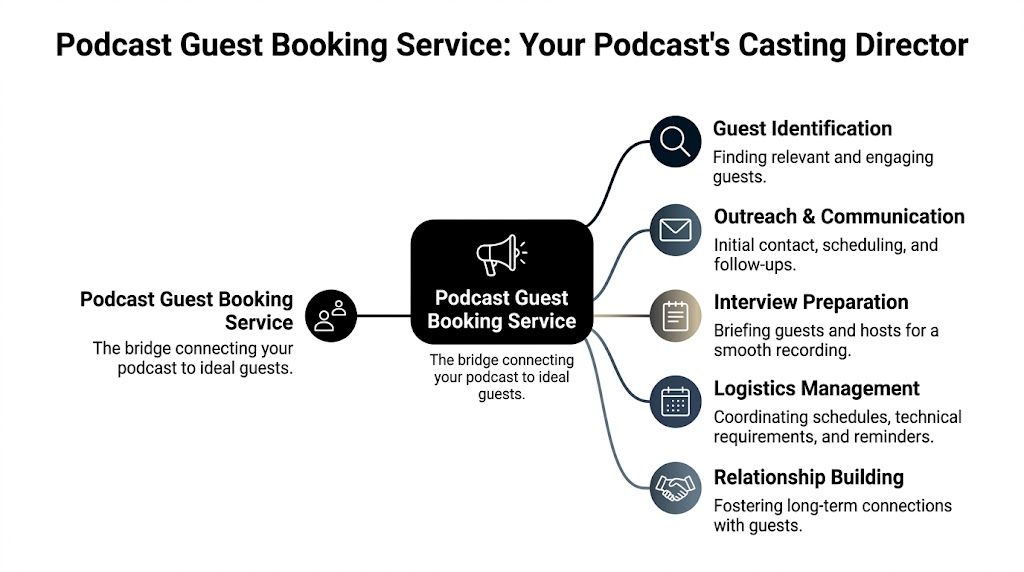
A podcast guest booking service systemizes how you find, vet, pitch, schedule, and prepare guests for your show.
That matters because guest booking is not a clerical task. It is audience strategy. The people you bring on shape your credibility, your distribution potential, and the kind of conversations your brand becomes known for. If you want serious growth, you need a process that produces the right guests consistently.
A good service handles the full chain. It identifies relevant experts, reaches out with a pitch that sounds human, screens for fit, manages scheduling, and gets the guest ready for recording day. The result is not just a fuller calendar. It is a stronger show.
The three models you’ll see most often
The market breaks into three clear models. Choose based on how much control, speed, and production support you need.
| Model | How it works | Best for |
|---|---|---|
| Automated marketplaces | You create a profile and get matched with hosts or guests through the platform | Independent creators who want speed and control |
| Full-service agencies | A team handles research, outreach, pitching, scheduling, and admin | Founders, executives, and brands who want a done-for-you process |
| Hybrid platforms | Software handles matching while humans support vetting and logistics | Teams that want efficiency without losing quality control |
Automated marketplaces are useful if you are still testing topics, formats, or audience fit. They help you move fast, but they still depend on your judgment. A profile match is not the same as a good episode.
Full-service agencies make sense once your podcast supports a business, personal brand, or content engine. You are paying for qualified introductions, cleaner logistics, and fewer weak interviews. Hybrid options sit in the middle. They combine platform efficiency with human screening, which is often the smartest model for a team that wants volume without sacrificing standards.
What you’re actually paying for
A real booking partner does more than send over a list of names.
Expect the work to include:
- Guest research: Finding people who fit your topic, tone, and audience
- Pitching and outreach: Writing messages that feel specific and credible
- Scheduling: Managing calendars, reminders, and recording logistics
- Screening: Filtering out guests who can speak, but should not be on your show
- Prep support: Collecting bios, talking points, and context before the session
Here is the standard I recommend. If a service only gives you contacts, you are buying access. If it gets the right people onto your calendar, prepped for a strong interview, you are buying production support.
That distinction matters even more if your show records in a professional studio. Remote guest sourcing can fill slots. A smart booking process tied to a physical production environment can improve the final product. When a sourced guest walks into a space like Flexwork Studios, you get stronger audio, better video, tighter pacing, and content that looks ready for serious distribution across podcast apps, YouTube, and social clips.
If you want that process to work, start with a clear podcast guest booking strategy and choose a partner that can support both outreach and production quality.
The Strategic Benefits of Professional Guest Sourcing
Guest booking is often highlighted as a time-saving tool. That undersells it.
Professional guest sourcing is a growth lever. It shapes how your show is perceived, who discovers it, and whether your content stack feels consistent enough to support a serious brand. If your podcast is part of your business ecosystem, your guest pipeline affects far more than your recording schedule.
Better guests sharpen your authority
The fastest way to make your show feel bigger is to book people with real credibility and relevant perspective.
When listeners hear thoughtful conversations with operators, founders, subject-matter experts, and authors who fit your niche, they start categorizing your show differently. You stop sounding like someone experimenting in public and start sounding like someone worth paying attention to.
That authority compounds. Better guests create stronger episodes. Stronger episodes create more trust. More trust makes future outreach easier.
A weak guest list tells your market you’re available. A strong guest list tells your market you’re selective.
Smart matching improves the content itself
This is where technology helps. Hybrid booking platforms use matchmaking systems that analyze over 50 data points per profile and can outperform manual outreach by 4x in booking efficiency, while reducing host admin time by 70%, from 5 to 10 hours per guest to under 1 hour, according to Leverage With Media. The same source says episodes with algorithm-matched guests see 22% higher listener retention and an 18% download uplift because the topical alignment is stronger.
That’s the part too many creators miss. Guest sourcing isn’t just administrative. It directly affects audience experience.
When the guest fits the show, the conversation moves faster. The host asks better questions. The clips are cleaner. The episode has more replay value. That’s what makes a show easier to recommend.
If you’re trying to grow your podcast audience, better guest selection is one of the cleaner levers you can pull because it improves both discoverability and listener satisfaction without forcing you into gimmicks.
Consistency is a brand signal
Nothing weakens a podcast brand faster than inconsistency.
One week you publish a sharp interview with a clear point of view. Two weeks later you scramble and release a flat conversation because someone canceled and you needed something, anything, on the calendar. Audiences notice. So do potential sponsors, collaborators, and clients.
Professional booking support helps prevent that volatility. It gives you a pipeline instead of a panic response.
A few practical gains stand out:
- Editorial stability: You can plan themes, guest categories, and release schedules in advance.
- Less founder bottleneck: You’re not the one doing every follow-up and calendar handoff.
- Stronger promotion windows: Guests can be prepared properly, which improves post-launch sharing.
- Cleaner business alignment: You can book around your goals, not around whoever happened to reply.
For creators who are still fighting for listener traction, this matters. A more disciplined content pipeline supports every other growth move, including the tactics covered in this article on how to get more podcast listeners.
How to Evaluate and Choose the Right Booking Partner
Don’t choose a booking partner because their website looks polished. Choose one because their process is tight.
A weak service creates more admin than it removes. A strong one improves guest quality, protects your calendar, and keeps your production flow clean. If you’re paying for help, the standard should be high.

Start with list quality, not sales language
The first thing to ask is simple. Where are they getting contacts, and how do they keep the data current?
Top-tier services use real-time validation and recency filters to achieve over 85% contact accuracy for podcast hosts, which reduces bounce rates and helps PR teams target shows with 2 to 3x higher response rates, according to PodSeeker. The same benchmarks show pitches to low-difficulty shows can convert at 15% to 25%, compared with 5% for unverified databases.
That means a booking partner using stale lists isn’t saving you time. They’re just automating failure.
Ask direct questions:
- How do you validate contact information?
- Do you filter out inactive shows?
- How do you define a good-fit podcast or guest?
- Do you track responsiveness by category or niche?
If they can’t answer clearly, move on.
Vet their taste
Booking is part operations, part editorial judgment.
You need a partner who understands your niche, but that isn’t enough. They also need to understand tone, audience maturity, and what your show should feel like on its best day. A creator building a polished founder-led interview show shouldn’t get the same guest recommendations as someone running a casual lifestyle podcast.
Use this simple screen:
| Question | Good answer | Bad answer |
|---|---|---|
| How do you qualify guests? | They mention relevance, expertise, speaking ability, and audience fit | They say they can book “almost anyone” |
| How do you handle brand alignment? | They ask about positioning, goals, and topic boundaries | They focus only on volume |
| What happens before recording? | They provide prep, bios, notes, and logistics support | They stop at the introduction |
The partner should protect your show’s standards, not just fill its calendar.
Get specific about deliverables
A lot of services sound full-service until the work begins.
You want the exact scope. Not broad promises. Not “campaign management.” Not “end-to-end support.” Get the checklist.
Look for clarity around:
- Research: Are they identifying targets from scratch or pulling from a fixed database?
- Outreach: Do they write custom pitches?
- Follow-up: How many times do they follow up before dropping a lead?
- Scheduling: Who owns the calendar process?
- Guest prep: Do they collect bios, headshots, and talking points?
- Reschedules and no-shows: Who handles cleanup?
If you’re also comparing broader production options, this guide on finding a podcast production company near me is useful because booking quality only matters if the rest of the production workflow can keep up.
Review the operating rhythm
A booking partner should have a clear cadence. Weekly updates. Pipeline visibility. Fast handoffs. Defined turnaround times.
If they communicate like a freelancer juggling twelve random clients, you’ll feel it quickly.
Watch how they answer during the sales process. That’s usually their best behavior.
A short explainer can help you spot the difference between basic support and a real system:
Read the contract like an operator
Most creators skim this part. That’s a mistake.
You need to know whether you’re paying on retainer, per booking, or through a hybrid model. You also need to know what counts as a “booked guest.” Is it a confirmed calendar invite? A completed recording? A guest who meets specific quality criteria?
Check for these points before signing:
- Ownership: Who owns the guest relationship after the introduction?
- Cancellation rules: What happens if a guest backs out?
- Replacement terms: Do they replace poor-fit or canceled bookings?
- Minimum term: Are you locked in before they’ve proven anything?
- Exit process: Can you leave cleanly and keep your pipeline data?
A serious partner won’t dodge these questions. They’ll expect them.
The Flexwork Advantage From Guest Booking to Final Cut
Your booking team finally lands a strong guest. Then the interview happens over a laptop mic, the lighting is flat, the framing is awkward, and the video clips look like every other low-budget remote show online. You did the hard part and still published an asset that undersells your brand.
That is the break point Flexwork solves.
A guest booking service should not stop at outreach and scheduling if your goal is real audience growth. The booking only creates the opportunity. The studio determines how that opportunity looks, sounds, and performs once it reaches the audience.

Why the studio environment matters
In-person production changes the value of every guest you book. A polished set, controlled sound, proper camera angles, and a producer in the room turn a conversation into a media asset you can publish across channels with confidence.
That is especially useful for creators and brands in the Springfield, NJ area who want more than a remote recording workflow. You can source the right guest, bring them into a professional environment, and leave with footage that actually supports a premium brand.
Here’s what improves when booking and studio production work together:
- Video quality stays consistent: Episodes look unified across your channel instead of changing with each guest’s setup.
- Clips become more usable: Strong lighting and clean audio give your team better material for short-form distribution.
- Guests show up differently: People tend to speak with more focus and authority in a real studio than on a casual video call.
- Your brand looks established: The final product signals intention, standards, and credibility.
A booked guest is potential. A studio session turns that potential into something publishable.
Why Flexwork’s model is stronger
Flexwork connects guest sourcing with a physical production space instead of treating them as separate vendors. That matters because every handoff creates risk. Details get lost. Standards slip. The episode becomes harder to finish well.
A tighter system fixes that. You bring in the right guest, record in a controlled environment, move directly into post-production, and package the conversation for distribution without rebuilding the process each week. If you want that post-production handled professionally, Flexwork’s audio editing service fits directly into that workflow.
Some teams also pair polished studio interviews with an AI podcast clip generator to turn long-form episodes into short-form assets faster. That only works well when the original footage is strong. Clean capture gives repurposing tools something worth cutting.
What this looks like in practice
Flexwork is not built for casual creators recording whenever they find time. The offering is structured for operators who treat podcasting as part of brand growth.
A Content Day is priced at $3000 per day and includes 20 edited reels or 60 professional photos. A podcast website is $5000 plus hosting. The Market, Manage & Produce My Podcast tier starts at $1500 per episode with a 20-episode growth commitment.
Those numbers make the point clearly. This is infrastructure, not a side project.
If your podcast supports client acquisition, authority building, or thought leadership, keep booking and production connected. The stronger play is simple. Source better guests, bring them into a real studio, and publish content that looks as credible as the brand behind it.
Conclusion Build a Stronger Podcast System
Your show reaches a ceiling fast when guest outreach, recording, and publishing run as separate jobs.
Serious creators build one operating system for all three. A podcast guest booking service gives you the front end of that system. It brings better-fit guests into the pipeline, protects your calendar, and keeps the show aligned with the audience you want to attract.
The bigger opportunity is what happens after the booking is confirmed. A strong guest list has more value when those conversations happen in a professional studio, with controlled sound, clean video, and a production team that knows how to turn one interview into a full content asset. That is the gap many shows miss. They invest in outreach, then record in conditions that weaken the result.
Creators who want real brand growth should connect sourcing with production. In the NJ and NY market, that means bringing the right guests into a space like Flexwork Studios and capturing interviews at a standard that matches the reputation you are trying to build.
Treat the show like media infrastructure, not a weekly task.
Book stronger guests. Record in a room built for credibility. Publish episodes and clips that make your brand look ready for bigger rooms, better partnerships, and higher-value opportunities.
Frequently Asked Questions About Guest Booking Services
How much should I budget for a podcast guest booking service
Set your budget based on outcome, not on the cheapest monthly fee.
Low-cost platforms can work if you are willing to research, screen, pitch, and schedule guests yourself. Full-service booking costs more because you are paying for targeting, outreach, follow-up, calendar coordination, and quality control. Expect a real service to sit in the hundreds to low thousands per month, depending on volume and selectivity.
The smarter test is simple. Does the service save your team time and bring in guests who make the show more credible? If the answer is yes, the spend makes sense.
Should I pay per booking or use a retainer
Choose a retainer if your podcast is part of your growth strategy.
A retainer gives the booking team time to learn your angle, refine outreach, and build a stronger pipeline month after month. Pay-per-booking can be useful for a short run or a trial, but it often rewards speed over fit. That is how creators end up with filled calendars and forgettable episodes.
You are not buying meetings. You are buying momentum.
Will I own the guest relationship after the intro
You should own it.
If a service tries to keep control of the relationship after the booking, walk away. Your show needs the right to bring strong guests back, build partnerships, and keep those connections inside your brand. That matters even more if you plan to invite guests into a physical studio for future interviews, panel sessions, or premium video shoots.
Get the handoff terms in writing before you sign anything.
Can a booking service get me top-tier guests right away
Sometimes, but serious creators build toward that level instead of waiting for a shortcut.
Big guests say yes to clear positioning, sharp outreach, and a show that already looks credible. That credibility is not only about downloads. It is also about presentation. A booked guest is more likely to say yes, and more likely to refer other strong guests, when they know the interview can happen in a polished environment like Flexwork Studios instead of a patchy remote setup.
Strong mid-tier guests are often the right first move. Record those conversations well, publish clips that look sharp, and your booking ceiling rises.
What should I prepare before hiring a booking partner
Get your fundamentals in order first.
You need a clear show description, a defined audience, a guest profile, topic boundaries, and a recording plan. You also need to decide whether your show is remote, in-person, or hybrid. If you have access to a professional studio, say so early. That detail changes who says yes, especially for guests who care about production standards and brand presentation.
Tighten your host skills too. Review these podcast interview tips for stronger guest conversations before you spend money bringing better people onto the show.
How long does it take to know if the service is working
You will see it in the pipeline before you see it in audience growth.
Early signs are better guest-fit, cleaner communication, fewer scheduling problems, and a calendar that reflects your brand direction instead of random availability. Audience results come later, after the episodes are recorded, edited, and distributed.
Judge the service in two stages. First, is it improving the quality of who gets booked? Second, are those interviews turning into stronger episodes, clips, and brand assets once they hit a proper production workflow?
Are booking platforms enough, or do I need human support
Platforms help with access. Human support protects quality.
If you have time to vet every guest, write personalized outreach, and manage scheduling yourself, a platform may be enough for a while. If you care about brand fit, stronger response rates, and a smoother path from outreach to recording day, human support is the better choice. The best setup is usually a mix of software for efficiency and experienced judgment for selection.
That mix becomes even more valuable when your goal is not just to book interviews, but to bring the right guests into a studio and turn each session into premium audio and video content.
What’s the biggest mistake creators make with guest booking
They treat guest booking like calendar management instead of brand building.
A full month of interviews means nothing if the conversations are weak, off-topic, or visually underwhelming. The right guest, recorded in the right room, gives you much more than one episode. You get social clips, YouTube assets, partner-ready content, and a stronger public image for the show.
That is the standard to use. Book guests who fit the brand. Then record them in a setting that makes the brand look established.
If you want a more professional podcast workflow, start with the room, the process, and the support behind it. Explore Flexwork Podcast Studios to see production options, studio services, and ways to build a cleaner path from guest outreach to polished release.