
33 41 Newark Street Hoboken NJ: A Creator’s Guide
 April 21, 202618 Minutes
Meta description: Evaluating 33 41 Newark Street Hoboken NJ for creators, plus when a dedicated studio is the smarter move for polished content.
URL slug: /33-41-newark-street-hoboken-nj-creators-guide
If you're searching 33 41 newark street hoboken nj, you're probably doing more than checking an address. You're scouting a mood. Maybe you want exposed brick, skyline energy, a recognizable Hoboken backdrop, and something that signals your brand has moved past DIY. On paper, that part of Hoboken looks like an easy yes.
For creators, though, a beautiful address and a productive shoot are not the same thing. A space can be photogenic and still slow down your day, compromise your audio, and leave you fixing avoidable problems in post. That's where the decision starts. If you're weighing a stylish location against a controlled recording environment, the smarter move depends on what you're trying to produce, and how often you need it to work. If you're also comparing event-style venues, it helps to look at Hoboken event space options through a production lens, not just an aesthetic one.
The Search for the Perfect Content Backdrop
A lot of creators hit the same moment. Your content is getting better, your audience is getting sharper, and suddenly your apartment wall, borrowed office, or coffee shop corner doesn't match the brand you're building. You want a setting that looks elevated without feeling stiff. Hoboken naturally enters the chat.
That search often leads straight to 33 41 newark street hoboken nj. It has the kind of location that sells itself. Downtown foot traffic, historic character, and the kind of visual energy that makes a short-form clip feel more premium before you even hit record. From the outside, it looks like the answer to a very modern creator problem.
A strong backdrop gets attention. A controlled environment keeps attention, because the content itself lands cleanly.
The practical question isn't whether the area is appealing. It is. The question is whether a trendy address can consistently deliver the sound, pacing, lighting, and workflow your business needs when content stops being casual and starts becoming part of your revenue engine.
Exploring 33–41 Newark Street in Hoboken
A creator scouting this corner for the first time will understand the appeal fast. 33-41 Newark Street sits in one of Hoboken's busiest, most visible pockets, and that matters if part of the goal is to borrow energy from the neighborhood itself.
What the address is
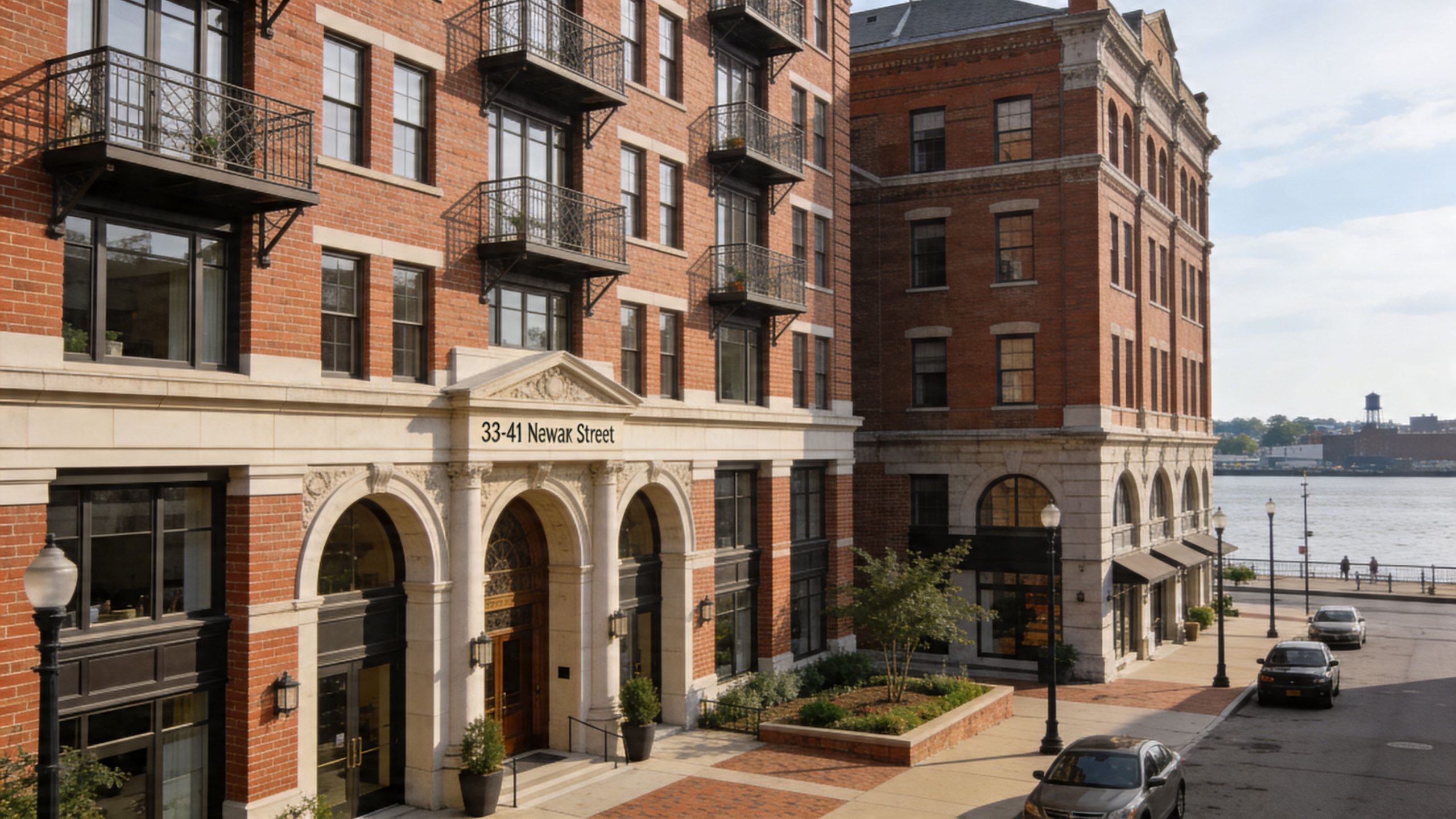
The property sits at the corner of River and Newark Streets, directly across from Hoboken Terminal, inside the Riverview Historical Plaza. According to the LoopNet property listing for 33-41 Newark Street, the site combines retail and office use in a location built around heavy commuter traffic and constant pedestrian exposure.
For brand shoots, interviews, or event-adjacent content, that kind of address does part of the visual work for you. Clients recognize it. Guests can find it. The setting already feels active before any production choices are made.
Why the building matters historically
The address carries more character than a standard storefront because it sits inside a part of Hoboken with real architectural memory. Municipal references have connected the property to the broader Newark and River Street corridor, an area shaped by Hoboken's commercial growth and long relationship to the waterfront.
That history matters to creators for a practical reason. Older buildings and established streetscapes tend to give you texture on camera. Brick, street lines, signage, and period details can improve a frame without adding set design costs.
What it is now
Today, the address is also associated with the Antique Loft, a rooftop event venue presented on the Flexwork Hoboken private event space page. That current use helps explain why the property stays in rotation for event planners, brand gatherings, and people looking for a space that already feels polished.
From a creator's perspective, that distinction matters. A strong event venue can look great in photos and still create trade-offs during production. It is built to host an experience first. A studio is built to support repeatable content workflows, tighter setups, and cleaner execution.
Creator Logistics in Downtown Hoboken
For a shoot day, downtown Hoboken gives you convenience and friction at the same time. That tension is the story.
What works well
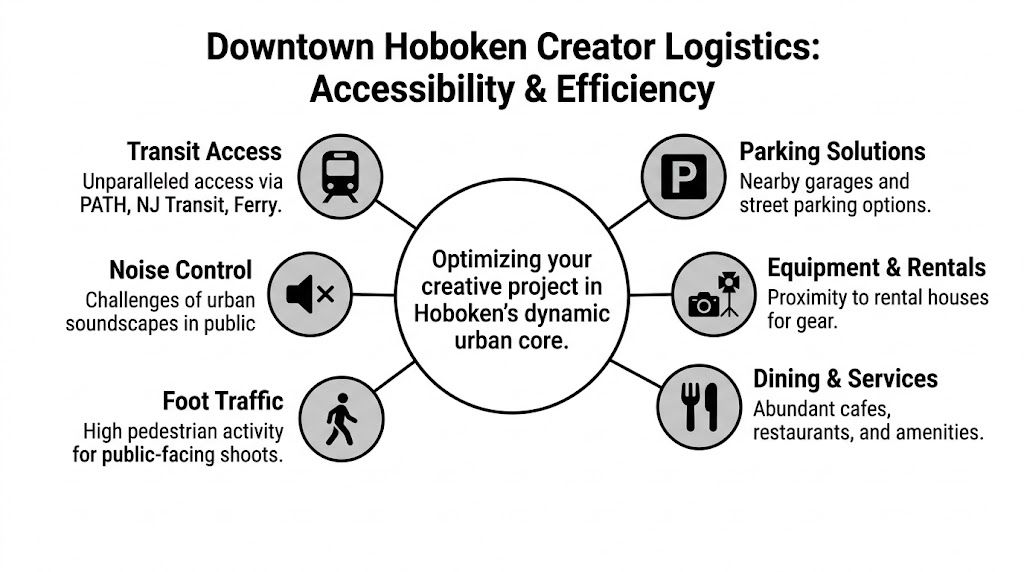
If your guest list is coming from both New Jersey and New York City, this part of town is easy to reach. PATH access, NJ Transit, ferries, buses, and light rail make arrival simpler than at a more isolated venue. For shoots that depend on multiple people showing up on time, transit-rich locations reduce one category of excuse.
The neighborhood also helps with supporting logistics. Need coffee before setup, lunch between takes, or a place for a client to wait? Downtown Hoboken offers that without much planning. If your day includes a brand team, a guest, a stylist, or a photographer, that kind of walkable ecosystem can help the schedule feel less brittle.
What gets harder fast
The convenience ends when gear enters the picture. Street-level urban shoots often sound easy until someone has to move cameras, lights, cases, wardrobe bags, or product boxes through active sidewalks and crowded corners. A location near heavy foot traffic is great for visibility. It is not always great for load-in.
Parking also changes the math. Even without quoting rates or availability windows, anyone who has produced in dense downtown areas knows the pattern. You can lose momentum before the first slate trying to coordinate arrivals, unload equipment, and keep talent from circling the block.
Let's consider this from a practical standpoint:
| Factor | Good for creators | Gets risky when |
|---|---|---|
| Transit access | Guests can arrive without driving | You need to move production gear |
| Walkable surroundings | Easy food, coffee, and client convenience | You need a quiet holding area |
| Public visibility | Great for lifestyle visuals | You need privacy or repeated takes |
| Downtown energy | Adds brand texture | Your team needs a predictable schedule |
When the neighborhood helps and when it doesn't
For lifestyle content, brand photos, walk-and-talk clips, or event coverage, this area can absolutely work. The environment gives you movement, architecture, and energy without much set dressing. That's useful.
For seated interviews, podcast episodes, talking-head education, or anything with multiple takes, the neighborhood starts asking more from the producer. You need tighter scheduling, lighter gear, and more patience than most creators budget for.
Field rule: If the space depends on the neighborhood's energy, build extra time around every production task.
If you're trying to turn a content day into a full workday with prep, meetings, edits, and revisions, it's worth comparing that approach with a coworking space in Hoboken or a dedicated production setup rather than relying on a public-facing venue to do everything.
The Dilemma Location Ambiance vs Production Control
A creator books a beautiful loft, the client loves the mood board, and the first 20 minutes feel like a win. Then the room starts making decisions for you. Sound reflects. Daylight shifts. A clean second take stops matching the first.

Why event beauty doesn't solve production problems
That is the trade-off at 33 to 41 Newark Street. The appeal is real. Spaces associated with this address photograph well, feel polished on arrival, and give clients the kind of first impression people expect from Hoboken. For events, that matters. For content production, it only solves one part of the job.
The harder part is consistency.
A venue built for gatherings usually prioritizes openness, atmosphere, and guest flow. A recording environment needs control. Those goals overlap sometimes, but not enough to treat them as the same thing. If the deliverable is a brand film, a podcast episode, a course module, or a batch of talking-head clips, the producer needs a room that behaves the same way from setup through wrap.
Here is where loft-style venues start costing time:
- Audio problems show up fast. Hard surfaces, street spill, HVAC noise, and activity outside the room all end up in the take.
- Window light looks great until it changes. Once the sun shifts or clouds roll in, continuity becomes an editing problem.
- Resets take longer. Every interruption means checking framing, sound, and exposure again instead of keeping momentum.
- Post gets heavier. Editors can clean up a lot, but cleanup is slower and more expensive than getting stable source footage.
Good gear helps, but only to a point. If you're still choosing your kit, a guide to best microphones for voice recording is useful. Even a strong mic will still capture a bad room if the room is doing the wrong things.
I tell rising creators to judge a location by the deliverable, not the vibe. A stylish backdrop can carry a short lifestyle reel. It is much less reliable for interviews, education content, podcasts, or client work that has to be approved, revised, and repurposed.
That is why many teams eventually stop renting for atmosphere and start booking a controlled room like The Studio Hoboken for professional content production. The visual identity can still be strong. The difference is that the production day stops depending on luck.
The Flexwork Solution for Flawless Content
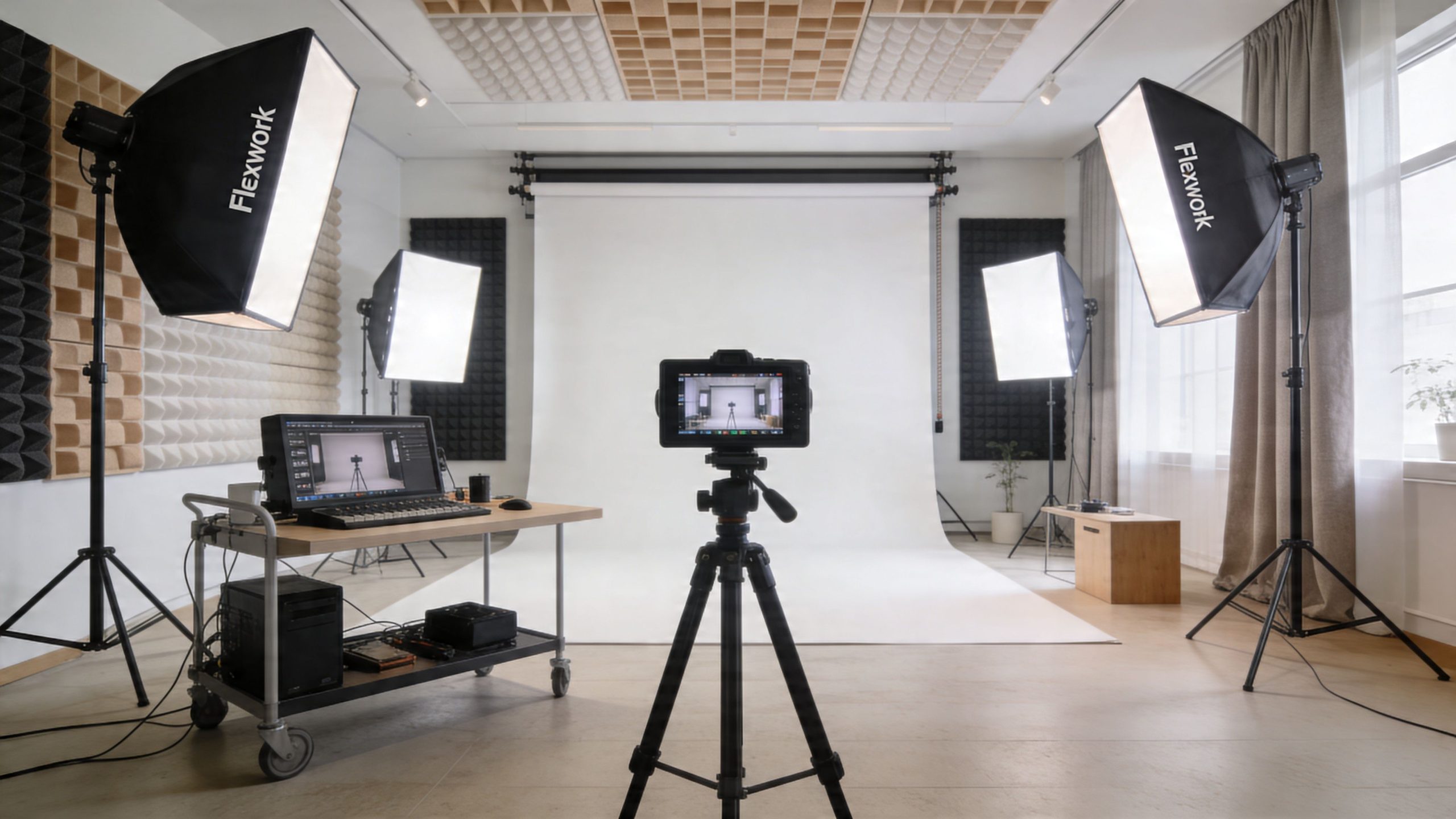
A purpose-built studio solves different problems than a venue does. That's the point. You trade novelty for repeatability, and repeatability is what lets a creator publish on schedule without draining time into fixes.
What a studio changes immediately
In a dedicated environment, you're not wrestling with room tone, daylight shifts, or public interruptions in the same way. The production day gets simpler. Setup is faster. Takes match. Your guest sounds like they're in conversation, not in a large live room.
For anyone who has spent hours trying to fix bad source audio, practical reading on how to reduce background noise for crystal-clear audio is useful. But the bigger lesson is upstream. Prevention beats repair. Good rooms save more time than clever cleanup.
Matching the setup to the goal
Different creator goals need different levels of support. Here's the cleanest way to decide.
| If you need | The smarter setup |
|---|---|
| A polished interview or podcast episode | Acoustically treated studio with fixed lighting and proper microphones |
| A full day of short-form capture | Structured batch production with a shot list and on-set support |
| Ongoing audience growth | Production plus editing, publishing, and marketing support |
| A branded home base online | Studio content paired with a dedicated podcast website |
One factual option in this category is Flexwork Podcast Studios, which offers turnkey podcast and video studios, editing, sound mixing, show branding, distribution support, and marketing services through its content creation studio offering. The package structure matters if you're trying to move from scattered recording days to a system.
Where the service packages make sense
Some offers are built for batching. Content Days are $3000/day and include 20 edited reels or 60 pro photos, based on the publisher brief provided for this article. That's useful when one recording day needs to feed weeks of posting.
Others are built for scale. The Market, Manage & Produce My Podcast package starts at $1500 per episode with a 20-episode growth commitment, again based on the publisher brief. That type of support fits founders, hosts, and teams who don't just want footage. They want a repeatable publishing machine.
Production rule: If your calendar depends on content, your recording environment can't be an afterthought.
The same brief also notes that podcast websites are $5000 plus hosting. That's relevant because professional content isn't only about capture. It also needs a home, clear branding, and a path from episode to inquiry.
Your Next Move From Aspirational to Professional
A place like 33 41 newark street hoboken nj makes sense if what you need is atmosphere, foot traffic, or an event setting with visual appeal. For some shoots, that's enough. For a creator trying to build a serious catalog, it usually isn't.
The shift happens when you stop optimizing for the vibe of the room and start optimizing for output. Clean audio. Reliable lighting. Fewer reshoots. Easier batching. A day that ends with assets you can use, not a folder full of almost-good takes.
That doesn't mean stylish locations are a mistake. It means they work best when they're chosen deliberately, for the right format, with the right expectations. If your content has become part of your sales process, your authority, or your audience growth, professional conditions stop feeling optional.
A smarter next move is simple:
- Use location-based venues for brand moments, events, and selective lifestyle visuals.
- Use dedicated studios for interviews, podcasts, education content, launch assets, and recurring series.
- Batch intelligently so one recording session turns into weeks of distribution.
- Build support around the shoot if editing, publishing, and web presence keep slipping down your to-do list.
Professional creators don't outgrow ambition. They outgrow avoidable friction.
If you're ready to record in a space built for clean audio, polished video, and efficient production days, explore Flexwork Podcast Studios and book a tour or start a conversation about the right setup for your next shoot.