
Podcast Marketing Digital Playbook That Grows Shows
 September 14, 202625 Minutes
You've recorded the episode, edited the audio, posted a clip, and still feel like the show is invisible. The problem usually isn't the quality of the idea. It's the absence of a connected system that turns one recording into discovery, trust, and measurable action.
Podcast marketing digital now spans audio, video, search, social, email, paid distribution, and owned web infrastructure. This playbook shows how to connect those pieces without turning your creative business into a second full-time job. Flexwork Studios in Springfield, New Jersey, fits naturally into that picture through studio rentals, production packages, Content Day sessions, and podcast websites built for professional publishing and growth.
Why Great Podcasts Still Struggle to Grow
A strong show can stall in a surprisingly ordinary way. The host records late at night, edits between client projects, designs a thumbnail minutes before publishing, and posts a single announcement after the episode goes live. The conversation may be excellent, but the audience only sees one inconsistent signal.
That pattern creates three problems at once. Production quality fluctuates, so the show feels less established than it is. Distribution stays narrow, so new listeners rarely encounter the episode. And the host spends creative energy managing exports, captions, uploads, guest coordination, and promotional copy instead of preparing a better conversation.
A founder might spend hours producing an episode about building a modern business, then release it without a clear search phrase, an episode page, a strong clip, or a reason for the guest to share it. A week later, the content has disappeared beneath newer posts. The show hasn't failed creatively. It has failed operationally.
The practical shift: Treat every recording as a campaign asset, not a single audio file.
The audience opportunity is substantial. Edison Research's Infinite Dial 2025 reports that 245 million Americans age 12 and older have listened to a podcast, a record level of U.S. reach. The same research reports that 70% of Americans age 12 and older have listened to a podcast, 55% consumed one in the last month, and 73% consumed a podcast in audio or video format, representing an estimated 210 million people. These figures are documented in Edison Research's Infinite Dial 2025 coverage.
The opportunity is no longer “publish and hope.” It's building a recognizable show with a repeatable path from recording to reach. Flexwork's guide to getting more podcast listeners is a useful starting point, but growth requires more than isolated promotion. It requires a format, a message, a publishing engine, and measurement that work together.
The Hidden Cost of DIY Podcast Marketing
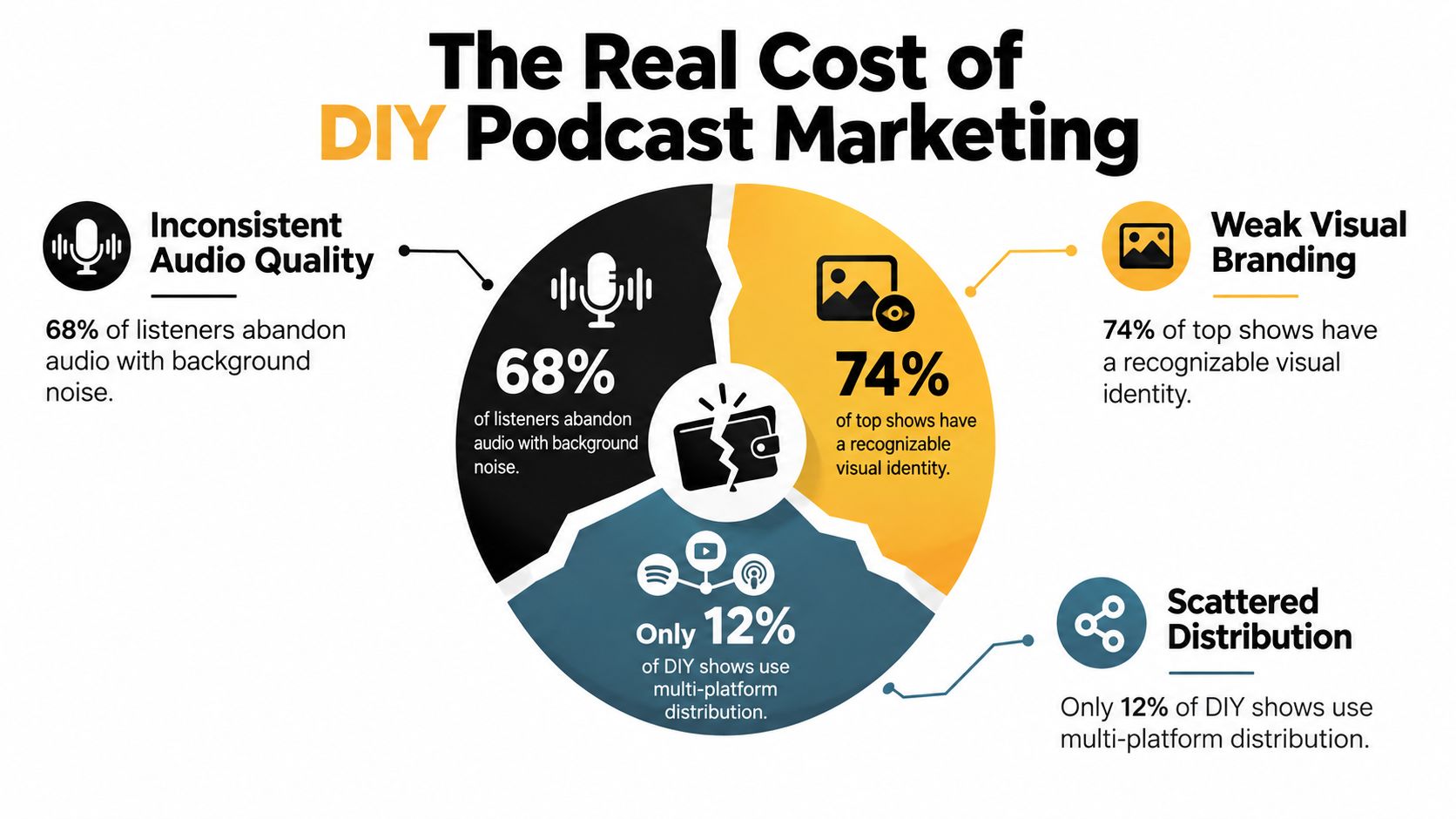
DIY production looks inexpensive because the invoice is invisible. The cost shows up as uneven sound, weak presentation, missed publishing windows, and hours taken from paid work or creative development.
A listener experiences those problems as friction. Uneven volume makes an episode difficult to follow. A vague title obscures why the conversation matters. A bare RSS feed gives new listeners no polished destination to meet the host, browse related episodes, or join an email list.
Podcast marketing now operates in a serious media market. The IAB and PwC projected U.S. podcast advertising would grow 12% to more than $2 billion in 2024 and approach $2.6 billion by 2026, according to the IAB U.S. Podcast Advertising Revenue Study. Later 2026 coverage citing the same industry data reported $2.862 billion in U.S. podcast ad revenue in 2025, up 17.6% year over year.
That trajectory raises the standard for creators. Brands already treat podcasts as a scalable digital media channel. A show with improvised production, irregular distribution, or no clear conversion path gives sponsors and listeners less reason to trust it.
Find the leaks before buying reach
Audit the experience from a stranger's perspective:
- Sound: Can listeners follow the conversation comfortably on headphones and a phone?
- Visual identity: Do the cover art, thumbnails, clips, and website feel like one recognizable brand?
- Discovery: Can someone find the episode through search, YouTube, social clips, or the guest's audience?
- Conversion: Does the show offer a clear next action, such as subscribing, joining an email list, booking a service, or visiting a relevant page?
- Consistency: Can the team repeat the workflow without exhausting the host?
If several answers remain uncertain, paid promotion will only send more people into an experience that has not earned their attention. Fix the production system first.
The before-and-after difference is operational. Before, one conversation creates one audio file and scattered posts. After, that conversation becomes a polished episode, a searchable page, short-form video, guest assets, email content, and a measurable path to action. Flexwork Podcast Studios can support that workflow through turnkey studio production packages and website infrastructure, so each recording functions as a coordinated video-led distribution system. More output matters, but coordinated output matters more.
Know Your Listener and Position Your Show to Win
A show aimed at everyone rarely gives anyone a reason to stay. Without a defined listener, the title, guest list, episode topics, clips, and video distribution all blur into the wider category.
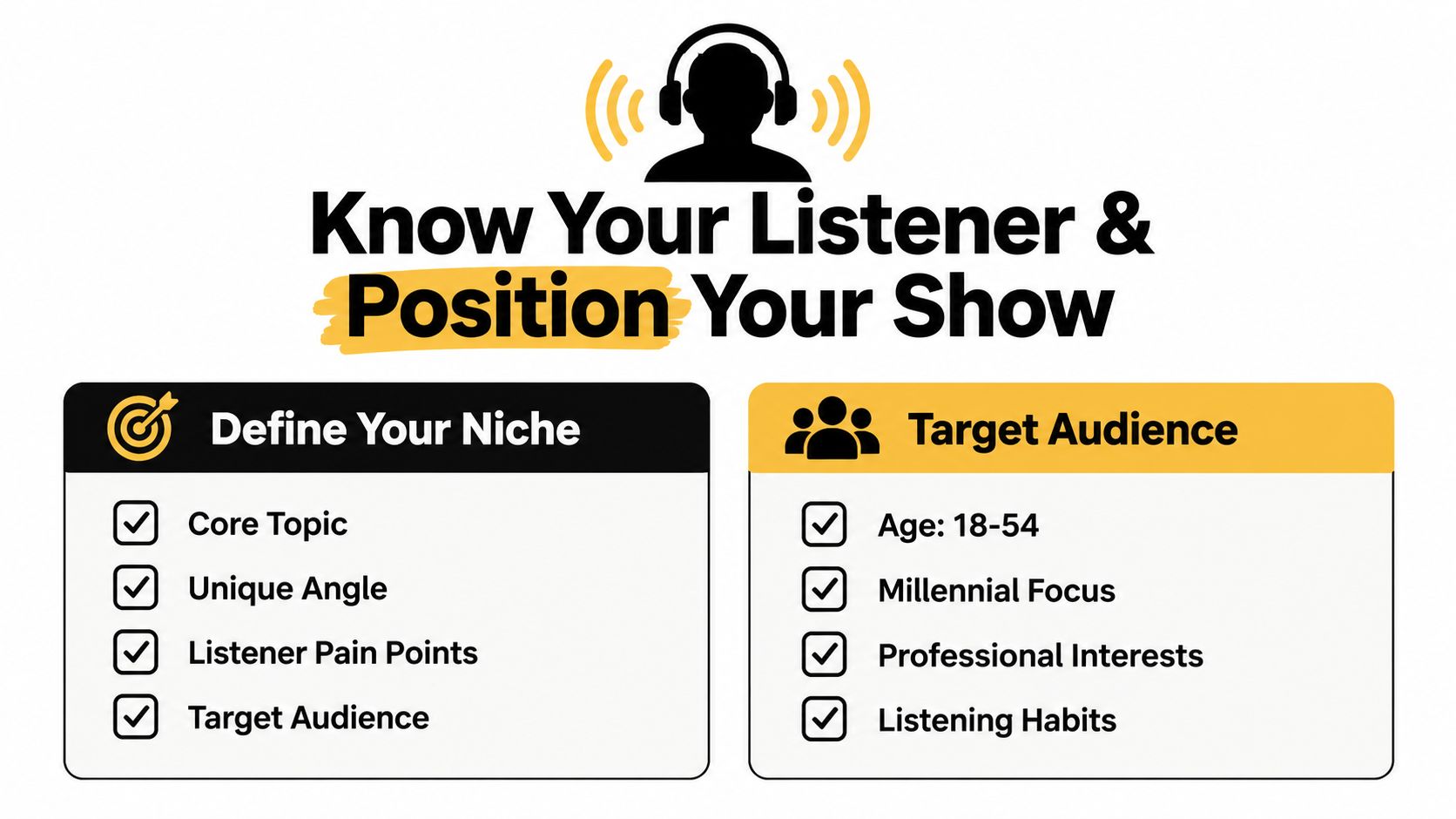
Podcasting has strong reach among working-age audiences. Edison Research reports strong reach among people ages 18 to 54, while a 2025 industry report on the state of podcast listening notes that people ages 18 to 44 make up a majority of U.S. podcast listeners in The Podcast Landscape 2025. That audience fits creators, founders, coaches, and lifestyle brands speaking to ambitious professionals.
Define the listener through a specific tension, not a broad demographic label. “Entrepreneurs” says little. “Independent creative founders building a premium service business without constant self-promotion” gives your editorial team a clear direction and gives every episode a sharper point of view.
Build a promise people can repeat
A strong show promise answers three questions:
- Who is this for? Name the person, stage, or professional identity.
- What changes after listening? State the insight, decision, or outcome the audience can use.
- Why this host? Identify the experience, perspective, access, or taste that makes the show distinct.
A useful promise might be: “Weekly conversations for creative founders who want sharper positioning, better systems, and a business that supports their lifestyle.” The right listener understands the benefit immediately, while potential guests can grasp the show's role before they agree to appear.
Use that promise to filter every editorial decision. Before booking a guest or approving a topic, ask:
- Does this person understand the listener's world?
- Does the conversation reveal a useful process, decision, or point of view?
- Can the topic become a compelling title and short-form video clip?
- Does the episode reinforce the show's central promise?
- Will the guest have a genuine reason to share the finished work?
Audience connection matters as much as audience definition. Audiences disengage when content fails to make them feel understood, as explained in the content problem nobody talks about. Use that principle when planning the episode, its clips, and the page where viewers take the next action.
Positioning rule: Don't ask, “What topic should we cover?” Ask, “What does this listener need help seeing clearly?”
Your visual identity should make the promise recognizable before someone presses play. Cover art, typography, set design, guest graphics, thumbnails, and the website need to signal the same world. Use Flexwork's guide to branding your podcast to define the system, then let Flexwork's turnkey studio production packages and website infrastructure apply it consistently across audio, video, and distribution.
Turn Every Episode Into a Searchable Growth Engine
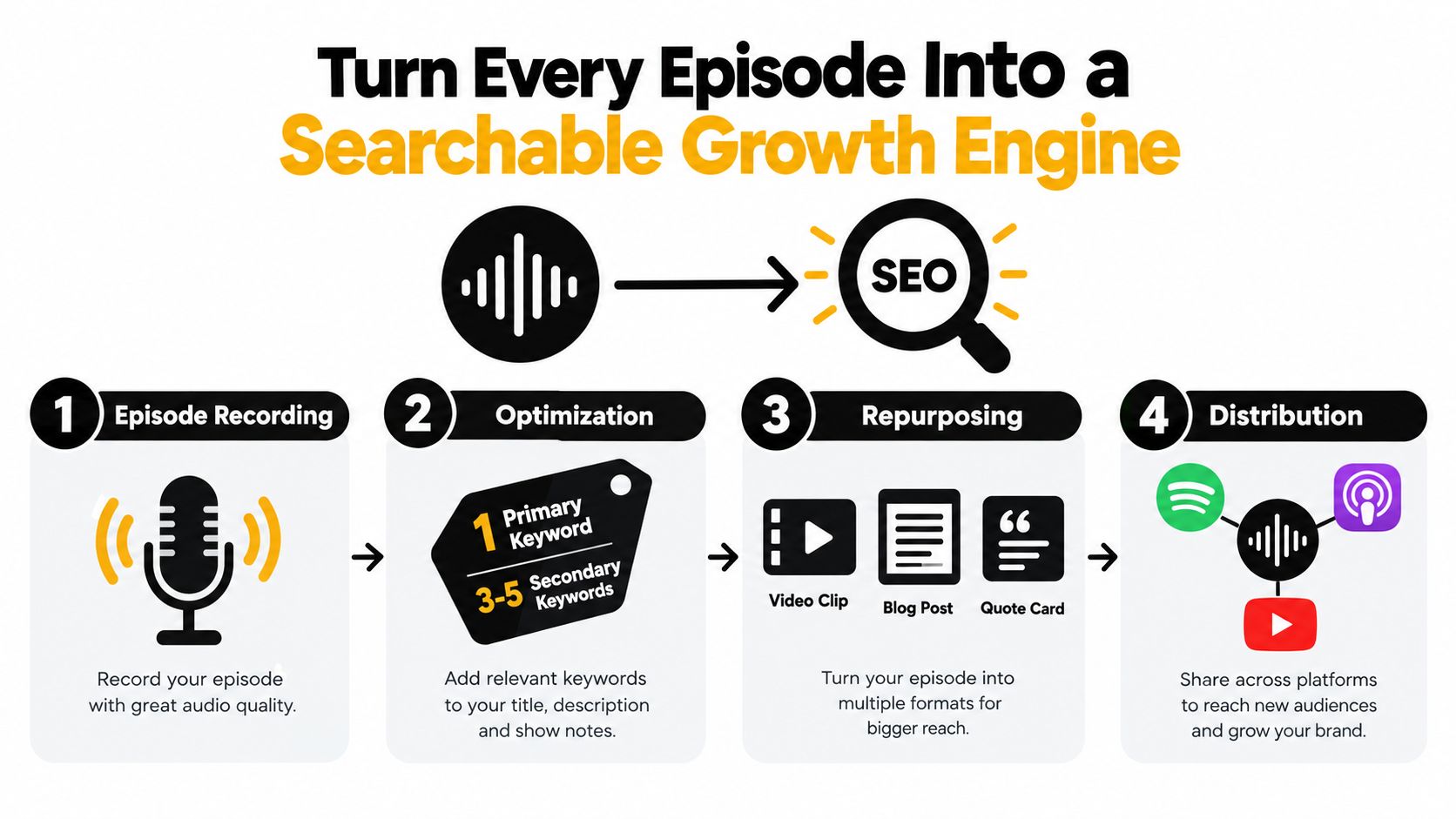
A podcast episode shouldn't end when the recording stops. The recording is the source material for a connected group of assets, each designed to perform a different job.
Begin with one primary keyword per episode. Choose the phrase that best matches the listener's intent and the episode's central question. Add three to five related secondary keywords to support the topic without making the title sound artificial. Search-focused podcast guidance also recommends structured data markup for episodes, optimized meta descriptions, descriptive image alt text, internal linking, fast load speed, HTTPS, and XML sitemap submission. These details are outlined in podcast discoverability guidance for 2025.
Use the episode page as the owned destination
A polished episode page should contain:
- A clear, keyword-aware title
- A concise summary that explains the listener benefit
- An embedded player so visitors can listen without leaving
- Key moments or concise show notes
- Links to the guest, referenced resources, and related episodes
- A visible subscribe or email-list call to action
- A relevant next step for the business or creator
Podcast website guidance recommends an optimized title and meta description, a clear description of the show, social proof such as testimonials or press mentions, direct subscription or email-list prompts, and an embedded player. That turns a website from a digital brochure into a conversion tool, as explained in podcast SEO and website recommendations.
The workflow below keeps each asset accountable.
| Asset | SEO Job | Distribution Job |
|---|---|---|
| Episode page | Target the primary keyword and related questions | Give listeners an owned destination |
| Show notes | Add useful context and internal links | Help readers scan, save, and share the episode |
| Short video clip | Capture attention around one specific insight | Reach viewers through YouTube, Reels, and Shorts |
| Quote card | Reinforce a memorable point visually | Give guests and followers an easy share |
| Email feature | Bring the episode to an existing audience | Drive repeat listening and deeper action |
| Guest toolkit | Extend the episode beyond your channels | Make sharing simple for the guest and their team |
Make video the discovery layer
Podcast discoverability is increasingly video-led. In 2026 benchmark data, 79% of episodic campaigns included a simulcast video component, and YouTube accounted for nearly two-thirds of measured video podcast impressions, according to 2026 podcast advertising benchmarks. Separate forecasting data says 53% of new U.S. weekly listeners actively watch video podcasts, up from roughly 22% in 2022, from the same source.
That doesn't mean every episode needs cinematic complexity. It means the recording should produce useful visual entry points. Frame the conversation for clean clips. Capture expressive reactions. Create thumbnails that communicate the tension or payoff. Give the guest a vertical cut with captions and a square or horizontal version where appropriate.
A Content Day makes this production model practical. One focused recording block can create a bank of edited reels or professional photos that support the show between episodes. Flexwork's quoted Content Day price is $3,000 per day, including 20 edited reels or 60 professional photos, according to the service details supplied for this offering.
A podcast website gives those assets somewhere durable to live. The social clip earns attention, the episode page builds context, and the email or guest share brings qualified people back to an owned destination. For a repeatable publishing structure, use Flexwork's podcast show notes template.
For a broader perspective on building data-driven content for growth, data-driven content for growth is a useful companion resource. The principle is simple: create every asset with a job, then track whether it performs that job.
Grow Faster With Social Paid Email and Community
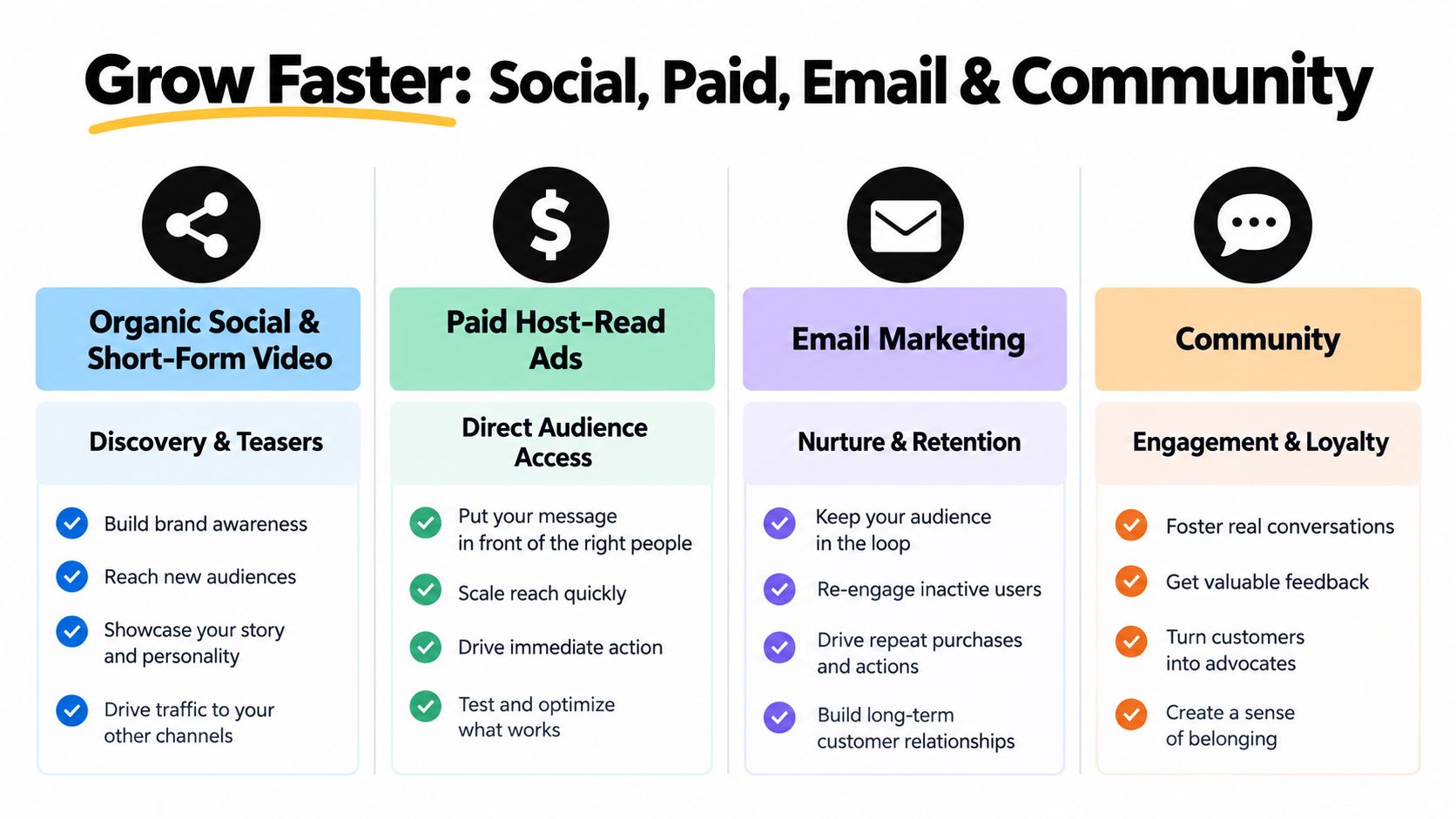
A strong episode can attract attention on social, convert through a host-read placement, bring listeners back by email, and turn regulars into contributors. Assign each channel a clear job, then connect every touchpoint to a video asset, a trackable website destination, and a next action.
Organic social builds discovery through consistent points of view and short-form video. Paid placements buy targeted reach. Email creates a direct relationship. Community gives listeners a reason to return and participate. Social cannot replace an owned audience, paid campaigns need credible creative and a destination that converts, and community requires active stewardship.
Choose the right lever for the job
| Growth lever | Best use | Trade-off |
|---|---|---|
| Organic social and short-form video | Introduce a point of view, test hooks, and encourage sharing | Requires a consistent stream of strong creative |
| Paid host-read ads | Reach an audience through a trusted creator-aligned voice | Host-read placements usually cost more than programmatic placements |
| Programmatic placements | Add scale and broaden media buying | They typically convert less effectively than host-read creative |
| Email marketing | Bring listeners back and guide them toward an offer | You must earn the subscription and maintain useful communication |
| Community engagement | Turn passive listeners into participants and advocates | The host or team must moderate and contribute consistently |
Host-read ads typically convert three to five times better than programmatic placements, while costing two to three times more, according to podcast advertising benchmark analysis. The same analysis found that smaller campaigns can struggle to generate enough signal, with 400,000 to 800,000 impressions producing about 1.24% average conversion. Campaigns needed 2 million to 4 million impressions to exceed 10,000 attributed visitors. Using more than 11 publishers lifted average conversion to 1.45%, compared with 1.09% with a single publisher.
Treat these figures as directional benchmarks rather than universal targets. Choose host-read creative when trust, context, and audience fit matter most. Use programmatic placements for broader reach, then judge quality through the website behavior and leads they generate.
Turn distribution into a video-led system
Every paid or organic placement should point to an owned episode page, not a dead-end feed link. Flexwork's turnkey studio and production packages can turn one conversation into a full distribution set: a video episode, vertical clips, captions, thumbnails, and email-ready excerpts. That gives each channel creative built for its format while keeping the campaign connected to one website infrastructure.
The website should make email capture feel like a natural extension of the show. Offer a private episode guide, concise resource list, founder worksheet, or early access to live recordings. Keep the form visible on episode pages without forcing listeners through pop-ups.
Build participation, not noise
Community works when the invitation is specific. A private discussion, office-hours format, listener Q&A, or curated event gives people a clear reason to participate. Create the community around a shared question listeners want to explore together, then let the host or team moderate and contribute consistently.
Creators combining audience research, social campaigns, and promotional partnerships can use influencer marketing strategies as a planning reference. For paid-distribution context, FindClout covers creator promotion marketplaces and sponsored social opportunities.
Flexwork's Market, Manage & Produce My Podcast service coordinates distribution, audience growth strategy, social campaigns, and podcast marketing support. It fits teams that want production, video distribution, and website destinations handled together, leaving the host focused on the conversation and relationships rather than moving every asset between platforms.
Measure What Matters and Scale With Flexwork Studios
Last-click reporting and promo codes rarely tell the full story of podcast performance. A listener may hear an ad, search for the brand later, watch a clip, return through a guest link, and convert after several touchpoints. Your measurement plan needs to account for that path.
Track response rate, site visits, lead conversion, and purchase conversion inside a defined attribution window. One 2026 benchmark summary reported a 2.29% average response rate from reached listeners who visited a site and a 9.74% average site visitor-to-lead conversion rate. It also reported global podcast ad analytics conversion benchmarks around 1.09%, with one in five engaged listeners ultimately converting, in Magellan AI's podcast measurement benchmark report.
The timing matters. The same benchmark summary reported that 45% of conversions happened within the first seven days after exposure. Don't limit reporting to the day an episode publishes. Set an attribution window, compare exposed and unexposed audiences where possible, and review branded search, direct traffic, assisted conversions, and lead quality alongside last-click sales.
Incrementality deserves a place in the dashboard. Recent benchmark data reports that only 66% of surveyed marketers measure incrementality, while pixel attribution captures 2.3 times more conversions than post-purchase surveys and 4.6 times more than promo codes. Those findings are summarized in Podscribe's podcast advertising measurement coverage. The same source reports that podcast ad spend grew 26% year over year in Q3 2025, 1,689 brands advertised on podcasts for the first time, and average ad load increased from 8.11% to 8.34% in one quarter.
Turn measurement into an operating system
A practical setup has four layers:
- Creative layer: Record clean audio and video, then produce clips that match the show's positioning.
- Distribution layer: Publish the episode page, RSS feed, YouTube video, short-form assets, guest toolkit, and email feature.
- Conversion layer: Direct attention toward a clear website action, such as subscribing, joining a list, booking, or purchasing.
- Measurement layer: Review exposure, visits, leads, purchases, assisted paths, and incrementality.
Flexwork Podcast Studios offers acoustically treated studios, hourly rentals, podcast production packages, Content Day sessions, podcast websites, editing, branding, distribution, and growth-focused marketing through an in-house digital marketing team. The Be My Podcast Producer package supports creators seeking hands-on production help, while Market, Manage & Produce My Podcast is intended for a more thorough growth commitment.
The quoted Market & Manage tier starts at $1,500 per episode with a 20-episode growth commitment. Podcast websites are quoted at $5,000 plus hosting, giving the show a dedicated search and conversion home. Content Days are $3,000 per day and include 20 edited reels or 60 professional photos.
For a deeper framework on evaluating outcomes, review how to measure branded podcast impact. Then choose the operating model that matches your ambition. If you need a fast, professional recording, book an Hourly Rental. If you need consistent polish, choose a producer package. If you're building a serious media property, connect production, marketing, website infrastructure, and measurement from the beginning.
Flexwork Podcast Studios provides turnkey, acoustically treated spaces, professional podcast and video production, Content Day sessions, podcast websites, and growth-focused packages for ambitious creators and brands. Visit Flexwork Podcast Studios to explore the production options, plan your next recording day, and turn your podcast marketing digital strategy into a system that can scale.