

You publish a thoughtful episode, share the link once, and wait for the audience to arrive. Instead, the download graph stays quiet, guests move on, and your team starts treating every release like a fresh launch. That isn't a content problem. It's a distribution and conversion problem. A practical podcast marketing strategy connects audience research, in-app discovery, audio and video production, repurposing, paid amplification, and measurable business actions. Flexwork Studios gives creators a production environment for recording, editing, branding, and marketing that system, but the strategy comes first. This guide shows how to turn each episode into a repeatable growth asset rather than another isolated file in your media library.
Why Most Podcasts Never Find an Audience
Releasing an episode isn't marketing. It's publishing.
Many independent shows invest their energy in recording, editing, and writing a careful description, then treat the RSS feed as the growth plan. That approach creates a familiar result: a polished episode goes live, a few loyal listeners press play, and the show disappears beneath newer releases. Listeners rarely discover an unfamiliar podcast by accident. They find it through search, recommendations, clips, guests, communities, and repeated exposure.
The most common failure points are predictable:
- No audience definition: A show made for “entrepreneurs” has no clear person to attract, no specific problem to address, and no obvious reason to follow.
- Weak app metadata: Clever titles and vague descriptions make it harder for podcast directories to match episodes with listener intent. The IAB and Podcast Host discoverability guidance points toward the practical issue: app search and recommendation systems need clear signals.
- No repurposing engine: A full conversation remains trapped in one audio file instead of becoming clips, written content, email, and guest-ready assets.
- Vanity measurement: Download totals can look encouraging while listeners skip early, ignore the call to action, or never enter an owned audience.
Practical rule: If an episode has no defined listener, discovery path, or next action, it isn't a marketing asset yet.

The solution is a full-funnel operating system. Start with the audience and the promise. Build metadata for the apps where people search. Record with audio and video distribution in mind. Cut the strongest moments into platform-native assets. Give every episode a useful, trackable next step, then review retention and qualified responses instead of celebrating reach alone.
Flexwork Studios fits into that workflow as an end-to-end production environment. A team can use a studio session for consistent sound and visuals, production support for editing and motion graphics, Content Day sessions for a larger batch of short-form assets, and podcast website development for a destination that captures demand. The point isn't to outsource judgment. It's to remove the operational friction that keeps a good podcast from shipping and circulating consistently.
The Market Has Quietly Become Massive
Podcasting has moved beyond a niche experiment. U.S. podcast advertising revenue reached $2.862 billion in 2025, up 17.6% year over year, compared with $105.7 million in 2015, according to IAB and PwC reporting summarized by Radio Ink. That history matters because advertisers don't sustain a channel at that scale without testing response, brand impact, host-read sponsorships, and repeat exposure.
The audience is large enough to support focused plans too. Global podcast listenership reached about 619 million people in 2026, up from roughly 546.7 million in 2024 and 584.1 million in 2025, as summarized by PodRewind's 2026 podcast growth coverage. In the U.S., 58% of people age 12 and older, about 167 million people, listened to a podcast in the last month in 2026, while 45%, about 130 million, listened in the last week, according to The Infinite Dial coverage from Podnews.
| Metric | Current Figure | Implication for Marketers |
|---|---|---|
| Global podcast listenership in 2026 | 619.2 million | A defined niche can support meaningful reach without chasing a mass-market topic. |
| U.S. monthly podcast listeners in 2026 | 167 million | Podcasts belong in serious awareness and authority plans. |
| U.S. weekly podcast listeners in 2026 | 130 million | Consistent releases can become part of a regular media habit. |
| U.S. podcast advertising revenue in 2025 | $2.862 billion | Paid podcast distribution deserves testing alongside other media channels. |
The strategic implication is straightforward. A small team shouldn't compete on raw reach with major publishers. It should compete on specific authority, useful conversations, and consistent packaging. Discovery is increasingly shaped by app search and recommendations, while attention also spreads across video clips and full video episodes. Build the show so audio serves the listening habit and video creates additional surfaces for discovery, trust, and conversion.
Define the Listener You Are Actually Building For
A strong show begins with a person, not a category. “Business,” “wellness,” and “marketing” describe shelves. They don't tell you who will subscribe, what problem will bring that listener back, or which guest can make the episode worth sharing.
Start with three research inputs:
- Existing buyers: Who already pays for the product, service, or expertise connected to the show? Look for repeated situations, language, objections, and desired outcomes.
- Live questions: Search communities, comments, newsletters, Reddit threads, LinkedIn discussions, and customer interviews for the questions people ask before they buy.
- Current listening habits: Identify the shows those people already subscribe to. Study their formats, recurring segments, guest types, episode titles, and opening hooks.
If your research needs a structured starting point, use this resource on how to find your ideal customers. The useful output isn't a demographic profile full of generic labels. It's a working editorial brief.
Build a positioning worksheet
Write the answers in plain language:
- Job to be done: What is the listener trying to accomplish when they press play?
- Current alternatives: What do they read, watch, listen to, or ask colleagues today?
- Trigger: What event makes them search for a new show now?
- Format preference: Do they want interviews, tactical solo episodes, debates, case analysis, or a mix?
- Consistent promise: What valuable experience should every episode deliver?
Positioning is the gap you own between topic, format, and audience. It isn't a tagline. “Interviews with founders” is a format description. “Practical operating decisions for creative founders building a profitable service business” gives the host a sharper editorial boundary.

A narrow persona may feel restrictive, but it creates useful repetition. The same listener can shape guest outreach, episode titles, clip hooks, newsletter language, paid targeting, and calls to action. You won't exclude everyone. You'll give the right people a reason to recognize themselves quickly.
For the visual side of that identity, use a focused guide to brand your podcast. A consistent name, cover treatment, set, thumbnail style, and tone should reinforce the promise rather than compete with it.
Win Discovery Inside the Podcast Apps First
Treat Spotify, Apple Podcasts, YouTube Music, and Pocket Casts as search environments, not passive hosting destinations. Forty percent of listeners prefer searching their podcast app directory to discover new shows, and 50% discover shows through app charts and recommendations, according to The Podcast Host's discoverability guidance. Your metadata has to help both systems and humans understand the episode immediately.
Begin with the exact phrases your listener types. Use customer language, search suggestions, competitor episode titles, comments, and questions from communities. Then place those phrases naturally in the show title or subtitle, episode title, opening description lines, category selection, and supporting page copy. Don't force keywords into awkward sentences. Clarity beats cleverness.
Separate show SEO from episode SEO
Show-level metadata explains the overall promise. Episode-level metadata answers a specific search intent. A show about creative entrepreneurship might use a clear show description, while an episode can target a precise question about pricing, hiring, or client retention.
The first two description lines deserve special care because they may determine whether a listener expands the listing. State the problem, name the guest or subject, and explain the useful outcome. Category choices should be precise rather than broad. Episode artwork should communicate the topic at a glance, especially when the show competes in a crowded recommendation surface.
A practical in-app optimization sequence:
- Days one through seven: Audit the show title, subtitle, category, description, cover art, trailer, and host profile.
- Days eight through fourteen: Rewrite priority episode titles around listener intent and improve the opening description copy.
- Days fifteen through twenty-one: Review search terms, recommendation placements, follows, saves, and completion behavior where platforms provide them.
- Days twenty-two through thirty: Refresh older metadata, compare artwork treatments, and document which wording earns stronger engagement.
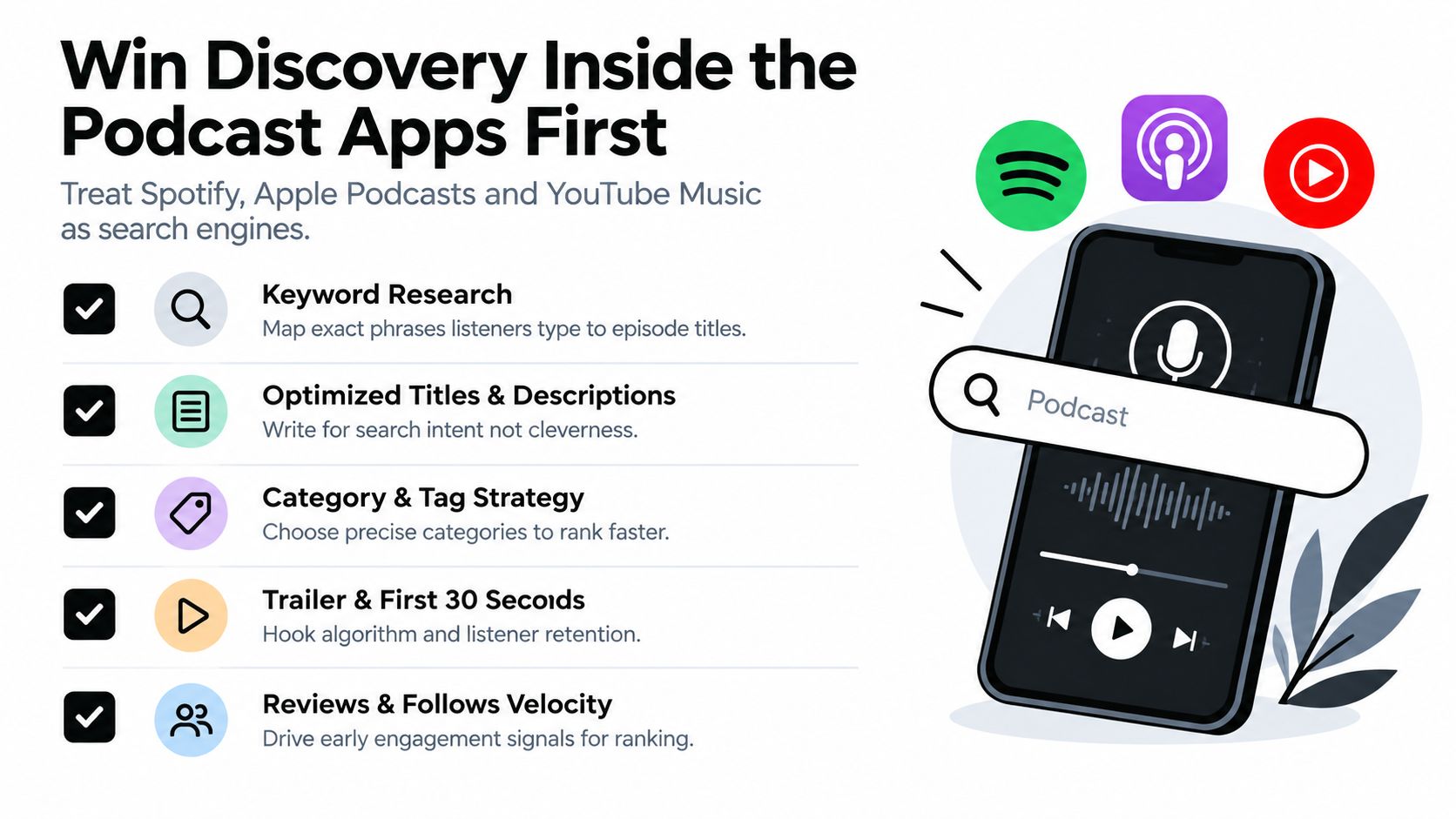
Chart placement, algorithmic recommendations, and search placement aren't the same outcome. Charts may reflect momentum, recommendations respond to listener behavior, and search depends heavily on relevance and clarity. Build the foundation before asking for a large burst of downloads, and make distribution decisions with how to distribute a podcast in mind.
Choose Your Show Format Before You Choose Your Channels
The recording format determines what you can promote efficiently. Audio-only is efficient and intimate, but it gives you fewer visual moments to circulate. Video-led production expands the surface area into YouTube, thumbnails, playlists, and short clips, but it demands stronger set design, lighting, camera direction, and post-production. Clip-led shows treat the conversation as source material for a steady stream of short-form video, which changes how guests answer questions and how the host structures the interview.
| Format | Production Cost | Distribution Reach | Conversion Strength | Best For |
|---|---|---|---|---|
| Audio-only | Lower and simpler to manage | Podcast apps, newsletters, guest feeds, audio communities | Strong when the host-read CTA fits the listening context | Thought leadership, intimate interviews, frequent guest swaps |
| Video-led | Higher because of studio, lighting, camera, and editing needs | Podcast apps, YouTube, video search, playlists, Shorts, Reels | Strong when visual trust and demonstrations support the offer | Product education, authority, branded media |
| Clip-led | Moderate to high, depending on clip volume and editing style | Short-form video platforms, professional networks, community feeds | Strong for discovery, weaker if clips lack a clear path to deeper content | Demand generation, creator brands, highly shareable conversations |
Match the lane to the business goal
Choose audio-only when speed, access, and conversational depth matter most. A coach or founder who needs a reliable interview series may get more value from excellent questions and consistent publishing than from a complex visual setup.
Choose video-led when the audience needs to see the person, product, process, or environment. A design consultant, fitness professional, or software founder can turn demonstrations and reactions into assets that audio can't carry alone.
Choose clip-led when short-form discovery is the primary acquisition route. The host must ask questions that produce complete, understandable moments rather than clips that depend on ten minutes of context.
Hybrid production is often the sensible middle. Record a full video conversation, publish the audio feed, and select clips based on actual audience response. Switch lanes when the current format consistently limits your strongest goal, not because another platform looks fashionable.
Turn Episodes Into a Measurable Funnel
A download doesn't pay the invoice. The episode needs a deliberate path from attention to action.
Start by defining the action before recording. Do you want the listener to download a resource, join an email list, book a consultation, attend an event, or explore a product? That choice affects the guest, questions, examples, episode title, show notes, and closing CTA.
Guests can distribute an episode, but guest reach isn't a strategy by itself. Invite people whose experience serves the listener and whose audience overlaps with your target. A host-read CTA usually feels more natural than a generic house ad because the host can explain why the next step matters. Keep the offer relevant and place it after the episode has earned attention. Repeating an unrelated pitch damages trust faster than it creates clicks.
Own the next relationship
Build a short email capture flow around one useful asset. It might be a worksheet mentioned in the episode, a private resource library, a community invitation, or a consultation page. Use a dedicated URL in the spoken CTA and a tagged link in the show notes, then connect the landing page form to your email platform.
Use consistent tracking fields:
- Episode identifier: Record the episode name or code.
- Traffic source: Separate podcast app notes, guest promotion, social clips, newsletters, and paid placements.
- Campaign detail: Distinguish the full episode from an individual clip.
- Conversion event: Track signup, booking, qualified lead, and sale separately.
Vanity URLs are easy to say aloud. Smart links can route listeners to the right destination. Neither replaces first-party data. Platform analytics help you understand listening behavior, while your website and email system help you understand the relationship you can continue building.
Use this funnel view in every review:
Impressions, plays, completes, CTA clicks, qualified leads.
The important question isn't which episode received the most plays. It's which topic attracted the right listener, held attention, produced a click, and created a credible business conversation. A clear episode repurposing workflow can give that funnel more entry points without changing the core recording.
Build a Distribution Engine Around Every Episode
A conversation should produce a release system, not a single announcement. Treat the episode as a source file that can become a hero audiogram, vertical clips, a quote card, a written recap with transcript excerpts, and a newsletter segment. Each asset should carry the same idea while adapting the hook, length, caption, and call to action to the platform.
For a substantial interview, plan a release sequence across 10 to 14 days. Publish the full episode first, then use the clearest clip to introduce the central problem. Follow with a contrarian insight, a practical example, a quote-led post, a written summary, and a guest collaboration. Keep enough variation between assets that the audience doesn't feel trapped in a repeated advertisement.
Use organic distribution to find the winner
Organic channels help you learn which ideas deserve amplification. Test YouTube Shorts, Instagram Reels, TikTok, LinkedIn, X, community posts, newsletters, and guest cross-promotion only where your listener already spends time. You don't need to maintain every channel. A small team usually performs better with a narrow, consistent channel mix than with a broad schedule it can't sustain.
The content distribution channels guide can help organize those choices around audience behavior rather than habit. Give each platform a job. Short-form video earns discovery, LinkedIn can frame professional implications, email brings back existing listeners, and the guest's network adds trusted reach.
Paid amplification should sharpen a working message, not rescue a weak one.
Use paid spend for retargeting engaged video viewers, returning them to the full episode, a relevant lead magnet, or a booking page. The strategic rule is to reinvest roughly 20% of production spend only after a clip crosses your own baseline engagement threshold, then pause assets that fail to convert within a one-week window. That percentage is a planning rule, not a universal benchmark. Set the threshold from your audience and offer, and judge the spend by qualified action.
Flexwork's Content Day sessions cost $3000 per day and include 20 edited reels or 60 professional photos, according to the service terms provided. That type of batch production can make a clip-led strategy easier to maintain, particularly when a team wants a consistent visual library without rebuilding the set for every post.
Measure What Matters and Execute With the Right Partner
Downloads can tell you whether distribution happened. They can't tell you whether the right people listened, trusted the host, or took a commercial action.
Track leading indicators weekly, including average consumption rate, completion behavior, follows, saves, clip engagement, and CTA clicks. Review lagging indicators monthly, including qualified leads, booked conversations, assisted pipeline, and revenue connected through tagged links, vanity URLs, or episode-specific promo codes. Compare guests, subjects, opening hooks, and clip formats so future production choices reflect evidence rather than personal preference.
| Metric Category | Vanity Indicator | Growth Indicator |
|---|---|---|
| Reach | Total downloads | Qualified impressions and relevant listener growth |
| Attention | Starts alone | Average consumption and completed episodes |
| Audience | Follower count | Returning listeners and email subscribers |
| Engagement | Likes and comments | CTA clicks, saves, replies, and meaningful conversations |
| Commercial impact | Traffic without context | Qualified leads, assisted pipeline, and attributed revenue |
For partnership and creator campaigns, a useful framework on outcome-linked influencer KPIs reinforces the same principle: measure the business outcome, not just visible activity. Podcast reporting should make that distinction clear for hosts, sponsors, and internal marketing teams.
Decide whether DIY still makes sense
DIY works when the host has the time, editorial discipline, editing skill, and distribution capacity to keep the loop moving. It stops working when research, guest booking, recording, sound mixing, video editing, clip selection, posting, paid testing, and reporting compete with the business the podcast is meant to support.
A done-for-you partner should own a connected workflow, not merely edit the audio. Flexwork Podcast Studios offers studio rentals, production packages, Content Day sessions, podcast websites, distribution, social promotion, and marketing analytics. Its Market, Manage & Produce My Podcast tier starts at $1500 per episode with a 20-episode growth commitment, while podcast websites are $5000 plus hosting, according to the supplied service terms. Those offers matter when the objective is a reliable operating system from recording through measurable growth.
Flexwork Podcast Studios combines acoustically treated studio rentals, production packages, Content Day sessions, podcast websites, distribution, and growth-focused marketing for creators building a full-funnel show. Visit Flexwork Podcast Studios to book a studio session, explore the Be My Podcast Producer and Market, Manage & Produce My Podcast packages, or start a conversation about your next episode.