
Podcast Marketing Services: A Pro’s Guide to Growth
 June 9, 202626 Minutes
Meta description: Podcast marketing services help creators move past DIY burnout with video-first growth, strategy, production, and measurable promotion.
URL slug: /podcast-marketing-services
Primary keyword: podcast marketing services
Secondary keywords: podcast promotion services, podcast growth strategy, podcast production and marketing
You've done the hard part. You built the show, found your voice, bought the gear, learned how to interview, and stayed consistent when others quit after a handful of episodes. Your podcast sounds sharp. Your guests are strong. Your branding looks polished enough. But the audience isn't moving the way you expected.
That stall point is where a lot of rising creators get frustrated. They assume the content must not be good enough, so they tweak the intro, change the artwork, or buy another mic. Usually, that's not the underlying problem. The problem is distribution, discoverability, and consistency across platforms. Great podcasts don't grow because they exist. They grow because someone is turning every episode into a system. If you've been trying to do that alone, professional podcast marketing services begin to make sense.
Your Podcast Sounds Amazing Now What
A lot of creators hit the same wall.
You record every week. You edit late at night. You post the episode link, add a few story slides, maybe cut one clip, then move on to the next interview. A month later, the show still sounds good, but growth feels random. Nothing is broken exactly. It's just not building.
That's the moment your podcast stops being a hobby problem and becomes an operations problem. You don't need more willpower. You need a better content engine.
If you've already seen how one episode can stretch into a bigger ecosystem, this breakdown on repurposing a single podcast episode into 10 pieces of content is the right mental shift. One recording should never live as one upload.
Professional podcast marketing services exist for creators who are ready to stop publishing and hoping. They want a show that reaches people, builds authority, and supports a real brand.
The Creator Plateau Why DIY Marketing Isnt Enough
DIY marketing works at the beginning because energy can cover for missing systems. It stops working when the show becomes consistent.
The issue isn't effort. The issue is that podcast growth now asks for several jobs at once. You're not only a host. You're also an editor, clip producer, thumbnail picker, scheduler, copywriter, social manager, distributor, and analyst. Most creators can do some of those jobs. Very few can do all of them well, every week, without their content suffering.
The opportunity cost is often underestimated. The podcast audience is already massive. A 2026 industry roundup reports more than 550 million monthly podcast listeners globally and says the United States accounts for roughly 165 million monthly listeners. The same source projects US podcast ad spend to exceed $3 billion in 2026. Those projections matter because they show podcasting isn't a side channel anymore. It's a real media market, and creators who market casually are competing against teams who don't (Digital Applied podcast statistics and advertising data).
The three DIY traps that stall growth
You publish audio, not campaigns
Most DIY creators upload an episode and call that promotion. It isn't. Promotion means building multiple entry points so the episode can travel beyond your existing audience.You make content in bursts
One week you post clips everywhere. The next week client work, family life, or plain exhaustion wipes out the schedule. Audiences feel that inconsistency fast.You track the wrong signals
If your only question is “How many downloads did this episode get?” you miss the real picture. Discovery often starts on video, search, or a guest's audience long before someone becomes a regular listener.
Practical rule: If marketing only happens after the episode is finished, it's already too late.
There's another problem. DIY creators often confuse production quality with growth strategy. A clean recording helps. Good lighting helps. But audience growth needs packaging and distribution. That's why going pro isn't just about better gear. It's about moving from scattered effort to a repeatable system. This comparison of studio vs DIY podcasting and what you gain by going pro gets that distinction right.
What burnout looks like in practice
You can usually spot creator burnout before the host says it out loud:
| DIY symptom | What it usually means |
|---|---|
| Clips go out late | Editing and publishing are competing for the same time |
| Show notes are thin | Search discoverability wasn't built into the workflow |
| Social posts feel repetitive | There's no content strategy beyond reminders to listen |
| The host dreads launch day | Marketing has become another unpaid production shift |
At that stage, hiring support isn't indulgent. It's a business decision. It frees the host to focus on conversations, positioning, and creative quality while the growth engine runs in parallel.
What Are Podcast Marketing Services Really
Your show can be excellent and still stay invisible.
That is the gap podcast marketing services are supposed to close. A real service does not exist to post a few clips after publication. It exists to turn each episode into a discoverable media asset, distribute it across the platforms that drive attention, and bring that attention back into your wider brand ecosystem.
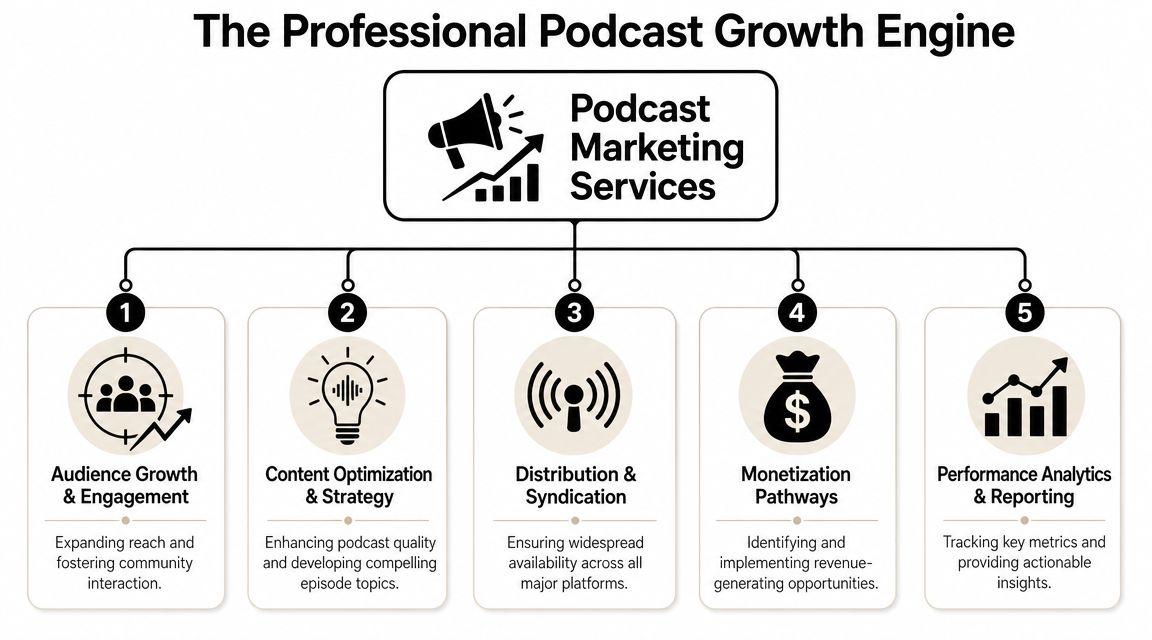
The core pillars that matter now
A strong service usually covers five connected functions.
Positioning and audience strategy
Before anything gets promoted, the show needs a clear role in your brand. Who should care, what promise does the show make, and what makes this episode worth a click from a busy stranger? Without that foundation, distribution turns into wasted effort.Video-first repurposing
This is the piece many traditional podcast guides still underplay. Discovery often starts with video, not audio. Analysts at Vendry highlighted Edison Research reporting YouTube as the top podcast listening platform for weekly U.S. podcast consumers ages 13+ in 2024, and noted Spotify made video podcasts available in more than 170 markets. A service that treats video as an afterthought is already behind (Vendry on podcast marketing agencies and platform behavior).Packaging and distribution
Good marketing changes how the episode is presented, not just where it gets uploaded. Titles, thumbnails, descriptions, guest share assets, posting cadence, and platform-specific formatting all shape whether the episode gets ignored or gets traction.Search visibility
Baremetrics makes the right point. Video repurposing, transcripts, and show-note SEO work best as one discoverability system, not as separate tasks completed at random (Baremetrics on podcast marketing). If you need a practical baseline before hiring help, this guide on how to market your podcast effectively lays out the mechanics.Performance review
You do not need another dashboard full of vanity metrics. You need answers. Which topics hold attention, which clips earn reach, which guests bring in new viewers, and which formats turn casual discovery into repeat listening?
What creators usually need but don't ask for
Many creators say they need promotion. What they actually need is managed execution.
That usually includes:
- Clip selection with intent so the best moments are built for discovery
- Thumbnail and headline decisions shaped for YouTube and social behavior
- Transcripts and show notes that support search and accessibility
- Guest amplification assets that make sharing more likely
- A website destination where a listener can keep exploring your work
If you want a practical outside perspective on how to grow your podcast audience, that guide is useful because it supports the same point. Growth rarely comes from one channel. It comes from packaging, repurposing, and disciplined distribution.
Judge podcast marketing services by one standard. Do they create a repeatable system that helps each episode get found in multiple formats, across multiple platforms, with video leading the way? If not, you are not buying a growth engine. You are buying busywork.
The Flexwork Solution From Production to Promotion
A managed service should remove friction at every stage. Planning, recording, editing, repurposing, distribution, and marketing should connect cleanly. If those parts live in separate vendors, the host usually ends up becoming the project manager anyway.
That's why integrated support works better for creators who are scaling. You're not buying isolated tasks. You're buying continuity.
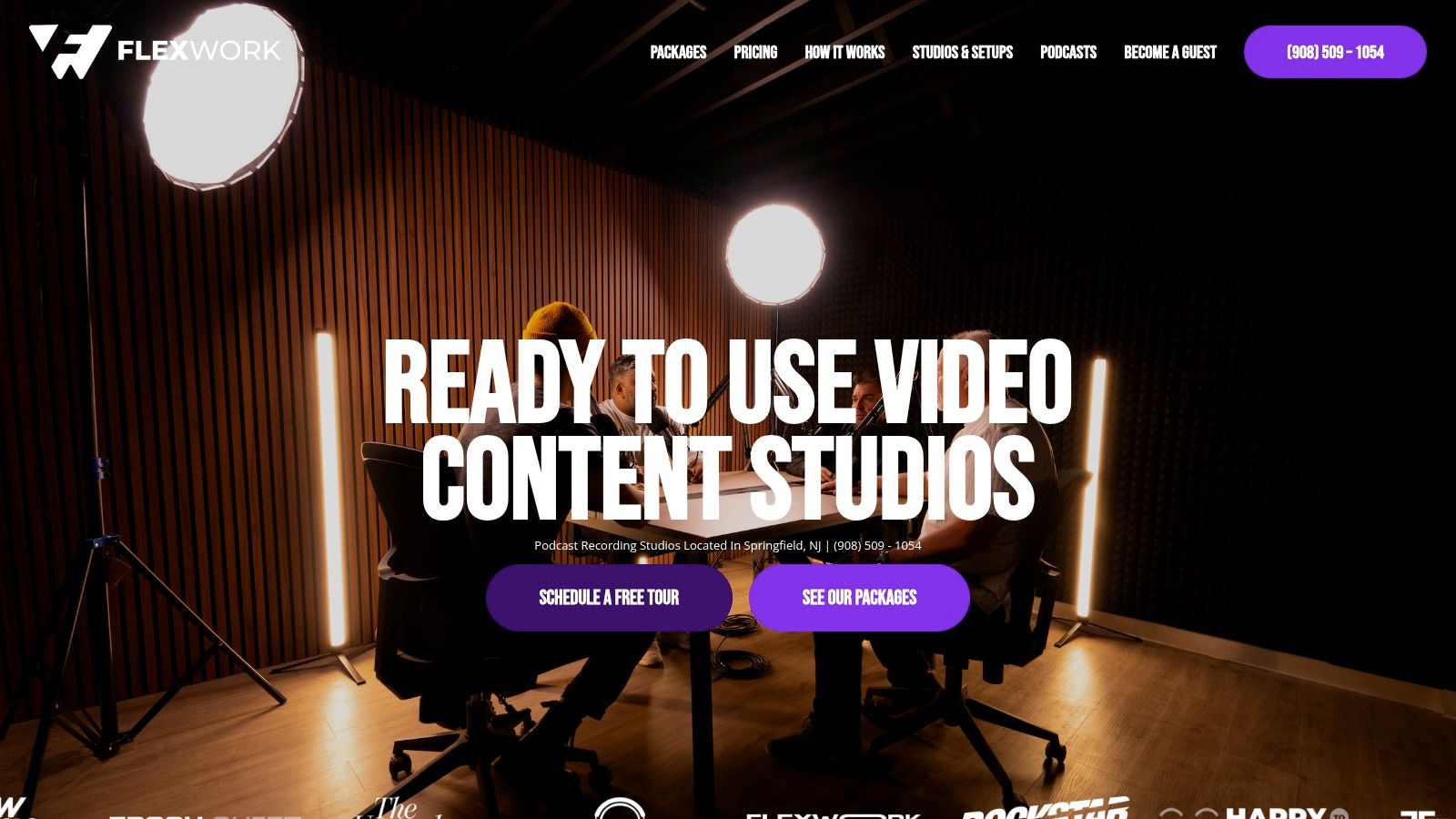
For creators in the NJ and NY orbit, Flexwork Podcast Studios is one example of that model. The studio handles recording, editing, show branding, distribution, social campaigns, guest support, and podcast website builds, which matters because growth gets easier when production and promotion are designed together instead of patched together after the fact.
The package that fits serious growth
If you're done testing and ready to build a real media property, the most relevant offer is the Market, Manage & Produce My Podcast package. It starts at $1500 per episode and requires a 20-episode growth commitment.
That pricing structure tells you something important. This is not casual help for someone who wants a few posts after publishing. It's for creators who understand that audience growth comes from consistency, repetition, and strategic packaging over time.
What that level of support should do in practice:
- Handle episode production so the show stays polished
- Build a repeatable content pipeline across audio, video, and social assets
- Support distribution and website visibility so episodes are easier to find
- Keep the brand cohesive across titles, visuals, clips, and platform presence
Why Content Days matter more than people think
Most podcasts don't fail because the host lacks ideas. They fail because the content bank is always running empty.
That's where Content Day sessions become valuable. At $3000 per day, they include either 20 edited reels or 60 professional photos. For a creator trying to maintain a premium presence, that's not extra content. It's fuel. It gives the show a backlog of visual assets for launches, teaser campaigns, guest promotion, and general brand consistency.
A strong studio day can produce:
- Evergreen host videos for brand positioning
- Guest promo clips for upcoming releases
- Behind-the-scenes material that makes the show feel active
- Short-form assets that keep your channels alive between episode drops
Here's the larger point. You cannot run a video-first strategy if you only create enough media for the podcast feed.
After you see how a professional setup changes pacing, visual quality, and workflow, this walkthrough is worth watching:
The monetization argument is simple
Professional marketing is not just about vanity. It affects revenue access.
Industry reporting summarized by Content Allies says host-read ad CPMs commonly command $25 to $50. That's a useful benchmark because it shows why trust, audience quality, and production polish matter. Premium sponsorship money doesn't usually go to a show with inconsistent output, weak branding, and sloppy listener experience. It goes to podcasts that feel stable, credible, and sponsor-safe (Content Allies on podcast advertising statistics).
You don't earn premium sponsorship opportunities just because your show exists. You earn them because your show looks managed.
That's also where a podcast website becomes part of the investment. Flexwork offers podcast websites at $5000 plus hosting. For creators building a broader business, that site isn't a vanity page. It's where episodes, show notes, lead capture, guest credibility, and search visibility can work together.
A managed service makes the most sense when your podcast is no longer just content. It's part of your business development, your public brand, and your long-term media footprint.
Measuring Success and The NJ NY Advantage
A lot of podcasters still measure success like it's 2018. They stare at downloads, feel good or bad for a day, then move on.
That's too narrow. A show can influence discovery, trust, inbound interest, and brand authority long before someone becomes a steady listener. If you only track listens, you miss the actual business effect.

The signals that matter more than vanity metrics
A stronger measurement stack looks at a mix of platform and business signals:
Engagement quality
Are people commenting on clips, replying to guest posts, or sharing moments from the show?Website behavior
Are listeners clicking through to your site, reading show notes, visiting service pages, or joining your email list?Audience crossover
Does the podcast help grow your social channels, guest network, and inbound conversations?Lead relevance
Are the people reaching out aligned with the work, offers, or partnerships you want?
A complete discoverability system matters. Baremetrics describes the right model well: video repurposing, detailed SEO show notes, and audio transcripts should work as one connected process so new listeners can find the show through multiple paths. That's the difference between episodic promotion and durable visibility.
Local partnership changes execution
Remote vendors can edit files. That's not the same as having a nearby production partner who can help you think, shoot, adjust, and move fast.
If you're based in the region, working with a local studio gives you practical advantages:
- In-person strategy sessions when you need to sharpen the show's direction
- Fast content capture when you need a batch of reels, interviews, or host segments
- Better creative feedback because you can review set design, camera framing, and delivery in real time
- Network adjacency in a market packed with founders, creators, operators, and potential guests
For many creators, the local benefit is simple. You stop treating your show like a file you upload from home and start treating it like a media property with a place, a process, and a team. If proximity matters, podcast studios near me in the NJ area is the practical search to start with.
A local studio doesn't just give you a room. It gives you momentum.
If you want a stronger framework for evaluating platform performance beyond likes and surface-level reach, this piece on social media analytics strategy is a useful companion. It helps clarify how to connect content activity to actual business outcomes.
Your Decision Checklist Before You Invest
You do not need a flashy agency deck. You need proof that the service can run your show like a system.
Most creators ask soft questions and get vague answers. Ask harder ones. The right partner should be able to explain workflow, priorities, and how they'll turn one episode into multiple assets without wasting your time.

Questions worth asking before you sign
How do you handle video-first distribution
If they lead with audiograms and barely mention YouTube Shorts, Reels, or searchable clips, they're behind.What happens after recording
You want a concrete post-production and publishing workflow, not a general promise to “support growth.”How do you approach show notes, transcripts, and SEO
If those pieces are optional add-ons instead of core deliverables, discoverability is not built into the service.How do you package guest promotion
Strong partners make sharing easy for guests with clips, graphics, and clean messaging.What will you expect from me each month
Good services reduce chaos. They should tell you exactly what you need to provide, approve, or record.
What you should prepare on your side
Come in ready. Managed services work best when the creator has basic brand clarity.
Bring:
- A clear show promise that says who the podcast serves
- An ideal listener profile so content decisions stay focused
- Existing brand assets like logos, fonts, colors, and headshots
- Topic priorities tied to your business, audience, or authority goals
- Examples of shows you admire for tone, pacing, or visual identity
If you're evaluating firms through a wider measurement lens, this marketing analytics agency guide is helpful for thinking through reporting, accountability, and fit.
Two internal checks creators skip
Use this quick filter when comparing offers:
| If a provider says this | Be cautious because |
|---|---|
| “We'll post your episodes on social” | Posting is not a strategy |
| “We can do clips if needed” | Clips should be part of the plan, not an afterthought |
| “We'll look at downloads” | That's too narrow for modern podcast growth |
| “We do production, marketing is separate” | Fragmented teams create fragmented results |
Before you commit, review the available service options and start a direct conversation through the package and contact paths on the site. You want a partner that can explain the process clearly before the first recording day.
Podcast Marketing FAQs
A polished show can still disappear. You publish on schedule, the audio is strong, guests are solid, and growth barely moves. That's the point where marketing stops being an optional side task and becomes part of the product.
If the show already sounds great, do you still need marketing help?
Yes, if your audience growth depends on hope, spare time, or inconsistent promotion. Strong production earns retention. Managed marketing creates repeatable discovery, audience pathways, and business value around each episode.
What should you ask a service provider in the first call?
Ask how they turn one episode into a full release package. You want a clear answer on pre-launch assets, clip selection, titles, thumbnails, publishing workflow, and follow-up distribution. If they only talk about posting episodes, keep looking.
What does a video-first approach change?
It changes the editing decisions from the start. A serious team records with clips, reels, shorts, and guest sharing in mind, not as leftovers after the audio cut is done. That gives your show more surfaces to be discovered and makes every recording session work harder for your brand.
Are social posts enough to grow a show?
No. Social posts support visibility, but they rarely carry the full load. Growth comes from a release system that connects platform-native video, episode packaging, guest distribution, searchable episode pages, and clear calls to action.
What should a podcast website include?
Keep it simple and useful. Your main navigation should include Episodes, About, Start Here, Guest Info or Work With Me, and Contact. Add an email capture point above the fold, a clear listener promise, and individual episode pages that give people a reason to stay instead of bouncing back to a listening app.
Who gets the best return from managed services?
Creators with a real point of view and a real schedule. If you publish consistently, use the podcast to support a business or personal brand, and know you're the bottleneck, you're ready.
How fast should you make the decision to invest?
Fast enough to protect momentum. Don't spend another season doing low-value tasks a managed team could handle better and faster.
If your show has outgrown the DIY phase, book a tour or start a conversation with Flexwork Podcast Studios. A professional podcast needs more than a clean recording. It needs a production and marketing system that turns each episode into brand growth.