
Content Creation Team Structure: Build Your Dream Team
 July 6, 202629 Minutes
Headline: Content Creation Team Structure for Podcasters
Meta description: Build a smarter content creation team structure for podcasting, video, and growth with studio support, clear roles, and scalable workflows.
URL slug: /content-creation-team-structure-podcast-team
Primary keyword: content creation team structure
Secondary keywords: podcast production team, content workflow, podcast content strategy
You've probably reached the point where your content looks successful from the outside and chaotic from the inside.
You record the episode, outline the clips, fix the audio, chase cover art, write the caption, upload the file, schedule the post, and promise yourself you'll finally build a system next week. Then next week turns into the same scramble. The show still goes out, but the polish slips. The consistency slips. Your energy slips first.
That's the moment when a creator stops needing more hustle and starts needing a real content creation team structure. If you're a podcaster, coach, founder, or media-minded entrepreneur, your next level won't come from doing more tasks yourself. It comes from building a team around your strengths and removing yourself from every role that shouldn't belong to you. If that sounds uncomfortably familiar, this breakdown on growing a podcast while running a business solo will probably feel very close to home.
From Solo Creator to Content CEO
The first version of your brand needed a maker. The next version needs an operator.
A solo creator can get surprisingly far on instinct. You can book guests, hit record, post clips, answer comments, and keep the whole machine moving on momentum alone. That works until the brand becomes bigger than your available hours. Then every new opportunity creates a new bottleneck.
The wall most creators hit
One client pattern shows up again and again. The host is smart, articulate, and already building traction. The problem isn't talent. The problem is that the same person is acting as host, producer, editor, creative director, social lead, and project manager.
That setup breaks for one reason. Your content quality starts depending on your exhaustion level.
When you're fresh, the episodes sound sharp and the visuals feel intentional. When you're overloaded, you rush the edit, skip the extra reel, delay the upload, and lose the consistency that makes audiences trust a brand.
The move from creator to CEO happens when you stop asking, “How do I get this done?” and start asking, “Who owns this part of the machine?”
What changes when you lead instead of do
A real team structure doesn't mean hiring a giant staff on day one. It means assigning clear ownership across strategy, production, publishing, and promotion. One person can still hold multiple roles early on. But the roles need to be defined.
That's how you stop building content in bursts and start running a content engine.
For podcasters and video-first entrepreneurs, that engine usually includes a lean in-house layer and an external production layer. You keep the vision, message, and decision-making close. You outsource the parts that require specialist speed, equipment, and repeatable execution.
That's the shift. You're not just making episodes anymore. You're building an asset library, a media brand, and a system that can scale without draining you.
The High Cost of DIY Content Burnout
You finish recording a strong episode, then spend the rest of the week chasing the edit, fixing audio, pulling clips, writing captions, reviewing thumbnails, and trying to publish on time. The episode goes out. Your pipeline slows down.
That tradeoff is expensive.
For podcasting and video, DIY burnout rarely starts as a creative problem. It starts as an operating problem. The founder stays stuck in production, and the business loses the hours that should go to sales, partnerships, guest relationships, offer development, and audience growth.
Burnout shows up in the output
You can spot it fast. Release dates slide. Shorts and reels feel random. Titles, show notes, and thumbnails lose sharpness. The content still exists, but it no longer feels like a serious media brand.
Podcast and video production break down when one person owns every handoff. Recording is one skill. Editing is another. Packaging, publishing, repurposing, and promotion each need different judgment and different pace. Once all of that lives on the founder's plate, quality becomes uneven and momentum gets fragile. That is why scaling creators eventually compare studio vs DIY podcasting and what you gain by going pro.
Burnout is usually a team design failure
Founders often blame themselves for inconsistency. They assume they need better habits or more discipline. In practice, they need role clarity and production support.
An undefined team structure creates hidden drag. Nobody fully owns pre-production. Nobody protects turnaround time. Nobody turns one recording into a week or month of useful assets. The founder fills every gap, which feels efficient at first and becomes unsustainable once the show starts growing.
That is the trap. A talented host can still run a weak content operation if the system depends on last-minute effort.
What DIY actually costs
The first loss is attention. Your best energy goes into tasks that should be handled by specialists or a studio partner. The second loss is consistency. The third is market position. If your show looks rushed, higher-value guests, sponsors, and clients notice.
The common breakdowns are predictable:
- Publishing rhythm: Episodes, clips, and promos slip because production happens around everything else.
- Brand consistency: Visual identity, messaging, and packaging change from release to release.
- Founder focus: Strategy time gets swallowed by editing notes, file management, and upload logistics.
- Content yield: One strong recording stays one episode instead of becoming a full distribution system.
A solo creator can launch a show this way. A serious brand should not stay there.
If you want a scalable content engine, keep creative direction close to the business and hand execution to the right mix of in-house operators and external production support. That is how you protect quality, increase output, and build a show that looks professional every week, not just when you have the energy for it.
Choosing Your Content Team Model
Most creators don't need a random pile of freelancers. They need a model.
The easiest way to understand team design is to think like a hospitality brand. One setup runs everything out of one kitchen. Another has a flagship kitchen with satellite locations. Another works like a network of independent kitchens following a shared standard.

Centralized
This is the single-kitchen model. One core team plans, produces, edits, and publishes almost everything.
It's the cleanest structure if your brand is still tight, your output is focused, and your voice needs strict control. A founder-led podcast with one show, one audience, and a small set of recurring offers can do very well with this model. It keeps approvals simple and branding tight.
The tradeoff is speed. A centralized team can become a bottleneck if every asset has to move through the same few people.
Hub and spoke
This is the smart growth model for most serious creators.
A small central team owns the brand strategy, messaging, editorial direction, and quality bar. Then specialist partners or contributors execute different parts of the work. That might mean an editor, a designer, a producer, a website partner, or a studio team working from the same core strategy.
This model works especially well for podcasting and video because the “hub” protects the voice while the “spokes” increase output. If you're evaluating whether building your own recording setup makes sense, this look at in-house studios is useful context.
Fully distributed
This is the network model. Different people or teams handle content across locations, functions, or business units with a looser center.
It offers flexibility and access to specialist talent. It can also create brand drift fast if nobody owns standards, approvals, and workflow discipline. This model is common when a company scales content across many channels, creators, or departments. For a solo creator or founder-led show, it's usually too loose unless you already have strong operational systems.
Content Team Model Comparison
| Model | Best For | Pros | Cons |
|---|---|---|---|
| Centralized | One show, one core brand, tight approvals | Strong voice consistency, simpler management | Limited capacity, slower scaling |
| Hub-and-spoke | Growth-stage creator brands and podcast businesses | Balances strategy control with specialist execution | Requires clear briefs and communication |
| Fully distributed | Large organizations or multi-brand ecosystems | Maximum flexibility and specialist access | Harder to maintain consistency and accountability |
Practical rule: If you're a scaling podcaster or entrepreneur, start with hub-and-spoke. It gives you leverage without sacrificing your voice.
The Key Roles on Your A-Team
Your team stops being “help” and starts becoming a real content engine when every part of the machine has an owner.
For a podcast or video brand, that means covering five jobs well: direction, recording, editing, distribution, and performance review. One person can own more than one job early on. The mistake is leaving any of them vague. That is how founders stay trapped as the bottleneck.

Strategic leadership
Content Strategist
This role sets the editorial direction. Topics, audience angles, show pillars, offer alignment, guest criteria, and brand standards all live here. In the early stage, the founder usually owns this. Keep it that way until someone else can protect the voice and make strong calls under pressure.
A weak strategist gives you busy output. A strong strategist gives you a catalog that compounds.
Creation and production
Host or On-Camera Talent
This person carries the brand in public. For founder-led podcasting, that is often you. But strong delivery still needs prep, structure, and repetition. Great episodes sound natural because somebody did the work before the red light turned on.
Producer
The producer protects the session itself. They handle run-of-show, guest coordination, recording flow, and the details that keep an interview sharp instead of scattered. If you have been looking for podcast producers near me, you are usually trying to solve this exact production gap.
A good producer buys back founder energy fast.
Video Editor or Post-Production Lead
Raw footage does not build authority. Edited footage does. This role shapes pacing, trims dead weight, adds visual polish, cuts short-form assets, and gets every deliverable ready for release. If your show feels inconsistent from episode to episode, post-production is usually where the standard is slipping.
A strong external studio partner like Flexwork can cover much of this function without forcing you to hire a full internal post team too early.
A good conversation about team roles is easier to absorb in motion, so this quick visual can help:
Distribution and growth
SEO Specialist
Search does not happen after publishing. It starts with episode framing, title choices, metadata, show notes, and the page structure supporting each asset. Bring this role in once you have enough output to justify a search library, not just isolated posts.
Social Media Manager
This role is packaging, publishing, repurposing, and audience feedback. It is not clerical work. A strong social lead knows how to turn one recording into a week or month of platform-specific assets that still feel on-brand.
Operations and accountability
Content Operations Lead or Analyst
Somebody has to track the pipeline, spot delays, maintain the calendar, review what performed, and decide what gets repeated. Without that discipline, creators mistake activity for progress.
This is also where many teams should hire by capability instead of pedigree. The hiring guide for healthcare and tech is a useful reference because the principle applies here too. Find people who can produce the outcome, not people with the flashiest title.
How the roster changes as you grow
Early on, one strong generalist and a few freelancers can carry a surprising amount of weight. Then the cracks show. The founder is still approving everything. Editing slows down. Distribution becomes inconsistent. Good ideas die in drafts.
That is the point where you need role clarity.
- Lean creator: founder-host, freelance producer or editor, contract designer
- Growth-stage brand: strategist, host, producer, editor, social lead, part-time SEO support
- Scaled content engine: content lead, show producers, editors, designer, distribution lead, ops manager, specialist partners for overflow and production
The smartest build is usually hybrid. Keep strategy, voice, and final approval close to the brand. Outsource technical production, editing capacity, and specialized execution to trusted partners. That structure gives you professional-grade output without bloating payroll.
Hire for outcomes. If one person or partner can turn a single recording day into polished episodes, clips, thumbnails, show notes, and publish-ready assets, you have found real capacity.
Your Content Production Workflow
You can spot a creator who is still running the whole machine alone. Recording day feels productive, then everything stalls. The episode sits unedited, clips never go out, titles get rushed, and publishing turns into a weekly scramble.
A real content engine runs on handoffs, deadlines, and clear ownership. If you want to scale a podcast or video show, build the workflow before you add more people. Otherwise, you are paying for extra hands inside a broken system.

The seven-step system
Ideation and planning
Set the business goal first. Then choose episode themes, guest angles, campaign priorities, and calls to action. The founder, content lead, or strategist should own this stage because it decides whether the content drives growth or just fills the calendar.Research and outline
Build the brief before anyone hits record. Gather source material, draft the angle, shape the narrative, and prep interview questions. Good prep shortens editing time and gives your host a stronger performance.Content creation
Record the episode, film the segment, or capture the raw material. Keep the on-camera talent focused on delivery, not production troubleshooting. The advantages of a hybrid model become evident. Internal talent owns the message, while a studio or production partner handles the technical environment and keeps quality consistent.Editing and review
Turn raw footage into a finished asset. That includes audio cleanup, video edits, graphics, pacing, captions, and quality control. Set one decision-maker for approvals or your review cycle will drag for days.
The final three steps create momentum
Optimization and publishing
Package the asset for discovery. Write the title, description, show notes, metadata, thumbnail direction, and landing page copy. If your team wants a practical model for multiplying each recording session, use this guide on repurposing a single podcast episode into 10 pieces of content.Distribution and promotion
Publish the long-form piece, then push the supporting assets to every channel that matters. Clips, emails, social posts, blog recaps, and short-form video should be planned before recording, not improvised after the edit is done.Analysis and iteration
Review retention, reach, conversions, and production speed. Then adjust the brief, format, cadence, or distribution mix for the next cycle. If your team needs better support on the search side, use this resource to discover AI tools for ranking.
Build the workflow around ownership
Every step needs an owner, a deadline, and a handoff rule. That is what separates a scaling creator from a busy creator.
For most podcast and video brands, the strongest setup is hybrid. Keep strategy, voice, and final editorial judgment in-house. Use external partners for recording support, post-production, repurposing, and overflow capacity. A partner like Flexwork helps you keep output consistent without forcing you to build a full internal production department too early.
Strong teams do not rely on heroic effort. They run on repeatable briefs, fast approvals, and a workflow that turns one recording session into a full publishing cycle.
Budgeting for Content That Converts
You do not build a scalable podcast or video brand by pricing out random tasks. You build it by funding the parts of the system that raise output, quality, and conversion at the same time.
Start with the choke point. If your show looks amateur, fix production. If recording days happen but nothing turns into traffic or pipeline, fix packaging and distribution. If your content sounds polished but disconnected from the business, put strategy under tighter ownership.
Spend where ownership matters
Budget follows control.
Keep strategy, brand voice, editorial judgment, and final approval close to the founder, Head of Marketing, or the person who owns growth. Fame argues the same point for B2B teams in its content marketing team structure article. Content performs better when it reports into revenue accountability instead of floating around as a creative side project.
That matters even more when a solo creator becomes a content CEO. Once you are publishing a podcast, filming video, cutting clips, and feeding multiple channels, every dollar needs to support a real operating model, not just help you survive the next week.
Build a budget around your actual team model
The smartest budget is usually hybrid.
Keep these functions in-house:
- Brand strategy: Positioning, offers, themes, and voice
- Editorial direction: Topic selection, angle, messaging, and standards
- Final approvals: The business owner should still approve what represents the brand
Buy specialist execution where quality and speed make the biggest difference:
- Recording environment and engineering
- Video editing and motion design
- Batch filming or podcast capture
- Technical production support and web implementation
That split gives you professional-grade execution without stuffing payroll with niche roles you cannot fully use yet. It also matches how serious creator businesses scale. One internal operator protects the brand. External specialists keep the machine moving. If you want a useful benchmark for that kind of system, review this Veo3 AI content framework.
Your budget stack should look simple
For a scaling creator or founder-led brand, a clean budget usually includes:
- One internal owner: Founder, content lead, or marketing lead
- One dependable production partner: Editor, producer, or studio support
- One repeatable capture rhythm: Recording days that create a backlog of episodes and assets
- One clear growth layer: Distribution, repurposing, and performance support once the content quality is stable
Cut the urge to hire a full internal media department too early. For podcasting and video, that is usually the expensive route, not the smart one.
A better plan is to keep the parts that define the brand in-house and use a studio partner like Flexwork for the parts that require equipment, engineering, editing capacity, and production discipline. That is how you move from creator-led output to a real content engine without burning cash or lowering the standard.
Scale Your Vision with a Studio Partner
Most creators should not build a full production infrastructure from scratch.
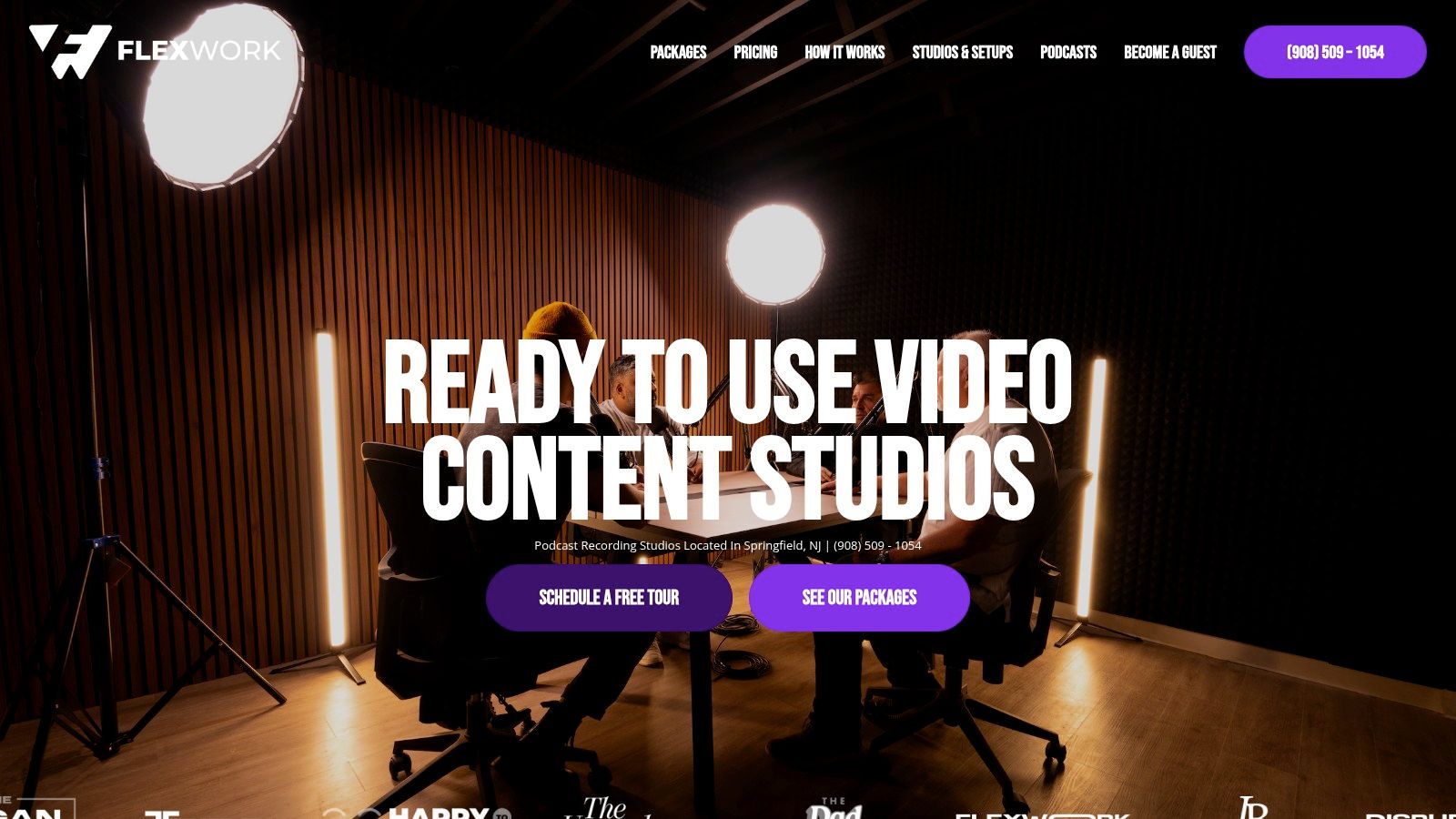
You can. But you'll spend time sourcing cameras, troubleshooting acoustics, managing edit pipelines, organizing gear, and solving production details that a specialist environment already solved years ago. That's not vision. That's overhead.
Why external production is now the normal move
This isn't a compromise. It's how modern teams scale.
According to GTM 8020, 84% of B2B marketing teams that outsource cite content creation as their primary external activity, and even mature teams often outsource 54% to 75% of content activities to keep output moving. The same analysis says internal teams increasingly keep strategy in-house while delegating specialist execution like video production to agencies, according to GTM 8020's B2B marketing team structure statistics.
That's exactly the right split for a serious podcast brand.
What a studio partner actually solves
A studio partner removes production friction all at once:
- Environment: Sound-treated rooms and camera-ready sets
- Execution: Producers, engineers, editors, and post-production support
- Batching: One session can create long-form episodes, social clips, and stills
- Speed: Your team leaves with assets in motion, not just raw files sitting on a drive
If you want a useful outside perspective on scaling with systems and support layers, this Veo3 AI content framework is worth reading alongside your own planning.
For creators in the NJ and NY orbit, Flexwork Podcast Studios fits this blended model well because it combines studio rentals, podcast production packages, Content Day sessions, editing, distribution support, and podcast websites in one operating layer. That makes it easier to build a lean internal team without sacrificing production quality.
The smartest build is rarely fully in-house
Keep the voice. Keep the strategy. Keep the business decisions.
Rent the complexity.
That's the version of a content creation team structure that scales. You stay the talent and the decision-maker. Specialists handle the environment, the technical quality, the post-production, and the repeatable systems that turn one recording into a real media engine.
If you're ready to stop running your show like a side project and start operating it like a brand, book a tour or explore the production options at Flexwork Podcast Studios. It's a practical next step if you want cleaner production, faster output, and a team structure that can grow with your vision.