

Podcast Content Strategy: Build a Show That Grows
 August 10, 202623 Minutes
Just over half of U.S. adults, 54%, reported listening to a podcast in the prior 12 months, up from 42% in 2023 and 9% in 2008. That's not a fringe channel anymore, it's a mainstream attention market, and the shows that win are the ones built with a real podcast content strategy, not a loose calendar and good intentions (Content Science podcasting fact sheet). In a market with over 4.5 million active podcasts worldwide and global podcast listeners measured in the hundreds of millions, the gap between a hobby show and a growth asset comes down to structure, positioning, and consistency (industry roundup). Flexwork Studios sees that reality every day in New Jersey, where creators don't need more ideas, they need a system that turns one recording into repeatable reach.
Why Podcast Content Strategy Determines Show Survival
Podcasting has crossed the line from creative experiment to crowded media channel. A market with over 4.5 million active podcasts worldwide gives listeners endless options, which means weak positioning gets ignored fast. That is why a real podcast content strategy has to shape the show before the first record button press, and why the planning layer belongs in a clear launch process instead of a last-minute scramble.
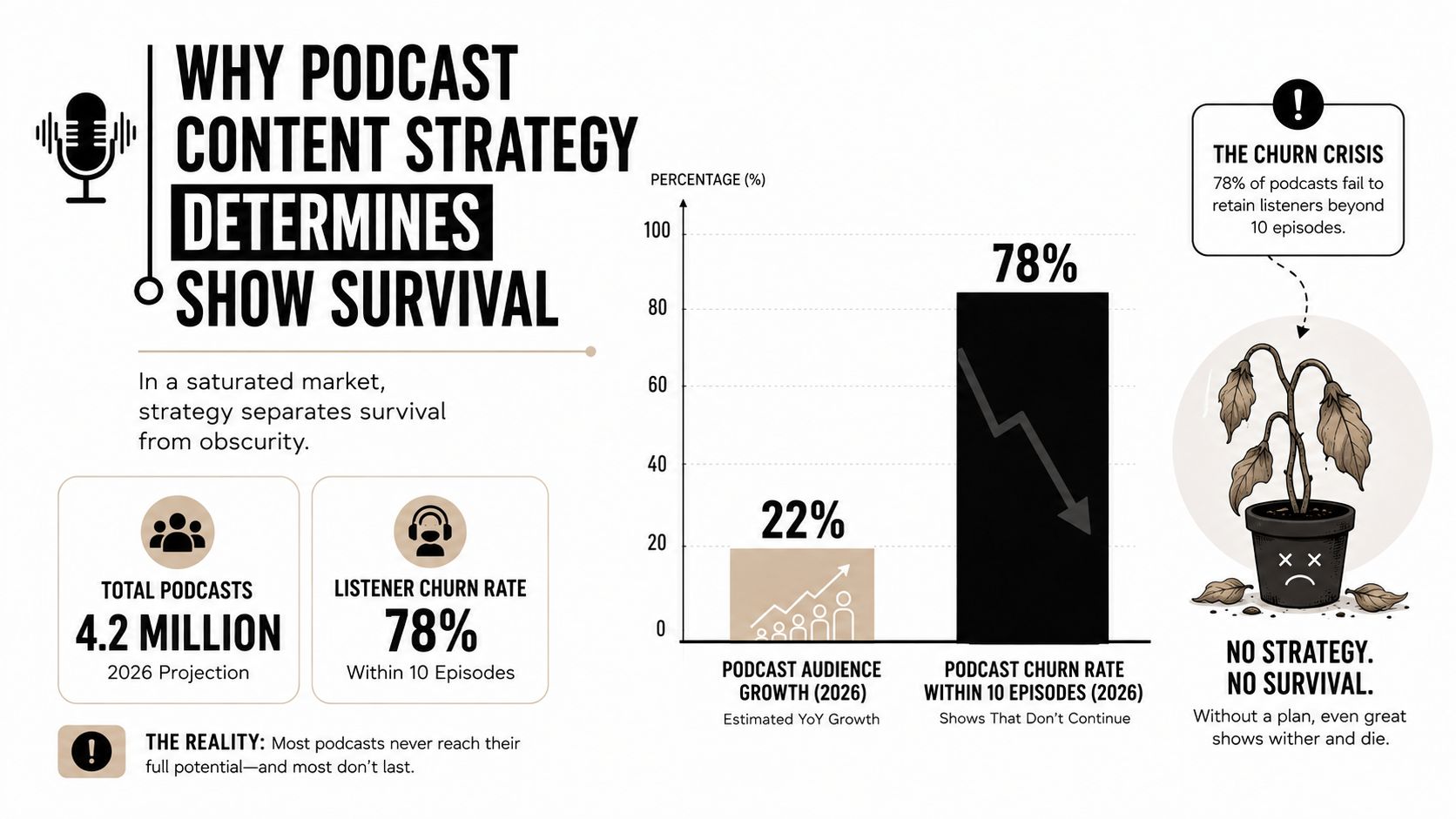
The hard truth is simple. A show without a system is what causes most podcasts to fail. One benchmark says roughly 80% of podcasts do not survive past their first 10 episodes, while up to 35% of listeners drop off in the first 5 minutes (Descript metrics guide). If the opening is soft, the positioning is broad, or the workflow depends on motivation, the audience disappears before the show has a chance to prove itself.
Strategy is the operating system, not the calendar
A real podcast content strategy starts before recording. It defines the listener segment, the unmet question the show answers, the episode structure, and the downstream assets each episode should create. That is the planning layer that keeps a show from drifting, and it is the difference between a release schedule and a growth plan.
If the first ten episodes are random, the market will treat the show like a random podcast.
Early momentum only happens when the show gives people a reason to return and a reason to share. A benchmark commonly used in podcast analytics says around 31 downloads in the first seven days can place a new show in the top 50% of podcasts (Descript metrics guide). You do not get there by improvising every week. You get there by making the show easy to understand, easy to share, and easy to continue.
The other failure pattern is DIY burnout. Creators spend all their energy on recording, then discover they have nothing left for packaging, clips, distribution, or measurement. That is a systems problem. Strong shows survive because every episode has a job, every role is clear, and every piece of content feeds the next one. As Oviond's guide to niche picking shows, narrow positioning makes that system easier to build because the audience and promise are specific from the start.
Validating Your Micro-Niche Before You Record
Broad topics are a trap. “Business,” “marketing,” “mindset,” and “entrepreneurship” sound open-ended, but they usually lead to vague episodes, weak search signals, and endless creative drift. A sharper niche gives you a clearer promise, a more obvious listener, and a much better chance of becoming memorable.
Start with a specific audience, not a theme
The best niche work begins with one question, who is this for, exactly? One content-strategy source frames the modern approach as a defined audience plus concept, cadence, distribution, atomization, and measurement, not just a list of episode ideas (Repcap podcast content strategy). That's the right mindset. You're not trying to cover a category, you're trying to serve a segment.
A useful external reference point is Oviond's guide to niche picking, which reinforces a simple idea. A niche should be narrow enough to be recognizable and specific enough to attract repeat attention. That same logic applies to podcasts. If your listener can't tell in one sentence why the show is for them, the market won't do the work for you.
The validation process should be practical:
- Search for the question set. Look at the wording people use when they ask for help in forums, community groups, and search results.
- Check the competitive gap. If every existing show covers the topic broadly, you need a tighter angle.
- Test your material volume. If you can't see a path to 50 episodes without stretching, the niche is too thin.
- Write the listener promise. Define who the show helps, what outcome it supports, and what problems it solves.
Map the niche to formats you can sustain
A micro-niche needs repeatable episode types, not just one-off brilliance. If your audience is founders hiring their first podcast producer, your formats might include teardown episodes, guest interviews, and tactical breakdowns. If your audience is brand marketers in a specific industry, your pillars might shift toward case-style analysis, workflow episodes, and distribution playbooks.
For producers and creators in the NJ and NY metro area, Flexwork's podcast genre and format guidance is useful because format choice affects pace, tone, and how easily a show can be packaged later. If the format doesn't match the listener's habits, even a good idea gets buried in friction.
A niche isn't a limitation. It's the reason someone remembers your show after one episode.
This is also where a podcast can borrow discipline from other content businesses. A show that serves one audience segment with one clear promise is easier to market, easier to script, and easier to repurpose. Generic shows force you to invent relevance every week. Focused shows earn it automatically.
Designing Episodes for Retention and Completion
Retention is where the show proves itself. Downloads can flatter you, but completion rate tells you whether the episode held attention, and listener drop-off tells you exactly where the structure failed. Industry analytics guidance often targets completion rates above 65%, because stronger retention usually signals better content fit and more usable moments for clips and repurposing (IAB measurement guidance).

The opening has to prove the episode
The first 30 to 90 seconds are not branding time, they're proof time. If the listener can't tell what the episode is about and why it matters almost immediately, you've already started losing them. That's why the opening should validate the premise, name the payoff, and establish the speaker's credibility without drifting into a long intro.
The drop-off data makes that urgent. With up to 35% of listeners dropping in the first 5 minutes (Descript metrics guide), the intro can't be polite and meandering. It has to earn attention fast.
A strong episode opening usually does three things:
- States the outcome. Tell the listener what they'll know, decide, or improve by the end.
- Signals the tension. Name the mistake, myth, or tradeoff that makes the topic worth hearing.
- Gets to the point. Cut the warm-up chatter that doesn't move the premise forward.
Structure the middle so it doesn't sag
Most retention problems happen in the middle, not the intro. That's where hosts drift into tangents, repeat the same point twice, or pad the episode because the outline was too thin. The fix is segment design. Break the conversation into recognizable beats, keep each beat tied to one idea, and remove any section that doesn't deepen the payoff.
A podcast episode should feel like a sequence of decisions, not a stream of thoughts.
You should also review retention curves after publishing. When you see the exact segment where listeners leave, that's not a failure to panic over, it's a section to cut, compress, or reframe in the next episode. That's how good producers work. They don't guess what's weak. They read the structure and adjust it.
For script structure, Flexwork's podcast scripting guide is a practical reference because a clean script doesn't make the show stiff. It makes the episode easier to follow, easier to edit, and easier to keep tight.
The Atomization Framework for Content Multiplication
One episode should never live as one file. If the recording is good, it should become a source asset for clips, email, web content, and social distribution. That's the difference between a show that publishes and a show that compounds.

Pick the moments worth multiplying
Not every sentence deserves to become a clip. The right approach is to identify the strongest segment while the episode is being recorded, then build the repurposing plan around that moment. That keeps distribution aligned with actual audience interest instead of forcing promotion around the entire episode equally.
A clean atomization workflow usually looks like this:
- Flag the standout line. Mark the part with the sharpest insight, strongest story, or most quotable moment.
- Cut for format. Turn that moment into a short-form clip, a web summary, or an email snippet.
- Reinforce the same idea. Use the clip, blog post, and social caption to point back to the same source episode.
- Track what moves. Watch which segments drive traffic, follows, and replies so the next recording is smarter.
The payoff is efficiency. You're not making more content by brute force. You're extracting more value from what you already recorded.
Build one recording session into a week of assets
Production teams get ahead of hobbyists. A single episode can fuel YouTube clips, audiograms, a summary post, an email teaser, and a social thread if the show is designed for it. The technical part is connecting creation and analytics so you know which segments produce attention.
The YouTube research here lines up with the repurposing logic. It treats the main episode as a content pillar and the smaller pieces as shoulder content that extends the life of the core recording. That's the right model for podcasting too. You're not squeezing content out of a finished episode, you're planning the episode so it can be distributed in layers.
If you need a practical workflow example, Flexwork's repurposing guide for podcast episodes is the right kind of model, because it treats one recording as the beginning of a content system, not the end of one.
Distribution Channels That Actually Convert
Distribution only matters if it moves people closer to listening, subscribing, or taking the next action. That's why owned channels beat borrowed reach. Independent podcast-marketing guidance says email-list subscribers convert to listeners at 4x the rate of social followers, and it also argues that niche podcasts targeting a specific professional audience or use case grow 3x faster and command 60% higher CPM rates than general-interest shows (Digital Applied podcast marketing guide). That's a loud argument for owned audience-building and focus.
Own the audience before you chase the platform
Social can spark awareness, but it rarely carries the whole load. Email gets people back to the show because it reaches a group that has already opted in. That makes it a stronger conversion channel than chasing likes from people who barely remember the post two minutes later.
The timing data matters too. One industry roundup says 46% of listeners tune in within 24 hours of release, and 78% of podcast listening happens Monday through Friday (RSS.com state of podcasting). So the release window isn't random. Consistency trains listening habits, and habits beat occasional spikes.
A practical distribution mix should prioritize:
- Email first. Announce the episode to people who already asked to hear from you.
- Social second. Use clips and short posts to extend reach, not replace it.
- Website third. Give the episode a search-friendly home that can keep working after launch day.
Don't build a channel strategy around vanity reach
A lot of creators overvalue platforms that look busy and undervalue channels that convert. A social following can be large and still ineffective if it doesn't drive repeat listening. An email list can be smaller and still outperform because the audience is warmer.
The broader lesson is durable content systems matter more than platform hype. One roundup says the average podcast publishes about 21 episodes before becoming inactive (RSS.com state of podcasting). That's a signal. If your promotion depends on constant manual effort, the show will fade when your energy does.
Flexwork's podcast marketing services fit this logic because distribution works best when it's tied to production, not bolted on afterward. The strongest shows build the promotion engine at the same time they build the episode.
Measuring What Predicts Growth and Survival
Growth measurement starts with retention, not applause. A show can collect downloads and still be headed nowhere if listeners bail early, never come back, or only sample episodes once. The numbers that matter tell you whether the format is holding attention, whether the audience is forming a habit, and whether the show can survive beyond the launch burst.
Track the signals that show people are staying
Podcast analytics guidance points creators toward listener demographics, engagement, new subscriber growth, chart ranking, consumption rate, retention rate, and unique listeners as the core set worth watching. Those signals show whether the show has a real audience and whether the content is getting stronger over time.
| Podcast Health Benchmarks | Benchmark | What It Signals |
|---|---|---|
| First-week downloads | 31 downloads in the first seven days | A new show reaching the top half of the field |
| Early survival | 80% of podcasts do not survive past their first 10 episodes | The show needs a repeatable production and publishing system |
| Opening retention | Up to 35% drop off in the first 5 minutes | The intro is too slow, unclear, or low-value |
| Completion rate | Above 65% | Stronger content-market fit and better clip potential (IAB measurement guidance) |
Use the numbers to change structure, not just headlines
If retention drops in the opening, fix the opening. If listeners leave in the middle, tighten the segment. If the show gets clicks but no repeat listening, the promise is wrong for the content. Analytics should point to structural changes, not confirm your assumptions.
The best dashboards don't just show performance. They expose bad assumptions.
Read the show like an editor, not a cheerleader. Downloads matter, but they are not enough. A show with a weak premise and a polished title still dies if the structure does not hold attention. A show with a tight concept, strong retention, and a clear listening pattern has a real chance to build momentum.
The same applies to production decisions. Even something basic like choosing headphones to avoid mic bleed before a session protects the edit and keeps the workflow clean. Small technical failures distort the numbers because they make good episodes harder to finish, harder to publish, and harder to measure fairly.
Use the metrics to find the bottleneck, then fix the bottleneck. That is how a show moves from noisy interest to durable growth.
Building Production Infrastructure That Scales
A strong content strategy collapses fast inside a bad production setup. If the room sounds wrong, the gear is unreliable, or the workflow eats time, quality becomes inconsistent and the show's pace slows down. That's why infrastructure isn't a luxury purchase. It's the thing that lets the strategy repeat.
The practical details matter more than most creators admit. Even basic decisions, like choosing headphones to avoid mic bleed before a session, can save a take and keep the edit clean (RemotionAI headphone guide). Small production mistakes compound when you record often. The cleaner the setup, the easier it is to stay consistent.
Professional environments also remove decision fatigue. An acoustically treated room, reliable audio chains, and a team that handles recording, editing, and deliverables mean the host can focus on the conversation instead of the mechanics. That's the same logic behind studio rentals, production packages, and Content Day sessions. They reduce friction so the show can keep moving.
Flexwork Podcast Studios is one option for that kind of infrastructure, with studio rentals, podcast production packages, Content Day sessions, and podcast websites built into one workflow. For creators serious about making the show sustainable, that kind of setup changes the job from “Can we get this recorded?” to “What's the next asset this episode should become?”
If you're ready to stop improvising your show and start building it like a real content system, book time with Flexwork Podcast Studios and turn your next recording into a cleaner episode, stronger clips, and a distribution plan that compounds. If you want studio rentals, production support, or a Content Day built around repurposing, Flexwork can help you ship with less friction and more consistency.