
How to Produce a Podcast: The 2026 Pro-Level Guide
 May 2, 202629 Minutes
Meta description: Learn how to produce a podcast with a pro-level workflow for strategy, recording, editing, video, and launch in the NJ/NY market.
URL slug: /how-to-produce-a-podcast
Primary keyword: how to produce a podcast
Secondary keywords: podcast production, podcast studio NJ, video podcast production
You have the idea. You know the audience you want. You can already hear the intro in your head.
Then reality shows up. You need a format, a recording setup, a guest workflow, clean audio, video clips, show notes, distribution, and a launch plan that doesn’t make your brand look half-finished. That’s where most promising podcasts stall. The issue usually isn’t creativity. It’s production drag.
If you’re serious about learning how to produce a podcast, stop treating it like a weekend side project and start treating it like a media property. That means building a real production ecosystem around the show. If you want help shaping that ecosystem before you ever hit record, this guide to AI content strategy for podcasters is a smart companion resource. It’s useful if you want your podcast to feed a broader content engine instead of sitting alone in an RSS feed.
Your Professional Podcast Production Blueprint
A familiar scenario plays out every week. A founder, coach, or creator has a strong point of view and a real reason to launch. They’re not short on expertise. They’re short on clarity.
They buy a mic, record a test, hate the sound, postpone the launch, overthink the branding, then lose momentum because every production decision now lives on their shoulders. That’s not a creativity problem. It’s an infrastructure problem.
A podcast that grows your brand needs more than a recording session. It needs a sequence. You need strategy before production, clean capture during recording, disciplined editing after the session, and promotion that turns one episode into many assets.
A polished show doesn’t happen because the host is talented. It happens because the workflow is disciplined.
That’s the blueprint serious creators follow. Not because it sounds advanced, but because it protects your time and your reputation.
The Hidden Costs of DIY Podcast Production
A founder blocks Friday at 2 p.m. to record. By 4:30, the episode still is not usable. The room sounds hollow, one camera file is corrupted, the guest has to leave, and the edit now sits on your weekend list. That is the actual cost of DIY production in the NJ and NY metro market. It rarely fails all at once. It drains momentum in small, expensive ways.
The mistake is treating podcast production like a gear purchase. It is an operating system. Strategy, recording, editing, publishing, and promotion all depend on each other. If you run the show alone, every weak point lands on your calendar.
DIY debt shows up in four places
- Audio quality becomes a repair problem: Home and office setups create predictable issues. Street noise, HVAC rumble, reflective walls, poor mic placement, and inconsistent levels force every episode into cleanup.
- Production time expands fast: Recording is the short part. Setup, troubleshooting, file management, editing, revisions, exports, uploads, and clip creation consume the bulk of your hours.
- Your brand starts to look inconsistent: One episode sounds clean, the next sounds distant. Video framing changes. Graphics feel improvised. That inconsistency signals lower standards before a listener judges your ideas.
- Revenue work gets pushed aside: If you are a consultant, executive, agency owner, or subject matter expert, production hours come out of selling, client delivery, and leadership time.
Serious shows stall at this point.
The cheapest setup often produces the highest total cost because new hosts count equipment and ignore labor. They price the microphone. They do not price the three hours spent fixing room noise, the delayed episode, or the missed chance to turn one recording into clips, reels, and sales assets.
That tradeoff matters more in a competitive regional market. In NJ and NYC, your show does not compete with hobby podcasts alone. It sits next to polished business content backed by teams, studios, and repeatable workflows. Publishable is not enough. Your show has to look organized, sound credible, and release on schedule.
Practical rule: If your production workflow depends on leftover time, your release schedule will break the moment business gets busy.
A professional partner removes that bottleneck by treating the show as a service stack, not a side project. If you want a clearer view of the tradeoff, read what you gain by going pro instead of handling studio vs DIY podcasting on your own. The value is not just cleaner audio. It is consistency, speed, and a show that supports the brand instead of stealing time from it.
Partnering for Polish and Performance
A founder records a strong conversation, then spends the next week chasing files, fixing audio, approving artwork, rewriting titles, and wondering why the episode still is not live. That is not a content strategy. It is an operations problem.
The fix is to build a production ecosystem with clear ownership. You lead the message, the guest relationships, and the business goal behind the show. Your production partner handles the technical environment, capture standards, post-production, publishing workflow, and the asset creation that turns one recording into usable marketing content.

What a real production ecosystem includes
Professional podcast production works as an integrated service stack. Each layer supports the next, and weak coordination at any point lowers the value of the whole show.
| Layer | What it handles | Why it matters |
|---|---|---|
| Strategy | Show concept, audience, format, launch plan | Prevents vague positioning and wasted episodes |
| Recording | Audio, video, lighting, room acoustics | Produces source material that is actually worth editing |
| Post-production | Editing, mixing, mastering, clip extraction | Protects pacing, clarity, and listener trust |
| Distribution | Publishing, metadata, platform setup | Keeps release operations organized and consistent |
| Growth assets | Reels, thumbnails, graphics, websites | Extends the value of each recording beyond the audio feed |
This matters more in the NJ and NYC market, where your show sits beside polished brand media from agencies, executives, and creator businesses with real support behind them. If your workflow is fragmented, the audience can hear it and see it.
A studio partner should reduce complexity, not add another vendor to manage. The useful model is one team that can align strategy, studio capture, editing standards, visual packaging, and release operations around the same business objective. Flexwork Podcast Studios is one example of that model in Springfield, NJ, built around treated rooms, podcast and video production, and coordinated post-production support.
What busy hosts should expect from a production partner
Do not shop for a podcast partner the way you shop for a microphone. Shop for decision relief and output quality.
A strong partner typically helps in four ways:
- Production planning: episode mapping, guest prep, run-of-show structure, and recording logistics
- Capture quality: audio, video, lighting, framing, monitoring, and file management
- Post-production: editing, cleanup, mixing, mastering, show notes, titles, and clip selection
- Content operations: publishing, asset packaging, approvals, and distribution support
That setup protects your time and your reputation. It also gives the show a repeatable operating system, which is what serious brand-building requires.
If you care about ROI, buy coordination
The expensive part of podcasting is not always the invoice. It is the executive attention burned on scattered decisions, delayed approvals, inconsistent outputs, and missed repurposing opportunities.
Choose a partner that can standardize the workflow. One intake process. One recording setup. One post-production path. One approval rhythm. One release cadence.
As noted earlier, the value of going pro is bigger than cleaner audio. You get speed, consistency, and a show that behaves like a business asset instead of a recurring production fire drill.
You do not need more gear research. You need a production system that protects quality and frees up your highest-value time.
Laying the Foundation for a Standout Show
A sharp mic won’t save a vague show. Before you think about recording, define what the podcast is for and who it’s for.
Most weak launches fail at the concept level. The host knows the subject but hasn’t translated that subject into a distinct promise for the listener. “Business podcast” is not a concept. “A weekly show where startup founders learn how to turn expertise into premium content assets” is getting closer.
Lock the positioning before you record
Start with four decisions:
Audience
Name the listener precisely. Not “entrepreneurs.” Be narrower. Early-stage founders. Health coaches building authority. Creators selling education products. Specificity improves every downstream choice.
Transformation
What should a listener get after an episode? More clarity, a tactic they can use, better decision-making, stronger conviction, or access to conversations they can’t get elsewhere.
Format
Interviews work if you’re strong at hosting and guest prep. Solo episodes work if your perspective is already sharp. Hybrid works if you can maintain consistency without confusing the audience.
Tone
Pick the feel of the room. Smart and warm. Tactical and fast. Elevated and editorial. Your tone affects guests, visuals, scripting, and the type of clips you can repurpose later.
Plan the first five episodes before episode one
Don’t launch on inspiration. Launch on a sequence.
Use this checklist:
- Episode one: State the show’s premise and why it exists.
- Episode two: Solve the most obvious pain point your audience already feels.
- Episode three: Bring on a guest who adds authority or contrast.
- Episode four: Address a common mistake or misconception in your niche.
- Episode five: Tackle a topic with strong clip potential and clear takeaways.
Decision filter: If a topic sounds interesting to you but wouldn’t make sense to a new listener, don’t make it an early episode.
A simple content calendar also helps. Map themes, possible guests, and supporting social ideas in advance. That way your recording day becomes execution, not brainstorming.
Capturing Broadcast-Quality Audio and Video
You can spot an amateur podcast in seconds. The voice sounds distant, the room rings, the guest is backlit, and the whole production signals low standards before the conversation has a chance to work.
Serious shows avoid that problem by treating capture as part of a production ecosystem, not a one-hour recording task. Strategy sets the format. The room supports the format. The gear fits the room. The engineer protects the session. Post-production gets easier because the source files were handled correctly from the start. That is how professional teams produce a show that builds brand trust in the NJ and NY metro market, where audiences and guests expect a polished experience.

What good capture actually requires
Broadcast-quality recording comes from control.
- Mic discipline matters: Keep your mouth at a consistent distance from the microphone. Drifting creates uneven levels, tonal changes, and extra repair work in post.
- Gain staging matters: Set levels before the conversation gets interesting. Record too low and you pull up room noise later. Record too hot and clipping ruins lines you cannot recreate.
- The room matters more than the mic: Expensive gear cannot hide a reflective room. Acoustic treatment improves the result faster than another equipment purchase.
- Monitoring matters: Wear headphones and catch problems while they happen. Plosives, table bumps, HVAC rumble, and cable noise are cheap to fix during the session and expensive to fix after.
Teams that want a more technical walkthrough should review these advanced recording techniques for stronger podcast sound.
Video should support the brand
Video production needs discipline too. A strong podcast frame is simple, repeatable, and aligned with your brand. Clean lighting, accurate skin tones, stable framing, and a set that fits your positioning will outperform an overbuilt setup that slows down production and makes every shoot harder to repeat.
That matters even more if you want social clips, YouTube distribution, and guest-ready sessions that reflect well on your company. In the NJ and NY metro area, your show competes with founder content, agency content, in-house media teams, and professional studios. Weak visuals make the brand look smaller than it is.
A well-run studio session solves the operational side. The room is treated. Camera positions stay consistent. The mic chain is tested before anyone sits down. Lighting is balanced for both the host and the guest. That infrastructure protects your recording day and raises the quality of every asset that follows.
Record with the assumption that every mistake will cost you time, money, or credibility later.
A clean recording day checklist
| Before recording | During recording | After recording |
|---|---|---|
| Test levels and headphones | Keep mic distance steady | Back up files immediately |
| Confirm lighting and framing | Pause and retake obvious mistakes | Label files clearly |
| Silence phones and room noise | Watch for clipping and plosives | Send notes with time markers |
This level of discipline is what separates hobby content from a media asset. If the goal is brand authority and ROI, capture quality is not a detail. It is the base layer of the entire production stack.
The Art of an Efficient Audio Edit
A founder records a strong interview on Tuesday, plans to publish on Thursday, and spends the entire Wednesday night buried in waveforms, retakes, and export settings. That is not production. That is overhead.
Editing is where a podcast either becomes a real brand asset or stays stuck as raw content with potential. Serious shows treat post-production as part of a larger service stack. Strategy shapes the episode. Recording captures it cleanly. Editing sharpens the message. Distribution and marketing turn it into reach. In the NJ and NY metro market, where your show sits next to polished agency content, founder media brands, and studio-produced interview series, post-production quality signals how seriously people should take your company.
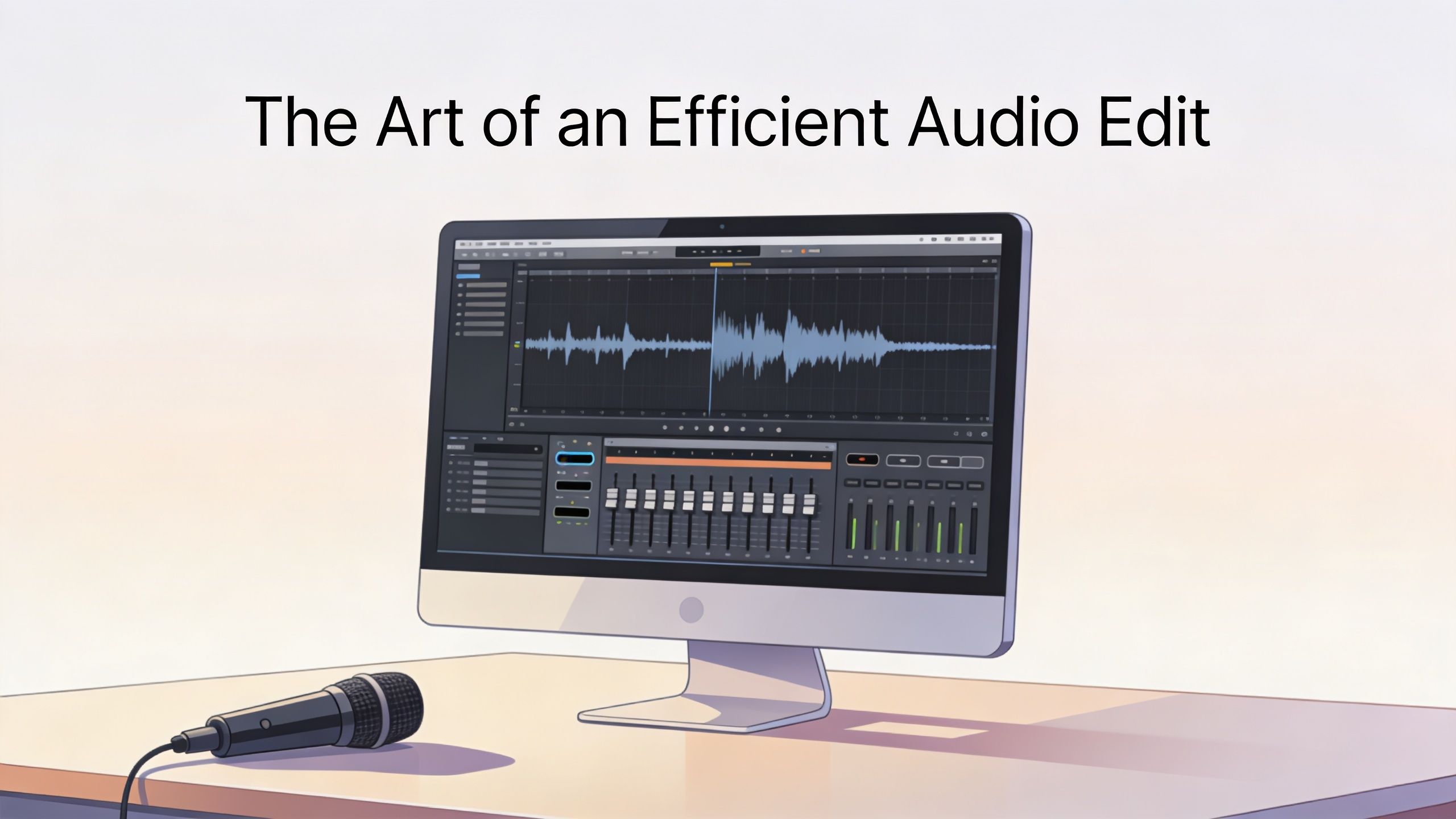
A strong edit protects pacing, clarity, and authority. It removes friction for the listener. It also protects your internal team from wasting hours on decisions a trained editor should make in minutes.
A professional edit follows a sequence
Start with organization. Separate the tracks, name every file correctly, confirm the preferred take, and review producer notes before making a single cut. Messy sessions create slow edits, inconsistent versions, and avoidable mistakes.
Then handle the content edit. Remove false starts, repeated thoughts, obvious filler, interruptions that break comprehension, and dead air that weakens momentum. Keep the host sounding sharp and the guest sounding credible. If a sentence wanders, tighten it. If a tangent supports authority or story, keep it.
Next, clean the sound. Use EQ to reduce low-end rumble and boxiness. Apply compression to control uneven dynamics. Tame harsh consonants with de-essing. Normalize loudness so the episode plays back consistently across podcast apps. These are baseline standards, not finishing touches.
Edit for authority, not perfection
New podcasters usually make one of two expensive mistakes. They publish conversations that feel unfiltered and tiring, or they overcut the episode until every voice sounds stiff.
Use a simpler standard. Cut anything that distracts from the point. Keep anything that strengthens trust.
- Remove: long hesitations, repeated words, mic bumps, crosstalk that confuses the listener, and off-topic detours with no payoff
- Keep: brief pauses for emphasis, natural laughter, strong conversational rhythm, and moments that reveal conviction or expertise
- Refine: transitions, intro and outro timing, music levels, and ad placements so the episode feels intentional from start to finish
One rule matters more than the rest.
Editing rule: If a cut makes the speaker sound less intelligent or less human, undo it.
This is also where production partners separate themselves from freelancers who only trim silence. A real post-production workflow includes editorial judgment, audio finishing, version control, show notes support, and handoff for clip creation. That ecosystem matters if your goal is consistent publishing and measurable ROI, not a one-off episode that looked easy until the files hit the editor.
If you want a clear benchmark for what polished post should include, review these post-production best practices for podcast episodes. Once the master edit is done, the same session can also be cut down to make engaging short-form video highlights without adding a second production cycle.
Creating Shareable Video and Social Assets
A serious podcast should leave every recording session with more than a finished episode. It should leave with a content package that feeds discovery, distribution, and brand recall across every platform that matters in the NJ and NY market.
That is the standard.
Audio gets loyalty. Video gets attention. Social assets create the repeated exposure that turns a first impression into a subscriber, client, or referral source. If your production process ends at the master file, you are paying for studio time and getting only a fraction of the return.
Build clips into the production ecosystem
Shareable content does not start after the edit. It starts before you record.
Frame the set for horizontal and vertical crops. Light for skin tone and contrast, not just the room. Record clean 4K video so the editor has room to punch in, reframe, and create visual variety from one master angle without degrading the image. That approach works especially well for founder-led shows, interview formats, and batch production days where speed matters as much as polish.
For serious creators, this is not a DIY trick. It is part of a production ecosystem. Strategy determines what moments are worth isolating. Recording captures those moments cleanly. Editing shapes them into platform-specific assets. Distribution puts them in front of the right audience on the right cadence. A studio partner that handles the full stack keeps all of that aligned.
Turn one recording into a content system
Every episode should produce a usable asset mix.
- Short vertical clips: Strong opinions, tactical advice, and emotionally charged moments that stop the scroll
- Platform-cut video edits: Different runtimes and framing for Instagram, LinkedIn, TikTok, YouTube Shorts, and full-length YouTube
- Quote graphics: Clean authority-building posts for guests, founders, and brand pages
- Teaser assets: Pre-launch clips that build anticipation before the episode goes live
- Evergreen excerpts: Timeless segments you can repost later without sounding dated
The goal is volume with standards. A weak clip posted five times does not build a premium brand. A sharp content package, released consistently, does.
If you want a practical reference for how to make engaging short-form video highlights, that guide is useful for shaping clips around pacing, payoff, and hook strength.
For a clearer repurposing model, review this guide on how to repurpose a single podcast episode into 10 pieces of content. It is the right way to plan output if you want each session to support audience growth, guest promotion, and sales visibility instead of producing one post and going quiet.
In a competitive market, polished social assets are not decoration. They are distribution infrastructure. That is why high-value shows treat clip strategy, edit decisions, and publishing support as one coordinated service, not a pile of disconnected tasks.
Launching Your Show and Driving Growth
A podcast launch isn’t the moment you upload audio. It’s the moment your production system starts working in public.
The market is crowded. There are over 4 million podcasts worldwide, and the average podcast gets just 29 downloads in the first month after publishing, according to Blubrry’s explanation of podcast analytics and performance benchmarks. That number should reset your expectations in a healthy way. Publishing alone doesn’t create momentum. Strategy does.

Launch like a media brand, not a hobbyist
Pick a hosting platform first. Then submit your show to the major listening apps and make sure your cover art, description, category, and metadata are clean and aligned.
Don’t launch with one lonely episode unless you have a strong reason. A small batch gives new listeners more to consume and gives your promotion more substance.
A clean launch week usually includes:
- A core episode release: Your strongest opening statement.
- Guest and partner amplification: Give collaborators ready-made assets so they can share without friction.
- Clips and visuals: Use the short-form assets from your recording pipeline.
- Email and website support: Publish with proper show notes, a clear summary, and links that move listeners into your world.
If you need structure for the written side, this SpeakNotes template for podcasts is helpful for shaping show notes that are useful.
Use analytics to make smarter editorial decisions
Downloads matter, but they’re not enough. Look at what people finish, where they drop, which topics pull attention, and which episodes attract the right audience profile.
If completion rates are weak, your pacing or intro probably needs work. If one topic attracts more listeners, build around that interest instead of guessing. If a certain guest type generates more response, adjust your booking criteria.
Growth comes from feedback loops, not ego. Publish, review, refine, repeat.
The teams that win at podcasting don’t only record more. They learn faster from each release.
That’s why marketing and production shouldn’t live in separate silos. Your launch assets, publishing habits, and episode analytics should inform the next recording block. If you want a practical framework for that side of the equation, review how to market your podcast.
If you’re ready to build a podcast that looks and sounds aligned with the brand behind it, start with Flexwork Podcast Studios. Book a tour, review the production options, and design a workflow that lets you show up as the host while the system handles the rest.