
How to Create Podcast Intro Music That Hooks Listeners
 August 12, 202618 Minutes
A long podcast intro can cost you the audience before the episode really starts. One guide citing Apple Podcasts data says 15% to 20% of listeners abandon an episode during a long intro Les FM, which is why the smartest opening music behaves less like a mini-movie and more like a clean signal that the show is worth staying for. If you're learning how to create podcast intro music, the core job is to make something that still feels sharp in earbuds, on phone speakers, and in the car. That's exactly the kind of practical production work Flexwork Studios in Springfield, NJ handles inside its broader podcast production and studio workflow.
Why Intro Music Is a Retention Tool Not Just Branding
The opening few seconds are not a branding vanity moment. They are a retention checkpoint, and that matters because listeners decide quickly whether the show feels worth staying with. If an intro drags, the music has to do more than sound polished, it has to justify the listener's patience right away.
The job of intro music is to clear the runway
A strong opener does three things at once. It signals identity, creates pace, and gets out of the way before the voice has to compete with it. That is why many production guides favor 8 to 15 seconds for weekly shows and suggest keeping intros under 20 seconds to reduce drop-off Les FM.
The best intros I hear in the room are compact. They do not try to act like a soundtrack, they work like a signature. A short, repeatable musical shape gives a show a recognizable front door without asking the listener to sit through an extended opener.
Practical rule: if the intro makes the host feel late to their own episode, it is too long.
That standard also reflects how people listen. A commuter hears your show beside traffic noise, someone in a kitchen may only catch the top end of the mix, and a workout listener often hears the episode through movement and background sound. Intro music has to survive those conditions, not just sit neatly inside a studio session. I look for a mix that keeps its identity on earbuds, phone speakers, and car audio, because a track that only works in headphones will fall apart where most episodes are heard.
For creators building a more polished identity, a useful reference point is Flexwork's custom studio assets workflow, which sits in the same lane as a strong intro strategy, branding that supports the listening experience instead of distracting from it.
Defining Your Audio Brief Before Opening a DAW
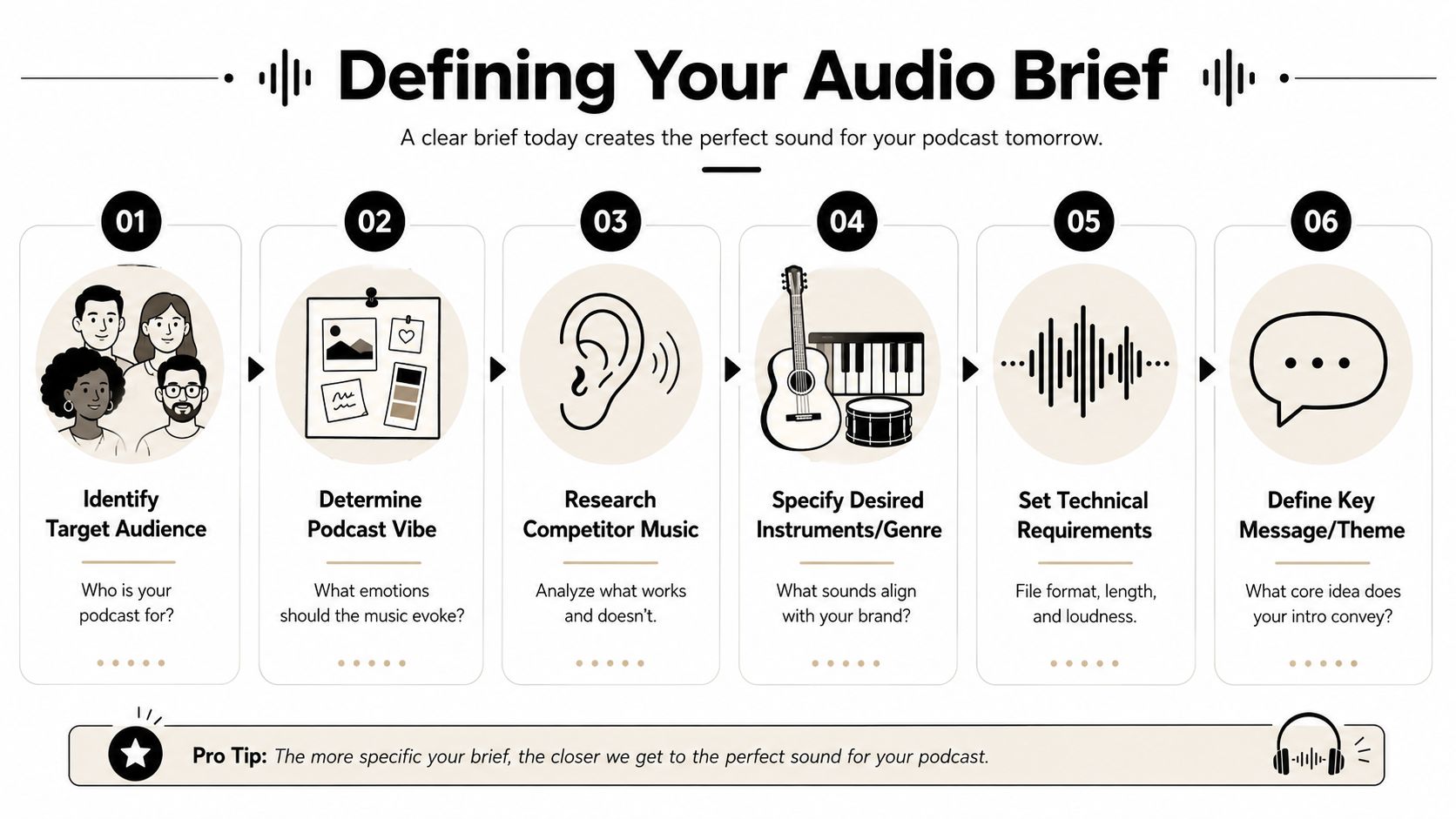
Bad intro music usually starts with a vague brief. Someone opens a sample library, hears something “cool,” and then spends an hour trying to make it fit a show that never asked for that mood in the first place. A better workflow starts with three decisions, mood, genre, and energy, before a single track gets dragged into the timeline Mubert.
Mood, genre, and energy need to match the show
Mood is the emotional temperature. Genre is the sonic language. Energy is the pace the listener feels in the first few seconds. A true-crime show usually needs a different emotional frame than a cheerful business interview, even if both want to sound premium and current.
Write the brief in plain language. “Moody, restrained, sparse percussion, modern but not aggressive” is more usable than “cinematic.” “Bright, energetic, forward-moving, confident” gives a producer something to build from without wandering into generic territory. That kind of specificity matters whether you're cutting it yourself or handing it to a production team.
Test the concept against the voice
The best pre-production check is simple. Play the proposed music under the first spoken lines and ask whether it supports the voice or steps on it. If the intro competes with the host's consonants, the arrangement is too dense, or the energy is too busy for the opening message.
A good brief makes the music easier to cut, but it also makes the show easier to recognize.
If you want a second resource for the setup side of this process, How to Contact studio guide is useful context for thinking about room, gear, and recording conditions before the final mix. For scripting the handoff between music and speech, Flexwork's podcast script guide is a practical companion because the music can only feel clean if the spoken intro is written cleanly too.
Timing and Structure Rules That Work

Good intro music has shape. It starts with a recognizable cue, moves with purpose, and hands the mic to speech before the listener feels trapped in the opener. One practical guide says intro length should usually stay within 15 to 30 seconds, with 15 seconds or shorter enough to grab attention and set the tone YouTube guide. Another expert tutorial recommends a 5-second intro plus a 2-second stinger for many shows Mubert.
Build around a short musical arc
A dependable structure looks like this. The opening establishes the brand. The middle lifts the energy just enough to feel intentional. The handoff lands cleanly into speech before the listener starts wondering when the episode begins.
That is why many producers work in sections instead of one long bed. A minimal opening, a build, and a speech handoff create movement without clutter. A 45-second idea can often be tightened into under 20 seconds without losing its identity, especially when the core melodic idea is strong YouTube guide.
Use the music as a cue, not a feature
The goal is not to squeeze every second for drama. The goal is to make the listener instantly understand, “I'm in the right place.” Repetition is what makes the intro memorable, not extended length or too many layers.
For creators who want a concrete template, this one works often enough to be useful:
- 0 to 3 seconds: brand cue or hook.
- 3 to 8 seconds: the main melody starts to move.
- 8 to 15 seconds: space opens for the host to enter.
- 15 to 30 seconds: only if the show truly needs a longer transition.
If you want a useful companion for the opening side of the episode plan, Flexwork's attention-first podcast launch guide pairs well with this structure because the opening seconds of the episode should match the opening promise of the show.
Mixing for Real-World Playback Environments
A mix that sounds polished on studio monitors can lose its shape the moment it reaches earbuds, a phone speaker, or a car stereo. That gap catches a lot of creators off guard when they are learning how to create podcast intro music. The primary job is not just making the track sound good in the edit bay, it is making sure it still supports the voice when low-end detail drops out and the midrange gets crowded Podpage.
Keep the music underneath the voice
The brief points to keeping intro music about 10 to 15 dB below the voice, or starting around -20 dB for music and -6 dB for voice as a working balance Soundstripe. Another guide recommends fading the music out over roughly 2 to 3 seconds once speech begins Soundstripe. Those are starting points, not fixed rules, but they help keep the host in control.
The common mistake is easy to hear. The host feels small because the bed is too busy. The intro turns muddy because low frequencies are stepping on consonants. In practice, the answer is usually less competition between tracks, not more processing.
Build a playback check that leaves the studio
The strongest test uses more than one device. Listen on earbuds, a phone speaker, and a car system if you can. A mix that feels balanced in one place can turn loud, thin, or abrupt somewhere else, especially in a mobile listening environment where playback quality changes from device to device Podpage.
If the voice disappears in the car, the intro is mixed for the editor, not the audience.
A repeatable check makes that problem easier to catch. Export a reference version, compare it against an episode that already translates well, then note where your intro sits against the voice. For a practical way to keep that review process consistent, the post-production best practices guide fits well here, because intro mixing works best as part of the full episode polish, not as a separate step. Some producers also separate tracks, normalize levels, and test playback before export so the music supports speech instead of fighting it Soundstripe.
DIY Production Versus Hiring Professional Help
A podcast intro can be built at home, and that is often the right move early on. Sample libraries, AI tools, and a basic DAW can produce something usable fast. If the show is still shaping its voice, speed and control can matter more than custom composition.
When DIY makes sense
DIY works best when the show is early, the budget is tight, or the host wants direct control over every creative choice. A simple loop, a short theme, and a clean edit can do the job if the content is strong and the audience is still small enough that consistency matters more than a bespoke score.
The weak point is usually execution, not taste. DIY intros often drift toward generic music beds, run too long, or sound balanced in headphones but thin in earbuds, car speakers, or phone playback. A finished mix has to survive those real listening environments, because that is where listeners hear it.
When professional help pays off
Hiring a team makes sense when the show needs a clearer identity, tighter pacing, or production that stays consistent from episode to episode. That is where studio versus DIY podcasting choices become practical, because the decision is not just about cost, it is about how much revision time and technical cleanup you want to own yourself.
Flexwork Studios offers audio editing and mixing that can fold intro and outro music into the episode for a smoother finish, and it also offers custom intro video animation as an add-on service. For creators who want the intro handled inside a broader workflow, that support keeps the music aligned with the episode instead of treated like a separate file.
If you are weighing how AI tools fit into that process, OpenAI's GPT Audio page is a useful reference for how audio tools are showing up in creative workflows. It helps clarify what software can speed up, and where a human ear still matters for balance, timing, and playback translation.
Professional help does not just buy better sound. It buys fewer revisions, fewer technical surprises, and a cleaner path from idea to publish.
Integrating Your Intro Into a Repeatable Workflow
A finished intro doesn't help much if every episode treats it differently. The easiest way to keep things professional is to standardize the handoff point between music and speech, then save that setup as a template in your editing software. That way, the opener starts the same way every time, which makes the show feel intentional before the first sentence lands.
Build the file like a reusable asset
Keep a master version, a shortened version, and any alternate endings in clearly labeled folders. Use version control so you always know which cut is live, especially if the show evolves and the opening copy changes. This avoids the common problem of a host using the wrong intro file because the filename looked close enough.
A simple quality checkpoint helps too. Before publishing, confirm that the music fades where it should, the voice enters cleanly, and the intro still feels right at normal playback levels. If a new episode has a different tone, revisit the handoff instead of forcing the old intro to work unchanged.
For teams that move fast, faster content workflow tips can be useful background on keeping approvals and asset handling tight without creating friction. Flexwork's production workflow can cover these same moving parts inside ongoing episode delivery, which is useful when the host wants to stay focused on content instead of file management.
Your Next Steps to Professional Podcast Audio
Great intro music is a retention decision, a mixing decision, and a workflow decision all at once. Keep it compact, define the mood before you produce, and test the mix in real listening environments instead of trusting studio monitors alone. If your show is ready to level up, Flexwork Studios can support the full path from recording to mixdown, with studio rentals in Springfield, NJ, production packages, and Content Day sessions built for creators who want a cleaner, more premium result.
If you're serious about scaling, explore the Market & Manage tier, which starts at $1500 per episode with a 20-episode growth commitment, or book a Content Day at $3000 per day for 20 edited reels or 60 pro photos. The right intro is only one part of that system, but it's the first part listeners hear.
Flexwork Podcast Studios helps creators turn a rough opening into a polished first impression, from studio recording to mixing and episode delivery. If you want a professional intro that holds up on earbuds, phones, and car audio, visit Flexwork Podcast Studios and book the next step for your show.