DJ Equipment Rental NYC: Your Ultimate Guide 2026
 July 26, 202619 Minutes
You're already behind schedule, and the venue still hasn't confirmed load-in. The guest list is locked, the camera is booked, and the audio chain still needs to be solved. That's why dj equipment rental nyc sounds simple until you're the one juggling traffic, building access, and a hard start time. Flexwork Studios fits into this conversation because the core issue isn't just gear, it's whether your content day or event can happen cleanly, with the least friction and the most professional result.
The High-Stakes World of NYC Audio Production
A creator in Manhattan doesn't just need sound, they need certainty. A DJ, podcast host, or brand team can have the playlist, the guest lineup, and the shot list ready, then lose the entire day to pickup timing, freight elevator rules, or a delivery window that doesn't line up with the venue. That's the hidden cost of working in New York, the city makes almost every production decision more expensive in time.
The market reflects that pressure. In the U.S., the average DJ hire cost is reported at $600 per set, with typical hourly pricing of $100 to $200 per hour. In major markets such as New York City, Bark's 2025 data puts a standard 5-hour booking at $800 to $1,500, with premium NYC wedding bookings reaching $1,200 to $1,800 or more. When the labor side climbs that high, people stop thinking about ownership and start looking for a setup that feels turnkey, fast, and controlled. The same logic applies to content production, because a polished session is only as strong as the logistics behind it. how to improve audio quality
Practical rule: In NYC, audio is rarely the hard part. Moving the gear, setting it up, and getting the building to cooperate is where most productions lose momentum.
The smartest creatives notice that early. They stop asking only what they can rent and start asking what environment lets them finish the job without improvising under pressure.
Navigating the NYC DJ Rental Landscape
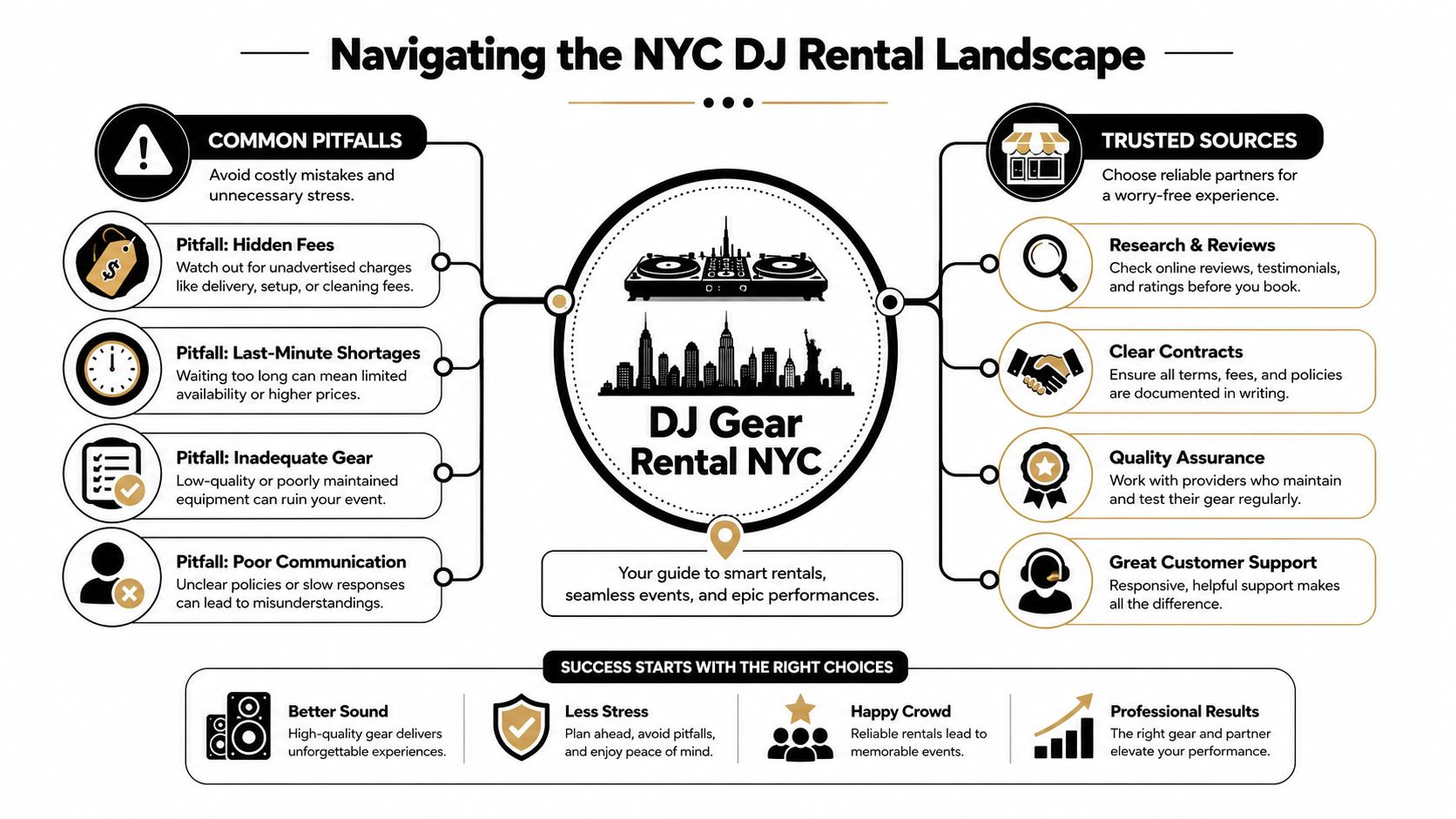
New York's rental market looks broad on the surface, but the friction starts after booking. What matters is not just whether the gear exists, it is how the gear gets from a warehouse or storefront into a building that may block your truck, your load-in, or your sound check. Public-facing rental pages from NYC vendors tend to spotlight inventory and contact info, while the operational details that matter most, cutoff times, after-hours returns, elevator access, loading docks, or venue drop-off rules, stay fuzzy. That is why a rental that looks easy online can turn into a scramble the moment you have to coordinate a van, a doorman, and a room that is already on the clock.
If you're trying to start your event planning business, this is the part nobody puts on the mood board. Gear availability is only one piece of the job. The city still has to cooperate, and New York rarely cooperates on your timeline.
The friction isn't inventory
The best rental houses can supply a strong kit, but the stress usually starts after you reserve it. You are coordinating who picks up, who unloads, who checks the model numbers, and who takes responsibility if something is missing at the door. A lot of operators end up with a plan that looks efficient in theory and feels chaotic in practice.
The hidden cost is time. Traffic cuts into pickup windows, building access slows the handoff, and setup always takes longer when the room is unfamiliar. If you are producing high-stakes content, that is exactly the wrong place to spend your energy.
A few patterns show up again and again:
- Pickup timing gets tight. If your day runs long, a normal return window can become a problem fast.
- Venue access is unpredictable. Some buildings make the simplest drop-off feel like a negotiation.
- Setup time gets underestimated. Even experienced teams lose time when they are assembling gear in an unfamiliar room.
- Backup plans are weak. If something is missing, the replacement only helps if it arrives fast enough to matter.
Direct advice: Do not judge a DJ rental by the list of gear alone. Judge it by how many moving parts you will have to manage yourself.
The search phrase dj equipment rental nyc is really a search for control. The problem is that control often costs more attention than people expect. In a city where every hour has a job, that tradeoff matters. If you want fewer moving parts and a cleaner production day, a dedicated space like a podcast studio rental in NYC gives you a turn-key setup without the pickup drama.
Your Essential DJ Equipment Rental Checklist
A rental quote only makes sense after you define the job. A club-style event, a livestream, a branded content day, and a wedding all ask for different gear, different support, and different tolerance for risk. If you skip that step, you end up paying for equipment that never gets used or scrambling for gear that should have been booked from the start.

Start with the equipment that actually fits the job
The right rental stack depends on the room and the output. A simple playback rig needs a different budget from a broadcast-grade setup, and NYC pricing reflects that spread. For current rental economics, planning around $50 to $500+ per day is realistic, depending on the setup. Basic mixer-plus-speakers packages often start at $100 to $200, controller rentals sit at $50 to $200 per day, mixers range from $50 to $300 per day, speaker rentals run $100 to $500 per day, and wireless mic systems fall around $30 to $150 per day. For club-style setups, a Technics SL-1200 turntable rental is cited at $50 to $100 per day, while Pioneer CDJ-3000s can run $150 to $300 per unit. Renting two CDJs plus a mixer can therefore exceed $500 per day. DJ equipment rental pricing breakdown
That pricing makes the decision clearer. If you need a modern professional setup, the paired Pioneer DJM-A9 + dual CDJ-3000 format is a real benchmark, and the CDJ-3000's 9-inch multicolor touchscreen shows where the market has moved, toward USB and rekordbox workflows instead of legacy media habits. paired DJM-A9 and CDJ-3000 rental format
A rental checklist should also cover the parts that usually get ignored until they cause delays. If you are planning content, review the best tools for content creators alongside the gear list so you are not buying equipment that looks good on paper but slows the shoot down in practice.
Read the contract before you read the flyer
The fine print decides whether the rental is manageable or annoying. Ask what counts as normal wear, what triggers a damage fee, whether the deposit is refundable, and who is responsible if the gear arrives late or incomplete. If the vendor will not answer those questions clearly, move on.
A clean rental checklist should include:
- Confirm model numbers. Do not accept a generic “controller” if you need a specific unit.
- Check availability in writing. A verbal promise is not enough when the day gets busy.
- Ask about insurance. Some providers want coverage or a waiver before pickup.
- Clarify return timing. A late return can disrupt the rest of the production day.
- Test cables and power. One missing cable can stop the entire setup.
Useful standard: If you cannot explain the rental terms to your client in one sentence, the deal is too messy for a high-stakes day.
The best event operators treat the agreement like part of the gear. They rent the sound, and they also take on the responsibility that comes with it, so the rules need to be clear before anyone signs.
The Studio Alternative A Turnkey Solution for Creators
A professional studio removes the weakest link in the whole process, the part where you have to become your own logistics manager. The gear is already there, it's already matched, and it's already wired for a clean result. That matters when you're building content for a client, a brand, or your own audience, because the fastest way to lose polish is to spend the day fixing small production problems instead of performing.
Why a studio beats a moving target
A rental rig can be great on paper and exhausting in real life. A studio is the opposite. You walk in, the room is already set, the sound environment is already controlled, and the session can stay focused on what matters, the performance, the message, and the final cut. That's a cleaner workflow for creators who don't want to burn half the day coordinating equipment movement.
Flexwork's Content Day sessions are built for exactly that kind of production discipline, and the pricing is direct, $3000/day, including 20 edited reels or 60 pro photos. For creators who need more than a single recording session, the Market, Manage & Produce My Podcast tier starts at $1500 per episode with a 20-episode growth commitment. Those numbers make a clear point, a studio is not just a place to record, it's a way to buy back time and consistency.
The premium play is fewer variables
If you're producing content that needs to look and sound sharp, the smartest move is to reduce the number of decisions you have to make on the day itself. In a studio, you're not wondering if the mixer is missing a cable, or if the room has enough clearance for a clean setup, or whether the gear will survive a tight turnaround. You're there to execute.
That's why a full-service environment wins for serious creators:
- Less setup friction. You don't waste creative energy assembling a technical stack.
- Better repeatability. A controlled room gives you a reliable starting point every time.
- Stronger output. Broadcast-ready conditions make content look more intentional.
- Simpler scheduling. The workday is about production, not transportation.
Bottom line: Renting gear can solve a short-term need. A studio solves the bigger problem, making sure the work actually gets made at a professional level.
For teams that need a more complete solution, the path is straightforward. rent podcast equipment if you're trying to patch together a production, but choose the studio when the project is critical enough that you can't afford setup mistakes.
Thinking Beyond the Gear NYC Event Logistics
DJ equipment is only one line item in an NYC production plan. Venue coordination, power access, turnover timing, and local sound rules all shape whether the day feels smooth or scrambled. A room can have excellent gear and still fail you if the building won't give you enough access to move it safely or if the schedule leaves no margin for technical setup.
If you're managing a live event or branded production, best event management approaches usually start with the same principle, reduce surprises before they hit the room. That mindset matters even more in New York, where a delivery that looks easy on paper can get derailed by traffic, a freight schedule, or a narrow setup window.
The hidden work sits around the gear
The city punishes bad assumptions. You need to know where the gear enters, where it lands, who signs for it, and who stays behind if the venue has a problem during load-in. Even after the gear is in place, there's still the question of whether the room can support the sound level and whether the team has enough time to make adjustments without delaying the shoot or the event.
A few planning questions separate clean productions from messy ones:
- Can the venue accept direct delivery? If not, you need a handoff plan.
- Who owns power coordination? Audio gear is useless without the right access.
- Is there enough setup buffer? Tight turnarounds expose weak planning fast.
- What happens after the event? Returns and teardown matter as much as pickup.
A studio removes most of the guesswork
A dedicated production space cuts out the moving parts that make rentals harder in the first place. You're not building a system from scratch in a borrowed room. You're working in an environment designed for content, which means fewer surprises and a more professional finish. That's a meaningful advantage for anyone trying to protect both the output and the schedule.
For creators comparing options across the region, Hoboken event space searches often lead to the same conclusion, space matters, but readiness matters more. If the room already supports the work, the whole day gets easier.
Upgrade Your Sound from Rented Gear to a Pro Studio
dj equipment rental nyc can absolutely solve a short-term problem, but it doesn't erase the reality of city logistics. You still have to manage pickup timing, venue access, setup pressure, and the risk that a small issue becomes a big delay. That's why so many serious creators outgrow the rental mindset once the work starts to matter more, the cost isn't just the gear anymore, it's the attention the gear steals from the actual production.
A professional studio is the cleaner move when you care about consistency, speed, and the final result. It gives you a room that's already optimized, a workflow that's already proven, and a team structure that keeps you focused on content instead of carts, cables, and curbside chaos. That's the difference between renting equipment and running a real production.
If you're ready to stop building every session from scratch, book time with Flexwork Podcast Studios. You'll get a smarter, more polished setup for podcasting, content days, and production work that needs to look and sound premium from the first minute.