
How to Grow a Podcast That Listeners Actually Return To
 August 28, 202625 Minutes
Most podcast growth advice still starts with the wrong question: How do I get more downloads? In 2026, the sharper question is, Why should a listener come back next week? The U.S. podcast audience is already enormous, with 167 million monthly consumers and 130 million weekly consumers aged 12 and older, according to Edison Research's 2026 podcast audience data. Reach is available. Attention is the scarce asset.
This guide shows you how to grow a podcast by building a repeat-listening habit first, then layering discovery, video, guests, search, and paid promotion on top. You'll get a practical operating system for episode design, retention tracking, YouTube discovery, content repurposing, and a 90-day rollout that can be handled in-house or supported through Flexwork Podcast Studios' production, Content Day, website, and marketing services.
Why Most Podcast Growth Advice Stops Working in 2026
Raw download growth is a poor north star. A show can attract first-time listeners while losing people who already sampled it, creating audience churn instead of a durable media property. In 2026, retention and habit formation must come before discovery tactics.
The market already rewards that priority. Edison Research estimates that 167 million Americans aged 12 and older consumed podcasts monthly in 2026, up from 158 million in 2025, while 130 million listened weekly, up from 115 million. The same estimate places the number of Americans who have ever consumed a podcast at 230 million. Podcasting has broad reach. Your job is to earn a place in an established listening routine. Edison's 2026 podcast industry summary supplies the wider market context.
Three familiar playbooks fail without a repeat-listening system:
- Launch with a binge. A large catalog lets curious listeners sample the show, but it does not give them a reason to return. Each episode needs a clear recurring promise.
- Post everywhere. Distribution only works when each post has a sharp hook, readable captions, recognizable visual identity, and a clear route to the full episode. Random clips produce random results.
- Book the biggest guest available. A recognizable guest can create a spike. If the conversation does not address your listener's real problem, that guest's audience will not become your audience.
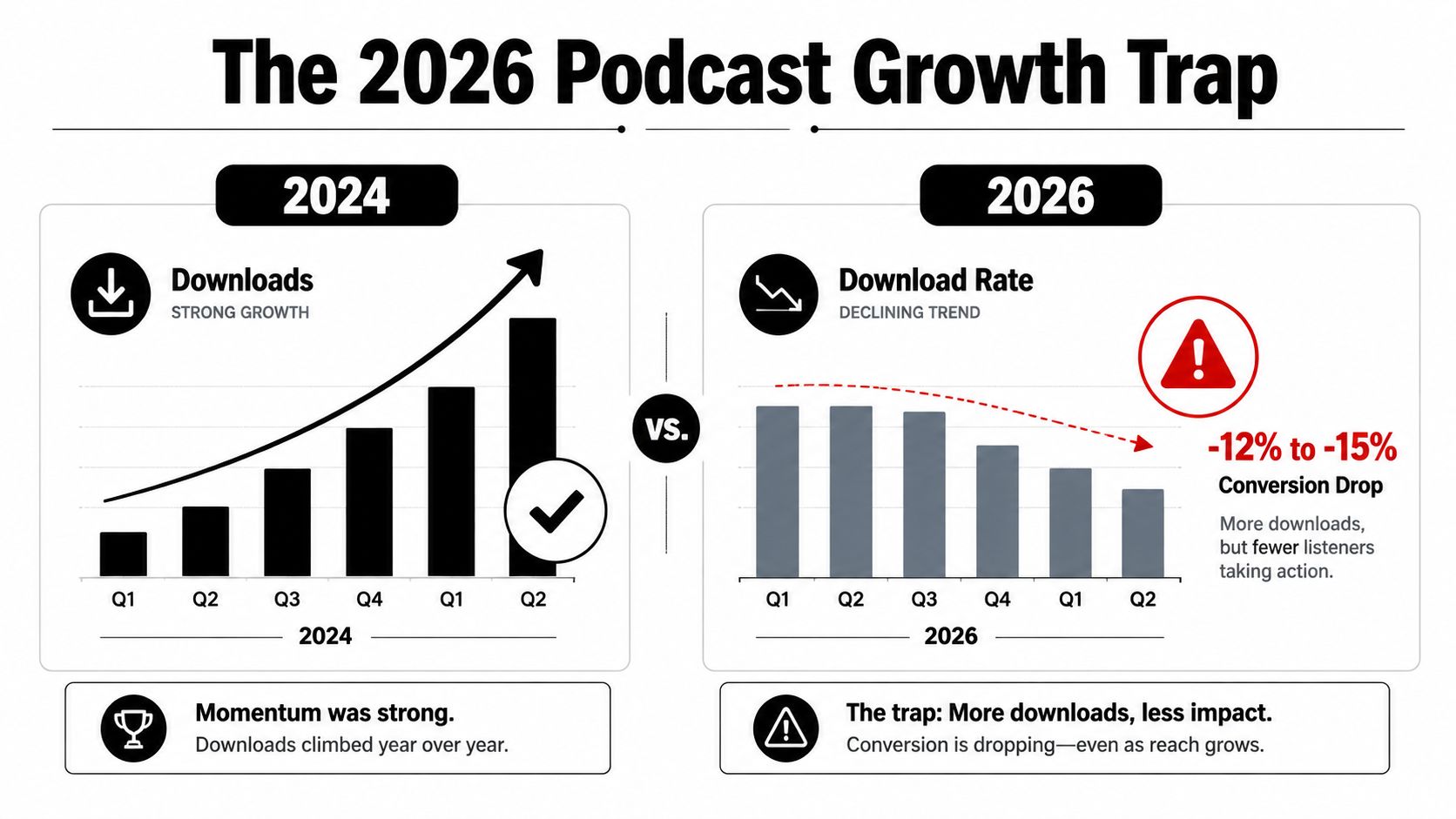
Industry reporting from Inside Radio's analysis of podcast reach and habit shows why reach alone cannot carry growth. Weekly reach rebounded to 57% of U.S. adults, while frequent listening stayed at 16% for two consecutive years and audience conversion fell from 37% in 2024 to 28% in 2026. Discovery brings trials. Retention turns trials into a show people regularly choose.
Producer's rule: Treat every new listener as a trial subscriber. Your episode has to earn the next listen.
Build organic discovery with the same discipline used to improve organic traffic in 2026, then track whether new visitors become regular listeners. Flexwork Podcast Studios' production model supports that operating system across audio, video, search, and social. Its guidance on the future of podcasting for business owners, influencers, and content creators reinforces the practical point: production packages should connect episode quality, packaging, distribution, and follow-up in one executable workflow.
Research the Listener Before You Press Record
Specificity beats broad positioning. “A podcast for ambitious entrepreneurs” gives a host nowhere useful to go. “A weekly show for New Jersey founders hiring their first operations leader” immediately sharpens the guest list, episode titles, examples, tone, and promotion.
Start with a Listener Profile Document. Keep it practical, not academic. Write down the audience's work, stage of life, frustrations, ambitions, media habits, and the problem they hire the show to solve. A useful profile answers four questions:
- Who is listening? Capture relevant demographics, location, role, career stage, and experience level.
- What do they already consume? List adjacent podcasts, newsletters, YouTube channels, communities, and creators.
- What do they need to feel or accomplish? Define the emotional and practical outcome.
- What job is the show hired to do? Is it helping them make a decision, improve a skill, find confidence, or stay current?

Use evidence instead of instinct
Mine Reddit threads and Facebook Groups for repeated questions. Don't collect topics because they sound interesting. Collect the language real people use when they're stuck. That language often becomes your strongest title and clip copy.
Audit five adjacent podcasts next. Review their Apple Podcasts chart presence, episode titles, recurring formats, guest categories, and Spotify's Listeners Also Like recommendations. You're not copying them. You're identifying the open territory they haven't claimed.
Then conduct five short calls with people who fit your intended audience. Ask what they tried, what failed, what they'd pay attention to, and which recent episode or video earned their time. For a useful framework on analyzing demographics for small teams, focus on turning observations into decisions rather than building a profile that sits in a folder.
Turn the profile into a production brief
Condense the research into one paragraph:
This show helps [specific person] solve [specific problem] through [distinct point of view], so they can [desired outcome].
Every planned episode should pass that test. If the idea doesn't serve the listener's job, cut it before it consumes recording, editing, and promotion time.
Your visual identity should come from the same profile. A career-focused audience may respond to a restrained, editorial look. A creator audience may need more movement, color, and personality. A focused Content Day can capture the cover artwork direction, intro music mood, host portraits, set details, and short-form footage in one coordinated session. Flexwork's podcast content strategy service can help turn that profile into a repeatable editorial system instead of a one-time launch document.
Design Episodes and Show Notes for Search and Retention
Episode architecture and search optimization belong in the same conversation. A searchable title earns the click, but a deliberate structure earns the second half of the episode.
Use a simple four-part format:
- Cold-open hook: Start with the tension, result, or question that justifies the listener's time.
- Context bridge: Explain why the issue matters to this audience now.
- Deep value: Deliver the argument, process, interview, or narrative without burying the useful material.
- Structured recap: Give the listener a concise summary and a clear next action.
Spotify's audience-retention analytics show the percentage of listeners present at each point in an episode, which makes the first seven days especially useful for evaluating openings, pacing, transitions, and ad placement. The platform's audience-retention guidance also supports a practical definition of returning listeners, people appearing in two or more consecutive release windows. Standardize your definitions before comparing episodes.
Set a realistic first-week target
Don't compare a niche solo show with a heavily promoted narrative series. Use format-specific benchmarks as directional planning tools, not promises.
| Episode Format | Low Benchmark | High Benchmark | Typical Retention |
|---|---|---|---|
| Solo | 200 | 500 | Strongest when the host reaches the central point quickly |
| Interview | 500 | 1,200 | Depends heavily on guest relevance and editing |
| Narrative | 800 | 2,000+ | Often benefits from stronger structure and serialized tension |
These format benchmarks come from the planning framework supplied for this article, but they aren't part of the verified industry data. For a verified cross-show benchmark, B2B podcast first-seven-day performance data reports 104 or more downloads for top-quartile shows, 428 or more for the top 10%, and more than 4,763 for the top 1% during the first seven days. Use the early window to judge launch velocity, not lifetime totals alone.
Build show notes that work twice
Your show notes should serve both search visitors and existing listeners. Use a keyword-front-loaded title, a concise summary, two relevant internal links, timestamped chapters for Spotify and YouTube, and a complete transcript with structured-data markup.
Chapters help listeners find their way. That matters because a listener who can reach the relevant moment may stay engaged even if they don't consume every minute in order. Your podcast show notes template should make this process repeatable across every release.
Don't promise a specific retention lift from chapters without testing it on your own feed. Compare episodes with similar topics and audiences, then inspect the retention curve, chapter clicks, average consumption, and next-episode follow-through.
Win Discovery on YouTube and Through Strategic Guests
YouTube is no longer a secondary video archive for podcasts. It has become a discovery surface that shapes whether new listeners notice a show at all. A 2025 report found that 44% of weekly podcast consumers who started a new show within the previous six months discovered it on YouTube, while Edison's findings identified YouTube as the leading platform for podcast consumption and discovery among Gen Z. The same research says 47% of weekly podcast users aged 13 and older use TikTok intentionally to discover podcasts. Cumulus Media and Signal Hill's podcast report makes the strategic implication clear: your audio feed needs a visual discovery layer.
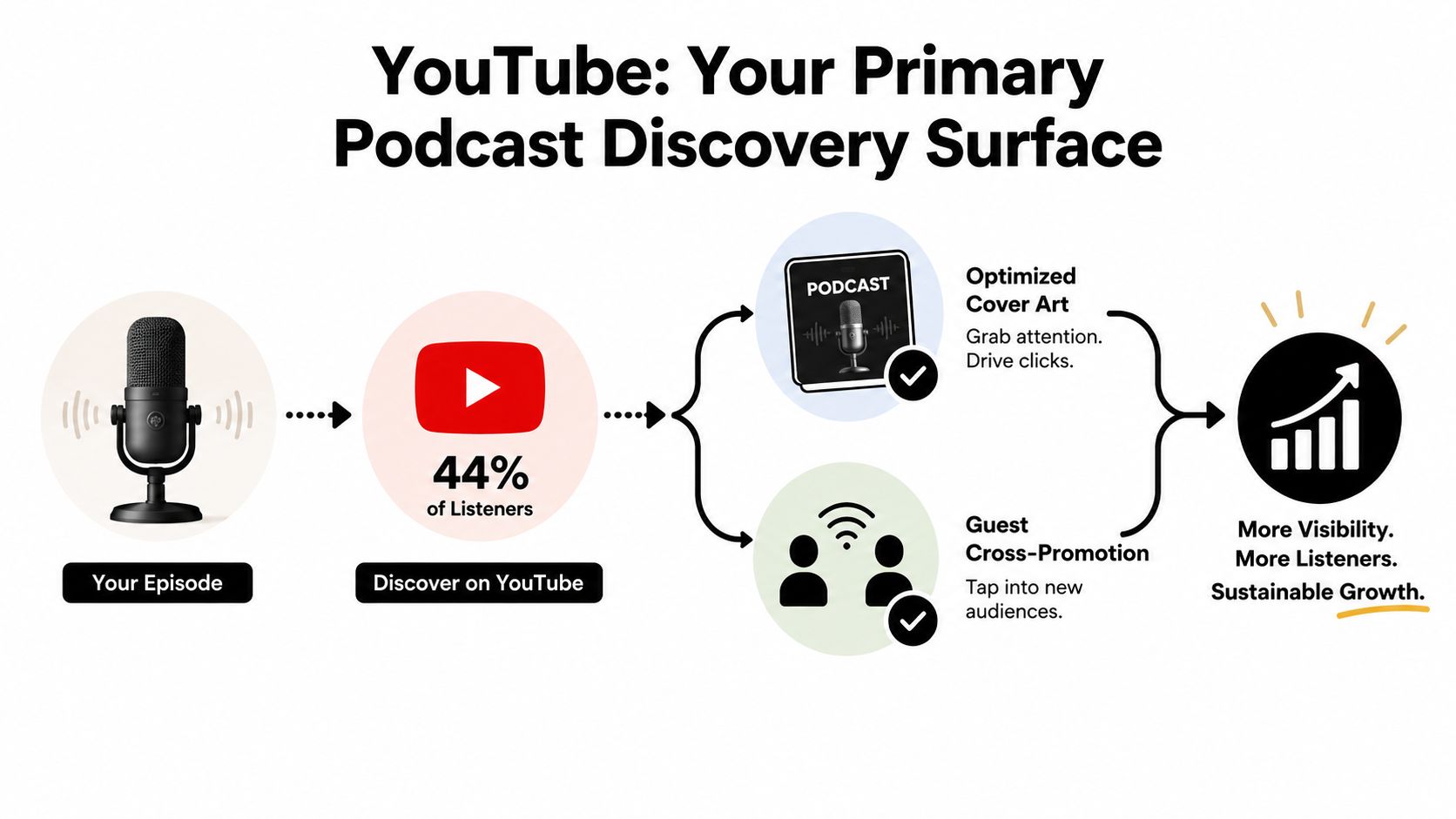
Your YouTube packaging needs its own decisions. Use a title that states the problem or promise, cover art with one readable focal idea, and a thumbnail that still works on a small screen. Don't upload a full conversation and hope the platform finds an audience. Cut the episode around moments that create a specific question.
Run guests as a distribution workflow
A guest is valuable when the episode gives that person a strong reason to share it. Use this sequence:
- Define your ideal listener before building the prospect list.
- Separate prospects into priority tiers based on audience relevance, expertise, and willingness to amplify.
- Pitch a specific angle, not a generic invitation.
- Hold a short pre-interview call to find the guest's strongest story and avoid surface-level questions.
- Record with enough visual coverage for the full episode and vertical clips.
- Produce three to five short-form clips from the conversation, each with a hook in the first three seconds, captions, a clear visual subject, and a call to the full episode.
Give the guest a simple share kit. Include the episode link, suggested copy, vertical files, a thumbnail, and the exact publication date. The easier you make amplification, the more likely it happens.
A guest should bring relevance, not just recognition.
Build a cadence that alternates guest episodes, solo analysis, and reply content based on listener questions. That rhythm keeps the feed active without forcing every episode to carry the same production burden. If YouTube is part of your acquisition plan, pair the recording workflow with guidance on how to grow a YouTube channel fast.
Turn Reach Into Habit With a Retention Dashboard
Completion rate tells you whether the show delivers on its promise. Downloads tell you how many times a file or episode was requested. Both matter, but completion and return behavior reveal whether your format deserves a place in a listener's routine.
A common operational target is 70% or higher episode completion, and Spotify's retention analytics let you inspect where listeners leave. Treat that target as a working benchmark, not a universal law. A long interview, a narrative episode, and a short solo briefing may need different expectations.
Track the numbers that guide decisions
Build one dashboard across Spotify for Podcasters, Apple Podcasts Connect, and YouTube Studio. Record first-seven-day downloads, average consumption, audience-retention curves, follows, returning listeners, and movement into the next episode.
| Metric | Where to Find It | Healthy Benchmark | Action If Below |
|---|---|---|---|
| First-seven-day downloads | Hosting analytics | Compare against your own recent releases and relevant format benchmarks | Strengthen launch-day distribution |
| Completion rate | Spotify and YouTube retention views | Around 70% or higher as an operating target | Tighten structure, pacing, and transitions |
| Returning listeners | Platform audience analytics | Appearing across consecutive release windows | Add recurring segments and stronger follow-up |
| Mid-episode drop-off | Retention curves | No unexplained structural cliff | Review the preceding minute, ad placement, or topic shift |
| Next-episode follow-through | Platform and website analytics | Consistent movement to another episode | Add a relevant recommendation and direct verbal CTA |
The dashboard should produce decisions, not merely reports. Cut segments that repeatedly precede a sharp drop. Double down on topics that attract both completion and return listening. Rebook guests whose episodes hold attention and bring listeners into another release.
Diagnose before you rewrite
A dip may be structural, seasonal, promotional, or technical. Check whether the decline appears at the same timestamp across episodes, whether the topic changed, whether the guest audience matched your listener profile, and whether distribution went out on schedule. Don't redesign the entire show because one holiday release underperformed.
Test one variable at a time. Compare a direct cold open with a longer introduction, or a mid-roll placement with a later break. Keep the rest of the episode type, topic, and promotion reasonably consistent so the result means something.
A growth-focused podcast marketing tool can help centralize planning and measurement, but the operating principle remains simple: review the curve, make one production decision, and measure the next release.
Build the Growth Engine Behind the Episodes
An episode is an asset. A growth engine is the system that gives that asset multiple ways to be discovered, remembered, and acted on.
Start with a conversion-focused podcast website. Give each episode a permanent page with the player, transcript, chapters, embedded video, key takeaways, guest links, and a clear next step. Add email capture tied to a useful lead magnet, such as a checklist, worksheet, or resource guide that directly extends the episode.

Connect every channel to the same idea
Repurpose around the episode's central argument, not around arbitrary file counts. One recording can become a YouTube episode, vertical reels, a LinkedIn point of view, a TikTok answer, an X thread, an email, and a website article. Each version should feel native to its platform while pointing back to the same primary episode.
That system also creates search value beyond podcast apps. Guests, brands, and publications may mention the show without linking to it. A thoughtful outreach process for getting backlinks from brand exposure can turn those references into discoverable pathways.
Use paid promotion after the basics work
The global market justifies investment in infrastructure. Industry summaries estimate around 619.2 million worldwide podcast listeners in 2026, compared with roughly 584.1 million in 2025, although methodology varies. A separate study across 49 countries found that 41% of consumers listen to podcasts for at least one hour per week, while 9% listen for more than 10 hours weekly. The 2026 global podcast statistics summary shows why a well-positioned show can serve audiences beyond its local market.
Paid promotion should come after the show has a clear promise, a strong landing page, reliable tracking, and several episodes that demonstrate quality. Test YouTube, Meta, podcast networks, and niche newsletters against the same conversion goal. Don't buy reach that lands on a weak profile or an episode with no obvious starting point.
Keep the assembly line visible
A workable weekly system might look like this:
- Tuesday: Record the episode and capture supporting vertical footage.
- Thursday: Finish the edit, clips, captions, transcript, and show notes.
- Sunday: Publish the episode and send the first listener email.
- Tuesday through Friday: Distribute clips, guest assets, quote graphics, and reply content.
If your team can't maintain that cadence, the answer isn't another productivity app. It's a production handoff. Flexwork Podcast Studios offers studio recording, editing, reels, show branding, podcast websites, distribution, and marketing support, which can place the recording and growth workflow under one operating plan.
Your 90 Day Podcast Growth Plan and Next Move
A 90-day plan should create evidence, not exhaustion. The first phase establishes what the show is, the second puts it in front of the right people, and the third compounds what the data proves.
Days 1 through 30 build the foundation
Define the listener profile, write the show promise, audit adjacent podcasts, and choose the episode architecture. Record enough material to establish a consistent visual and editorial identity. Set up retention tracking before publishing so your first release gives you a baseline.
Your weekly scorecard should include whether the episode shipped on schedule, whether the title and description match the listener's problem, whether the show notes are complete, and where the early retention curve breaks. Don't judge the strategy from download totals alone.
Days 31 through 60 activate discovery
Create the YouTube version, cut short-form clips, and begin targeted guest outreach. Give every guest a share kit and track which clips generate profile visits, episode starts, and email signups. Add solo or reply episodes so the feed doesn't depend entirely on guest availability.
Days 61 through 90 compound reach
Launch or refine the podcast website, connect the lead magnet, and establish the repurposing loop across LinkedIn, Instagram Reels, TikTok, and X. Test paid amplification only after the organic packaging and tracking are reliable. Review retention every week and make one structural improvement at a time.
| Phase | Focus | Key KPI | Flexwork Tier |
|---|---|---|---|
| Days 1 to 30 | Positioning, listener research, format, tracking | Consistent publishing and a usable baseline | Hourly studio rentals or Content Day |
| Days 31 to 60 | YouTube, guests, clips, social distribution | First-seven-day velocity and qualified discovery | Be My Podcast Producer |
| Days 61 to 90 | Website, email capture, paid testing, retention reviews | Returning listeners and episode completion | Market, Manage & Produce My Podcast |
Flexwork's Content Days are $3000 per day and include 20 edited reels or 60 professional photos. A podcast website is $5000 plus hosting. The Market & Manage tier starts at $1500 per episode with a 20-episode growth commitment. Choose the level that matches your bottleneck. If you need a room and reliable capture, rent the studio. If you need polished assets, book a Content Day. If you need someone to manage distribution, analytics, guest booking, and the growth loop, use the managed tier.
The market is too crowded for a show that treats production as an afterthought. Build a repeatable promise, make every episode easier to find, and use retention data to decide what deserves more of your time.
Flexwork Podcast Studios offers acoustically treated studio rentals, production packages, Content Day sessions, podcast websites, and managed marketing support for creators building a consistent show. Visit Flexwork Podcast Studios to choose the right production path and book the session that turns your 90-day growth plan into a working publishing system.