
Podcast Marketing Tool Playbook for 2026
 August 6, 202620 Minutes
You've probably got the same scene open right now, too many tabs, too many half-finished ideas, and one podcast that's supposed to keep growing while you're also trying to run a business. The hosting dashboard is open, clip edits are waiting, the social scheduler is humming, and your inbox is full of guest pitches you meant to answer yesterday. That's usually where the phrase podcast marketing tool enters the conversation, but the question isn't which software looks slick. It's what moves a show forward without turning you into the unpaid operations department.
For creators and brands in the NJ and NY orbit, that question matters even more because polished content is now expected, not optional. Flexwork Studios sits in that gap between DIY overload and expensive chaos, giving hosts a premium place to record, produce, and package a show that can support growth. The right decision isn't always another subscription. Sometimes it's a smarter stack, sometimes it's a managed service, and sometimes it's a studio-based workflow that replaces three tools and a headache.
The Tabs Are Winning Again and What a Podcast Marketing Tool Solves
A typical creator browser tells the whole story. One tab runs hosting, another handles clip editing, a third schedules social posts, a fourth shows analytics, and a fifth holds guest outreach that has already gone stale. That setup feels productive until the week fills up and the show starts stealing time from everything else.
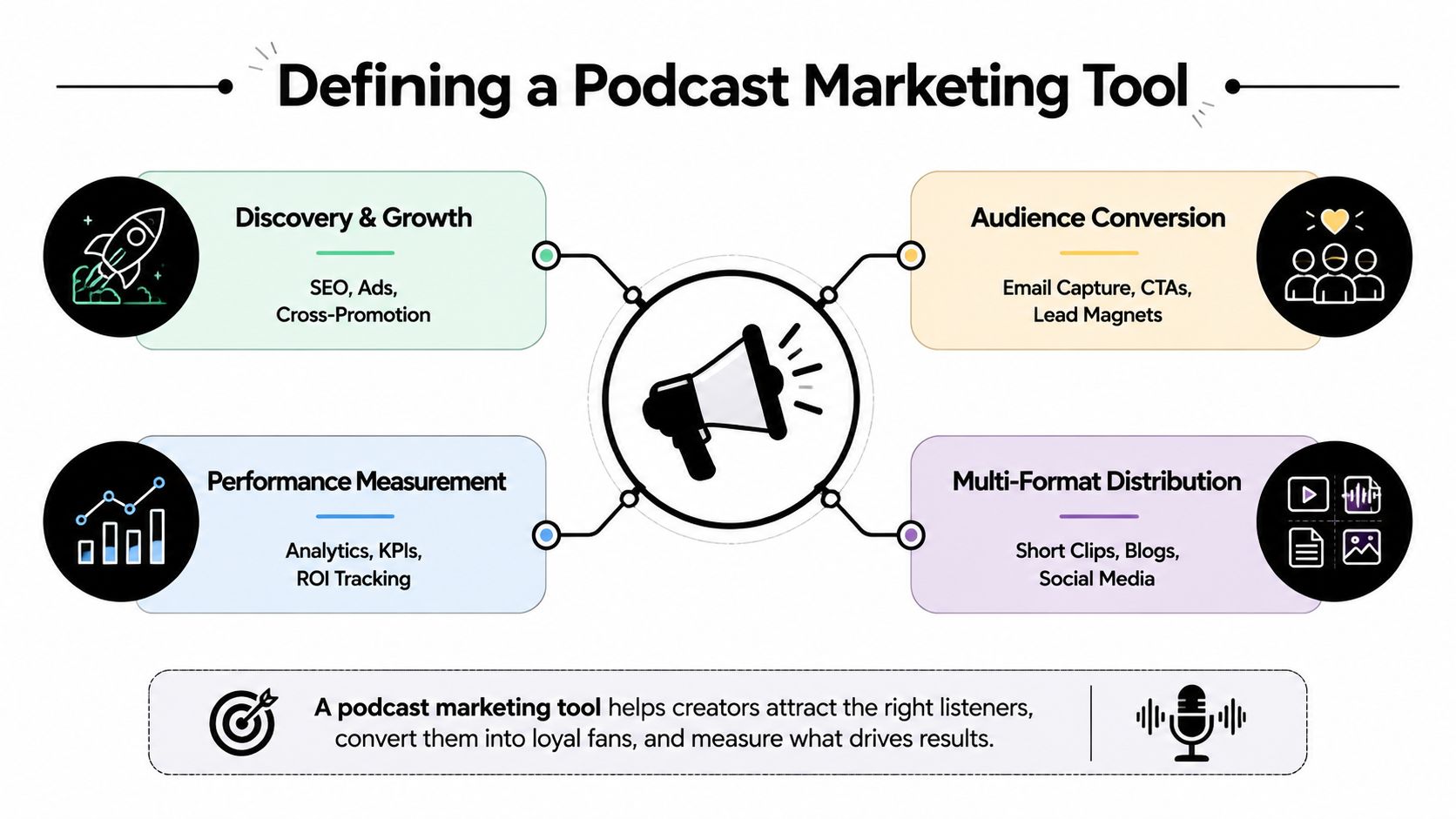
A podcast marketing tool should handle four jobs at once, not one. It should help people discover the show, convert listeners into subscribers or leads, measure what is working, and repurpose the episode across formats without forcing the host to live in five dashboards. If it only publishes files or clips, it is a helper. If it connects growth to outcomes, it belongs in the business.
Practical rule: if a tool does not reduce manual follow-up or show where listeners came from, it is probably a convenience layer, not a growth system.
That distinction matters because podcasting is no longer a side project. U.S. podcast ad revenue reached $2.862 billion in 2025, up 17.6% from 2024, and it is projected to pass $3 billion during 2026 according to industry summary data tied to IAB / PwC benchmark research. In a market like that, the tool you choose should support discoverability, sponsorship packaging, audience analytics, clipping, and cross-channel promotion, not just file uploads.
If you are sorting through options, start with this creator tool guide from Flexwork Studios. Then ask the blunt question: do you need software, or do you need an operating system for the show? If the goal is to build an organic content strategy, the stack should make that process faster, clearer, and easier to measure.
Defining a Podcast Marketing Tool in a Multi-Format World
A podcast marketing tool is any software or managed service that helps a show get found, pull in listeners, and track what happens after someone presses play. That can mean hosting, clipping, email capture, SEO pages, outreach, analytics, or a team that does those things for you. The category got much bigger once podcasting moved beyond audio and into video, shorts, newsletters, livestream promotion, and search-friendly content.
Think of the podcast like a restaurant. The tool is the signage out front, the reservation system, the delivery apps, and the loyalty program all working together. A good menu doesn't matter if nobody can find the place, and a good episode doesn't matter if nobody shares it, searches for it, or remembers to come back.
The scale explains why the category expanded so fast. Independent 2026 statistics report more than 550 million monthly podcast listeners globally, with the U.S. at roughly 165 million monthly listeners and about 55% of the 12+ population (Digital Applied). That audience is large enough to justify systems, not just posting habits. It also means the modern tool has to work across different listener behaviors, because people discover shows in apps, on social feeds, through guests, in email, and through search.
A podcast marketing stack should fit the show's real path to discovery, not the creator's favorite app.
Before comparing tools, it helps to know the three buckets. Solo tools do one job well. All-in-one platforms try to cover most of the stack. Studio-based services like a production partner can replace several tools and a lot of labor when the bottleneck is execution rather than software. If you want a deeper framework for turning this into an overall channel plan, build an organic content strategy first, then choose tools that support it instead of guessing in the dark.
For repurposing, this guide to turning one episode into multiple pieces of content is the right way to think about the format shift. One recording should feed several marketing outputs, or you're burning content for one use only.
The Six Tool Categories Mapped to Real Marketing Goals
Most roundups just throw software names at you. That's lazy. The smarter way is to match the tool category to the goal, because a show chasing downloads needs a different setup than a show chasing leads, community, or authority.
| Tool Category | Primary Marketing Goal | Sample Feature | KPI to Track |
|---|---|---|---|
| Distribution and hosting | Make episodes available everywhere | RSS publishing, platform submission | New listens per release |
| Clip and short-form repurposing | Expand reach across social | Auto-clipping, subtitle generation | Clip saves and shares |
| SEO and discoverability | Capture search intent | Episode pages, keyword-friendly show notes | Organic visits to episode pages |
| Email and list-building | Own the audience | Lead capture, episode-linked CTAs | Email-attributed listens |
| Audience analytics | Prove what's working | Retention data, consumption curves | Retention past the midpoint |
| Guest and outreach management | Grow through other people's audiences | Guest booking, promo asset sharing | Referral traffic and guest-driven listens |
A download-first show can lean hard on hosting and analytics. A B2B show should care more about email capture, episode pages, and guest outreach, because leads usually happen after multiple touches, not on first play. A community-driven show may prioritize clips and newsletter placements because the goal is repeated visibility, not a one-time spike.
creator-friendly management platforms can help if you only need scheduling and light coordination, but they don't replace a strategy for where the audience comes from. That's why the category split matters. If you buy the wrong type of tool, you'll end up with pretty dashboards and weak outcomes.
One more thing. The show's growth problem usually isn't “post more.” It's choosing the right channel for the right job, then tracking whether that channel moved a real metric instead of vanity engagement.
Smart buying rule: spend first on the category that closes your biggest gap, not the category with the longest feature list.
If your team is already thinking in terms of service tiers and production support, Flexwork's podcast marketing services are worth comparing against software because the job may already be half-done by people, not platforms.
Must-Have Features and KPIs That Actually Matter
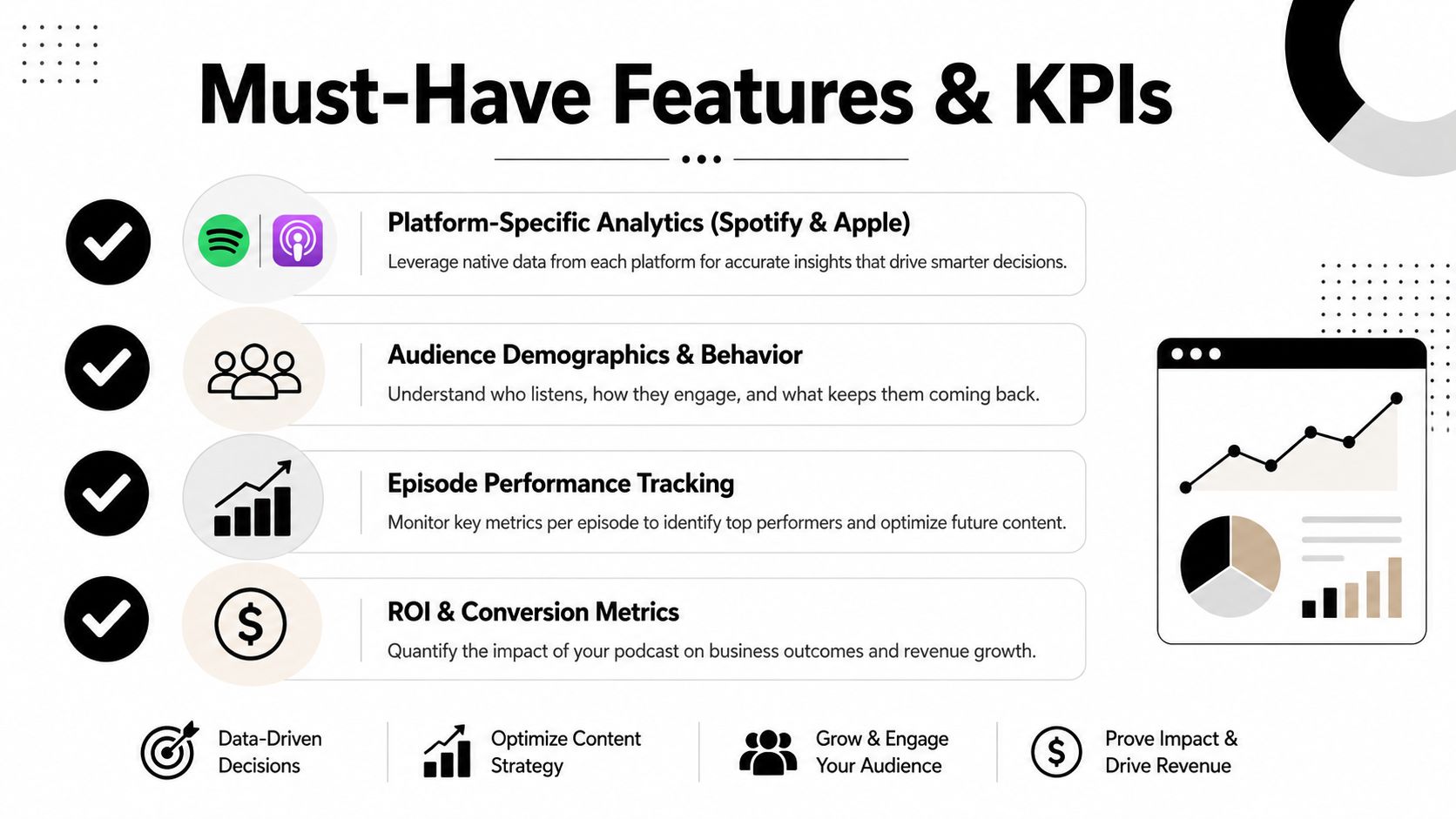
The best podcast marketing stack isn't the one with the loudest promise. It's the one that tells you where listeners came from and what they did next. That means platform-specific analytics, attribution links, retention data, clip workflows, and an actual email capture loop.
Spotify for Podcasters and Apple Podcasts Connect matter because they expose platform-level audience behavior, not just download totals. Attribution tools can tie a guest appearance, campaign, or social push to follower growth and new listens, which is how you compare channels instead of guessing. And if email is part of the strategy, benchmark guidance in podcast-focused marketing points to average open rates around 20%–22%, with welcome emails reported as high as 82% (Castos). That's why subject lines, segmentation, and episode-linked calls to action deserve real attention.
The KPIs that hold up in a real meeting
A Monday meeting needs harder proof than total downloads. I'd want to see:
- Attributed downloads per campaign to know which promo path brought in actual listens.
- Retention past the midpoint to see whether the content holds attention.
- Email-attributed listens to measure whether owned media is working.
- Conversion from listener to lead if the show supports revenue, sales, or bookings.
That list is broader than what many dashboards show on the surface, and it should be. Attribution-focused guidance argues that clicks and pixels won't tell the full story, because listeners often convert later through search, word of mouth, or untracked paths. Fairing's measurement guidance makes that point directly and recommends combining audience surveys, promo codes, and other signals to understand what's really happening (Fairing).
Don't buy a dashboard that only flatters you
A tool that gives you pretty graphs but can't tie campaigns to outcomes is a vanity machine. If it doesn't answer “what happened after this episode?” it's not serious enough for a show that wants to grow on purpose.
For production polish, even a small thing like your intro matters because it shapes whether people keep listening. This podcast intro guide from MartiniArt is useful context if you're tightening the first 30 seconds before you scale distribution. Better creative plus better tracking beats either one alone.
When a Studio Service Replaces the Stack Instead of Adding to It
The default assumption says every show needs more tools. That's wrong for a lot of hosts. If the core problem is that you don't have enough premium content to feed a marketing machine, another subscription won't fix it. A stronger recording day, better editing, and a team that can package the output often solve the actual bottleneck.
The math gets ugly fast. A modest monthly stack can eat both cash and time, and time is the expensive part because someone still has to manage uploads, clip pulls, asset handoff, guest follow-up, and reporting. A studio-led workflow can replace several of those moving parts with one coordinated process.
Flexwork's Content Day is priced at $3000/day and includes 20 edited reels or 60 pro photos, which is a clean answer when the content engine itself is the problem. The podcast website package is $5000 plus hosting, which gives you a search-friendly home base in one purchase. The Market, Manage & Produce tier starts at $1500 per episode with a 20-episode growth commitment, which matters if you want analytics, social, and guest-booking work handled without stitching together three separate services (Flexwork podcast production services).
If your show is still in the “make it look and sound right” stage, software is secondary. Production quality comes first.
When the studio path makes more sense
A studio service wins when:
- You need content output, not more dashboards.
- You want one team handling recording, editing, and packaging.
- You're building a branded show that needs consistent quality.
- You'd rather buy outcomes than manage software subscriptions.
That's where Flexwork sits in the conversation, especially for creators who want a premium production environment and a real marketing backstop. It's not the only route, but it is the cleaner route when the show needs to look and sound like a serious asset.
For hosts in the area, Flexwork podcast studios near me is the practical starting point if you're trying to decide whether to build the stack or delegate the work.
A Four-Stage Decision Framework for Picking Your Path
The smartest buyers make this decision on paper before they spend. Keep it simple and force the answer out of the fog.
Stage 1, define the outcome
Write down your top three goals for the next ninety days. Do you need more listeners, more leads, stronger guest authority, or cleaner production? Rank them, because the top goal should drive the tool choice.
Stage 2, audit the gaps
List the six categories from earlier and mark each one as covered, partially covered, or missing. If you already have distribution but no attribution, that tells you more than a product demo ever will.
Stage 3, choose build, buy, or partner
Score each gap by speed and labor. If software can solve it fast and your team can use it, buy the tool. If the job requires content creation, coordination, or consistent execution, a managed service may be the better path.
Stage 4, set two proof points
Pick two KPIs before you sign anything. One should show audience movement, the other should show business value. If the tool or service can't move either metric, it's the wrong fit.
For a B2B thought leadership show, the answer often comes out cleanly. Use a podcast website for search and credibility, then hand the growth work to a managed package like Market, Manage & Produce if you don't have staff to run the outreach, clipping, and reporting. That setup works because it connects the episode to a business outcome instead of treating the podcast like a content hobby.
The right decision is the one your team can repeat next month without chaos.
Print the framework, mark the gaps, and be honest about what your team will maintain. If the workflow depends on heroic effort, it's already fragile.
Putting It Together for NJ and NY Podcasters Ready to Move
There are really three paths. Indie creators can build a lean stack and keep the costs contained. Scaling shows can layer Flexwork production on top of what already works. Hosts serious about reach can hand the full growth loop to the Market, Manage & Produce package and stop pretending they need to do every job themselves.
That's the premium move in the New Jersey podcasting scene, because it trades scattered effort for a controlled output. If you want to compare spaces, services, and the next step, start with the studio, then look at the production packages, then decide whether the show needs more software or more support.
Flexwork Podcast Studios gives you the recording space, production support, and growth-focused services to build a show that looks and sounds premium. If you're deciding between a tool stack and a studio-based workflow, visit Flexwork Podcast Studios and book the path that fits your next release cycle.